Can We Solve All Our Fiscal and Economic Problems at the Same Time?


This website, It Does Not Add Up, is devoted to discussing our country’s most serious economic and fiscal problems.  They are:

  • Stagnant Economy. Since the end of the Great Recession in June 2009, the economy has been growing on average at the historically slow rate of about 2.3%. Slow growth means higher unemployment, stagnant wages and less tax revenue.
  • Massive Debt. U.S. public (on which we pay interest) debt is now 74% of GDP (highest since WW II) and projected by CBO to grow rapidly unless strong measures are taken to reduce it. This puts our country’s future wellbeing and prosperity at great risk.
  • Increasing Income Inequality. Incomes for the high-skilled and well-educated are increasing much faster than for the low-skilled and less-educated workers.

The new Republican majorities in Congress are stirring the waters by proposing a ten year plan to shrink the deficit down to zero, i.e. to balance the budget by 2025.  The opposition claims that this would “sharply cut the scale of domestic spending, which would mostly fall on the poor.”
Capture1But the American Enterprise Institute’s James Pethokoukis points out that social spending in the U.S., both public and private, is very generous and second only to France in the entire OECD. So here is how we could proceed to address our basic problems in a unified manner:

  • Balance the Budget by a combination of Republican spending cuts and cutting back on two major tax deductions: Employer-sponsored Health Insurance (cost: $250 billion per year) and Mortgage Interest (cost: $70 billion per year).
  • Boost Economic Growth by expanding the Earned Income Tax Credit to encourage more people to accept low paying, entry level jobs. Increase the Social Security eligibility age from 67 to 70, thereby keeping near retirees in the workforce for three additional years (this will also extend the solvency of the Social Security Trust Fund).
  • Decrease Income Inequality. Cutting back on tax deductions, in part to pay for expansion of the EITC, lessens income inequality as well as shrinking the deficit. A faster growing economy also lessens inequality by providing more opportunities for upward mobility.

In other words, addressing each of these fundamental problems in an intelligent manner contributes to solving the remaining problems as well.  This creates a virtuous circle for economic progress!

How the Obama and Republican Budgets Compare


The Budget Committees for both the House of Representatives and the Senate have now passed plans to achieve balanced budgets within a ten year period.  My last two posts have discussed the compelling need to get deficit spending under control and an overall rationale for how to approach this difficult task. Today I will take a look at the major differences between the Obama budget and the House and Senate budgets.  The two congressional budgets are quite similar and will surely be reconciled into a single budget.
CaptureHere are the major differences:

  • Revenue. The President wants to raise taxes by $3 trillion over 10 years to pay for more spending while the Republicans wants revenue-neutral tax reform in order to increase economic growth.
  • Spending. Under current policy the government will spend $48.6 trillion over the next ten years which represents a 5.1% annual rate of spending increase over the present. The President wants to spend an additional $1 trillion over this time period on new initiatives. The Republicans propose spending about $5.4 trillion less, or $43.2 trillion, which still works out to a 3.3% annual rate of increase over the present.
  • Deficits. Under current policy the deficit would start to increase, as a percentage of GDP, in 2018. The President proposes to stabilize the deficit at 2.5% of GDP. The Republicans would balance the budget within ten years by shrinking the deficit down to zero.
  • Public Debt. Under current policy the public debt (on which interest is paid) will increase to 79% of GDP by 2025. The President’s budget would stabilize the debt at the current level of 73% of GDP. The Republican’s balanced budget would shrink the debt to 57% of GDP by 2025.


There are stark differences between the President’s proposed budget and the Republican alternative.  Which is the better route to progress and prosperity?  Is it to raise taxes, increase government spending and only stabilize the debt or is it to streamline taxes, slow down the growth of spending and shrink the debt?  This is a fundamental question of government policy which will not be quickly resolved.  But at least the question is being raised in a dramatic way!

The Slow Growth Fiscal Trap We’re Now In.


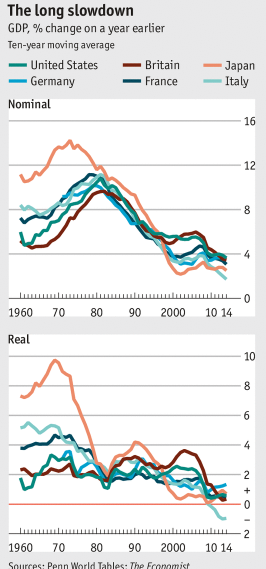
Our economy has been growing very slowly, about 2.2% per year on average, since the end of the Great Recession in June 2009.  The Congressional Budget Office predicts that this slow growth will continue indefinitely, although with a brief respite of 2.9%  growth in 2015 and 2016.  The American Enterprise Institute predicts an even lower, less than 2% growth rate, going forward.
CaptureHere’s the essence of the overall problem:

  • Slow growth keeps the unemployment level high and also means minimal raises for employed workers  The resulting economic slack leads to
  • Low Inflation. But low inflation in turn means that the Federal Reserve can try to increase growth with quantitative easing and at the same time maintain
  • Low Interest Rates to encourage borrowing. But an unfortunate side effect of low interest rates is that Congress can borrow at will and run up huge deficits without having to worry about paying interest on this “free” money. This leads to:
  • Massive Debt. But what is going to happen when inflation does take off which is bound to happen eventually? Then the Fed will be forced to raise interest rates quickly and we will be stuck with huge interest payments on our accumulated debt. When this happens, interest payments plus ever growing entitlement spending will eat up most, if not all, of the federal budget. This will almost inevitably lead to a severe
  • Fiscal Crisis.

                                                    FLOW CHART

  Slow Growth->Low Inflation->Low Interest Rates->Massive Debt->Fiscal Crisis

Of course, there are alternative scenarios.  Congress might become more responsible and cut spending and/or raise taxes.  We might luck out, so to speak, with such prolonged slow growth that inflation stays low indefinitely and interest rates never increase.  But slow growth is not pain free.  There are 20 million unemployed or under-employed Americans who want to work and whose lives are much less satisfying as a result of being idle.
Isn’t it obvious that the best response to this slow growth fiscal trap is to adopt policies to make the economy grow faster?  There are lots of things that could be done, many of which I addressed in my last post (https://itdoesnotaddup.com/2015/03/01/will-middle-class-economics-lift-us-out-of-secular-stagnation/) so I won’t repeat them here.  But I’ll be coming back to them again and again in the future!

Will ‘Middle Class Economics’ Lift Us Out of ‘Secular Stagnation’?


‘Secular Stagnation’ is the expression, made popular by the economist Larry Summers,  to refer to the present time period, since the end of the Great Recession, with slow economic growth, high unemployment, stagnant middle-class wages and increasing inequality.  It is to be contrasted with ‘The Great Moderation,’ from 1982 – 2007, with a rapidly growing economy, rising wages and stable prices.
CaptureMy last post, “Does ‘Middle Class Economics’ Really Work,” discusses President Obama’s attempt to appeal to middle-class families with policies such as:

  • Tax and regulatory provisions such as tax credits for childcare, college tuition, and second earners in two parent households; also requiring paid sick leave and a higher minimum wage.
  • Expanding access to community colleges to make workers more productive.
  • Increased infrastructure spending to boost employment.

The problem with this strategy is that it is much too weak to combat the huge headwinds opposing it.  In addition to the well-known effects of globalization and technological advance, consider the demographical challenge described below:

OECD old age support ratio:  the number of workers aged 20-64 relative to those aged over 65
Capture1
As is very clear from this chart, the demographics are just going to keep getting worse and worse and will be very bad indeed by 2050.
Here is a surprising quote from Mr. Summers: “To achieve growth of even 2 percent over the next decade, active support for demand will be necessary but not sufficient.  Structural reform is essential to increase the productivity of both workers and capital, and to increase growth in the number of people able and willing to work productively.  Infrastructure reform, policies to promote family-friendly work, support for exploitation of energy resources, and business tax reform become ever more important policy imperatives.”
I would add several additional policy changes which would speed up change in this direction:

  • Reform (but not repeal!) the Affordable Care Act by eliminating all mandates. This would incentivize businesses to move part-time employees to full time. Tax credits and subsidies provide enough incentive for individuals to become insured.
  • Regulatory reform to make it easier to start a new business.
  • Raise the age limits for both Social Security and Medicare to encourage people to work longer.
  • Reform disability insurance to make it more difficult to be declared disabled.
  • Tighten up welfare requirements to require all able-bodied adult recipients without dependents to work.
  • Reform immigration with guest-worker visas for needed foreign workers.

We need to get serious about boosting our labor participation rate in order to grow the economy faster.  Happy talk about ‘middle class economics’ will simply not do the trick!

How Do We Speed Up Economic Growth?


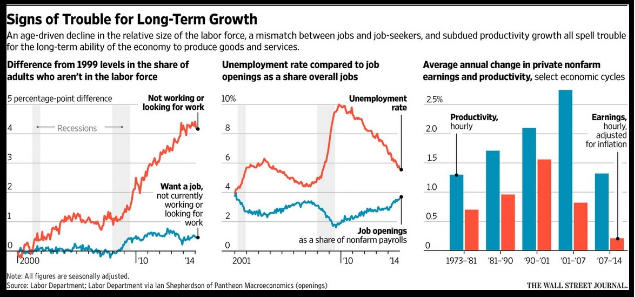
The 2015 Economic Report of the President has just been released.  It shows that the slow growth of productivity is playing a bigger role in squeezing middle class incomes than the rise of economic inequality.
CaptureThe above chart makes some dire predictions:

  • The labor force, which has averaged 1.5% growth since 1950, is likely to grow just .5% a year in coming decades, because any increase in new workers is likely to be swamped out by baby-boomer retirements.
  • Productivity has grown just 1.3% a year since the end of the last expansion in 2007.
  • These two figures together predict an anemic, less than 2% growth, economy going forward.

The President proposes several policies to address this slow growth:

    • Immigration Reform would provide more highly skilled workers for the economy as well as a more efficient guest worker system for low-income labor.
    • Increased Foreign Trade would expand our export economy.
    • An Expanded Workforce could be achieved with a higher Earned Income Tax Credit to boost dual-income households.
    • An increase of Infrastructure spending of 1% of GDP is estimated to boost output by 2.8% after 10 years.
    • Corporate Tax Reform would encourage U.S. multinationals to bring their foreign profits home for reinvestment.

These are good ideas but much more could be done as well:

  • Individual Income Tax Reform, exchanging lower tax rates for all by closing loopholes and deductions would boost spending by middle- and lower-income tax payers.
  • Reforming Social Security and Medicare by setting higher retirement ages would encourage longer work lives.
  • Reforming the Affordable Care Act by removing the employer mandate would boost productivity by making the labor market more efficient.

Faster economic growth will not only reduce unemployment, it will also make it much easier to shrink the deficit as more tax revenue is raised.  This should be one of the very highest priorities for our elected representatives in Washington!

Is the Democratic Party Giving Up On Growth?


Prospects for future economic growth are decidedly grim.  The Congressional Budget Office has just reported that after a brief improvement for a couple of years, annual GDP growth will likely hover around 2.2% for the remainder of the ten year window 2015 – 2025.  This means, in turn, that the unemployment rate will also not likely fall much below its current level of 5.7% for the same ten year period.
CaptureA new report from the McKinsey Global Institute makes the even gloomier prediction that average U.S. GDP growth rate for the next 50 years will be only 1.9% per year, given current trends and policies.  A summary of this report is provided by the Brookings Institution social economist, William Galston.
On the other hand, according to New York Times columnist, Nate Cohn, the Democratic Party may be adopting a new policy direction, “The Parent Agenda, The Democrats’ New Focus.”  By this new focus he means:

  • Paid family leave
  • Universal preschool
  • An expanded earned-income tax credit and child tax credit
  • Free community college
  • Free four year college in time

Mr. Cohn points out that both President Obama as well as Hillary Clinton have endorsed such ideas.  Initiatives such as these are unlikely to go far in the current Republican Congress but they may still sound very attractive to the many hard-pressed middle class families with stagnant incomes.
The problem is that to emphasize a “family” political agenda like this is in effect to accept the conventional wisdom that faster economic growth is unattainable.  This is a defeatist attitude which is very harmful to the 20 million Americans who are either unemployed or under-employed. Here, briefly, is what could be done to boost economic growth in the short term:

  • Implement broad-based tax reform with lower tax rates for all, paid for by closing loopholes and limiting deductions.
  • Reduce regulatory burdens on business by, for example, streamlining (not repealing!) the Affordable Care Act and the Dodd-Frank Financial Reform Act.
  • Expand legal immigration with additional high-skill visas as well as an adequate guest worker program.
  • Expand international trade with new trade agreements.

These are all political footballs, of course, but also policies with much potential to speed up economic growth.  Either we take initiatives such as these or we consign our country to a future of relative economic stagnation with slow wage growth, high unemployment and increasing income inequality.

The President’s Budget: Stabilization of the Debt Is Not Enough!


President Obama has proposed a $3.99 trillion budget for next year, a $340 billion increase from the current 2015 budget year.  As shown in the charts below, it projects deficits of about 2.6% over the next ten years equal to its (optimistic in comparison to the CBO) growth projections for GDP.  This means that the debt would stabilize at about 73% of GDP.  And, of course, achieving his predicted stabilization of debt will require big tax increases over this ten year period.
CaptureHere are the major weaknesses in the budget:

  • Sequestration. The President declares that “I’m not going to accept a budget that locks in sequestration going forward.” Everyone deplores the mindlessness of sequestration but the only responsible alternative is to make targeted cuts throughout the budget. The President makes no attempt to do this. And he wants to add spending for various new education and research initiatives, as well as an expanded Earned Income Tax Credit for low-income workers.
  • Infrastructure. Spending over the next six years would increase by $238 billion to be raised from a 14% repatriation tax on the $2 trillion in foreign earnings held overseas by American multinational corporations. The problem is that any repatriation tax should be tied in with overall corporate and business tax reform, exchanging lower tax rates in return for closing loopholes and deductions, in order to make U.S. business taxes competitive with those of other countries. Fundamental tax reform is the key to getting our economy growing faster.
  • Entitlements. The President’s budget does not even mention the biggest threat to long-term fiscal sustainability, namely the rapidly increasing spending for Social Security, Medicare and Medicaid. It will be very difficult to make progress on this critical issue without presidential leadership.
  • Stabilization of the Debt. The President’s budget, with quite optimistic revenue and growth projections, stabilizes the debt over ten years. But this is not nearly good enough. To be satisfied with a public debt of 73% of GDP indefinitely into the future is simply too risky. What’s going to happen when we have another financial crisis, as we surely will? How are we going to cope with our growing rivalry with China with very little budget flexibility? And one can imagine any number of other possible emergencies which might occur. Putting the debt on a clear downward trajectory is the only prudent thing to do!

It’s Paul Krugman Who Is Being Irresponsible!


The New York Times columnist, Paul Krugman, writes provocatively on fiscal and economic issues and is well-known as a liberal icon.  Usually I ignore his diatribes.  But his column yesterday, “The Long-Run Cop-Out” goes way overboard.
CaptureI will refute several of the statements from this column.

  • “Think about it: Faced with mass unemployment and the enormous waste it entails, for years the beltway elite devoted all most all its energy not to promoting recovery, but to Bowles-Simpsonism – to devising “grand bargains” that would address the supposedly urgent problem of how we’ll pay for Social Security and Medicare a couple of decades from now.” Worrying about our enormous and rapidly increasing national debt, does not mean ignoring our sluggish economy and the high unemployment it causes. The way to increase economic growth is to enact broad based tax reform by lowering tax rates, offset by closing loopholes and limiting deductions. This will further boost the economy in the same way that lower gasoline prices is already doing.
  • “Many projections suggest that our major social insurance programs will face financial difficulties in the future (although the dramatic slowing of increases in health costs makes even that proposition uncertain).” Healthcare costs dropped to 4.1% in 2014 but this is still more than double the inflation rate of 1.7%. This isn’t nearly good enough.
  • “Why, exactly, is it crucial that we deal with the threat of future benefit cuts by locking in plans to cut future benefits?” The point is to protect benefits, not curtail them. If we act now, to increase revenue and/or slow down the growth of entitlement spending, then we won’t have to cut future benefits.
  • “So why the urge to change the subject (from austerity) to structural reform? The answer, I’d suggest, is intellectual laziness and lack of moral courage.” $6 trillion added to our debt in the last six years is profligacy, not austerity. It is immoral to burden future generations with such massive new debt.
  • “In today’s economic and political environment, long-termism is a cop-out.” Preparing for the future is just plain common sense. Should we ignore festering problems like global warming, illegal immigration and increasing poverty until they get much worse? Of course not. We should address these problems now and get our debt under control at the same time.  

What Will It Take to ‘Fix the Debt’?


I have recently become a volunteer for the national bipartisan organization, Fix the Debt. It is the outreach arm for the Washington think tank, Committee for a Responsible Federal Budget, which is an offshoot of the Simpson-Bowles Commission from several years ago.
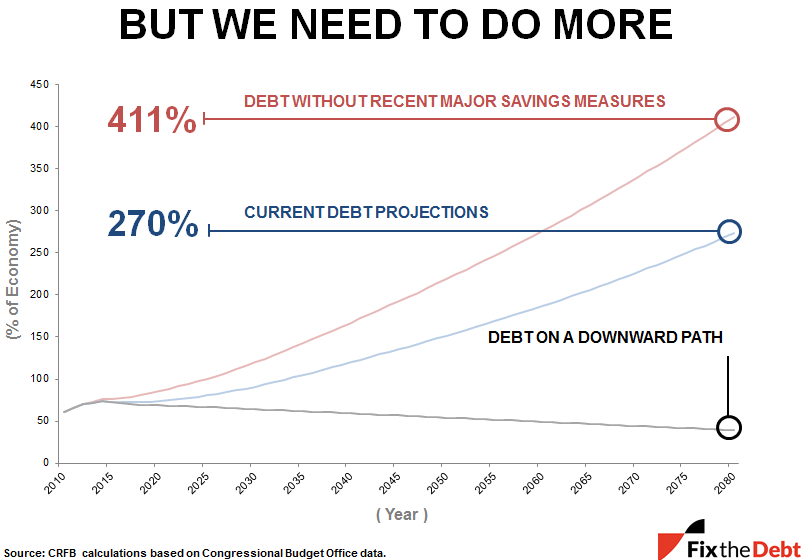
As such, I give presentations to local civic organizations about our national debt and what needs to be done to get it under control. Typically the audience will readily appreciate the seriousness of our debt problem.  What they want to talk about are practical ways to address it.  They have their own ideas and want to know what I think as well.  My first message is that we don’t have to pay off the debt or even balance the budget going forward.  Realistically we need to shrink our annual deficits in order to put the debt on a downward course as a percent of our growing economy,  as shown in the chart just below.

Capture It will be a huge challenge to accomplish even this!  Here are my ideas, in very general outline, on how to get this done:

  • Entitlements (Social Security, Medicare and Medicaid) are the biggest single problem because our population is aging so fast. Furthermore, in order to control the growth of Medicare and Medicaid, we have to do a much better job of controlling the overall cost of healthcare in the U.S. For example, even though healthcare costs slowed down to an increase of only 4.1% in 2014, this is still more than twice the rate of inflation!
  • The second thing we need to do is to make our economy grow faster than the roughly 2.3% growth we have achieved since the end of the Great Recession. The main way to get this done is through broad-based (and revenue neutral) tax reform at both the individual and corporate levels, by reducing tax rates, paid for by closing loopholes and limiting deductions.
  • Finally, there is enormous waste and inefficiency in the federal budget, with huge redundancy and overlap of programs between different federal departments. Responsibility for such programs as education, community development, transportation and social welfare, for example, should be returned to the states with block-grant funding to replace rigid federal control.

I have discussed each of these major reform ideas in much detail in previous blog posts and will continue to do so.  As large as our fiscal problems are, I remain optimistic that they can and will be successfully addressed.

Status Quo on the Budget Is Not Good Enough


I have now been writing this blog for just over two years.  I usually write three posts per week and this one is #280.  My top sources for background information are the New York Times and the Wall Street Journal.  My own local newspaper, the Omaha World Herald, carries the Washington Post economics journalist, Robert Samuelson, whom I greatly respect.
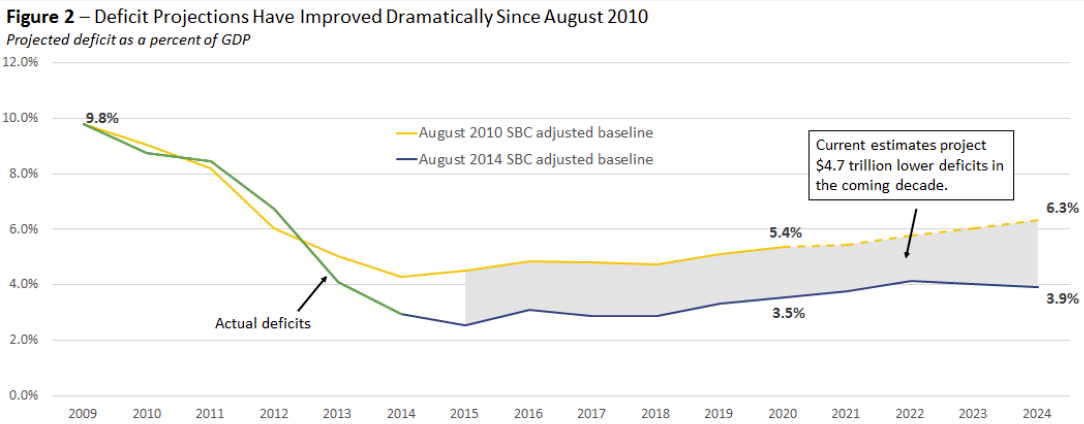
A column of his discusses a recent report from the Senate Budget Committee prepared by its outgoing chair, Patty Murray (D-WA), entitled “The updated fiscal outlook and its implications for the budget debate next year.”  To me this report clearly shows why there has been so little progress made in straightening out the budget over the past few years.
CaptureCapture1Here are some highlights of the report:

  • “Both our current fiscal situation and the outlook going forward have significantly improved, meaning we need a budget approach more focused on jobs and growth, not just on cuts.”
  • “Deficits have fallen dramatically over the last five years, and projected debt and deficits have also declined.”
  • “Revenue losses due to the recession and slow recovery were significant enough to counteract nearly half of the improvement in projected deficits, which highlights the need for new revenue from the wealthiest Americans and biggest corporations as part of any future deficit reduction effort.”
  • “It is clear that we need a federal budget approach more focused on jobs and growth, not on cuts for the sake of cutting. That leaves Republican leaders with a critical choice.”

In my opinion there are two basic problems with Senator Murray’s analysis:

  • Deficits have indeed fallen dramatically from their very high level in 2009, but not far enough! Deficits are projected to rise back to 3.9% in just ten years, as shown in the first chart. This means that debt will keep growing indefinitely, as shown in the second chart. This is unacceptable!
  • We do badly need to focus on jobs and growth but more deficit spending is not the way to do it. Although immigration reform and expanded trade would help, fundamental tax reform, individual and corporate, is what is really needed to grow the economy.

Hopefully a new Congress will be able to move in this direction next year!