“We’ve Got to Do Something about Income Inequality”


This is what I hear over and over again from my liberal-minded friends.  Their solution is to raise taxes on the rich and give to the poor.  This might help a little but not nearly enough.
The best way to help middle- and lower-income people is to give them more opportunities for self-advancement by providing more upward mobility in society.  Right now the middle class is being “hollowed out” as shown in the chart just below.
CaptureThere are three major reasons for this:

  • Economic Globalization which provides low cost goods from around the world and thus puts pressure on low- and semi-skilled workers in the U.S.
  • Rapid technological advancement which puts a higher premium on educational attainment and advanced skill acquisition.
  • Slow economic growth averaging only 2.3% since the end of the Great Recession in June 2009.

Globalization and technological advancement are strong worldwide forces likely to continue indefinitely.  We will simply have to adapt to them with long term strategies such as improved educational outcomes at all levels (early childhood, K-12 and post-secondary).  But speeding up economic growth is under our direct control with tried and true methods which are not being fully utilized at the present time. Such as:

  • Tax Reform. We should lower tax rates for individuals across the board, paid for by shrinking deductions for the wealthy. This will give middle- and lower-income workers, as well as new entrepreneurs, more money to spend, thereby boosting both supply and demand in the economy.
  • Increasing the Earned Income Tax Credit paid for by using some of the increased revenues from shrinking deductions for the wealthy. This would encourage more people to take and hold onto entry level jobs, thus boosting the economy by increasing the size of the workforce.

In other words, much can be done to reduce income inequality.  Redistribution of tax revenue is fine as long as it is done in a way which increases economic growth, rather than just punishing the rich.

Can We Solve All Our Fiscal and Economic Problems at the Same Time?


This website, It Does Not Add Up, is devoted to discussing our country’s most serious economic and fiscal problems.  They are:

  • Stagnant Economy. Since the end of the Great Recession in June 2009, the economy has been growing on average at the historically slow rate of about 2.3%. Slow growth means higher unemployment, stagnant wages and less tax revenue.
  • Massive Debt. U.S. public (on which we pay interest) debt is now 74% of GDP (highest since WW II) and projected by CBO to grow rapidly unless strong measures are taken to reduce it. This puts our country’s future wellbeing and prosperity at great risk.
  • Increasing Income Inequality. Incomes for the high-skilled and well-educated are increasing much faster than for the low-skilled and less-educated workers.

The new Republican majorities in Congress are stirring the waters by proposing a ten year plan to shrink the deficit down to zero, i.e. to balance the budget by 2025.  The opposition claims that this would “sharply cut the scale of domestic spending, which would mostly fall on the poor.”
Capture1But the American Enterprise Institute’s James Pethokoukis points out that social spending in the U.S., both public and private, is very generous and second only to France in the entire OECD. So here is how we could proceed to address our basic problems in a unified manner:

  • Balance the Budget by a combination of Republican spending cuts and cutting back on two major tax deductions: Employer-sponsored Health Insurance (cost: $250 billion per year) and Mortgage Interest (cost: $70 billion per year).
  • Boost Economic Growth by expanding the Earned Income Tax Credit to encourage more people to accept low paying, entry level jobs. Increase the Social Security eligibility age from 67 to 70, thereby keeping near retirees in the workforce for three additional years (this will also extend the solvency of the Social Security Trust Fund).
  • Decrease Income Inequality. Cutting back on tax deductions, in part to pay for expansion of the EITC, lessens income inequality as well as shrinking the deficit. A faster growing economy also lessens inequality by providing more opportunities for upward mobility.

In other words, addressing each of these fundamental problems in an intelligent manner contributes to solving the remaining problems as well.  This creates a virtuous circle for economic progress!

Is the Democratic Party Giving Up On Growth?


Prospects for future economic growth are decidedly grim.  The Congressional Budget Office has just reported that after a brief improvement for a couple of years, annual GDP growth will likely hover around 2.2% for the remainder of the ten year window 2015 – 2025.  This means, in turn, that the unemployment rate will also not likely fall much below its current level of 5.7% for the same ten year period.
CaptureA new report from the McKinsey Global Institute makes the even gloomier prediction that average U.S. GDP growth rate for the next 50 years will be only 1.9% per year, given current trends and policies.  A summary of this report is provided by the Brookings Institution social economist, William Galston.
On the other hand, according to New York Times columnist, Nate Cohn, the Democratic Party may be adopting a new policy direction, “The Parent Agenda, The Democrats’ New Focus.”  By this new focus he means:

  • Paid family leave
  • Universal preschool
  • An expanded earned-income tax credit and child tax credit
  • Free community college
  • Free four year college in time

Mr. Cohn points out that both President Obama as well as Hillary Clinton have endorsed such ideas.  Initiatives such as these are unlikely to go far in the current Republican Congress but they may still sound very attractive to the many hard-pressed middle class families with stagnant incomes.
The problem is that to emphasize a “family” political agenda like this is in effect to accept the conventional wisdom that faster economic growth is unattainable.  This is a defeatist attitude which is very harmful to the 20 million Americans who are either unemployed or under-employed. Here, briefly, is what could be done to boost economic growth in the short term:

  • Implement broad-based tax reform with lower tax rates for all, paid for by closing loopholes and limiting deductions.
  • Reduce regulatory burdens on business by, for example, streamlining (not repealing!) the Affordable Care Act and the Dodd-Frank Financial Reform Act.
  • Expand legal immigration with additional high-skill visas as well as an adequate guest worker program.
  • Expand international trade with new trade agreements.

These are all political footballs, of course, but also policies with much potential to speed up economic growth.  Either we take initiatives such as these or we consign our country to a future of relative economic stagnation with slow wage growth, high unemployment and increasing income inequality.

It’s Paul Krugman Who Is Being Irresponsible!


The New York Times columnist, Paul Krugman, writes provocatively on fiscal and economic issues and is well-known as a liberal icon.  Usually I ignore his diatribes.  But his column yesterday, “The Long-Run Cop-Out” goes way overboard.
CaptureI will refute several of the statements from this column.

  • “Think about it: Faced with mass unemployment and the enormous waste it entails, for years the beltway elite devoted all most all its energy not to promoting recovery, but to Bowles-Simpsonism – to devising “grand bargains” that would address the supposedly urgent problem of how we’ll pay for Social Security and Medicare a couple of decades from now.” Worrying about our enormous and rapidly increasing national debt, does not mean ignoring our sluggish economy and the high unemployment it causes. The way to increase economic growth is to enact broad based tax reform by lowering tax rates, offset by closing loopholes and limiting deductions. This will further boost the economy in the same way that lower gasoline prices is already doing.
  • “Many projections suggest that our major social insurance programs will face financial difficulties in the future (although the dramatic slowing of increases in health costs makes even that proposition uncertain).” Healthcare costs dropped to 4.1% in 2014 but this is still more than double the inflation rate of 1.7%. This isn’t nearly good enough.
  • “Why, exactly, is it crucial that we deal with the threat of future benefit cuts by locking in plans to cut future benefits?” The point is to protect benefits, not curtail them. If we act now, to increase revenue and/or slow down the growth of entitlement spending, then we won’t have to cut future benefits.
  • “So why the urge to change the subject (from austerity) to structural reform? The answer, I’d suggest, is intellectual laziness and lack of moral courage.” $6 trillion added to our debt in the last six years is profligacy, not austerity. It is immoral to burden future generations with such massive new debt.
  • “In today’s economic and political environment, long-termism is a cop-out.” Preparing for the future is just plain common sense. Should we ignore festering problems like global warming, illegal immigration and increasing poverty until they get much worse? Of course not. We should address these problems now and get our debt under control at the same time.  

“Manana Is Not a Credible Fiscal Plan”


Thus spoke George Osborne, Great Britain’s Chancellor of the Exchequer, in a recent speech to the Economic Club of New York.  “By applying a consistent and long-term economic plan, we can ensure that our best days lie ahead.  If we reduce our high debt so we can weather new shocks, and take the difficult decisions to make our economies more productive, we can provide rising living standards for our citizens.”
CaptureAccording to Mr. Osborne, any long term economic plan needs to include three elements:

  • An activist monetary policy to do whatever it takes to sustain sufficient demand in the economy.
  • A credible commitment to sustainable fiscal policy. Some have argued that fiscal consolidation is incompatible with economic recovery. But recent experience, e.g. sequestration in the U.S. and a balanced budget in the U.K., has shown the reverse.
  • An ambitious program of supply-side reform. The U.S. has a booming technology sector and the fracking revolution. The U.K. has cut its corporate tax rate to 20%, welcomes disruptive innovation and is pushing ahead on shale gas.

In the U.S. things are moving in the right direction and so the focus needs to be on keeping the momentum going.  Monetary stimulus has accomplished much but now a sound exit policy is needed.  Sequestration has slowed down the growth of government debt but has not ended it.  Further progress will require entitlement reform, especially for Medicare and Medicaid.  But first, the Affordable Care Act needs to be improved to do a better job of controlling the overall cost of healthcare.  Infrastructure improvement, tax reform and expanding trade are the supply side keys to increasing productivity and shared prosperity.
Activist monetary policy, credible fiscal policy, and ambitious supply side reform: these are the policies which will lead to future progress!

The American People Are Amazingly Upbeat!


I think of myself as a political moderate, conservative on fiscal matters and somewhat liberal on social issues.  My blog posts are usually based on a recent newspaper article or think tank study presenting one side or the other of an important issue in an intelligent way.  In other words, I seldom bother to refute what I consider to be dumb ideas.  I assume that they will eventually die of their own dead weight.  My favorite approach is to respond to an attractive article with which I may have a somewhat different point of view.
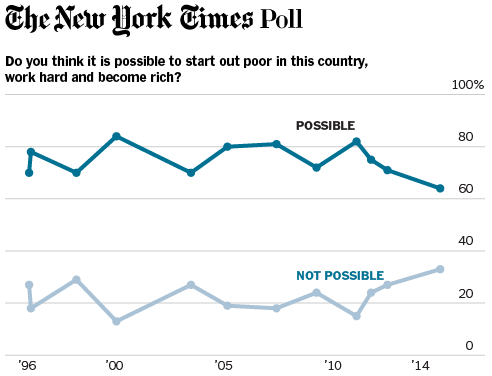
CaptureToday’s New York Times has such an article, “Many Feel American Dream is Out of Reach, Poll Shows,” pointing out that 64% of a NYT Poll respondents think that it is possible to start out poor and become rich (see above chart), which opinion has dropped from 72% in 2009.  The Poll also reports that:

  • 81% of Americans have confidence in their own local banks whereas only 41% have confidence in Wall Street bankers and brokers.
  • 52% think the economic system in the U.S. is basically fair, since all Americans have a chance to succeed, whereas 45% think it is unfair.
  • 54% of Americans think that over-regulation of the economy, which interferes with economic growth, is a bigger problem than under-regulation, which may create an unequal distribution of wealth.

For almost two-thirds of Americans to be upbeat about the American Dream, after six or seven years of recession and slow recovery is to me a very positive sign.  After a severe financial crisis, it is not at all surprising that “main street” bankers have a much higher favorability rating than “Wall Street” bankers.
Several months ago I reported on a survey taken by the progressive Global Strategy Group showing that 80% of voters consider economic growth more important than income inequality.
Both today’s NYT Poll and the previous GSG Survey are saying loud and clear that Americans put a high premium on economic growth and this is where our national leaders should be concentrating their time and energy.  The new Republican majority in Congress has an almost historic opportunity to get this right.  Let’s hope they don’t blow it!

Inequality Does Not Reduce Prosperity


In the national elections this year four states: Alaska, Arkansas, Nebraska and South Dakota raised their state minimum wage rates above the national rate of $7.25 per hour and, at the same time, elected Republicans to the U.S. Senate, in three cases replacing Democratic incumbents.  Does this represent contradictory behavior by the voters?
CaptureThe American Enterprise Institute’s James Pethokoukis recently reported (see above) that the U.S. has the third highest rate of billionaire entrepreneurs behind only Hong Kong and Israel, as well as by far the most billionaires over all.  These are the high-impact innovators like Bill Gates, Steve Jobs and Mark Zuckerberg and the Google Guys.
These observations are put in context by the Manhattan Institute’s Scott Winship who recently reported that “Inequality Does Not Reduce Prosperity.” Here is a summary of his findings:

  • Across the developed world, countries with more inequality tend to have higher living standards.
  • Larger increases in inequality correspond with sharper rises in living standards for the middle class and poor alike.
  • In developed nations, greater inequality tends to accompany stronger economic growth.
  • American income inequality below the top 1 percent is of the same magnitude as that of our rich-country peers in continental Europe and the Anglosphere.
  • In the English-speaking world, income concentration at the top is higher than in most of continental Europe; in the U.S., income concentration is higher than in the rest of the Anglosphere.
  • With the exception of a few small countries with special situations, America’s middle class enjoys living standards as high as, or higher than, any other nation.
  • America’s poor have higher living standards than their counterparts across much of Europe and the Anglosphere.

Conclusion: Americans are fair-minded and would like to help the working poor do better.   But Americans also appreciate the value of innovation and entrepreneurship.  When there is a tradeoff between increasing prosperity and reducing inequality, greater prosperity comes first.

An Economy Doing Half Its Job


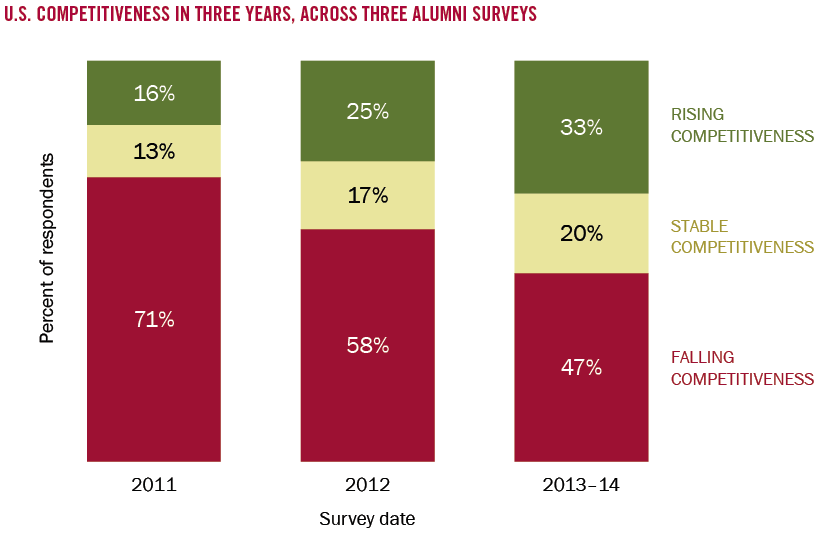
The Harvard Business School has just conducted its third alumni survey on U.S. competitiveness and finds “An Economy Doing Half Its Job.”  “Our report on the findings focuses on a troubling divergence in the American economy: large and midsize firms have rallied strongly from the Great Recession, and highly skilled individuals are prospering.  But middle- and working-class citizens are struggling, as are small businesses.  We argue that such a divergence is unsustainable.”
CaptureHighlights of the survey are:

  • Survey respondents were pessimistic on balance, although less so than in previous surveys. By a ratio of three to two, those who foresaw a decline in U.S. competitiveness in the next three years outnumbered those who predicted an improvement. Respondents were much more hopeful about the future competitive success of America’s firms than they were about the future pay of America’s workers.
  • Respondents saw weaknesses in those aspects of the U.S. business environment that drive the prospects of middle- and working-class citizens, for instance, the education system, the quality of workplace skills, and the effectiveness of the political system.
  • Alumni working in small businesses had more negative views of virtually every aspect of the U.S. business environment. This finding echoes growing evidence from other sources that small businesses are disadvantaged in America.

Capture1The authors of the report “see a need for business leaders to move toward strategic, collaborative efforts that make the average American productive enough to command higher wages even in competitive global labor markets.  Without such actions, the U.S. economy will continue to do only half its job, with many citizens struggling.” What’s interesting about this report is that it describes the problems of the American economy in a straightforward and practical way with no apparent ideological slant.  Of course, addressing these issues requires political action with all of its messy, partisan overtones. Nevertheless perhaps all parties can at least agree on what the basic problem is.

Frustration Has Deep Economic Roots


My last two posts have dealt with the racial unrest in Ferguson MO and how American society should respond to the basic underlying causes.  In particular Omaha NE where I live is in the process of setting up a large scale pilot project in early childhood education to better prepare children from low-income families to succeed in school.
The St. Louis Post Dispatch had a recent article “Frustration in North County Has Deep Economic Roots” pointing out, for example, that unemployment for young black men in St. Louis is 47% compared to 16% for young white men.  Said the author, David Nicklaus, “If police tactics were the spark which set off the explosion in Ferguson this week, then poverty and hopelessness were the tinder.  Those in charge of the police can begin the healing process, but it won’t be complete unless we tackle the deeper economic issues too.”
CaptureThe Equality of Opportunity Project at Harvard University has published a chart (above) showing the degree of upward mobility for children born into low-income families in different parts of the country.  Omaha ranks much higher than St. Louis but not as high as it could.  The current unemployment rate in Omaha is 3.8% which essentially represents full employment.  This means that there are plenty of jobs available for well qualified applicants.
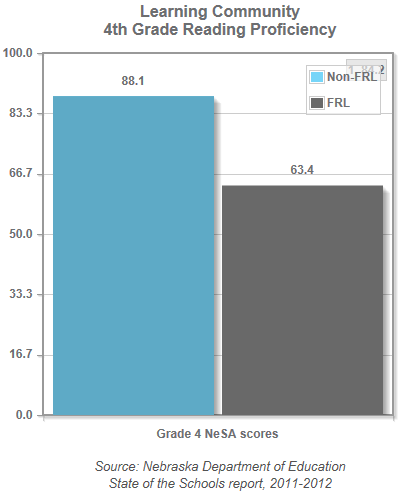
Capture1However the above chart shows the extent of the achievement gap in metro Omaha between middle class children and children living in poverty.  It is already substantial for fourth grade reading proficiency and becomes much worse in the higher grades. Conclusion:  in Omaha NE the root cause of lack of economic opportunity for racial minorities living in poverty is not the availability of jobs but the inadequate educational achievement to hold a good job.
Omaha is a prosperous community in a prosperous state.  But it could do a better job of educating children living in poverty.

A Rescue That Worked But Left a Troubled Economy


The occasion of the publication of Timothy Geithner’s book “Stress Test,” giving his version of the financial crisis, has led to a number of newspaper articles looking back at the Great Recession and its aftermath.  The New York Times’ economics reporter David Leonhardt has such an analysis “A Rescue That Worked, But Left a Troubled Economy” in today’s NYT.
Capture“The Great Depression created much of modern American government and reversed decades of rising inequality.  Today, by contrast, incomes are rising at the top again, while still stagnant for most Americans.  Wall Street is flourishing again.”
“The financial crisis offered an opportunity to change this dynamic.  But the (Dodd-Frank) law seems unlikely to transform Wall Street, and the debate over finance’s huge role in today’s economy will now fall to others.  Should the banks be broken up?  Should the government tax wealth?  Should the banks face higher taxes?”
In my opinion, the real problem is not our financial system but the strong headwinds which are slowing down the economy.


  • Globalization of markets which creates huge pressure for low operating costs.
  • Labor saving technology which also puts downward pressure on wages.
  • Women and immigrants having entered the labor market in huge numbers, and therefore greatly increasing the labor supply.

The loss of wealth in the Great Recession also means that even people with good jobs have less money to spend.  What we sorely need is faster economic growth to create more jobs and higher paying jobs.  How do we accomplish this?

  • The best way to boost the economy is with broad-based tax reform to achieve the lowest possible tax rates to put more money in the hands of the working people who are the most likely to spend it. Such lower rates can be offset by closing the myriad tax loopholes and at least shrinking, if not completely eliminating, tax deductions which primarily benefit the wealthy.
  • Lowering corporate tax rates, again offset by eliminating deductions, providing a huge incentive for American multinational companies to bring their profits back home for reinvestment or redistribution.

With millions of unemployed and underemployed workers, reviving our economy with a faster rate of growth should be one of the very top priorities of Congress and the President.  Survey after survey show that this is what voters want.  Why isn’t it happening?