
How Do We Increase Economic Mobility?


As the Wall Street Journal reported several days ago, “Economic Mobility Is the New Flashpoint”.  “Both parties agree the opportunity gap is widening, but the proposed solutions are starkly different.”  The Democrats want to increase the minimum wage, extend unemployment benefits, and expand access to college.  The Republicans suggest a whole potpourri of approaches such as reforming welfare (including food stamps), extending school choice, cutting taxes, and relaxing regulations on new businesses.
A look at the latest jobs report from the Labor Department should provide the focus which Congress needs to figure out how to increase economic opportunity.  Although the unemployment rate dropped substantially to 6.7% from 7.0% at the beginning of December, only 74,000 new jobs were created in December.  The explanation is that 347,000 left the labor force last month.  The labor force participation rate, the share of the U.S. working-age population employed, age 16 and over, has dropped from 64.5% in 2000, to just under 63% at the beginning of 2008 to near a post-recession low of 58.6% last month (see chart below).
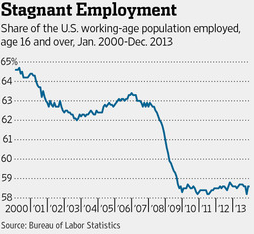
CaptureIn other words, Congress should be totally focused on speeding up economic growth in order to create more jobs.  Since new businesses create the most new jobs, we should indeed relax as many regulations as possible which impede entrepreneurship.  We should lower the corporate tax rate from its very high current value of 35% to get American multinational companies to bring their trillions of overseas profits back home for reinvestment in the U.S.  Moving to a national consumption tax (see the Graetz Plan discussion in my January 7 post), could mean dropping the corporate tax rate to as low as 15%.
Isn’t is obvious that the best thing we can do to give low income people an opportunity to rise up the economic ladder is to just give them a job in the first place?  If they’re ambitious they’ll take any opportunity they can get and run with it!

Fundamental Tax Reform Is the Key to Solving Our Economic and Fiscal Problems I. Why Change Is Needed

I have been writing this blog for just over a year.  It addresses what I consider to be the two biggest problems faced by our country at the present time.  First is our enormous national debt, now over $17 trillion, and the huge annual budget deficits which are continuing to make it worse.  The second problem, of equal magnitude, is our slow rate of economic growth, about 2% of GDP annually, ever since the Great Recession ended in June 2009.
CaptureThese two problems are closely related.  If the economy grew faster, federal tax revenue would grow faster and the annual deficit would shrink faster.  Not to mention that a faster growing economy would create more jobs and lower the unemployment rate, which is still a high 7%.
The impediments to solving these problems are huge.  Our public debt, on which we pay interest, is now over $12 trillion or 73% of GDP.  Although it may stabilize at this level for a few years, it will soon begin climbing much higher, without major changes in current policy.  This is primarily because of exploding entitlement spending for retirees (Social Security and Medicare) who will increase in number from about 50 million today to over 70 million in just 20 years.  As interest rates return to normal higher levels, just paying interest on the national debt will become, all by itself, a larger and larger drain on the economy.
The impediments to faster economic growth are increasing global competition, such as inexpensive foreign labor, as well as rapid advances in technology, such as electronics and robotics.  Both of these trends reduce the need for unskilled workers in America which in turn holds down wages and slows down economic growth.
At the same time we have an antiquated tax code to raise the huge sums of money necessary to pay for a large and complex national government.  It worked fine through the post-World War II period, as long as the U.S. had the dominant world economy with little significant competition from others.  But this situation no longer exists.  We now have a tax system which doesn’t raise enough money to pay our bills and at the same time is so progressive that the highest rates (39.6% on individuals and 35% for corporations) are not sufficiently competitive with other countries.  This discourages the entrepreneurship and business investment we need to grow the economy faster and create more jobs.
We have an enormous problem on our hands!  Is it possible to fundamentally change our tax system to turn things around?  My next post will answer this question in the affirmative!

How to Get the Economy Back on Track


Harvard Economist, Martin Feldstein, has an Op Ed column in yesterday’s New York Times, “Saving The Fed From Itself”, which gets our current economic situation half right.  First of all, Mr. Feldstein says that the Fed’s quantitative easing policy is inadequate because “the magnitude of the effect has been too small to raise economic growth to a healthy rate.  … The net result is that the economy has been growing at an annual rate of less than 2 percent.  … Weak growth has also meant weak employment gains.  … Total private sector employment is actually less than it was six years ago.  … While doing little to stimulate the economy, the Fed’s policy of low long-term interest rates has caused individuals and institutions to take excessive risks that could destabilize the economy just as it did before the 2007-2009 recession.”  So far he’s right on the button!
But then he goes on to say, “To get the economy back on track,” Congress should enact a five year plan to spend a trillion dollars or more on infrastructure improvement and that this would “move the growth of gross domestic product to above three percent a year.”  An artificial stimulus like this might work temporarily but then it ends and we’re back where we started.  We need a self-generating stimulus that will keep going indefinitely on its own.  How do we accomplish this?
The answer should be obvious.  We do it by stimulating the private sector to take more risk in order to generate more profits. In the process they will hire more employees and boost the economy.
How do we motivate the private sector?  By lowering tax rates and loosening the regulations which stifle growth.  Closing tax loopholes and lowering deductions (which will raise revenue to offset the lower tax rates) has the added benefit of attacking the corporate cronyism which everyone deplores.
We really do need to put first things first.  If we can jump start the economy by motivating the private sector to invest and grow, we will have more tax revenue to spend on new and expanded government programs as well as shrinking the federal deficit.
Why is this so hard for so many people to understand?

Should the Minimum Wage Be Raised?

In today’s New York Times, the economist Arindrajit Dube has an Op Ed column in the Great Divide series, “The Minimum We Can Do”, pointing out that today’s minimum wage of $7.25 per hour is only 37% of today’s median hourly wage of about $20 per hour.  This compares with the 1968 minimum wage of $10.60 per hour (in today’s dollars, adjusted for inflation) which was 55% of the median wage at that time.  This is in line with the current Democratic proposal to raise the minimum wage to $10.10 per hour.
The standard argument against raising the minimum wage is that it will reduce employment because “when labor is made more costly, employers will hire less of it.”  However Mr. Dube offers empirical data which “suggest that a hypothetical 10% increase in the minimum wage affects employment in the restaurant or retail industries by much less than 1 percent” and therefore very little.
Basically Mr. Dube is arguing that raising the minimum wage won’t hurt the economy and it will help many low-paid workers.  The problem with this point of view is that it distracts attention from what we really should be doing: namely, everything we possibly can to speed up economic growth.  By far the best way to raise wages is to increase the value of labor by creating more jobs!
I may sound like a broken record, repeating the same thing over and over again, but we badly need to concentrate on the fundamentals of growing the economy: lowering tax rates, individual and corporate, to stimulate business investment and risk taking by entrepreneurs; removing onerous regulatory burdens, especially on new businesses and existing small businesses; and emphasizing career education and job training to fill the millions of high skill job openings which exist.
There are strong headwinds facing our economy: bad demographics (rapidly retiring baby boomers), pressure from technological progress and globalization which put a high premium on education and advanced skills, and massive national debt which will become a huge burden as interest rates inevitably increase.
These strong headwinds aren’t going away.  To overcome them we need national leaders who are able to rise above ideology and focus on the fundamentals.
Conclusion: we should raise the minimum wage when unemployment drops to 6% or, perhaps, tie a raise in the minimum wage to a tax reform measure which significantly lowers tax rates.

How to Create a More Just and Equal Society


In a recent Washington Post column, “Government is Not Beholden to the Rich”, the economics writer Robert Samuelson shows that the federal government is actually “beholden to the poor and middle class.  It redistributes from the young, well-off and wealthy to the old, needy and unlucky.”
For example, in 2006 “53% of non-interest federal spending represented individual benefits and healthcare.  Of these transfers (nearly $1.3 trillion), almost 60% went to the elderly.  Of the non-elderly’s $550 billion of benefits and healthcare, the poorest fifth of households received half.  The non-elderly paid about 85% of the taxes, with the richest fifth covering two-thirds of that.  If government taxes and transfers – what people pay and get – are lumped together, the average elderly household received a net payment of $13,900 in 2006; the poorest fifth of non-elderly households received $12,600.  By contrast, the net tax payment for the richest fifth of non-elderly households averaged $66,000.”
A couple of months ago a Wall Street Journal Op Ed “Obama’s Economy Hits His Voters Hardest” by the economist Stephen Moore, points out that during the time period 1981 – 2008, the Great Moderation, income for black women was up by 81%, followed by white women up 67%, black men up 31% and, finally, white men up only 8%.  Of course, all of these groups have lost income in the last four years, during the very weak recovery from the Great Recession.
The answer is clear.  The best way to help low income people lift themselves up is not to redistribute even more government resources to them but rather to boost the economy to create more and better jobs.  There are tried and true methods to get this done: tax reform (to encourage more risk taking and entrepreneurship), immigration reform (to provide more willing workers) and true healthcare reform (to get healthcare spending under control).
We need national leaders who understand how to make the economy grow faster and are able to stay focused on this urgent task.

The Floundering of America


In yesterday’s Wall Street Journal, columnist William Galston talks about “The Floundering of America”.  Based on recent reports from the Congressional Budget Office, Mr. Galston says that “Today we are hurtling toward a less dynamic economy, a meaner society and a riskier world.”
His argument is based on these observations:

  • For the past 40 years, 1970-2010, the labor force expanded at an average rate of 1.6% per year.  It will soon slow to only .4% annual growth, because of more retirements and a plateauing of women’s labor-force participation. This means that growth in GDP will slow down to about 2% annually from its historical average of over 3%.
  • America is aging very fast.  Today there are 57 million Social Security beneficiaries which will increase to 76 million in 2023.  Obviously this will rapidly increase entitlement spending on retirees.
  • America already spends 18% of GDP on healthcare costs and the CBO projects that this will grow to 22% by 2038.

“In sum, current trends and policies will yield lower rates of economic growth, painfully slow gains in real incomes, huge increases in outlays for expenses related to an aging population, and a health sector that devours more and more of the national product”, he says.
These trends are all contributing to an explosion of the national debt.  The only current strategy to keep this debt even roughly stable during the next decade, let alone reduce it, is to shrink discretionary spending through sequestration.  This will lead to a decline in discretionary spending to 5.3% of GDP by 2023.  This means roughly 2.6% of GDP for national defense with an equal share or all other domestic purposes.
“This is pure folly”, says Mr. Galston. “The country needs a new national strategy for a viable future.”
How do we achieve a new strategy?  Immigration reform will increase the size of the workforce.  Tax reform could boost the economy by encouraging business expansion, risk taking and entrepreneurship.  True (consumer-driven) healthcare reform could dramatically lower the cost of healthcare.  In other words there are potential policies out there that address our national floundering. We simply need leaders who are capable of going beyond partisanship in order to help create a better future!

Are Deficit Fears Overblown?


In yesterday’s Wall Street Journal columnist David Wessel responds too mildly in “Why It’s Wrong to Dismiss the Deficit” to Larry Summers’ view that we should not worry about the deficit.  Mr. Summers says, “Let me be clear.  I am not saying that fiscal discipline and economic growth are twin priorities.  I am saying that our priority must be on increasing demand.”  According to Mr. Wessel, here is the essence of Mr. Summers’ argument:

  • The deficit isn’t an immediate problem; growth is.
  • We’ve done enough (about the deficit) already.
  • The future is so uncertain that acting now is unwise.

Granted that the deficit for fiscal year 2013 is “only” $680 billion after four years in a row of deficits over a trillion dollars each and that interest rates are at an historically low level at the present time.  The problem is that the public debt is now at the very high level of 73% of GDP and is projected by the Congressional Budget Office to continue climbing indefinitely.  Interest on the debt was $415 billion for fiscal year 2013 which represents 2.5% of GDP of $16.8 trillion.  With GDP growth increasing at about 2% per year since the end of the recession in June 2009, this means that interest on the debt is already slowing down the economy and it’s just going to keep getting worse as interest rates inevitably return to higher historical levels.
Growth is very definitely an immediate problem.  But increased government spending is the wrong way to address it.  The right way to address it is with broad based tax reform (lowering tax rates in return for closing loopholes) to stimulate investment and risk taking by businesses and entrepreneurs.  Significant relaxing of the regulatory burden would also help, especially for the small businesses which are responsible for much of the growth of new jobs.  So would immigration reform to boost the number of legal workers.
As uncertain as the future is, we can be quite sure that entitlement spending (Social Security, Medicare and Medicaid) will be going up fast in the very near future as more and more baby boomers retire and the ratio of workers to retirees continues to decline.  It would be very risky indeed to assume that economic growth will increase fast enough to pay for increased entitlement spending.
Conclusion:  large deficits are a very urgent and immediate problem which we ignore at our peril!   Furthermore the best ways of boosting the economy don’t require increased government spending.

Where Are the Jobs? II. How to Create More of Them

My previous post, two days ago, introduced a new book by two economists, John Dearie and Courtney Geduldig, “Where the Jobs Are, Entrepreneurship and the Soul of the American Economy”.  They make a very strong case that net job creation comes primarily from businesses less than one year old, true “start-ups”.  But, unfortunately, there has been a huge drop off in the number of new businesses created each year since 2007 and, furthermore, the historical average of seven new jobs created by a firm in its first year has now fallen to less than five.
How do we reverse this alarming trend?  Here is what the authors have learned from the many entrepreneurs they have talked to:

  • “Not enough people with the skills we need”
  • “Our immigration policies are insane”
  • “Regulations are killing us”
  • “Tax payments can be the difference between survival and failure”
  • “There’s too much uncertainty and it’s Washington’s fault”

Although there are 24 million Americans either unemployed or underemployed, there are also 3 million advertised high skill job openings going begging and many more potential jobs available for qualified individuals.  A greater emphasis on STEM (Science, Technology, Engineering and Mathematics) education in the U.S. would help.  But also immigration reform is urgently needed.  The Senate has passed legislation to raise the annual cap on H1-B visas (for high skilled workers) from 65,000 currently to 110,000.  Hopefully the House will concur.
A Preferential Regulatory Framework for New Businesses could be devised to help fragile new businesses in their first five years.  A Regulatory Improvement Commission could be created to streamline the entire federal regulatory process.  Likewise a Preferential Tax Framework for New Business should be created and could, for example, recommend taxing income for the first five years at a much lower rate than normal.
Regarding policy uncertainty the authors refer to the U.S. Economic Policy Uncertainty Index which is at a very high level since the Great Recession.  Economic uncertainty obviously discourages business growth.
Conclusion:  A very good way to boost the economy and create more new jobs is to put greater emphasis on supporting entrepreneurs who are trying to start new businesses.  There are a number of concrete actions that the federal government can take to do this and doing so should be a very high priority for our national leaders.

Where Are The Jobs? I. The Basics

Two economists, John Dearie and Courtney Geduldig, have just published a very interesting new book, “Where the Jobs Are, Entrepreneurship and the Soul of the American Economy”.   In April 2011, Mr. Dearie and Ms. Geduldig launched an effort to understand the nature and scope of the damage to the U.S. labor markets caused by the Great Recession and, if possible, identify new ways to enhance the economy’s job-creating capacity.
They quickly “learned of research that demonstrates how virtually all net new job creation in the United States over the past 30 years has come from businesses less than a year old – true ‘start-ups.’  Investigating further, they also learned that America’s job creation machine is faltering, with the rate of start-up formation declining precipitously in recent years.  To find out why, they launched an ambitious summer road trip – conducting roundtables with entrepreneurs in 12 cities across the nation.”  Here is what they learned.
First of all, the U.S. labor market is tremendously dynamic, as existing businesses create new jobs and eliminate others.  “In 2011, for example, 47.5 million separations occurred while 49.6 million Americans took new jobs.”  But “existing firms, of any age or size, in aggregate, nearly always produce more separations than hires.  … Indeed, existing businesses shed on a net basis a combined average of about 1 million jobs each year as some businesses fail, others become more efficient, and as separations simply outpace new hires.  By stark contrast, new firms in their first year of existence, create an average of 3 million new jobs.”
Unfortunately, there has been a huge drop off in the number of new businesses created annually since 2007.  Furthermore, the historical average of seven new jobs created by a new firm in its first year, has now fallen to less than five new jobs.
The obvious question which this discussion raises is: what policy changes are needed to boost the creation of new businesses?  This will be the topic of my next post in a couple of days!

A Pessimistic View of America’s Future II. What Does Everyone Want?


In my previous post I laid out the view of the economist, Tyler Cowen, in his new book “Average is Over”, that the powerful trends of globalization, technology, and ever increasing machine intelligence (such as Google’s search engines), will lead to a super elite 10-15% of American’s who will have the ability and self-discipline to master tomorrow’s technology and profit from it.  The average middle class worker will be increasingly replaced or downgraded by intelligent machines.  Social and economic inequality will continue to grow and this new trend will be very hard to overcome.  This is a bleak prospect for the future of America.
What can be done to resist this trend and to try to turn it around?  Jim Clifton, the CEO of the Gallup Organization, says in “The Coming Jobs War”, that “what everyone in the world wants is a good job” and he has many ideas about how to boost the economy in order to produce more good jobs.  According to Mr. Clifton, there is no shortage in this country of creativity, new inventions and innovation.  What is lacking are successful business models to commercialize the good ideas which are already out there and create customers for new products.  We need entrepreneurship.  “Entrepreneurship has a direct impact on supply and demand, but with a distinction.  It doesn’t just provide supply, it builds demand.”
Next question: how do we boost entrepreneurship?  We get government out of the way as much as possible.  This means the lowest possible tax rates (offset by eliminating tax loopholes for the wealthy) and fewer burdensome regulations (such as the employer mandate for health insurance).
 As a society we have to decide which is more important:  creating more and better jobs by growing the economy faster or making everyone more equal with higher taxes and more income redistribution.  We can’t have it both ways.  To reverse or at least slow down the trends which are now shrinking the middle class,  the best policy is to go all out for entrepreneurship and investment!