The Fundamental Driver of Our Debt Problem: the Cost of Healthcare


How to grow the economy faster. How to get our rapidly growing national debt under control.  These are the two main problems facing our country which I address over and over again on this blog.  Finding satisfactory solutions to these two problems will determine our future strength and prosperity as a nation.  Today’s discussion is about the major cause of our debt and deficit problem.
CaptureI recently came across the above chart showing the steady rise of overall American healthcare spending (public and private).  In 1960 it was less than 6% of GDP.  Now it is approximately 18%, a tripling, compared to the overall size of the economy, in just 55 years. Of course it is the cost of public healthcare programs such as Medicare, Medicaid and the Affordable Care Act which directly contribute to our growing deficits and to the accumulated debt.
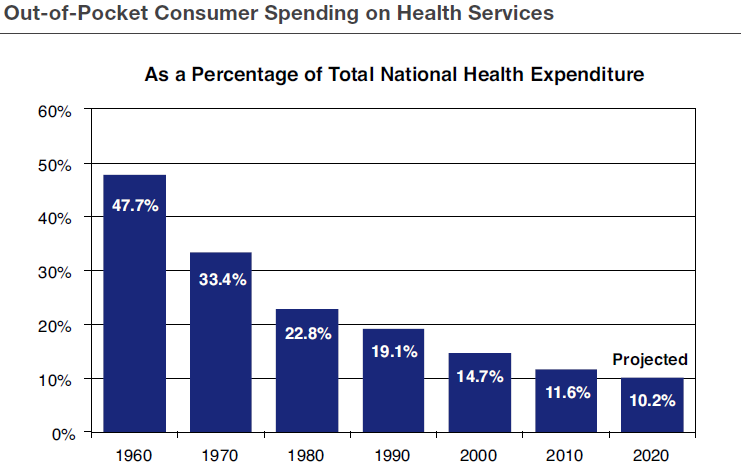
However we will never be able to limit the cost increases of these public programs until we get the fundamental drivers of private healthcare costs under control. As pointed out (in the chart below) by several scholars from the American Enterprise Institute, the basic reason for the high cost of private American health care is that “we don’t have enough skin in the game” as shown by the chart just below.  We are paying less and less of total healthcare costs out of our own pockets because more costs are paid directly by third party insurers.  This means we have less incentive to control our own healthcare costs.
Capture2The AEI has suggested several reform measures to improve this situation such as:

  • Placing an upper limit on the tax exemption for employer-paid insurance premiums.
  • Expanding the use of Health Savings Accounts to be used in conjunction with high deductible plans.

We have a stark choice in front of us. Either we move in this direction in the near future or we will face another, much worse, financial crisis.  In the latter case we will end up with an inferior healthcare system, much less responsive to our wants and desires.

Follow me on Twitter: https://twitter.com/jack_heidel
Follow me on Facebook: https://www.facebook.com/jack.heidel.3

The Quality of American Health Care


One of the most common themes on this website is the high cost of American healthcare. What I am saying is that our annual deficits are way too high and that our accumulated debt is increasing too fast.  Furthermore, the only way to get the cost of healthcare entitlements, Medicare and Medicaid, under control, is to get the overall cost of private healthcare under control as well.  And, of course, I support specific policies to do just this.
CaptureIt so happens that I have just had a major interaction with the American healthcare system in Omaha NE where I live.  I go jogging first thing in the morning, five days a week, all year around.  I have done this all my life and have never had a problem – until last Monday morning when I slipped on some ice, fell down and fractured my wrist.  What I did then was:

  • Call off my 8:00 A.M. Calculus class
  • My wife, Sharon, took me to a Minor Medical facility at 8:00 A.M. just as it opened.
  • The facility x-rayed my wrist and determined that I had broken several bones.
  • They then located an orthopedic surgeon who could see me the same day at 2:50 P.M.
  • The surgeon scheduled me for surgery the very next morning.
  • The surgery was successful and I am now recovering.
  • In other words, 30 hours after my accident occurred, I had had an intense inter-action with American medicine and came through with flying colors.
  • To say the least, I am very impressed with the quality of the facilities and healthcare professionals with whom I interacted.

It may cost an arm and a leg for this superb medical treatment but then I have excellent health insurance which I have seldom had to make use of.
Conclusion: Although we must make significant changes in healthcare delivery in the U.S., to make the system more cost efficient, we should try hard to do this without affecting the high degree of quality inherent in the system.

Follow me on Twitter: https://twitter.com/jack_heidel
Follow me on Facebook: https://www.facebook.com/jack.heidel.3
Lowering the Cost of American Healthcare III. Single Payer?


My last two posts, here and here, argue that the high costs of American healthcare, almost double what other developed countries pay per-capita, has two fundamental causes which must be addressed:

  • Very low out-of-pocket costs as a result of the tax exclusion for employer provided care.
  • The very expensive, and rapidly growing, government entitlement programs of Medicare and Medicaid.
    Capture4

It is often suggested that the best way to get these high costs under control is for the U.S. to adopt a single-payer, government run, healthcare system, like many other developed nations have done. Writing in yesterday’s Wall Street Journal, the policy analyst, Nathan Nascimento, makes a persuasive, and well referenced, counter argument to this suggestion:

  • The State of Vermont recently backed away from implementing a single payer system because of the very high tax increase which would have been required, more than doubling Vermont’s annual budget.
  • The State of Colorado will vote a year from now on a petition-supported single payer proposal, ColoradoCare, which would be paid for by a $26 billion annual state tax increase and is therefore unlikely to pass.
  • In Canada, which has a single payer system, the average wait between a general practitioner’s referral and delivery of treatment was more than four months in 2013.
  • Our own Veterans Affairs hospital system, a single payer system on an annual budget, is failing thousands of veterans who often die while waiting for treatment.
  • Medicare, an open ended single payer entitlement system, now costing almost $600 billion per year, is one of the main causes of our burgeoning, out of control, national debt.

Conclusion: For the U.S. to move to a national single payer system would be very risky and very costly. It is far better to wait and see if Colorado or some other state is willing to take such a leap of faith and then see how it works out in that context.

Follow me on Twitter: https://twitter.com/jack_heidel
Follow me on Facebook: https://www.facebook.com/jack.heidel.3

Lowering the Cost of American Healthcare II. Entitlements


My last post emphsizes that any solution to our nation’s long term debt problem must include reining in the cost of American healthcare.  There are two major drivers to this problem as is made clear by a new report from the American Enterprise Institute, “Improving Health and Health Care: An Agenda for Reform.”
Capture1First of all, out-of-pocket consumer spending on healthcare has been steadily declining for many years. The less we pay directly for our own healthcare, the less incentive we have to control costs.
Capture2Secondly, the cost of healthcare entitlement spending, for Medicare and Medicaid , is growing rapidly as a percentage of GDP.  Such a rapid increase is unsustainable and must be curtailed. Here is what the AEI report recommends for doing this.

  • Medicaid. It serves two groups of people: 1) able bodied adults and their children and 2) the disabled and elderly. The federal government should make fixed, per-capita payments to the states based on historical spending patterns for these two groups. The able-bodied adults and children would get the same (refundable) federal tax credits as everyone else supplemented by Medicaid payments. The states would be totally responsible for the second group.
  • Medicare. The current system would be gradually migrated to a premium support system which would provide enough to pay for a choice of competing insurance options. The eligibility age would gradually rise to 67, consistent with Social Security.
    Capture3
  • Health Savings Accounts. HSAs are tax-preferred vehicles for saving for medical expenses until the (perhaps high) deductible amount is reached. Their use is growing rapidly. A one-time $1000 federal tax credit for establishing an HSA would increase their number even more. Their use should be expanded into Medicaid and Medicare as well.

Such reforms as these can significantly lower the cost of providing healthcare to the poor, the elderly and everyone else as well. If we don’t do something along these lines, we will eventually end up with a government run single payer system much to our detriment.


Follow me on Twitter: https://twitter.com/jack_heidel
Follow me on Facebook: https://www.facebook.com/jack.heidel.3


Lowering the Cost of American Healthcare


It is well understood that entitlement spending (Social Security, Medicare and Medicaid) is the biggest driver of our very serious long term debt problem.  Furthermore the high costs of Medicare and Medicaid can’t be separated from the high cost of American healthcare in general.  In other words, getting the cost of national health spending  under control is a fundamental fiscal and economic issue.
Capture1A major reason for this high cost is the tax exclusion of employer provided healthcare.  American out-of-pocket spending on healthcare is only 11% of the total as compared to 26% in Switzerland or 52% in Singapore, two examples of countries with efficient free-market systems.  Americans have little incentive to hold down the cost of their own care because it is mostly paid for by third party insurance companies.
The Affordable Care Act (aka Obamacare) expands access to healthcare but does nothing to control overall costs.  This means that any changes made to the ACA should be aimed at preserving access but making healthcare much more cost efficient.  This can be accomplished by

  • Keeping the Exchanges. The exchanges were set up to expand access for the uninsured and provide subsidies for those who couldn’t otherwise afford health insurance. This is the best feature of the ACA and should be retained.
  • Repealing the mandates for both individuals and employers. Mandates mean that benefits have to be strictly defined, uniform for all, and therefore more expensive. Employers are burdened by extra regulations which affect hiring and growth decisions.
  • Replacing the employer tax exclusion with a uniform tax credit for all. The credit would be about $2500 per person, the cost of high deductible catastrophic care. Employers could still provide insurance to employees but the tax deduction would be limited to the amount of the tax credit. The self-employed would get the same tax credit and it would also be refundable for those with low-incomes.

The American Enterprise Institute’s James Capretta describes how a transition could be made from the current ACA to such a new system.

Follow me on Twitter: https://twitter.com/jack_heidel
Follow me on Facebook: https://www.facebook.com/jack.heidel.3

Can America’s “Fourth Revolution” Be Avoided?


My last post, “America’s Fourth Revolution,” presented a persuasive argument by the political scientist, James Piereson, that our currently dysfunctional political system will be unable to solve our most fundamental problems of massive debt, accompanied by a rapidly aging population and slowing economic growth. This will result, according to Mr. Piereson, in a severe crisis leading to a fourth revolution, overthrowing the New Deal liberal consensus which has prevailed since 1932.
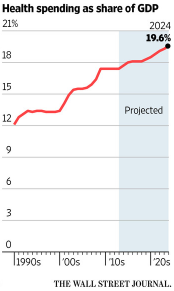
It is commonly understood that entitlement spending: Social Security, Medicare and Medicaid, is the main driver of our rapidly growing national debt. A recent report from the Centers for Medicare and Medicaid Services, summarized in the Wall Street Journal, shows that U.S. healthcare spending is likely to rise from just under 18% today to 19.6% of GDP in 2024.
Capture2Barron’s editor, Thomas Donlan, has just reported that the Director of the Congressional Budget Office, Keith Hall, stated in a recent hearing of the Senate Budget Committee that if spending for Medicare and Medicaid, as a percentage of GDP, fell by 25% over ten years, and then stayed in line with GDP after that, the U.S. would have a budget surplus of 2% of GDP in 2040 instead of the otherwise projected deficit of 6.6% of GDP. Furthermore debt held by the public would fall to 24% of GDP, a remarkable achievement.
This is significant because one country, The Netherlands, spends 12% of GDP on healthcare, and every other country in the world (except for the U.S.) spends less than 12%.
Conclusion: all the U.S. needs to do, so to speak, is to bring healthcare costs in line with the rest of the world and our entire deficit spending problem would be solved! Nobody is claiming that this will be easy but it certainly is within the realm of possibility. It is also far superior than waiting to act until we have another fiscal crisis and thus risking a huge change, a revolution, in our way of life.

Why Obamacare Should Be Fixed and not Repealed


The Supreme Court will soon render an opinion in King v. Burwell challenging the implementation of the Affordable Care Act.  If the Court agrees with the plaintiffs, then anyone receiving health insurance through one of the federal exchanges operating in 33 states is not eligible to receive a subsidy.  Several Committees in the House of Representatives are proposing to take such an opportunity to make improvements to the ACA.
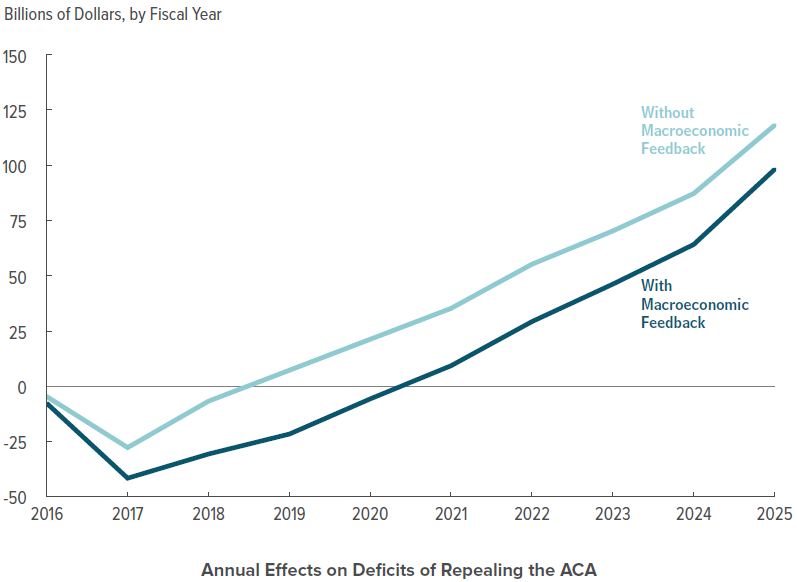
CaptureIn addition, the Congressional Budget Office has just released a report on the “Budgetary and Economic Effects of Repealing the Affordable Care Act,” indicating that repeal of the ACA would add $137 to the deficit over 10 years.  This is because the loss of ACA imposed new tax revenues and spending cuts to Medicare would exceed the amount of money spent to expand insurance coverage.
The economist John Goodman has an excellent new book, “A Better Choice: Healthcare Solutions for America,” describing several basic changes which would greatly improve the ACA.  In summary they are:

  • Replace all of the ACA mandates and tax subsidies with a universal (and refundable) tax credit which is the same for everyone. This is the fairest way to subsidize healthcare for all and it also removes the huge market distortion provided by employer provided health insurance which is tax exempt. The tax credit would be about $2500 per individual and $8000 for a family of four, the approximate cost of catastrophic health insurance and also the average cost of Medicaid.
  • Replace all of the different types of medical savings accounts with a Roth Health Savings Account (after-tax deposits and tax-free withdrawals).
  • Allow Medicaid to compete with private insurance, with everyone having the right to buy in or get out.
  • Keep the ACA exchanges which would be required to provide change-of-health status insurance for the protection of the chronically ill.

Changes such as these would dramatically lower the cost of American healthcare by making all of us directly responsible for the cost of our own healthcare.  They would also virtually eliminate the perverse market effects of the ACA which encourage companies to cut back on numbers and working hours of employees.  This in turn would speed up the growth of our stagnant economy!

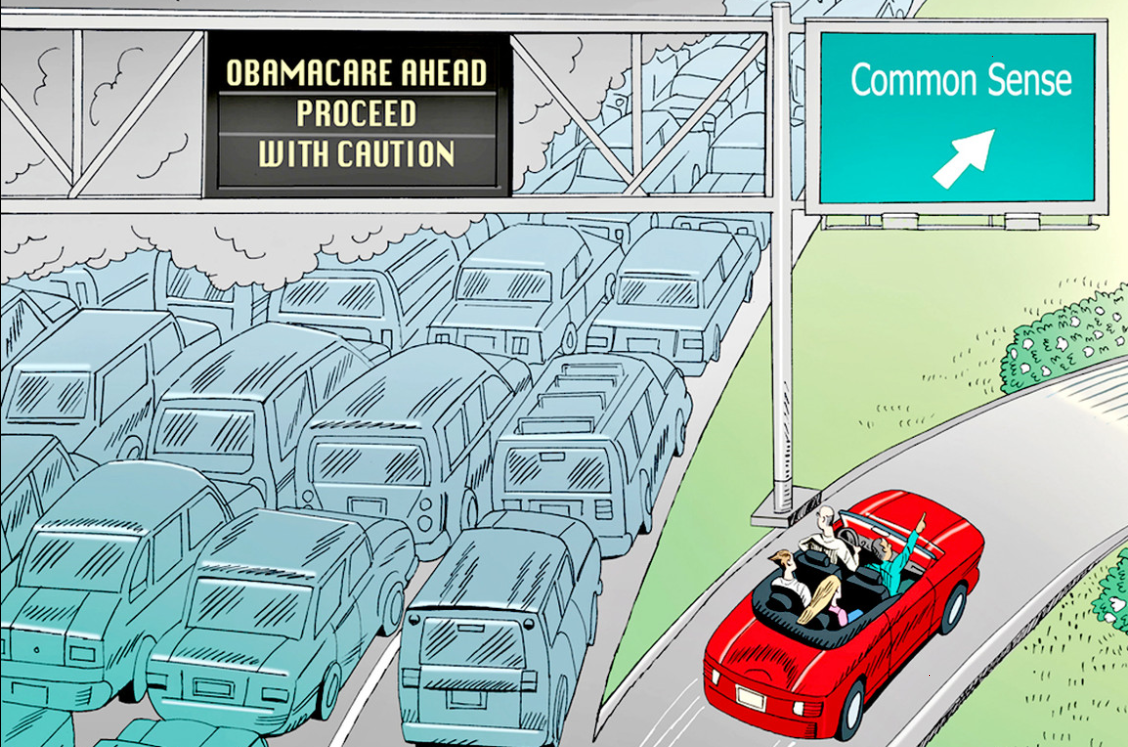
An Off-Ramp from Obama Care


The Supreme Court will soon render an opinion in King v. Burwell, challenging the implementation of the Affordable Care Act which stipulates that subsidies can only be paid “through an Exchange established by the State.”  If the plaintiffs are upheld, it will mean that anyone receiving health insurance through one of the federal exchanges operating in 33 states is not eligible to receive a subsidy.  It will be necessary for Congress to intervene to fix a problem like this.
CaptureThree committee chairs in the House of Representatives, John Kline, Paul Ryan and Fred Upton, are proposing to take such an opportunity to improve the Affordable Care Act along the following lines:

  • First of all, making health insurance more affordable by ending both the individual and employer mandates, and giving choices back to the states, individuals and families.
  • Secondly, supporting Americans in purchasing the coverage of their choosing. For example, people could save money by buying insurance across state lines.
  • Finally, many existing features of the ACA would be retained. Children could stay on their parents policies until age 26. Lifetime limits on benefits would be prohibited. People with existing conditions would be protected. Renewability would be guaranteed. Insurance would be decoupled from employment by offering equal (perhaps, age adjusted) tax credits for all.

There remains the practical problem of providing immediate assistance to the approximately 5 million people currently receiving subsidies through the federal exchanges, while larger scale changes are being worked out by Congress.  The American Enterprise Institute has proposed a simple way for Congress to do this as follows:

  • Enact a short-term extension of subsidies for current enrollees.
  • States with federal exchanges could immediately set up a state exchange if they wished.
  • People with preexisting conditions and/or continuous coverage would be protected.

Both quality control and cost control are badly needed to make the ACA sustainable for the long run.  Given the right decision in King v. Burwell, these two plans outline a possible way to accomplish this.

How Can We Achieve a Free Market in Healthcare?


My last post, “Why Is American Healthcare So Expensive?” suggests that we don’t have enough “skin in the game” because most costs are paid for by third party insurance companies.  One way to alleviate this problem is to subsidize insurance coverage only for catastrophic care with a high deductible and to encourage health savings accounts to pay for routine healthcare expenses.
CaptureBut the University of Chicago’s John Cochrane points out in “After the ACA: Freeing the market for health care” that getting to a true free market in healthcare “will be a long hard road” because “both supply and demand must be freed.”

  • Health care supply. Cost reduction only comes from new entrants into a business, not reform of old businesses. But in 36 states, for example, every new hospital or even major purchase requires a Certificate of Need issued by Hospital Equalization Boards which have explicit mandates to defend the profitability of existing hospitals.
  • Health care demand. True “need” is simply not a well-defined concept when a third party is paying the bills. The consumer must pay a lot closer to the full marginal cost of healthcare, or perhaps receiving the full financial benefits of any economies which he is willing to accept.

What are the objections to establishing a free market system?

  • The homeless and mentally ill, etc. Charity will always be needed for those who fall through the cracks. This doesn’t require a nanny state for the rest of us.
  • Adverse selection. In a free market sick people are more likely to buy insurance and healthy people to forgo it. Sick people would pay more but “health status” insurance and guaranteed renewability will mitigate this problem.
  • Shopping paternalism, i.e. people faced with serious illnesses are incapable of making cost-based decisions. These people and their families will simply have to learn to shop around. In a competitive market, a hospital which routinely overcharges cash customers will be “creamed by Yelp reviews.”

Conclusion.  There are only two ways to get health care spending under control.  A single payer system with rigid regulations and severe rationing or else a deregulated free market system where individuals have primary responsibility for their own care.  Americans are likely to prefer the second option if given a clear choice.

Why Is American Healthcare So Expensive?


The U.S. spends almost 18% of GDP on healthcare costs, double what any other developed county spends.
CaptureThere are many reasons for our excessive healthcare spending.  For example:

  • As illustrated in the above chart, many medical procedures are far more expensive here than in other countries.
  • Profit levels in the healthcare industry are often very high, for example: 16.4% for pharmaceuticals, health-care information 9.4%, home healthcare firms 8.5%, medical labs 8.2% and generic drug makers 6.5%.
  • Health insurers, on the contrary, have a very low profit margin, (2.2% in 2009), and so can hardly be blamed for the high cost of healthcare.

The Affordable Care Act greatly expands access to healthcare but does very little to control costs.  The Manhattan Institute’s Avik Roy has outlined a plan, “Transcending Obamacare: A Patient Centered Plan for Near-Universal Coverage and Permanent Solvency” which would reform Obamacare by making it more like two very successful and low cost consumer-driven plans, those in Switzerland and Singapore.
These two countries feature government sponsored health savings accounts, backed up by insurance for catastrophic care.  What happens is that out-of-pocket spending for healthcare per individual is higher in Switzerland and Singapore than it is in the U.S., as indicated in the chart below.
Capture1In other words, the real reason for our high cost of healthcare is that Americans don’t have enough “skin in the game.”  We have very little incentive to hold down the cost of our own care because it is mostly paid for by third party insurance companies.
As the cost of healthcare continues to climb, such changes are already beginning to creep into the health insurance market place.  Private companies are raising the deductibles on the insurance plans which they subsidize.  The bronze, silver, gold and platinum plans on the ACA exchanges differ largely by the level of the insurance deductible.
Avik Roy’s plan referred to above in essence speeds up the process of converting the ACA into an efficient, consumer-driven healthcare system by making it more flexible and therefore more adaptable to market forces.