
The Looming Demographic and Generational Showdown


An extraordinary new book has just been published by the Pew Research Center’s Paul Taylor, “The Next Generation: Boomers, Millennials and the Looming Generational Showdown”, describing huge demographic changes which are already beginning to wash across the American political landscape. They are in brief outline:

  • The retirement explosion. Today’s 45 million aged 65+ population will increase to 70 million by 2030.
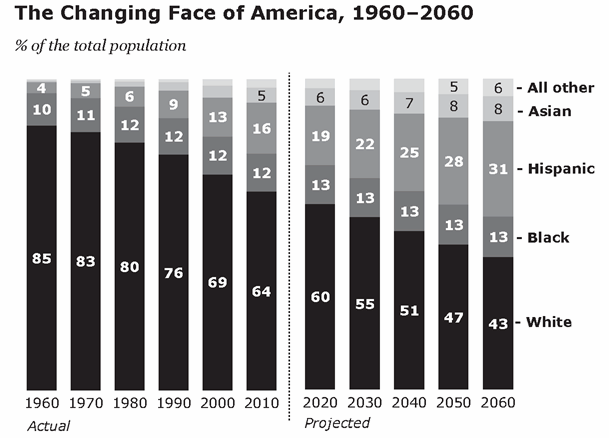
  • The color explosion. Today’s 65% Caucasian population will likely shrink to 43% by 2060.
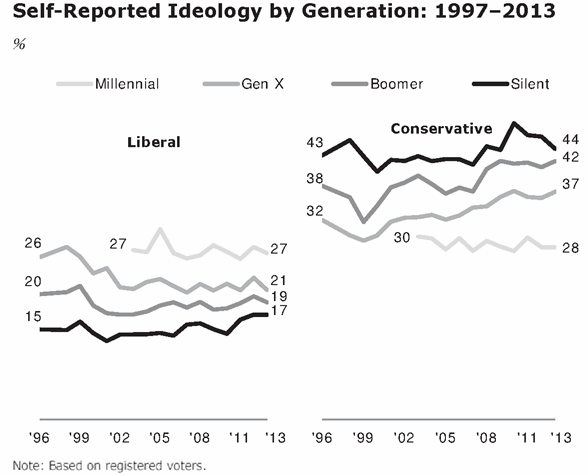
  • The ideology gap. The four current American generations; the Silents, the Boomers, the Gen Xers, and the Millennials are increasingly less conservative and more liberal.
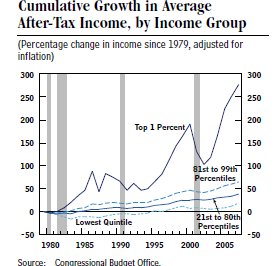
  • The inequality gap. Both income and wealth inequality are growing rapidly and this trend is likely to continue.

Each of these trends is firmly established by data as shown in the accompanying charts. There are huge political implications for these mega-trends. For starters, the biggest threat to our nation’s finances is the rapidly increasing cost of entitlements, especially Social Security and Medicare. Where will the political will to control this spending come from when there are ever more retirees who want to keep their benefit programs?
CaptureWith a surging immigrant population, primarily Hispanic and Asian, constantly gaining more political clout, it becomes more and more urgent to move our 12 million undocumented aliens out of the shadows with some kind of legal status. A broad based guest worker program would be a good way to get started.
Capture1The ideology gap is more difficult to interpret. The four groups are more conservative than liberal and people in general become more conservative as they grow older. Nevertheless, there is an overall trend towards liberalism as age decreases.
Capture2Finally, the growing inequality gap will inevitably create much resentment if ignored by our political system.
Capture4Each of these four mega-trends will create pressure for more federal spending to address the needs and interests of various segments of society. We already have huge deficits, and rapidly increasing national debt, to contend with. How do we balance the pressure for more spending with the need for fiscal restraint? Stay tuned!

Harnessing Market Forces versus Offsetting Market Forces


The economist Matthew Slaughter writes in today’s Wall Street Journal that ’High Trade’ Jobs Pay Higher Wages. He points out that the 22.9 million Americans who work for U.S. headquartered multinational companies made an average of $73,338 in 2011 compared with the overall average wage of about $55,000 that year.  “Workers in multinational firms earn more, as global engagement fosters innovation and productivity growth.”
“There is a growing concern about stagnant or falling incomes, yet most of the measures proposed to deal with the issue – raising the minimum wage and reinstating unemployment benefits – purport to help workers by offsetting market forces.  Less attention is given to harnessing market forces.”
CaptureThis can be done by “liberalizing U.S. trade, investment, immigration and tax policies.”  In other words, we need more trade agreements like NAFTA, which has been so successful in increasing trade in North America.  We need more high skilled workers, both domestic and foreign.  We need lower corporate tax rates to encourage multinational corporations to bring their trillions of dollars in overseas profits back home.
We should always strive for a more equal society with less income inequality.  But the best single way to do this is to create more opportunity by growing the economy, i.e. by harnessing market forces.

An Optimistic View of America’s Future!


In the latest issue of Barron’s, Frederick Rowe, the managing partner of Greenbrier Partners Capital Management, asks in “More Than a Sugar High?” , “Can you imagine a country that is managed in an economically rational manner, creating the wealth that’s necessary to take proper care of the citizens who get left behind? … What if our economic recovery is more than a sugar high?  What if there is more here than insanely stimulative monetary policy from the Federal Reserve?  What if the U.S. has already begun to steer an economic course to a period of unprecedented and genuine prosperity, achievement, and problem solving?”
Here are eight factors which Mr. Rowe gives to point us in the right direction:

  • North American Energy Independence (already on the horizon).
  • Sensible Immigration Reform: encouraging our most enterprising and hard-working people to become citizens rather than chasing them away.
  • Repatriation of Corporate Income: if a company domiciled in the U.S. makes money in Argentina and wants to invest it in the U.S. we double-tax the daylights out of it.  It would be hard to imagine a more counterproductive tax policy.
  • Changing Directors and Their Thinking: the once unthinkable mindset of corporate directors acting on behalf of long-term owners (rather than the CEOs with whom they play golf) is actually gaining traction.
  • Lowering Corporate Taxes: the tax-writing committees in Congress are working on this.
  • Increasing Technological Leadership: the most dynamic technology companies in the world are domiciled in the U.S. Technology, in the short run, displaces workers.  But eventually workers catch up because new technology creates new kinds of jobs that were never imagined before.
  • Americanization of the World: more than three billion people around the world will soon be able to afford to live much more like the 300 million Americans do.  So companies which make it big here have an automatic global opportunity.
  • Obamacare:  Even this bureaucratic catastrophe provides a large opportunity for economic opportunity.  Think of Jimmy Carter’s failures which led to Ronald Reagan’s successes.

“Let your imagination run and consider all the things that can be accomplished by an energy-independent, cash-generating, cash-repatriating country that is a hotbed of technological innovation.”
I can’t possibly say it any better than this!

How to Create a More Just and Equal Society


In a recent Washington Post column, “Government is Not Beholden to the Rich”, the economics writer Robert Samuelson shows that the federal government is actually “beholden to the poor and middle class.  It redistributes from the young, well-off and wealthy to the old, needy and unlucky.”
For example, in 2006 “53% of non-interest federal spending represented individual benefits and healthcare.  Of these transfers (nearly $1.3 trillion), almost 60% went to the elderly.  Of the non-elderly’s $550 billion of benefits and healthcare, the poorest fifth of households received half.  The non-elderly paid about 85% of the taxes, with the richest fifth covering two-thirds of that.  If government taxes and transfers – what people pay and get – are lumped together, the average elderly household received a net payment of $13,900 in 2006; the poorest fifth of non-elderly households received $12,600.  By contrast, the net tax payment for the richest fifth of non-elderly households averaged $66,000.”
A couple of months ago a Wall Street Journal Op Ed “Obama’s Economy Hits His Voters Hardest” by the economist Stephen Moore, points out that during the time period 1981 – 2008, the Great Moderation, income for black women was up by 81%, followed by white women up 67%, black men up 31% and, finally, white men up only 8%.  Of course, all of these groups have lost income in the last four years, during the very weak recovery from the Great Recession.
The answer is clear.  The best way to help low income people lift themselves up is not to redistribute even more government resources to them but rather to boost the economy to create more and better jobs.  There are tried and true methods to get this done: tax reform (to encourage more risk taking and entrepreneurship), immigration reform (to provide more willing workers) and true healthcare reform (to get healthcare spending under control).
We need national leaders who understand how to make the economy grow faster and are able to stay focused on this urgent task.

The Floundering of America


In yesterday’s Wall Street Journal, columnist William Galston talks about “The Floundering of America”.  Based on recent reports from the Congressional Budget Office, Mr. Galston says that “Today we are hurtling toward a less dynamic economy, a meaner society and a riskier world.”
His argument is based on these observations:

  • For the past 40 years, 1970-2010, the labor force expanded at an average rate of 1.6% per year.  It will soon slow to only .4% annual growth, because of more retirements and a plateauing of women’s labor-force participation. This means that growth in GDP will slow down to about 2% annually from its historical average of over 3%.
  • America is aging very fast.  Today there are 57 million Social Security beneficiaries which will increase to 76 million in 2023.  Obviously this will rapidly increase entitlement spending on retirees.
  • America already spends 18% of GDP on healthcare costs and the CBO projects that this will grow to 22% by 2038.

“In sum, current trends and policies will yield lower rates of economic growth, painfully slow gains in real incomes, huge increases in outlays for expenses related to an aging population, and a health sector that devours more and more of the national product”, he says.
These trends are all contributing to an explosion of the national debt.  The only current strategy to keep this debt even roughly stable during the next decade, let alone reduce it, is to shrink discretionary spending through sequestration.  This will lead to a decline in discretionary spending to 5.3% of GDP by 2023.  This means roughly 2.6% of GDP for national defense with an equal share or all other domestic purposes.
“This is pure folly”, says Mr. Galston. “The country needs a new national strategy for a viable future.”
How do we achieve a new strategy?  Immigration reform will increase the size of the workforce.  Tax reform could boost the economy by encouraging business expansion, risk taking and entrepreneurship.  True (consumer-driven) healthcare reform could dramatically lower the cost of healthcare.  In other words there are potential policies out there that address our national floundering. We simply need leaders who are capable of going beyond partisanship in order to help create a better future!

A Pessimistic View of America’s Future V. When Wealth Disappears


Several of my recent posts have been pretty gloomy.  “Average is Over,” “What, Me Worry?” and “The Age of Oversupply,” for example.  Here’s another gloomy one.  The British economist, Stephen King, has an Op Ed column in last Monday’s New York Times, “When Wealth Disappears.”, based on his new book, “When the Money Runs Out.”
Our GDP grew at 3.4% per year in the 1980s and 1990s, then dropped to a growth rate of 2.4% from 2000 – 2007.  Since the Great Recession ended it has averaged barely 2% per year.  The Democrats say we just need more fiscal stimulus and monetary easing to boost the growth rate.  The Republicans say deficit reduction including entitlement reform, slashing regulations and tax reform is what is needed to revive the economy.
“Both sides are wrong,” says Mr. King.  “The underlying reason for the stagnation is that a half-century of one-off developments in the industrialized world will not be repeated.”  These one-off developments are: the unleashing of global trade after World War II, financial innovation such as consumer credit, expansion of social safety nets which reduces the need for household savings, reduced discrimination which has flooded the labor market with women and, finally, the great increase in the number of educated citizens.
What Mr. King recommends is “economic honesty, to recognize that promises made during good times can no longer be easily kept.  What this means is a higher retirement age, more immigration to increase the working age population, less borrowing from abroad (by holding down deficit spending), less reliance on monetary policy that creates unsustainable financial bubbles, a new social compact which doesn’t cannibalize the young to feed the boomers, and a further opening of world trade.”
“Policy makers simply pray for a strong recovery.  They opt for the illusion because the reality is too bleak to bear.  But as the current fiscal crisis demonstrates, facing the pain will not be easy.  And the waking up from our collective illusions has just begun.”
It is obviously time to bite the bullet, lower our expectations, and start doing the hard work needed for even incremental economic progress.

Does the Economy Need More Spending Now?

In today’s Wall Street Journal the economist Alan Blinder writes, “The Economy Needs More Spending Now”, that the tax hikes and spending cuts agreed to in January and before are reducing GDP growth by 1.5% – 2% annually.  Mr. Blinder claims that it would be easy to design a new fiscal stimulus package that adds 2% to GDP per year as long as it lasts.  He also claims that a fundamental change like tax reform might only add a much smaller .2% to GDP per year although this much smaller annual effect would repeat indefinitely and therefore eventually amount to a large cumulative effect.  This is a sensible argument as far as it goes but is incomplete.
In the last five years there has been almost $6 trillion in (deficit) stimulus spending, coupled with a $3 trillion quantitative easing program by the Federal Reserve.  This represents an unprecedented fiscal and monetary stimulus to the economy by the federal government.  And the result has been a tepid although steady 2% annual growth in GDP, much slower than usually follows a recession.
After all of this enormous stimulus, which is having only a meager effect, what makes more sense:  to try even more stimulus or to try something different?  What else is there to try?  Immigration reform will boost the economy by drawing our 11,000,000 illegal immigrants into the main stream economy.  Note that citizenship (amnesty) is not required to accomplish this, only legal status.  Also, requiring many people receiving welfare (food stamps, disability benefits, etc.) to work would boost the economy by increasing the size of the labor force.
Broad based tax reform, greatly curtailing most, if not all, tax preferences, would be so attractive that it should not be put on a back burner, as Mr. Blinder suggests.  In fact, completely repealing the ACA’s Employer Mandate, now that it’s been postponed for a year, would give a big boost to many medium sized companies for which required health insurance is a big impediment to growth.
The point is that there are many ways to boost the economy besides even more artificial deficit stimulus, whose effect would be at most temporary anyway, as Mr. Blinder suggests.  It really is important to shrink our still very large annual deficits down to zero fairly quickly so that we stop adding to the huge burden which we have already placed on future generations.  In other words, we can likely have stronger economic growth and fiscal restraint at the same time, the best of all possible worlds!

Immigration Reform is Pro-Growth


The lead editorial in today’s Wall Street Journal, “A Pro-Growth Reform”, is right on the money.  It challenges the GOP House to improve the Senate immigration bill, not kill it.  The emphasis in the Senate bill is to provide an eventual path to citizenship for the approximately 11,000,000 illegal immigrants currently in the US.  To offset the charge that this is amnesty, the Senate bill greatly increases enforcement by doubling the size of the border patrol, at a cost of $4 billion per year, and increasing the criminal penalties for employers who mistakenly hire an illegal.  The Senate bill also increases the quota for skilled workers from the current 65,000 per year limit to 120,000 per year but it only barely increases the annual quotas for construction and agricultural guest workers, which doesn’t nearly meet current needs.
What is needed is less emphasis on eventual citizenship (coupled with stronger enforcement) but rather more emphasis on simply having an adequate supply of both skilled and unskilled legal guest workers.  This presents an opportunity for the House of Representatives to produce a better bill.
First of all, raising the quotas for both skilled and unskilled guest workers should be the first priority for the House.  An adequate supply of legal guest workers means there will be much less demand for illegals, which, in turn, means less need for the increased enforcement measures of the Senate bill.
Secondly, what immigrant workers need most is legal status rather than a guaranteed path to citizenship.  It is the constant risk of deportation and separation from their families which adversely affects their quality of life, rather than the lack of US citizenship.
More immigrants, both skilled and unskilled, will help our economy grow faster and recover more quickly from the Great Recession.  We should provide immigrants with the legal status they need to come to our country and succeed and prosper!

Is Faster Growth Under Our Control?


In today’s Wall Street Journal, columnist David Wessel declares that “Faster growth relies on a bump free road”.  Mr. Wessel cites a new forecast from the International Monetary Fund that sees a “three speed recovery” with the U.S. lagging behind emerging markets and developing economies but doing much better than the no-growth Euro zone.  According to Mr. Wessel our own economic growth is so closely tied in with the rest of the world, and especially Europe’s floundering economy, that the best we can do is to avoid “overly strong deficit reduction” and hope that there are no major bumps in the road.
It is pessimistic indeed to assume that there is little if anything we can do to boost economic output.  We can lower both individual and corporate tax rates, offset by eliminating deductions and closing loopholes, in order to stimulate more private investment.  We can help small businesses grow by removing the huge burden of having to provide health insurance to their employees (this can be accomplished by changing the tax treatment of health care insurance).  We can encourage more entrepreneurial activity with targeted (but temporary) tax exemptions. Immigration reform, hopefully now in the works, will boost the productivity of our 11,000,000 illegal immigrants by giving them more economic freedom.
Twenty million U.S. citizens are either unemployed or underemployed.  Our national leaders should consider it to be their moral duty to adopt measures to put more of them back to productive employment.  In addition, as the strongest economy in the world by far, we will boost the entire world economy if we can speed up our own growth.  The benefits of faster growth are so obvious that it should be the first priority of Congress and the President to work together to get this done!

What are the Economic Effects of Immigration Reform?

Mr Argeo Cellucci and Stephen Kelly have recently (WSJ on March 10, 2013) made a very interesting proposal for immigration reform: Taking a Nafta Approach to Immigration”.  The North American Free Trade Agreement, starting in 1994, has boosted trade between Canada, Mexico and the United States by over 400%.  Their proposal is to give unrestricted visas to all American, Canadian and Mexican citizens to live and work anywhere within the borders of our three countries.

Enacting such a plan would mostly solve our long simmering immigration problem overnight.  It does not offer citizenship for illegals in the U.S. and therefore is not amnesty.  Our current illegals with Mexican citizenship would attain legal status with visas but would still have to apply for, and wait for, citizenship through ordinary channels.

But the main reason for making such a change in immigration policy is economic, rather than to ease law enforcement or border control problems.  The scholar Raul Hinojosa-Ojeda has recently demonstrated inThe Economic Benefits of Comprehensive Immigration Reform  the huge benefits that would ensue from such a policy change.  It would boost U.S. GDP by at least .84% annually which means that our slow recovery from the recession of about 2% GDP growth per year would increase by 50%.

Faster economic growth is the elixir our country badly needs to not only provide more jobs but to enable us to rapidly shrink deficit spending at the federal level and restore our national government to sound fiscal health.  Here’s how we can do it!