How To Address Inequality: A Summary


I have had many recent posts addressing the problem of income inequality in the United States and what can and should be done about it.  Below is a chart, from the Congressional Budget office, which also appeared in my December 24, 2013 post.  It shows that all income groups have made gains since 1980 but that higher income groups have gained the most.
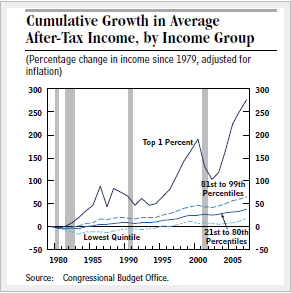
CaptureThis means that income inequality is increasing.  The question is what to do about it.  My own attitude is to try to provide more economic opportunity for low income people.  How do we do this in the most effective way?

  • First and foremost by stimulating the private economy to grow faster and therefore to create more and higher paying jobs.  This can be done with broad based tax reform (lowering tax rates offset by closing loopholes), fiscal stability achieved by eliminating deficit spending, expanded foreign trade for a more efficient global economy, and finally, immigration reform to give legal status to undocumented workers and allow more high skilled foreigners to immigrate to the U.S.  Such measures as these require action by Congress and the President.
  • Secondly, by improving human capital, meaning fixing underperforming schools, improving rundown neighborhoods, combatting inner city crime more effectively, providing at least part-time jobs to young people and combatting teenage pregnancy. Problems such as these are best addressed at the state and local level.
  • Finally, providing more motivation for the unemployed and underemployed to find jobs and hold onto them.  A very effective way to do this is with the federal Earned Income Tax Credit.  It supplements the salary of working adults with children.  New York City is conducting an experiment to see if a similar program will also motivate childless adults to try harder to find work and stay employed.

Conclusion:  the best way to address inequality is to give people the best possible opportunity to obtain full time employment.  This means 1) creating more jobs, 2) providing better qualified workers for all jobs and 3) motivating the unemployed more strongly to find jobs and hold on to them.
Government at all levels can help people find jobs, in one way or another, and therefore become more productive citizens.  This will lead to a happier, healthier, and therefore a stronger society.  All of us will benefit from this happening!

Should Government Address Inequality Directly?


Wall Street Journal columnist William Galston suggests in “Where Right and Left Agree on Inequality”, that both sides of the political spectrum agree that economic inequality is increasing in America and that government needs to address this problem.  “Poverty is part of the explanation, as liberals insist.  But so are parenting and family structure, as conservatives believe.”
CaptureIt so happens that we have a broadly supported federal program which simultaneously addresses both poverty and family structure.  It is the Earned Income Tax Credit program.  It provides $3,305 a year to low-income working families with one child and up to $6,143 for families with three or more children.  The U.S. spends $61 billion a year on this program and it has proven to be very successful in encouraging low-income people to find and keep jobs.  In fact, the economist, Gregory Mankiw, recommends the EITC over a higher minimum wage as a better way to increase the earnings of the working poor.
The New York Times’ Eduardo Porter reports in “Seeking Ways to Help the Poor and Childless”, that New York City is conducting an experiment to see if a locally run program similar to the EITC  will have the same positive effect in increasing employment of childless adults.  It is understood that many of the jobs being created in today’s economy are low paying service jobs.  As Mr. Porter says, “for the American market economy to remain viable, being employed must, one way or another, provide for workers’ needs.”
Conclusion:  as important as it is for Congress and the President to adopt measures to increase economic growth (e.g. tax reform, fiscal stability, expanded foreign trade, immigration reform), in order to create more and better paying jobs, government also has a responsibility to provide direct help to the needy who are trying to help themselves.  The EITC program is an excellent way to do this!

How Do We Increase Economic Mobility?


As the Wall Street Journal reported several days ago, “Economic Mobility Is the New Flashpoint”.  “Both parties agree the opportunity gap is widening, but the proposed solutions are starkly different.”  The Democrats want to increase the minimum wage, extend unemployment benefits, and expand access to college.  The Republicans suggest a whole potpourri of approaches such as reforming welfare (including food stamps), extending school choice, cutting taxes, and relaxing regulations on new businesses.
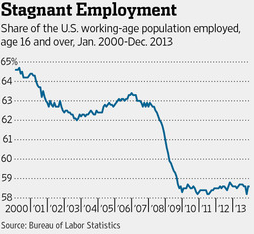
A look at the latest jobs report from the Labor Department should provide the focus which Congress needs to figure out how to increase economic opportunity.  Although the unemployment rate dropped substantially to 6.7% from 7.0% at the beginning of December, only 74,000 new jobs were created in December.  The explanation is that 347,000 left the labor force last month.  The labor force participation rate, the share of the U.S. working-age population employed, age 16 and over, has dropped from 64.5% in 2000, to just under 63% at the beginning of 2008 to near a post-recession low of 58.6% last month (see chart below).
CaptureIn other words, Congress should be totally focused on speeding up economic growth in order to create more jobs.  Since new businesses create the most new jobs, we should indeed relax as many regulations as possible which impede entrepreneurship.  We should lower the corporate tax rate from its very high current value of 35% to get American multinational companies to bring their trillions of overseas profits back home for reinvestment in the U.S.  Moving to a national consumption tax (see the Graetz Plan discussion in my January 7 post), could mean dropping the corporate tax rate to as low as 15%.
Isn’t is obvious that the best thing we can do to give low income people an opportunity to rise up the economic ladder is to just give them a job in the first place?  If they’re ambitious they’ll take any opportunity they can get and run with it!

Why a High Corporate Income Tax Is So Damaging to Our Economy


My previous post, “Fundamental Tax Reform Is the Key to Solving Our Economic and Fiscal Problems II.  The Graetz Plan”, describes a tax reform plan which establishes a 14% national consumption (VAT) tax, exempts families earning under $100,000 from paying any income tax and also reduces the Corporate Income Tax to 15%.  All of this is done in a revenue neutral manner while also preserving all of the progressivity of our current income tax system.
CaptureA recent Op Ed column in the New York Times, by the economist Lawrence Kotlikoff, “Abolish the Corporate Income Tax”, makes the case that such a proposal “might sound like a gift to the rich, but it would actually help workers. … Apple’s tax return says it all:  The company, according to one calculation, paid only 8% of its worldwide profits in United States corporate income taxes, thanks to piling up most of its profits and locating far too many of its operations overseas.”
Our corporate income tax rate, at 35%, is one of the highest in the world and this is what encourages American multinational companies to move their business to other countries.  Whether we abolish the corporate income tax entirely, or just reduce it to 15%, is less important than recognizing the need to overcome popular prejudice about big business and make fundamental changes in our tax structure.
Solving our country’s many problems, from rising inequality at home to projecting adequate strength around the world, requires that the U.S. have a strong economy.  An annual growth rate of 2% of GDP is not nearly good enough to end our current economic stagnation.  To accomplish this will require overcoming the strong headwinds of increasing global competition and the replacement of people with machines.  We will need innovative thinking and initiative to break out of the old ways of doing things which are holding us back.
Are the American people “exceptional” enough to accomplish this challenging task?

Fundamental Tax Reform Is the Key to Solving Our Economic and Fiscal Problems I. Why Change Is Needed

I have been writing this blog for just over a year.  It addresses what I consider to be the two biggest problems faced by our country at the present time.  First is our enormous national debt, now over $17 trillion, and the huge annual budget deficits which are continuing to make it worse.  The second problem, of equal magnitude, is our slow rate of economic growth, about 2% of GDP annually, ever since the Great Recession ended in June 2009.
CaptureThese two problems are closely related.  If the economy grew faster, federal tax revenue would grow faster and the annual deficit would shrink faster.  Not to mention that a faster growing economy would create more jobs and lower the unemployment rate, which is still a high 7%.
The impediments to solving these problems are huge.  Our public debt, on which we pay interest, is now over $12 trillion or 73% of GDP.  Although it may stabilize at this level for a few years, it will soon begin climbing much higher, without major changes in current policy.  This is primarily because of exploding entitlement spending for retirees (Social Security and Medicare) who will increase in number from about 50 million today to over 70 million in just 20 years.  As interest rates return to normal higher levels, just paying interest on the national debt will become, all by itself, a larger and larger drain on the economy.
The impediments to faster economic growth are increasing global competition, such as inexpensive foreign labor, as well as rapid advances in technology, such as electronics and robotics.  Both of these trends reduce the need for unskilled workers in America which in turn holds down wages and slows down economic growth.
At the same time we have an antiquated tax code to raise the huge sums of money necessary to pay for a large and complex national government.  It worked fine through the post-World War II period, as long as the U.S. had the dominant world economy with little significant competition from others.  But this situation no longer exists.  We now have a tax system which doesn’t raise enough money to pay our bills and at the same time is so progressive that the highest rates (39.6% on individuals and 35% for corporations) are not sufficiently competitive with other countries.  This discourages the entrepreneurship and business investment we need to grow the economy faster and create more jobs.
We have an enormous problem on our hands!  Is it possible to fundamentally change our tax system to turn things around?  My next post will answer this question in the affirmative!

Is the American Middle Class in Decline?

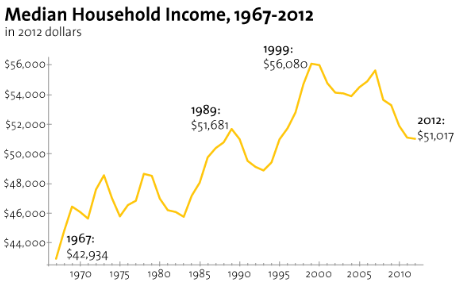
Many political commentators have been complaining recently about the financial difficulties of the American middle class.  For example, a recent report from Bill Moyers and Company, “By the Numbers: The Incredibly Shrinking American Middle Class”, has a chart showing that the median middle class salary, adjusted for inflation, is now no better than it was in 1989 and not much higher than in 1979:
CaptureBut there is another point of view, very well described by the two economists, Donald Boudreaux and Mark Perry, in the Wall Street Journal just about a year ago, “The Myth of a Stagnant Middle Class”.  They make several pertinent points:

  • The Consumer Price Index overestimates inflation by underestimating the value of improvements in product quality and variety.
  • Wage figures ignore the rise over the past few decades in the portion of worker pay taken as (nontaxable) fringe benefits.  Health benefits, pensions, paid leave, etc. now amount to almost 31% of total compensation according to the Bureau of Labor Statistics.
  • The average hourly wage has been held down by the great increase of women and immigrants into the workforce over the past three decades.  Because the economy was (before the Great Recession) so strong, it created millions of jobs for the influx of often lesser skilled workers into the workforce.

Messrs. Boudreaux and Perry point out several other improvements in the quality of life which Americans enjoy:

  • Life expectancy has increased to 79 years for an American born today, five years longer than in 1980.  And the gap in life expectancy between whites and blacks has narrowed.
  • Spending by households on the basics of food, housing, utilities, etc. has shrunk from 53% of income in 1950, to 44% in 1970 to 32% today.
  • Although income inequality is rising when measured in dollars, it is falling when measured in terms of our ability to consume.  For another example, air travel is now as common as was bus travel in an earlier era.  And another: the latest electronic products are available to even middle class teenagers.

Conclusion: We should stop complaining about inequality and thank our lucky stars for the free enterprise system which has been so successful in improving our quality of life.

More on Inequality: What Does the Data Mean?

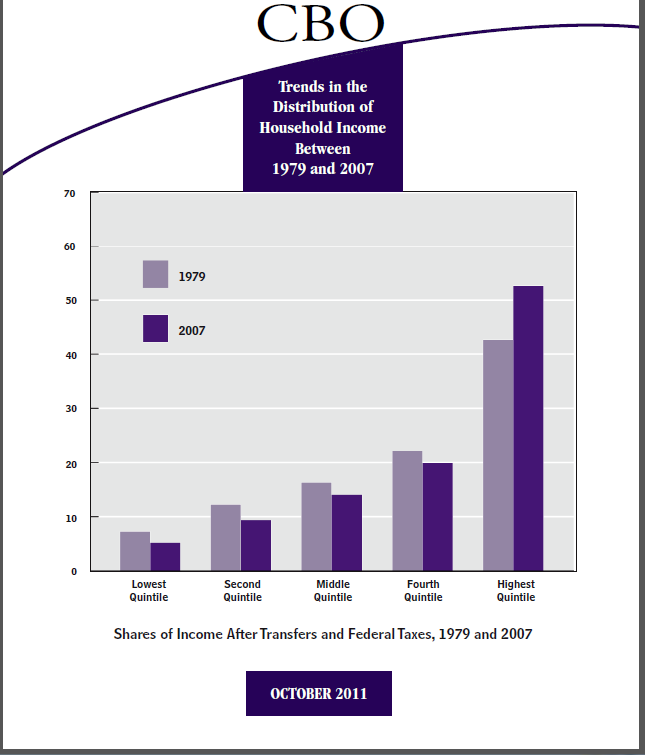
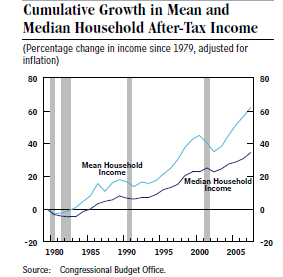
In yesterday’s Wall Street Journal, the economist Robert Grady addresses “Obama’s Misguided Obsession With Inequality”.  The basic problem is that an important Congressional Budget Office report in 2011, “ Trends in the Distribution of Household Income Between 1979 and 2007”, is easy to misrepresent and misinterpret.  Here are three basic pieces of data from the CBO report:
Capture3CaptureCapture1The first chart shows that yes, between 1979 and 2007 the rich did indeed get richer relative to the rest of the population.  The second chart shows, however, that median household income increased by 62% during this same time period.  And the third chart shows that all five income groups made substantial gains at the same time.
As Mr. Grady says, “Here is the bottom line.  In periods of high economic growth, such as the 1980s and 1990s, the vast majority of Americans gain and have the opportunity to gain.  In periods of slow growth, such as the past four and a half years since the recession officially ended, poor people and the middle class are hurt the most, and opportunity is curbed. … The point is this: If the goal is to deliver higher incomes and a better standard of living for the majority of Americans, then generating economic growth – not income inequality or the redistribution of wealth – is the defining challenge of our time.”
So then, what is the best way to address income inequality?  Should we concentrate on raising taxes on the rich and increasing spending on social programs like we have done in the last five years?  Or should we rather concentrate on speeding up economic growth, as Mr. Grady says, in order to create more jobs and more opportunities for advancement?
Compare the enormous growth in the period from 1979 to 2007 with the stagnation of the past five years.  Isn’t it obvious which is the better way to proceed?

Inequality III: Is the Game Rigged?


The economist Joseph Stiglitz has an Op Ed column in today’s New York Times, “In No One We Trust”, blaming the financial crisis on the banking industry.  “In the years leading up to the crisis our traditional bankers changed drastically, aggressively branching out into other activities, including those historically associated with investment banking.  Trust went out the window. … When 1 percent of the population takes home more than 22 percent of the country’s income – and 95 percent of the increase in income in the post-crisis recovery – some pretty basic things are at stake. … Reasonable people can look at this absurd distribution and be pretty certain that the game is rigged. … I suspect that there is only one way to really get trust back.  We need to pass strong regulations, embodying norms of good behavior, and appoint bold regulators to enforce them.”  
CaptureMr. Stiglitz is partially correct.  Although the housing bubble, caused by poor government policy – loose money, subprime mortgages, and lax regulation – was the primary cause of the financial crisis, nevertheless, poorly regulated banking practices made the crisis much worse.  But this is all being fixed with Dodd-Frank, a just recently implemented Volker Rule, and a soon coming wind-down of Fannie Mae and Freddie Mac. 
Mr. Stiglitz concludes, “Without trust, there can be no harmony, nor can there be a strong economy.  Inequality is degrading our trust.  For our own sake, and for the sake of future generations, it is time to start rebuilding it. 
But how do we reduce the inequality in order to restore the trust which is necessary for a strong economy?  Mr. Stiglitz doesn’t say!
What we need is faster economic growth in order to create more new jobs.  The last four years have demonstrated that the Federal Reserve can’t accomplish this with quantitative easing.  It needs to be done by private business and entrepreneurship.  Tax reform and the easing of regulations on new businesses is what we need.  It’s too bad that ideological blinders prevent so many people from understanding this basic truth!    
    

More on Inequality: How Bad Is It and Why?


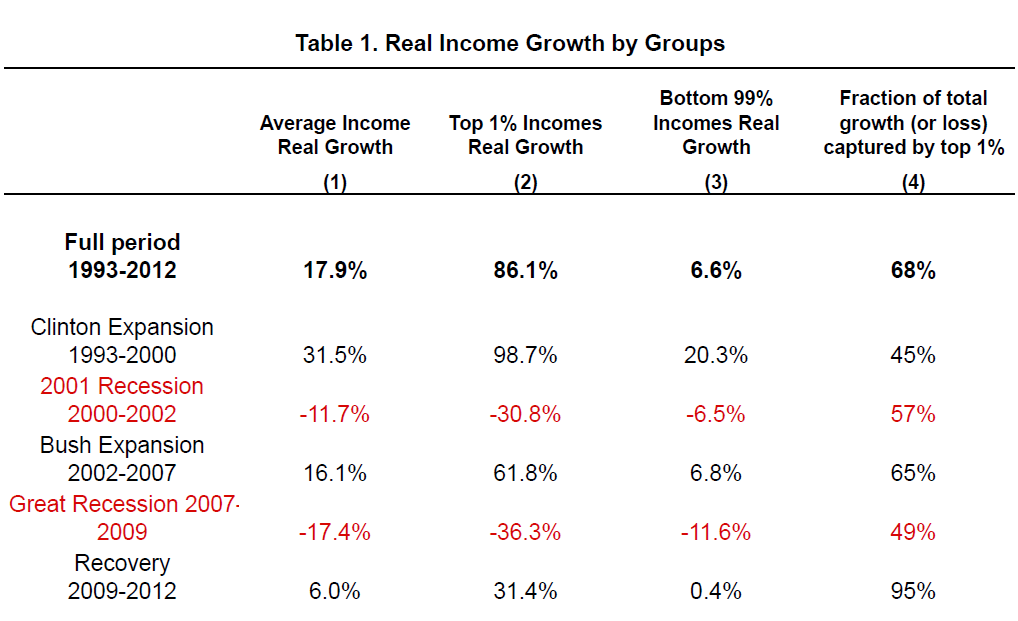
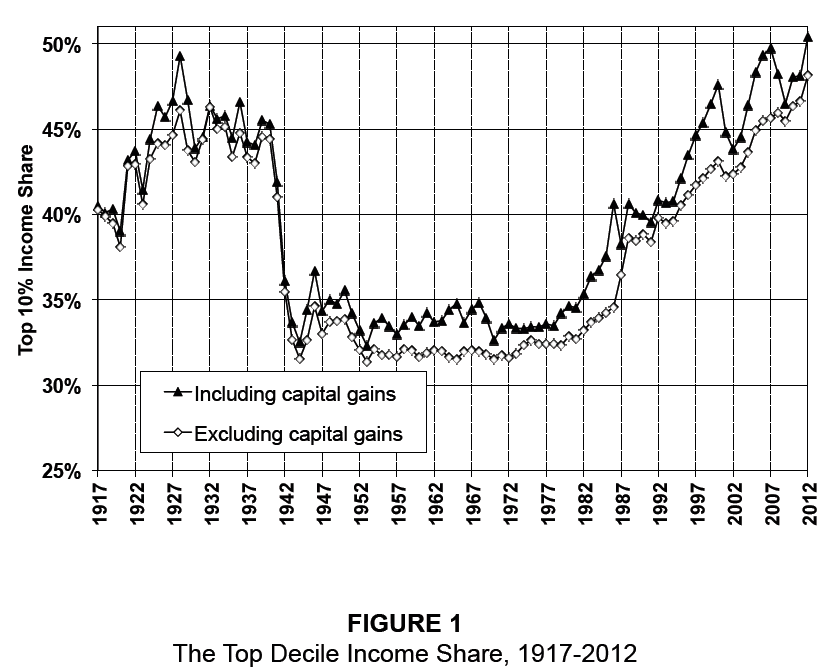
A recent article in Bloomberg View by Cass Sunstein, “How Did the 1 Percent Get Ahead So Fast?“, discusses the significance of new research by the economist Emmanuel Saez, ”Striking it Richer: The Evolution of Top Incomes in the United States”.  Referring to Saez’s table and chart below, the conclusion is that income inequality has been getting steadily worse since the early 1980s and has been especially pronounced since June 2009 when the Great Recession ended.
Capture1Capture2In particular, 95% of all income gain in the last four years has gone to the top 1%.  This is a much greater disparity than during the so-called Clinton Expansion, from 1993 – 2000 (45% to the top 1%) or during the Bush Expansion, from 2002 – 2007 (65% to the top 1%).  According to Mr. Sunstein, “one point is clear: through 2012 the gains from the current recovery were concentrated among the top 1 percent, and that pattern, extreme though it is, fits with a general surge in economic inequality over the last 40 years.”
CaptureBut there is more to the story!  Looking at the final chart, just above, it is clear that the economy grew much faster during the Clinton Expansion than during the Bush Expansion, and, in turn, much more slowly during the Obama Recovery.  In other words, the way to reduce inequality is to speed up economic growth.  There are tried and true ways to speed up growth (e.g. tax reform with lower rates, emphasis on deregulation, boosting entrepreneurship, etc.).  It is unfortunate that too many in Congress, as well as the President have ideological blinders which prevent them from moving in this direction!

How Do We Fight Economic Inequality? By Restoring Growth!

The liberal economist Paul Krugman returns to one of his favorite topics in yesterday’s New York Times, “Why Inequality Matters”.  “On average, Americans remain a lot poorer today than they were before the economic crisis.  For the bottom 90 percent of families, this impoverishment reflects both a shrinking economic pie and a declining share of that pie.”  The problem with Mr. Krugman’s analysis is that he offers no solution beyond more fiscal stimulus: “the premature return to fiscal austerity has done more than anything to hobble the recovery.”
CaptureBut there is another route to recovery and it is propounded in today’s Wall Street Journal by George Osborne, the United Kingdom’s Chancellor of the Exchequer, “How Britain Returned to Growth”. “We cut spending and top tax rates, and now deficits are down and jobs are being created at a healthy clip … at the rate of 60,000 per month, roughly equivalent to 300,000 in the U.S. … The corporate tax rate is being cut to 20% from 28%. … As a result, more international firms are moving their headquarters to Britain and investment is flowing into our country.”
Yes, as Mr. Krugman says, economic inequality in the U.S. is bad and getting worse.  The question is what to do about it.  Shall we try to improve the situation with artificial stimulation, increasing government debt, already very high, for future generations?  Or shall we address this inequality by encouraging businesses to grow and expand and thereby raise wages and hire more people.
The good news is that America is the success story of the 20th century.  The bad news is that everyone else in the world has figured this out and is now copying our own best methods.  Either we can compete, innovate, stay on top and thrive, or else we can get lazy, stagnate and sink down in the pack.
Will it be more inequality or more growth?  The choice is up to us!