Is Single-Payer Health Care a Good Idea?


My last two posts, here and here, have discussed major intrinsic problems with the Affordable Care Act.  It has been set up in an actuarially unsound manner and the cost of insurance coverage through the exchanges is growing very fast.
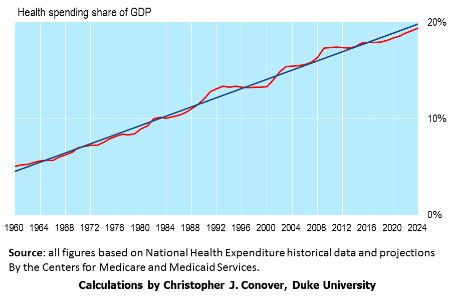
CaptureThe rapidly rising cost of American health care, public and private, is in fact one of our country’s biggest problems.  It is an affordability issue for millions of American households.  Furthermore the rapidly rising cost of the entitlement programs of Medicare and Medicaid is the fundamental driver of our exploding national debt problem.
As I see it there are two different routes we can take to solve this problem.  One way is to move towards a true free-market approach where healthcare consumers (all of us!) have more “skin in the game” in the sense that we move away from third party payment for routine care.  It is quite interesting that this is already starting to happen under Obamacare!
The other way of getting costs under control is to adopt a single-payer system, like much of the rest of the developed world.  But this would necessarily involve stringent cost controls and severe rationing and would be a lot more difficult than just enrolling everyone in Medicare. For example:

  • American doctors and nurses are very well paid. The average family physician in the U.S. earns $207,000, double the rate for general practitioners in Great Britain, which has a single-payer system. Are we going to arbitrarily chop doctor salaries in half in order to control costs?
  • The State of Vermont recently backed away from implementing its own single-payer system because the needed tax increases would have more than doubled Vermont’s annual budget. Colorado will vote in November on a petition-supported single-payer proposal, ColoradoCare, which would be paid for by a $26 billion annual state tax increase, and is therefore unlikely to pass. For a state to implement its own single-payer system at least requires budget honesty, since all states are required to balance their budgets. There is no such requirement for our federal government and so a single-payer system would be financed just like Medicare, with deficit spending. Bad idea!

Conclusion. American healthcare needs radical reform but adopting a single-payer system is not the best way to do it.

Follow me on Twitter
Follow me on Facebook


The Inherent Instability of Obamacare


The recent announcement by Aetna Insurance Company that it will exit the health insurance market in most of the states where it now operates raises a fundamental question about the stability of the Affordable Care Act. As shown by the following map  from yesterday’s New York Times, it appears that at least five states with 17% of the American population will have only one health insurer to choose from next year.
Capture33As the Wall Street Journal’s Greg Ip points out in a recent article, “the problem isn’t technical or temporary, it is intrinsic to how the law was written”  Specifically:

  • Insurance is supposed to price risk but the ACA changed this. Insurers can no longer charge or exclude coverage for pre-existing conditions, charge men and women different rates, or charge older customers more than three times as much as the young.
  • For example, a 64-year-old consumes six times as much health care as the average 21-year-old. Adhering to the 3-to-1 maximum ratio, the insurer would have to greatly overcharge the 21-year-old than his actual cost and/or greatly undercharge the 64-year-old.
  • The rational response for unsound pricing is for young and healthy customers to stay away and sick, older customers to flock to the exchanges. ACA mechanisms to prevent this type of behavior aren’t working very well.Capture32
  • One example of this is that the ACA exchanges, which provide income-based subsidies for those without employer provided health insurance, are mainly attracting those people just slightly above the poverty line who get the biggest subsidies (see chart).

I have pointed out many times that the cost of health care, especially for the entitlement programs of Medicare and Medicaid, is the fundamental driver of our exploding national debt and therefore must be curtailed.  But now, in addition to the cost problem, we are discovering that the ACA also has a fundamental access problem as well. Big changes are clearly needed in the ACA.  More details later!

Follow me on Twitter
Follow me on Facebook

Paul Krugman’s Great Crime: Stealing from Our Nation’s Future


New York Times columnist Paul Krugman is perhaps the most ardent Keynesian economist in the U.S. today. Let’s agree that Mr. Krugman is a very intelligent and articulate fellow.  He is a Nobel Prize winner and undoubtedly has made important contributions to economics. But he has the absolutely nutty idea that extreme deficit spending not only doesn’t hurt our economy but can actually be beneficial.  His column, “Time To Borrow”  in yesterday’s NYT is a perfect example of this dangerous idea.
Capture31Here is the essence of his thinking:

  • Our national debt of $19 trillion is just a big scary number. Actually just our public debt alone of $13 trillion (on which we pay interest) is 75% of GDP, the highest since the end of WWII, and is projected (by the CBO) to steadily become much worse.  
  • Federal interest payments are only 1.3% of GDP, low by historical standards. Just lock in repayment with 30-year inflation protected bonds, yielding .64% interest. Okay, suppose we can lock in very low interest payments on our current debt and therefore just borrow away oblivious to total debt for the next 30 years. In 2046 I expect to be gone but my children and grandchildren will still be around. Why should they be stuck with paying off or refinancing our own extravagant debt at likely much higher interest rates?
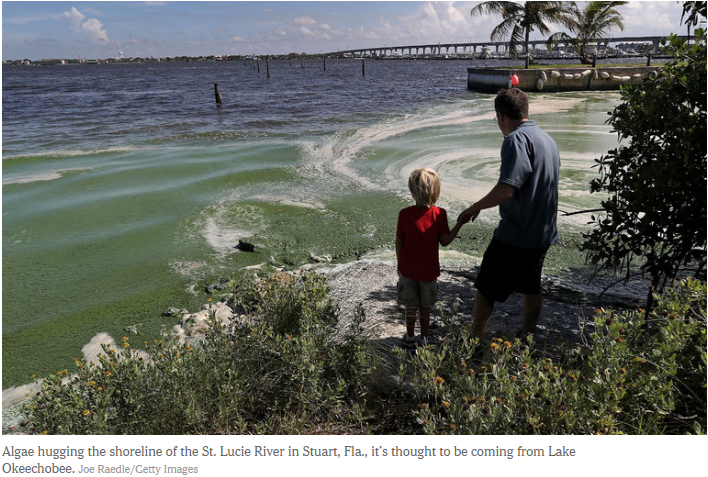
  • There are pressing infrastructure problems all over the country which need fixing now. For example, in Florida, green slime infests beaches because of failure to upgrade an 80 year old dike. The answer is to let Florida voters decide if they want to issue bonds for this project and pay them off with state tax revenue. Nebraska, for example, has decided to raise its state gas tax by 6 cents/gallon in order to pay for infrastructure upgrades.


Conclusion. The U.S. is currently in a huge fiscal bind with massive debt and continuing large annual deficits. It is extremely reckless to continue even current deficit spending, let alone increasing it, for anything less than a true national emergency.  Infrastructure repair, for example, is an important but routine need which should be paid for out of current tax revenue.

Follow me on Twitter
Follow me on Facebook
The Republican Party beyond Donald Trump


My last several posts have discussed the strengths and weaknesses of the U.S. economy and where the presidential candidates stand on the main issues.  As Donald Trump now slides further and further behind in the polls due to his juvenile tit-for-tat personality, his personal views matter less and less.
Capture31What does matter now is how the Republican Party will use the Trump disruption to broaden its appeal in the future. Here is a restatement of several of my ideas, influenced by two recent articles in the New York Times, here and here:

  • Reject tax cuts for the wealthy. But rather support tax rate cuts across the board, paid for by shrinking deductions which primarily benefit the wealthy. Such tax reform will give a sorely needed big boost to the economy.
  • Help workers displaced by foreign trade with expanded retraining programs and wage insurance. Increased globalization will also boost economic growth but it will stall without greater public support.
  • Acknowledge that universal health care is here to stay but push for market-oriented changes such as eliminating the mandates required by the ACA.
  • Disavow mass deportations but set up a firm border security program along with an adequate guest worker program to provide businesses the workers whom they are unable to hire locally. Again, legitimate immigration reform will boost the economy.
  • Admit that Invading Iraq was a mistake but nevertheless insist on a muscular foreign policy. U.S. economic and military strength provide peace and stability for the whole world including us.
  • Loosen up on social policy. Insist on restrictions on abortion (e.g. a 20 week cutoff) rather than abolition and work requirements for social welfare recipients rather than cutbacks in aid. In general turn over more social policy regulation to the individual states.

Conclusion. The U.S. badly needs more fiscally conservative national leaders. But conservatives will not prevail in the political process without using more common sense.

Follow me on Twitter
Follow me on Facebook

Amazing! Some Progressives May Actually Understand Economics


I have to constantly remind my readers that I am a non-ideological fiscal conservative. I simply want our national leaders to address our two most serious fiscal and economic problems which are:

  • Massive Debt. Our (public, on which we pay interest) debt is now 75% of GDP, the largest since WWII and steadily getting worse. When interest rates go up, as they surely will before long, interest payments on the debt will increase by hundreds of billions of dollars per year and become a huge drain on the federal budget, eventually leading to a new financial crisis, much worse than the last one.
  • Slow Economic Growth. The economy has grown at the average rate of only 2.1% since the end of the Great Recession in June 2009. Such slow growth means fewer new jobs for the unemployed and underemployed and smaller raises for all workers.

My last several posts, here and here have pointed out that neither of our two main presidential candidates is adequately addressing these issues.  Both of them claim that they want faster growth but their policy proposals will just make our humongous debt even worse.
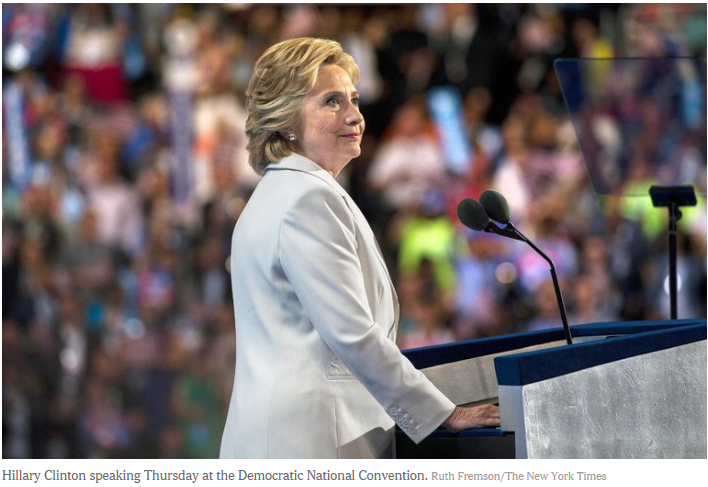
Capture31So I was quite surprised by a column in yesterday’s New York Times by Thomas Friedman, “How Clinton could knock Trump out,” trying to “push Clinton to inject some capitalism into her economic plan.”  Says Mr. Friedman:

  • Clinton could be reaching out to center-right (and anti-Trump) Republicans with a real pro-growth, start-up, deregulation, entrepreneurship agenda.
  • If Clinton wins, she will need to get stuff done, not just give stuff away.
  • The concerns of the Sanders supporters with fairness and inequality can only be addressed with economic growth; the rising anti-immigration sentiments can be defused only with economic growth; the general anxiety feeding Trumpism can be eased only with economic growth.

Conclusion. I am pleased to hear such sensible thoughts from one of the leading columnists of the NYT. If Clinton wins the election (as I expect) and if the Republicans continue to hold the House of Representatives (as I fervently hope), there could be much common ground for constructing an intelligent agenda going forward.

Follow me on Twitter 
Follow me on Facebook
What Is Right and Wrong With the U.S. Economy


My last several posts have discussed the poor economic proposals of both major presidential candidates. Today’s New York Times has an excellent article by Neil Irwin, “Here’s What’s Going Right and Wrong in the U.S. Economy.”  According to Mr. Irwin and the NYT:

  • GDP Growth Disappointing. GDP growth was only 1.2% in the second quarter of 2016 and in fact has now averaged only 1.2% for the past year, much lower than the 2.1% average growth since the end of the Great Recession in June 2009.Capture30
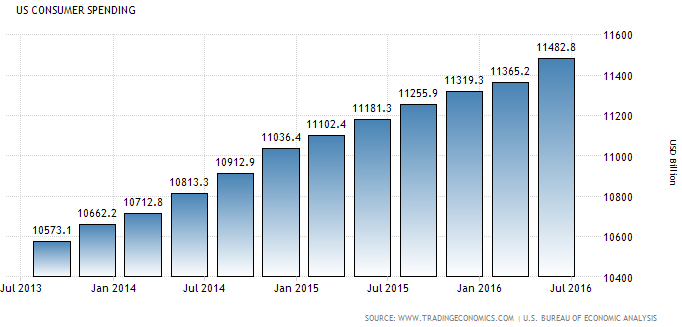
  • Consumers Spending Money. Consumer spending was up 4.2% in the second quarter continuing a long term trend. This means that there is plenty of demand for new products in the economy.Capture26
  • Wages Rising More Quickly. Total compensation is not only rising but the wage and salary component, not counting benefits, is up 2.5% over one year ago. This means that consumers have more money to spend.Capture27
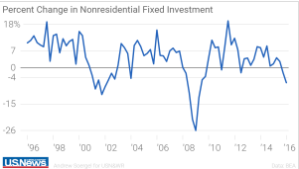
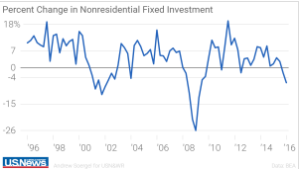
  • Investment Shrinking. Investment in new business structures, equipment and intellectual property has now fallen for the third consecutive quarter.  Eventually, if not turned around, this decrease in new investment will lead to fewer jobs and less consumer spending.Capture28
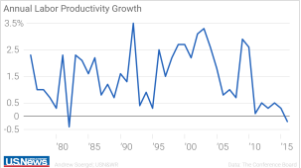
  • Poor Productivity Growth. Labor productivity fell .6% in the first quarter of 2016, a continuing slide. Weak productivity growth is a grave threat to long term prosperity in the U.S.Capture29

Conclusion. Wages are going up and consumers have money to spend. But worker productivity can only increase when business makes new investment.  This is not happening nearly fast enough. The House Republicans have an excellent plan to encourage business investment.
Is either presidential candidate paying attention to this opportunity to speed up economic growth?
I, for one, am waiting to find out!

Follow me on Twitter
Follow me on Facebook


Donald Trump’s Best Chance to Win in November


As I occasionally remind my readers, I am a non-ideological fiscal conservative and a registered independent. In November I will vote for the presidential candidate who has the most credible plan to address what I consider to be our country’s two more serious problems:

  • Slow Economic Growth, only 2.1% per year for the past seven years since the end of the Great Recession in June 2009. Faster growth will create more jobs and bigger wage gains for America’s workers.
  • Massive Debt. Our public debt (on which we pay interest) is now 75% of GDP, the highest it has been since the end of WWII, and likely to keep getting worse unless strong measures are taken to prevent this from happening.

According to current polls, Hillary Clinton is strongly predicted to be elected our next president. However her policy proposals will do little, if anything, to stimulate economic growth and are likely to make our debt much worse than it already is.
Capture8Donald Trump has a strong base of support among working class whites who are suffering in today’s economy and blame illegal immigration and unfair foreign trade for their woes.  However this base of support, while large enough for Mr. Trump to win the Republican nomination, is not nearly large enough to bring victory in November. The only way Mr. Trump can win is to greatly expand his base of support by appealing to moderate Republicans and Independents who are highly concerned about the direction our country is taking.
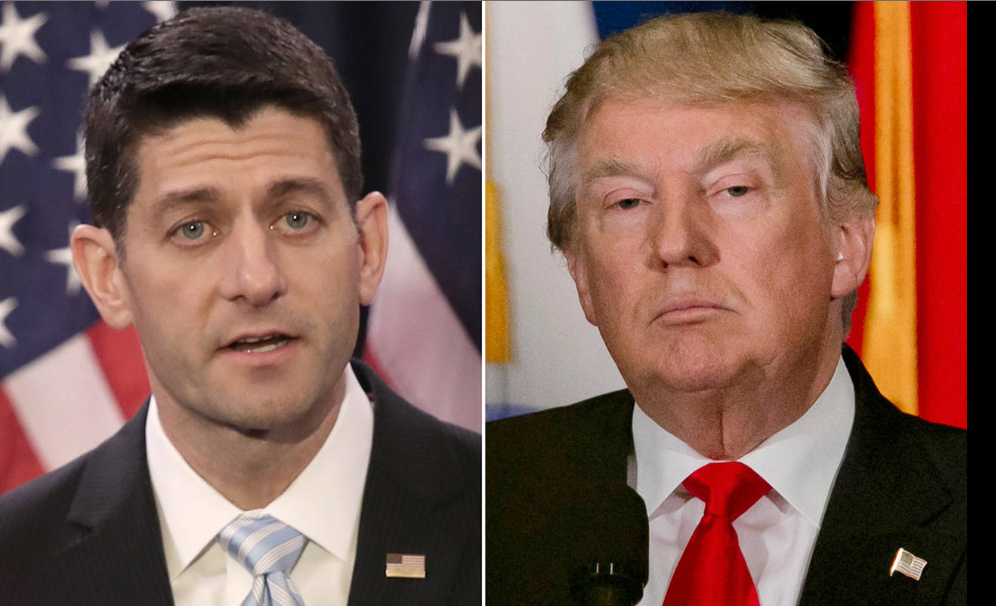
Capture9The best and most direct way for him to do this is to endorse the reform program, “A Better Way,” developed by the Republican House of Representatives, under Speaker Paul Ryan. This reform program has already unified the fractious Republicans in the House, and could easily serve as a vehicle for unifying the entire Republican party as well as many independents.
In my next post I will delineate how the Trump platform could easily mesh with “A Better Way.”

Follow me on Twitter 
Follow me on Facebook
What Should Brexit Mean for the U.S.?


My two main sources of information for this blog are the New York Times and the Wall Street Journal. In particular I am always eager to read Eduardo Porter’s weekly column, Economic Scene, in the NYT.  He frames the issues very well, even though I often disagree with him on the details.
Capture17Yesterday’s column, “In Brexit and Trump, a Populist Farewell to Laissez-Faire Capitalism,” points out the similarities in the white working class support for both Brexit and for Donald Trump.  It then goes on to advocate for what the economist Larry Summers refers to vaguely as “responsible nationalism.”
I couldn’t agree more with Mr. Porter and Mr. Summers that we need policies to boost the fortunes of blue collar workers, and here are some good ways to do it:

  • Tax reform to put more disposable income in the pockets of middle- and lower-income workers, to support job creators, and to provide a big incentive for American multinational companies to bring their earnings back home for reinvestment.
  • Immigration Reform. The key here is a rigorous Guest Worker Visa program to provide immigrant employees for businesses who are unable to hire enough qualified domestic workers. At the same time, a strict eVerify enforcement system would also be established to catch illegal immigrants and deport them.
  • Free and Fair Trade. Free trade among nations has lifted hundreds of millions of people out of poverty worldwide, as well as benefitting all Americans with lower prices. What we have failed to do is to adequately help displaced workers retrain for the millions of high skilled jobs available in the U.S. which go unfilled for lack of qualified applicants.

Conclusion. Our country faces severe problems. If we don’t get deficit spending under greater control, we risk a new and more severe financial crisis.  If we can’t create more and better paying jobs for the modestly educated, we will be faced with Trump-like demagogic candidates for president every four years. It will be a huge challenge for us to extricate ourselves from this mess in a peaceful manner.

Follow me on Twitter
Follow me on Facebook

Can the U.S. Economy Do Better VI. Does the President Matter?


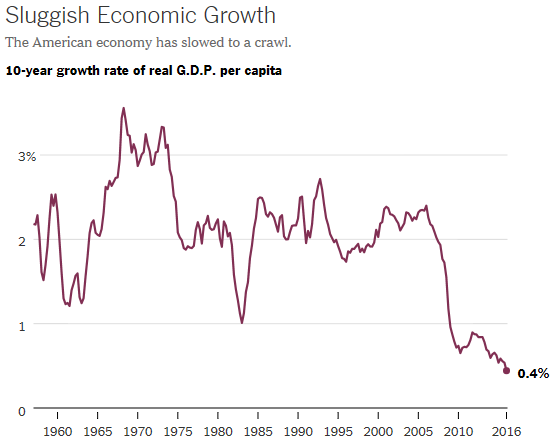
My last five posts have discussed several different aspects of the question, “Can the U.S. Economy Do Better?”  Our economy has been doing especially poorly since the end of the Great Recession seven years ago (see the chart below).  Many people claim that the President doesn’t really have all that much control over the economy.
Capture6 Here is what the2016 presidential candidates are saying on economic policy so far:

  • Hillary Clinton. She wants national paid family leave, a national minimum wage increase and more government spending on infrastructure projects. She would raise taxes by about $100 billion per year to pay for these initiatives. She is opposed to the Trans Pacific Partnership to expand trade with 11 other Pacific Rim countries.
  • Donald Trump. His top priorities are trade and immigration policy. Would he be able to successfully address China’s currency manipulation without starting a trade war? How would he be able to round up and deport millions of illegal immigrants without destroying millions of jobs and thereby crippling many businesses? His plan to slash tax rates would boost the economy but also add trillions of dollars to the debt.

As I have discussed over and over again on this blog, see, for example, here and here,  there are several fundamental policy changes needed to make our economy grow faster and create more and better paying jobs.  We need to:

  • Make it easier to start a small business by simplifying regulations at all levels.
  • Lower tax rates and simplify the tax code, paid for by shrinking deductions and closing loopholes.
  • Respond to globalization and new technology by helping its victims rather than blocking progress.

Our two presidential candidates are appealing to the fears of the voters rather than to their hopes and aspirations. Neither of them is espousing policies which will help the economy really grow in a healthy way.

Follow me on Twitter
Follow me on Facebook
A Guaranteed Income for All: Good Idea or Bad Idea?


The social scientist and American Enterprise Institute scholar, Charles Murray, has an interesting article in yesterday’s Wall Street Journal, “A Guaranteed Income for Every American,” Mr. Murray proposes a Universal Basic Income (UBI) with the following features:
Capture6

  • Every American citizen age 21 and older would get a $13,000 annual grant deposited electronically into a bank account in monthly installments. $3000 would be applied towards health insurance.
  • UBI is financed by eliminating all other welfare programs: Social Security, Medicare, Medicaid, food stamps, housing subsidies, aid for dependent children, etc. as well as agricultural subsidies and corporate welfare.
  • People can make up to $30,000 a year without losing any part of the grant. Above $30,000 in earned income, the grant decreases to $6500 when the income reaches $60,000. The $6500 retained by all compensates for losing Social Security and Medicare.
  • The overall cost of UBI will be $200 billion per year less than the current system. By 2020 UBI would be nearly $1 trillion per year cheaper.

On the other hand, there are at least two possible drawbacks to the Murray plan, as discussed recently by Eduardo Porter in the New York Times:

  • It would probably discourage work. Right now 80% of Americans in their prime working years, 25 – 54, are employed. Work is not just what people do for a living, it organizes people’s lives. Making work more optional would impair this basic social structure.
  • A UBI divorces assistance from need. For example, a housing voucher could lead a family to move to a better neighborhood. A basic monthly income would probably not.
  • More generally, a single parent with several children would be strapped to get by for $10,000 per year without any additional welfare assistance. We can’t let the kids starve.

Conclusion: UBI appears to be an attractive way to simplify our vast welfare system and would save a significant amount of money (always important). But the poor would not be well served.  There are better ways to reform our public assistance programs.

Follow me on Twitter
Follow me on Facebook