
Nebraska Will Benefit From Immigration Reform


Several months ago the Omaha World Herald reported that Nebraska has approximately 45,000 illegal immigrants, or about 2.5% of the state’s population.  Nebraska’s unemployment rate has now dropped to 3.4%, the third lowest in the nation behind only North Dakota and South Dakota.  Such a low unemployment rate represents a labor shortage.  There simply aren’t enough Nebraskans to perform all of the physically demanding, low skill work needed in the agriculture, meatpacking and construction industries.  It is this labor shortage which is attracting such a large number of illegal immigrants to Nebraska.
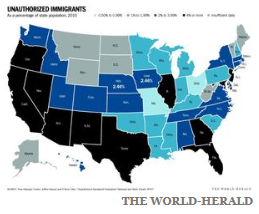
CaptureAccording to the New York Times, the Tea Party has recently changed its focus from “curtailing the reach of the federal government, cutting the deficit and countering the Wall Street wing of the Republican Party to becoming largely an anti-immigration overhaul movement.”  This is a very unfortunate development.
Why would it be so difficult to solve our illegal immigration problem in the following manner:

  • Give all businesses a limited period of time, perhaps six months, to present a list of current employees who are illegal. Everyone on this list without a criminal record would receive a guest worker visa.
  • Going forward, businesses would be authorized to hire additional foreign workers as needed with guest worker visas issued in their home country. This would eliminate the need for illegal entry into the U.S.
  • As of a certain date in the near future, all businesses would be required to periodically demonstrate the legal status of all workers on their payroll.
  • Guest workers would be eligible to apply for citizenship after a lengthy period of time, perhaps ten years.

Once an adequate guest worker visa program has been set up and is operating efficiently, security on our southern border with Mexico would hardly be more of a problem than is security on our northern border with Canada. Illegal immigration should be considered as an economic problem, not a law-enforcement problem.
If it were handled correctly in this way, the problem would disappear in short order!

Three Cheers for Blue Cross Blue Shield Nebraska!


As I reported in my last post healthcare costs in the U.S. are expected to start climbing rapidly in next few years as the economy continues to recover and insurance coverage expands.
The Manhattan Institute’s Avik Roy has proposed a comprehensive new plan, ”Transforming Obamacare” to achieve, at the same time, both near-universal coverage and stringent cost control for healthcare.  Mr. Roy emphasizes the need to regulate hospital system consolidation which is especially responsible for driving up the cost of healthcare.
CaptureIn Omaha NE, where I live, there are three hospital systems: Catholic Health Initiatives, the Nebraska Medical Center and the Methodist Hospital System.  According to the insurance company, Blue Cross Blue Shield Nebraska (OWH 9/6/14), “CHI prices are 10 to 30 percent higher than for the Nebraska Medical Center and Methodist Hospital System.”  BCBS insists that CHI cut its prices.  As of September 1, CHI hospitals are out of network for BCBS and so patients who are insured by BCBS have to pay higher hospital rates.
“We are ready and willing to meet with them when they propose an agreement that gets serious about the cost issue,” said Lee Handke, a senior vice-president for Blue Cross Blue Shield.
Reports the OWH  “Blue Cross’ biggest customers are the region’s employers, whose 560,000 workers and family members supply 80% of Blue Cross’ revenue each year.  A big share of these people are CHI customers, too. … Blue Cross has told us (an insurance benefits broker) they understand that they might lose some business over this deal, but they feel that the point they have to make on the cost disparity is more important.”
For one hospital system to charge 30% more than two others for the same services is totally unacceptable.  It means that customers for the other two systems are paying higher insurance costs in order to subsidize the system with the higher prices.
In the Omaha market, Blue Cross has the clout and the will to force CHI to lower its prices.  But many other communities may not be as fortunate.

Immigration Reform Will Benefit Nebraska


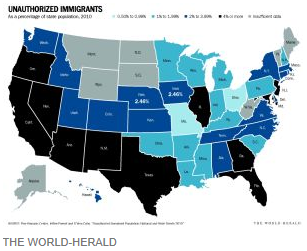
Today’s Omaha World Herald has an excellent article, “A Window on Immigration.”  It points out that 2.46% of Nebraska residents as of the 2010 census were illegal immigrants.  This works out to about 45,000 illegal immigrants in Nebraska today compared to just 3,000 as recently as 1980.  This is really a shocking figure.  It is roughly the same as the population of Nebraska’s fourth largest city (Grand Island) or Nebraska’s fifth largest county (Buffalo).  Nebraska’s unemployment rate of 3.9% is really a labor shortage.  It needs these 45,000 illegal immigrant workers!
CaptureWhy is it so difficult for our national leaders to solve this problem?  It’s crazy to think that we are going to round up 11 million illegals throughout the country and dump them into Mexico unless they are willing to “self-deport.”  Amnesty and citizenship are bogus side issues.  Here is the outline of a simple plan which would solve the problem:

  • Give all businesses a limited time period, perhaps six months or a year, to present a list of their current employees who are illegal. Everyone on this list without a criminal record would receive a guest worker visa along with all necessary legal papers. These papers would belong to the individual worker who could use them to change employment from one business to another.
  • Going forward, businesses would be authorized to hire additional foreign workers as needed who would automatically qualify for guest worker visas. Such visas would be granted in the country of origin thereby avoiding the need for illegal entry into the U.S.
  • As of a certain date in the near future, all businesses would be required to periodically demonstrate the legal status of all workers on their payroll. Penalties for non-compliance would be severe.
  • Guest workers would be eligible to apply for citizenship after a relatively lengthy period of time, perhaps five years or ten years.

Once an adequate guest worker visa program has been set up and is operating efficiently, allowing all businesses to hire as many foreign workers as they need, security on our southern border with Mexico would be no more of a problem than is security on our northern border with Canada.
In other words, illegal immigration is an economic problem, not a law enforcement problem.  The way to solve this problem is to address it correctly!

Many Skilled Jobs Are Going Begging in the U.S.

A few days ago the Omaha World Herald ran a story, ”Manufacturers Want More Young People to Consider a Job on the Factory Floor”, pointing out that there are almost 100,000 manufacturing jobs in Nebraska paying an average salary of $55,000 per year, many of which are unfilled because of a lack of qualified applicants.  Says Dwayne Probyn, Executive Director of the Nebraska Advanced Manufacturing Coalition, “Science, technology, engineering and math, that’s what we need.”
This is in fact a nationwide problem.  A few weeks ago the New York Times had an article, “Stubborn Skills Gap In America’s Work Force” reporting on a recent study by the Organization for Economic Cooperation and Development assessing literacy, math skills and problem solving using information technology, for people aged 16 – 65, in the 22 advanced nations of the O.E.C.D..  Eduardo Porter reports that while the U.S. is about average in literacy skills, it lags way behind in both math and problem solving skills.
One question addressed by Mr. Porter is the much larger wage premium for highly skilled U.S. workers over unskilled workers, than in most other O.E.C.D. countries.  Another question is “how can the U.S. remain such an innovative, comparatively agile economy if the supply of skilled workers is so poor?”  The suggested answer is troubling.  “The American economy rewards skill very well but the supply hasn’t responded.”
This situation is first of all an indictment of K-12 education in the U.S. which has a high school graduation rate of only 80% and also focuses too much on college preparation rather than career education.  These two problems are likely interrelated and at least partially explain the skills gap.
Another factor is immigration.  Right now the U.S. is still attracting more talented foreigners than other countries.  But it is risky to our economy to depend on foreign talent which can stay home as well as choosing to go elsewhere.  Immigration reform will help with this problem but improved K-12 education will help even more.

The Best Way to Help Working People


The lead story in today’s Omaha World Herald, “Demand for skilled labor rising”, along with an accompanying editorial, point out that “Ours is a place where opportunity exists, to the tune of 35,000 advertised job openings counted by the Nebraska Department of Labor.”
Terry Moore, President of the Omaha Federation of Labor, predicts that demand for construction workers will only increase in the near future.
Gary Kelly, Business Manager for Local 22 of the International Brotherhood of Electrical Workers, said “It’s times of full employment that allow us to go out and organize the unorganized.”
Kirk Ahrends, Dean of Applied Technology at Metropolitan Community College, said that instructors who teach 16 different trade professions get many requests for job candidates.  “They’re knocking on the door.  Not only the students, but the industries.  They’re saying ‘Get us some graduates.’”
Nebraska is fortunate to have such a good job market, much better than the U.S. as a whole which is suffering from an unemployment rate of 7.4% and an anemic growth rate of just 2% a year.
By far the best thing the government can do to help workers is to adopt policies which will speed up economic growth.  This can be accomplished by giving entrepreneurs and investors greater incentives to take more risks.  Lowering tax rates (offset by closing loopholes) and easing burdensome regulations are the tried and true methods of getting this done.
There are twenty million unemployed and underemployed Americans who would benefit from national leaders more attuned to their need for work.

How Can We Boost Stagnant Wages?


Today’s Wall Street Journal has a column by Neil Shah, “Stagnant Wages Crimping Economic Growth”, pointing out that the average hourly pay for non-supervisory workers, adjusted for inflation, has declined to $8.77 last month from $8.86 in June 2009, when the recession ended.  It has also been reported recently, e.g. in the New York Times, that U.S. medium household income, now at $52,100, has not nearly recovered from its prerecession peak of $55,500 and is even below its $54,500 level in June 2009, at the end of the recession.
Lower income for workers and households mean lower consumer spending.  This is a major reason for our economy’s low annual growth rate of only 2% of GDP since the end of the recession.  Of course, the high unemployment rate, currently 7.4%, as well as increasing global competition, contribute to downward pressure on wages.  But there is another factor, directly under government control, which is a major contributor to stagnant and declining wages.
Washington Post columnist, Robert Samuelson, in a recent column reprinted in the Omaha World Herald, reported that, from 1999 to 2013, wages and salaries rose 50% (adjusted for inflation) while health insurance premiums increased 182%.
Most health insurance is provided and largely paid for by employers and is therefore an indirect form of compensation.  The huge disparity between wage gains and health insurance premium increases in recent years means that wages are being held back by the rapidly increasing cost of health care.  The U.S. spends 18% of GDP on healthcare, twice as much as any other country and this is clearly out of line.
The best single thing we can do to slow down healthcare inflation is to remove the tax exemption for employer provided healthcare (and offset it with lower overall tax rates).  Employees would then pay taxes on their health insurance benefits as part of their pay. This would have the beneficial effect of making consumers far more conscious of the true cost of healthcare and therefore consumers a strong incentive to hold down these costs.
It is up to Congress to change this provision of the tax code.  Let’s insist that they get this done!

Is a ‘Do Nothing’ Congress Really a Serious Problem?

Today’s Omaha World Herald reprints the article “Get-nothing-done Congress is disrespectful to democracy” by the Baltimore Sun writer, Andrew Yarrow.  Mr. Yarrow says that “the 112th Congress, which ended in 2012, passed fewer bills than any Congress in recent memory, and the current 113th Congress is on track to do just as badly.  …  What Congress does do often seems patently ridiculous.  …  We need to … ramp up public pressure to get something done, rather than just fight.”
But is the problem just to do something, anything, or is it rather to do something worthwhile?  And what if there is a fundamental disagreement, as there is today, about what is worthwhile?  One party thinks that the way to boost the economy and speed up the recovery is to increase artificial stimulus (government spending) and to pay for it by raising taxes on the rich.  The other party is appalled by the $6 trillion in deficit spending racked up so far by the current administration and wants to slam on the brakes.  Each side is working as hard as it can to prevail, especially by discrediting and embarrassing the other side.  How do you resolve a dispute like this?
There is really only one person who has the clout and visibility to get this done and that is the President.  But when the President is the divider-in-chief, spending much of his time and effort proposing unsound economic and fiscal policies, intended primarily for short term political gain, what is the other party supposed to do?  Acquiesce by passing new laws that will just make things worse?  Or by standing firm on principle and hoping that the general public will be able to understand and appreciate its opposition to bad policies?
This is the situation which we are currently in.  It makes for a difficult and unpleasant time.  The economy is slowly recovering from the Great Recession on its own.  Let’s hope that this trend continues and that we can muddle through our present political predicament.