Global Warming Is For Real II. How Do We Move Forward?


The Intergovernmental Panel on Climate Change has just issued a new report, reported in yesterday’s New York Times, “Climate Efforts Falling Short, U.N. Panel Says”. The IPCC is saying that an intensive effort is needed in the next 15 years to prevent the global average temperature from rising more than 3.6 degrees Fahrenheit (2 degrees Celsius) above the preindustrial level. Since the U.S. and China are the biggest emitters of carbon, it is critical for the U.S. to show leadership on this issue.
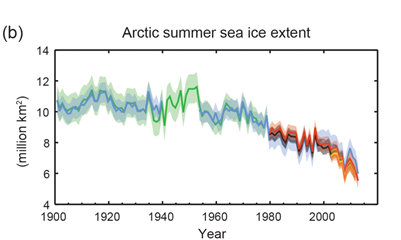
CaptureOne dramatic piece of evidence that global warming is real is the rapidly shrinking size of the artic polar ice cap measured at the end of each summer. In a previous post last December 8, I took note that at least 29 U.S. companies “are incorporating a price on carbon into their long range plans.” I also noted a report from the Congressional Budget Office which estimates that a tax on energy companies of $20 to emit a ton of CO2 would raise $120 billion a year and raise the cost of gasoline by 10 to 15 cents per gallon.
The scene is clearly set. There is a serious threat to life on earth. We have a good estimate of what it will take to meet the threat and a specific time window for responding. We also know the approximate cost of a sensible plan for doing so. Can our democratic political system be moved to action?
A large energy tax like this will take a bite out of the economy. An attractive way of building support would be to make it part of broad based tax reform designed to stimulate the economy with lower individual and corporate rates offset by closing loopholes and eliminating deductions. In fact a carefully assembled package might be able to reduce carbon emissions, stimulate the economy (with lower tax rates) and raise revenue to pay down the deficit, all at the same time!
Is this too much to hope for?
Response to a Persistent Critic


You keep saying that we need lower tax rates to boost the economy but what makes you think this will help? Businesses are sitting on piles of cash. They have plenty of money to invest in expansion. What they need are more customers. The basic problem is not enough demand for more goods. This is what is holding back the economy. It doesn’t much matter what the tax rates are. If the demand and customers are there, businesses will spend their own money or borrow as much money as they need, at low interest rates, to produce all the products they can sell.                                                                                                                Anonymous Critic

I have several responses to this criticism:

  • First of all I want to make it clear that all cuts in tax rates must be offset by shrinking or eliminating tax preferences.   So there will be no loss of tax revenue. Two thirds of all taxpayers take the standard deduction and will therefore automatically benefit from lower tax rates. This will put tens of billions of new dollars into the hands of middle class wage earners who will spend most of this money because they have tight budgets. This will give the economy a big boost.
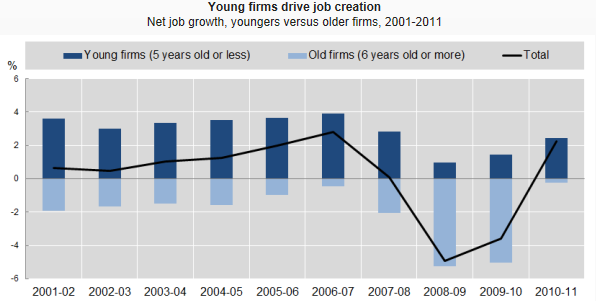
  • As I discussed in my blog post from October 26, 2013 “Where are the Jobs? II. How to Create More of Them,” most net new job creation comes from businesses less than one year old, the true “startups.” New business owners are typically not wealthy, with lots of personal tax deductions. They need all the financial resources they can muster. Lower tax rates will save them money and therefore help them get their new business going.
    Capture
  • In general, tax deductions such as for mortgage interest, municipal bond interest payments, state and local taxes, etc. benefit the wealthiest tax payers.  Therefore the lowering of tax rates, offset by shrinking tax deductions, represents a shift of funds from the wealthier to the less wealthy. This will at least slow down the increase of inequality which afflicts the modern world.

Conclusion: Lower tax rates will put more money in the hands of people who will spend it, thereby boosting the economy by creating more demand, provide support for entrepreneurs starting new businesses (which will create more jobs) and lessen income inequality. All in all this represents major progress!

Do We Need a New School of Economics?


“Consider the following scenario. You are an airline pilot charged with flying a planeload of passengers across the Atlantic. You are offered the choice of two different aircraft. The first aircraft has been prepared by chief engineer Keynes and the second by chief engineer Hayek.
You have to choose which plane to use, so naturally you ask the advice of the two engineers. Keynes urges you to use his aircraft, offering a convincing explanation of why Hayek’s plane will crash on take-off. Hayek urges you to use his aircraft, offering an equally convincing explanation of why Keynes’s plane will crash on landing.

At loss as to which plane to choose, you seek the advice of two leading independent experts – Karl Marx and Adam Smith. Marx assures you that it does not matter which aircraft you choose as both will inevitably suffer catastrophic failure. Similarly, Smith also reassures you that it does not matter which aircraft you choose, as long as you allow your chosen craft to fly itself.”
Thus begins a fascinating new book, “Money, Blood and Revolution: How Darwin and the doctor of King Charles I could turn economics into a true science,” by the fund manager and economist, George Cooper.
CaptureMr. Cooper sets up a circulatory model of democratic capitalism whereby rent, interest payments and profits flow from low income people at the bottom of the pyramid to the wealthy at the top. And then tax revenue (collected mostly from the wealthy) is redistributed downward in the form of government programs.
According to Mr. Cooper, the financial crisis was caused by a combination of lax regulation and excessive credit and monetary stimulus. The question is what to do about it. Mr. Cooper says:

  • Stop adding to the problem. High student debt and high mortgage debt are still being supported by government programs.
  • Change the course of the monetary river. Quantitative easing does not work because it just puts money into the hands of the wealthy and they have no incentive to spend it.
  • Change the course of the fiscal river. Instead put money into the hands of the people at the bottom of the pyramid with expanded government spending on infrastructure (paid for by taxing the wealthy).

Without endorsing all of Mr. Cooper’s suggestions, he nevertheless has many good ones and expresses them in a highly entertaining style!

The Long Run and the Short Run


“I agree with you that something must be done now. The trick is what will work the best in the short term to trigger the agreement between the fiscal conservatives and the modern liberals to cut costs and balance the budget that we both agree on. We can agree to disagree on the solution details but I hope you are successful in achieving the short term goals you are working tirelessly on.
Just as big a question is what will work the best in the long run to prevent it from happening again. I will continue to work on changing the intellectual environment that I see as a precondition to solidifying your short-term gains and preventing a re-occurrence.”
Capture
These are the words of my Omaha libertarian friend, David Demarest, with whom I have an ongoing dialogue.  He wants to cut back and limit the scope of government.  I’m willing to have a more expansive government as long as we’re willing to pay for it.
The secret to solving many of our current problems (stagnant economy, high unemployment, massive debt, increasing inequality) is to grow our economy faster.  The best way to accomplish this is by boosting investment and entrepreneurship with broad-based tax reform, by lowering tax rates for both individuals and corporations, paid for by eliminating deductions and closing loopholes.
But some people think that lowering tax rates means lower taxes on the rich.  To counteract this perception, and at the same time to raise additional tax revenue to lower the deficit, I propose to  levy a new wealth tax of 1% of assets with an exemption of $10 million per person to make sure that the tax only applies to the “truly wealthy.”
I believe that a program along these lines is the best way to get our economy back on track.  But, at the same time we need to figure out how to avoid falling back into another slow growth, high debt trap anytime soon.
A good way to achieve long run protection is with a balanced budget amendment.  It would need to be flexible, allowing for emergencies, and also phased in over several years to allow citizens and legislators time to make the necessary adjustments to spending and taxes.

Why a High Corporate Income Tax Is So Damaging to Our Economy


My previous post, “Fundamental Tax Reform Is the Key to Solving Our Economic and Fiscal Problems II.  The Graetz Plan”, describes a tax reform plan which establishes a 14% national consumption (VAT) tax, exempts families earning under $100,000 from paying any income tax and also reduces the Corporate Income Tax to 15%.  All of this is done in a revenue neutral manner while also preserving all of the progressivity of our current income tax system.
CaptureA recent Op Ed column in the New York Times, by the economist Lawrence Kotlikoff, “Abolish the Corporate Income Tax”, makes the case that such a proposal “might sound like a gift to the rich, but it would actually help workers. … Apple’s tax return says it all:  The company, according to one calculation, paid only 8% of its worldwide profits in United States corporate income taxes, thanks to piling up most of its profits and locating far too many of its operations overseas.”
Our corporate income tax rate, at 35%, is one of the highest in the world and this is what encourages American multinational companies to move their business to other countries.  Whether we abolish the corporate income tax entirely, or just reduce it to 15%, is less important than recognizing the need to overcome popular prejudice about big business and make fundamental changes in our tax structure.
Solving our country’s many problems, from rising inequality at home to projecting adequate strength around the world, requires that the U.S. have a strong economy.  An annual growth rate of 2% of GDP is not nearly good enough to end our current economic stagnation.  To accomplish this will require overcoming the strong headwinds of increasing global competition and the replacement of people with machines.  We will need innovative thinking and initiative to break out of the old ways of doing things which are holding us back.
Are the American people “exceptional” enough to accomplish this challenging task?

Fundamental Tax Reform Is the Key to Solving Our Economic and Fiscal Problems II. The Graetz Plan

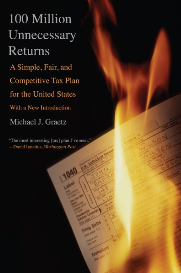
The Yale Tax Law Professor, Michael Graetz, has proposed a new tax system “100 Million Unnecessary Returns: A Simple, Fair, and Competitive Tax Plan for the United States” which would do wonders towards straightening out the huge fiscal and economic problems now facing our country.
CaptureHow do we rev up the national economy in order to put more people back to work and, at the same time, raise the revenue needed to operate the government in the 21st century without mountains of debt?  Mr. Graetz’s basic idea is to tax consumption rather than relying totally on an income tax.  Under his plan both savings and investments will be taxed at a lower rate which will encourage more of both.  The Plan has these features:

  • A broad based Value Added Tax of about 14% is enacted on goods and services.  The U.S. is the only advanced economy without a VAT.
  • Families earning less than $100,000 are exempted from the income tax.  For incomes between $100,000 and $250,000, the tax rate would be 15%.  For income over $250,000, the rate would be 25%.
  • The corporate income tax rate is lowered to 15%.
  • The Earned Income Tax Credit (EITC) is used to provide relief from the VAT burden to low-income families by using payroll tax offsets.
  • The plan is designed to be revenue neutral as verified by the Tax Policy Center.

This plan has many advantages including:

  • Taxing consumption and lowering the corporate tax rate to 15% from its current level of 35% would dramatically encourage investment in the U.S. thereby stimulating the economy and creating both new jobs and higher wages for American workers.
  • It would eliminate more than 100 million of the 140 million U.S. tax returns.
  • With many fewer Americans paying income taxes there would be far less temptation for Congress to use income tax exclusions, deductions and credits to try to address social and economic problems.
  • The plan retains all of the progressive features of our current tax system whereby higher income earners pay higher tax rates.

The point of describing the Graetz Plan in some detail is not to suggest that it is the best way to implement tax reform but rather that here, at least, is one attractive way to do it.  The purpose is to move the discussion forward.  We badly need to make changes along these lines!

An Optimistic View of America’s Future!


In the latest issue of Barron’s, Frederick Rowe, the managing partner of Greenbrier Partners Capital Management, asks in “More Than a Sugar High?” , “Can you imagine a country that is managed in an economically rational manner, creating the wealth that’s necessary to take proper care of the citizens who get left behind? … What if our economic recovery is more than a sugar high?  What if there is more here than insanely stimulative monetary policy from the Federal Reserve?  What if the U.S. has already begun to steer an economic course to a period of unprecedented and genuine prosperity, achievement, and problem solving?”
Here are eight factors which Mr. Rowe gives to point us in the right direction:

  • North American Energy Independence (already on the horizon).
  • Sensible Immigration Reform: encouraging our most enterprising and hard-working people to become citizens rather than chasing them away.
  • Repatriation of Corporate Income: if a company domiciled in the U.S. makes money in Argentina and wants to invest it in the U.S. we double-tax the daylights out of it.  It would be hard to imagine a more counterproductive tax policy.
  • Changing Directors and Their Thinking: the once unthinkable mindset of corporate directors acting on behalf of long-term owners (rather than the CEOs with whom they play golf) is actually gaining traction.
  • Lowering Corporate Taxes: the tax-writing committees in Congress are working on this.
  • Increasing Technological Leadership: the most dynamic technology companies in the world are domiciled in the U.S. Technology, in the short run, displaces workers.  But eventually workers catch up because new technology creates new kinds of jobs that were never imagined before.
  • Americanization of the World: more than three billion people around the world will soon be able to afford to live much more like the 300 million Americans do.  So companies which make it big here have an automatic global opportunity.
  • Obamacare:  Even this bureaucratic catastrophe provides a large opportunity for economic opportunity.  Think of Jimmy Carter’s failures which led to Ronald Reagan’s successes.

“Let your imagination run and consider all the things that can be accomplished by an energy-independent, cash-generating, cash-repatriating country that is a hotbed of technological innovation.”
I can’t possibly say it any better than this!

How to Get the Economy Back on Track


Harvard Economist, Martin Feldstein, has an Op Ed column in yesterday’s New York Times, “Saving The Fed From Itself”, which gets our current economic situation half right.  First of all, Mr. Feldstein says that the Fed’s quantitative easing policy is inadequate because “the magnitude of the effect has been too small to raise economic growth to a healthy rate.  … The net result is that the economy has been growing at an annual rate of less than 2 percent.  … Weak growth has also meant weak employment gains.  … Total private sector employment is actually less than it was six years ago.  … While doing little to stimulate the economy, the Fed’s policy of low long-term interest rates has caused individuals and institutions to take excessive risks that could destabilize the economy just as it did before the 2007-2009 recession.”  So far he’s right on the button!
But then he goes on to say, “To get the economy back on track,” Congress should enact a five year plan to spend a trillion dollars or more on infrastructure improvement and that this would “move the growth of gross domestic product to above three percent a year.”  An artificial stimulus like this might work temporarily but then it ends and we’re back where we started.  We need a self-generating stimulus that will keep going indefinitely on its own.  How do we accomplish this?
The answer should be obvious.  We do it by stimulating the private sector to take more risk in order to generate more profits. In the process they will hire more employees and boost the economy.
How do we motivate the private sector?  By lowering tax rates and loosening the regulations which stifle growth.  Closing tax loopholes and lowering deductions (which will raise revenue to offset the lower tax rates) has the added benefit of attacking the corporate cronyism which everyone deplores.
We really do need to put first things first.  If we can jump start the economy by motivating the private sector to invest and grow, we will have more tax revenue to spend on new and expanded government programs as well as shrinking the federal deficit.
Why is this so hard for so many people to understand?

Labor’s Share of National Income Is Falling

The latest issue of the Economist shows quite dramatically in the article “Labour Pains” that labor’s share of national income is dropping.  In the U.S. workers’ wages have historically been about 70% of GDP.  In the early 1980s this figure started falling and is now 64%.  Similar declines are occurring in many other countries.
This phenomenon is closely related to what others are observing as I have reported recently.  Tyler Cowen’s new book “Average is Over” discusses the threat of technology to the middle class.  Daniel Alpert in “The Age of Oversupply” talks about the increase of competition from various global forces.  Stephen King’s “When the Money Runs Out” makes the case that “a half-century of one-off developments in the industrialized world will not be repeated.”
Historically the stability of the wage to GDP ratio “provides the link between productivity and prosperity.  If workers always get the same slice of the economic pie, then an improvement in their average productivity – which boosts growth – should translate into higher average earnings. … A falling labour share implies that productivity gains no longer translate into broad rises in pay.  Instead, an ever larger share of the benefits of growth accrues to the owners of capital.”
A shrinking share of a GDP which itself is slowing down is a double whammy.  The only way to address the problem effectively is to deal with the root causes.
First of all, we need to boost overall economic growth by the proven methods of broad based tax reform, especially including much lower corporate tax rates, making regulations less onerous, carrying out immigration reform, and giving special attention to helping entrepreneurs create new businesses.
How can we, additionally, help low skilled and low waged workers move up the ladder?  Long term the most worthwhile action is to change K-12 education by putting more emphasis on career education to produce more highly skilled workers.  Short term, we should provide crash job training for the estimated three million current job openings in the U.S. which require skilled workers.
Economic inequality in the U.S. is becoming progressively worse all the time.  There are fiscally sound ways to address this alarming problem and it is important that they be clearly and forcefully advocated.

Can We Solve Our Fiscal Problems by Taxing the Rich? II. Robert Reich’s View


One of America’s foremost liberal writers, Robert Reich, a Professor of Public Policy at UC Berkeley, argues in his latest book, “Beyond Outrage”, that “America’s economy and democracy are working for the benefit of ever-fewer privileged and powerful people.”  He presents “a plan for action for everyone who cares about the future of America.”  Mr. Reich’s tax policy:

  • Raise the tax rate on the rich to what it was before 1981

“Sixty years ago Americans earning over $1 million in today’s dollars paid 55.2 percent of it in income taxes, after taking all deductions and credits.  If they were taxed at that rate now, they’d be paying at least $80 billion more annually.”

  • Put a two percent surtax on the wealth of the richest one-half of one percent

“The richest on-half of one percent of Americans, each with over $7.2 million of assets, own 28 percent of the nation’s total wealth.  Given this almost unprecedented concentration, and considering what the nation needs to do to rebuild our schools and infrastructure, as well as tame the budget deficit, a surtax is warranted.  It would generate another $70 billion a year.”

  • Put a one-half of one percent tax on all financial transactions

“This would bring in more than $25 billion per year.”

These new tax provisions would together raise tax revenue by $175 billion per year.  But our deficit this fiscal year, ending September 30, 2013, is about $700 billion.  In a few years, without significant changes in either discretionary or entitlement spending, annual deficits will be back up over a trillion dollars per year and climbing.  Mr. Reich’s steep taxes on wealth and wealth creation are not enough to seriously tame deficit spending, let alone end it.
Let’s be honest and admit that some new tax revenue is probably going to be necessary in the future if we are ever going to be able to eliminate the deficit.  But it makes no sense to start out with a tax increase which will be strongly opposed anyway.  It is far more sensible to first wring out the hundreds of billions of dollars in wasteful federal spending which now exists.  After this is done there likely will still be a big deficit.  Then, and only then, would it be appropriate to generate significant new revenue by raising taxes.