Tax Reform for Faster Economic Growth


Several of my recent posts have been devoted to the topic of faster economic growth, see, for example, here. One way to do this is by making it easier to start and grow a small business.  Another way is with broad-based tax reform.
Capture11House Republicans have just released the outline of a plan for fundamental tax reform, “A Better Way: A Pro-Growth Tax Code for All Americans.”  It has the following main features:

  • The current seven tax brackets for individuals are condensed to just three: 12%, 25% and 33%.
  • The standard deduction of $12,600 (for joint returns) is raised to $24,000 and the $4,050 personal exemption is eliminated. This feature means that fewer filers will need to itemize deductions.
  • In fact, all itemized deductions for individuals are eliminated except for mortgage interest and charitable contributions.
  • To encourage business creation and expansion, the pass through tax rate for small business will be 25%. Full and immediate expensing for investments in new equipment and technology will be allowed.
  • The corporate tax rate will drop from 35% to 20%, paid for by eliminating dozens of tax carve-outs and deductions, including net interest expensing. A territorial system will be established whereby multinational firms will no longer be taxed both abroad and at home for the same dollar of income. This will encourage the multinationals to keep production facilities in the U.S. and to bring home foreign profits for reinvestment here.

The purpose of this plan, according to Kevin Brady, Chair of the House Ways and Means Committee, is “to rev up the economy, cut taxes on business, simplify the code and let American families file on a postcard.” The authors of the report claim that this tax proposal is revenue neutral, i.e. will not lower tax revenue, on a dynamic scoring basis, taking resulting economic growth into account.  If this assertion holds up under nonpartisan analysis, then this is an excellent proposal which deserves broad support.

Follow me on Twitter
Follow me on Facebook


Can the U.S. Economy Do Better? IV. Let’s Try Tax Reform!

Image


After seven straight years of anemic, sub-par growth of 2.1% annual growth, one of the most important questions in public policy today is whether or not the U.S. economy can do better. I have devoted my last three posts, here, here, and here, to this question, presenting both positive and negative points of view.
Capture7There are very definitely strong headwinds slowing down growth but there are also specific strategies that are very likely to help speed up growth. One of these is tax reform.  The nonpartisan Tax Foundation (TF) has just issued an excellent report, “Options for Reforming America’s Tax Code” with many good ideas. Here are just three of the many different examples presented.  But they show the powerful effects that would be generated by significant tax reform.

  • Replace the Corporate Income Tax with a Value Added Tax (VAT) of 5%. This would be a huge change but it would also have a hugely positive impact. TF estimates that doing this would boost the economy by 5.5% in the long run as well as boosting tax revenue by a whopping $315 billion per year on average. Furthermore, all income groups from low to high would see equal gains in income.
  • Eliminate All Itemized Deductions Except for Charitable Contributions and Mortgage Interest and Lower the Top Individual Income Tax Rate to 27%. This change would grow the economy 1.1% in the long run and also create 496,000 new jobs. It would also increase tax revenues by $26 billion per year on average. It has the defect of raising incomes more for the affluent than for low- and middle-income groups. But this defect could easily be remedied by, for example, limiting the size of the mortgage interest deduction.
  • Cap the Total Value of Itemized Deductions at $25,000. This popular proposal would not help grow the economy but would bring in almost $200 billion a year in new tax revenue.

What is the better strategy? To be pessimistic and accept the point of view that faster growth is just too difficult or to adopt specific policies which are likely to help?

Follow me on Twitter 
Follow me on Facebook


What Might Fundamental Tax Reform Look Like?


All four of the major presidential candidates have tax plans. Hillary Clinton would make small tweaks in our current tax system.  Bernie Sanders would raise current taxes substantially.  Both Donald Trump and Ted Cruz would both radically reduce the size of the federal income tax but would also greatly add to the national debt over the next ten years.
I have been trying to make the case on this blog that fundamental tax reform is the best thing we can do to get the economy growing faster in order to create more and better paying jobs.  I have also discussed a specific way to accomplish fundamental reform, namely the so-called Competitive Tax Plan proposed by the tax law expert, Michael Graetz.  It is a progressive consumption tax, a so-called Value Added Tax.
Capture2As reviewed in yesterday’s Wall Street Journal by Reihan Salam, the editor of the National Review, the Graetz Plan has these features:

  • A broad-based VAT of about 14% on goods and services.
  • Families earning less than $100,000 per year are exempt from the income tax. The tax rate would be 15% for incomes between $100,000 and $250,000 and 25% above this level.
  • The payroll tax (supporting Social Security and Medicare) would be greatly reduced for all workers earning less than $40,000 per year.
  • The corporate tax rate would be lowered to 15%, making it among the lowest in the world.
  • The Graetz Plan is revenue neutral as verified by the Tax Policy Center.

Think of the incredible advantages of such a tax plan. Of the expected 145 million tax returns for this year, 120 million would no longer be necessary.  Extravagant deductions such as for mortgage interest would have much less political support. The low corporate tax rate would bring jobs back to the U.S. instead of sending them overseas.  The rampant cronyism involved in tax breaks being handed out by Congress would be greatly reduced.
What is not to like about the Graetz Plan?

Follow me on Twitter: https://twitter.com/jack_heidel
Follow me on Facebook: https://www.facebook.com/jack.heidel.3

Republican Congress Approves Irresponsible Budget


Congress has adjourned for Christmas having passed a final budget for the 2016 Fiscal Year extending through next September. It puts into place for this year the two year spending agreement reached between Congress and the President in October.  However Congress started out the year by passing a ten year budget plan resolution leading to a balanced budget by 2025.  The budget just passed leads instead to a deficit of $1.1 trillion in 2025.
CaptureHere are the details as described by the nonpartisan Committee for a Responsible Federal Budget:

  • Revenue: decreased under new budget by a $650 billion (over ten years) by making various temporary tax deductions permanent.
  • Discretionary Spending: increased by $50 billion for the current budget year (by breaking the sequester cap).
  • Medicare: instead of saving $430 billion over ten years, Medicare spending is increased by $95 billion over ten years.
  • 2025 Deficit: instead of shrinking to zero in ten years, it is now projected to be more than $1 trillion in 2025.
  • 2025 Debt: currently the (public, on which we pay interest) debt is 74% of GDP. The ten year balanced budget plan would reduce the debt to 56% of GDP. Instead, the debt is now on track to reach 80% of GDP by 2025.

Granted the Republican Congress hopes to develop a tax reform plan in 2016 which would lower tax rates for everyone, paid for by closing many of the loopholes and deductions just approved last week. One very good way to do this has recently been proposed by the Tax Foundation. The TF plan would boost economic growth and thereby increase tax revenue substantially over ten years.
The problem is that real tax reform is unlikely to happen without a Republican president in office.  If a Democratic president is elected in 2016, then the dire predictions made by the CRFB (above) are likely to remain valid for the foreseeable future. Our fiscal and economic future remains quite precarious at the present time!

Follow me on Twitter: https://twitter.com/jack_heidel
Follow me on Facebook: https://www.facebook.com/jack.heidel.3

Stopping Donald Trump II. Less Inequality or More Growth?


In my last post I presented the argument that voters are often more reasonable than the populist leaders who are trying to appeal to them.  They would rather hear something more optimistic than rage against a dangerous world.
Capture0But there is a difference of opinion on how to reach these voters:

  • Leading Democratic presidential candidate Hillary Clinton endorses the Buffett Rule which calls for millionaires to pay a minimum tax of 30% on their income. Says Clinton, “I want to go even further because Warren is right. I want to be the president for the struggling, for the striving and the successful.”
  • All of the Republican presidential candidates, including Donald Trump, have tax reform plans which will grow the economy but none of which are revenue neutral. In other words, they will all add to annual deficits and therefore make our debt problem much worse than it already is.
  • The nonpartisan Tax Foundation has issued a new report, “Options for Broadening the U.S. Tax Base,” which proposes capping itemized deductions at $25,000 per individual combined with
    i)   cutting the corporate tax rate to 27%
    ii) cutting the top three ordinary income brackets by 5%, and
    iii) implementing a top capital gains tax rate of 20%.
    Such a plan would be revenue neutral and would lead to a long term GDP gain of 2.7%, a long term wage gain of 2.2% and a ten year dynamic revenue gain of $759 billion.

The Clinton plan would bring in up to $50 billion per year in new tax revenue but would do little to boost the economy. The Republican presidential tax plans are fiscally irresponsible. The Tax Foundation plan would boost the economy and reduce deficits rather than increase them.  Other specific reforms would boost the economy even more.
In other words there are clear cut ways to create more jobs and raise wages.  This is a message which should appeal to the angry and disaffected voters who are attracted to Donald Trump.

Follow me on Twitter: https://twitter.com/jack_heidel
Follow me on Facebook: https://www.facebook.com/jack.heidel.3


What Defines a (Fiscal) Conservative?


After four debates among the Republican presidential candidates, differences between them are becoming clearer.  The New York Times has an interesting article about this in today’s paper, “G.O.P. Fight Is Now a Battle Over What Defines a Conservative.”
CaptureHere are my views on the four issues discussed:

  • A Wall or a Path? We need to solve our illegal immigration problem and the key is to set up a viable guest worker program. The fact is that our economy needs foreign workers for many jobs which require hard physical labor such as in agriculture, meatpacking and construction trades. If businesses are able to bring in immigrants when sufficient domestic labor is not available, then other issues such as border security and verifying legal status can easily be resolved.
  • The U.S. Place in the World. U.S. leadership makes the world a safer place. This means we need a strong military presence all around the world as well as active alliances, trade and military, with many other countries.
  • Of Banks, Bailouts and Blame. The cause of the financial crisis was the bursting of the housing bubble, in turn caused by an unrealistic government housing policy as well as lax enforcement of existing regulations. Blaming greedy bankers is a copout. The Dodd-Frank Law is overkill which creates a drag on the economy by hampering smaller financial institutions and community banks. The best way to control large banks is to increase their capital requirements.
  • Who Should Get Tax Cuts? The main purpose of tax reform should be to boost the economy without increasing deficit spending. The way to do this is with across the board cuts in tax rates, paid for by closing loopholes and shrinking deductions. Here are some details. The 64% of taxpayers who do not itemize deductions will get an immediate tax cut and income inequality will be greatly reduced.

Getting the answers to these issues correct will have a large effect on the future wellbeing of our country.  The Republican presidential candidates should be commended for grappling with them in a productive manner.


Austerity’s Grim Legacy?


There is a very important debate going on in the country right now as I have discussed in my last three posts:

  • The Republican presidential candidates are proposing big tax cuts to stimulate the economy but at the cost of huge increases in annual deficits and the accumulated debt.
  • The Democratic candidates want to raise taxes on the wealthy but even raising the top tax rate from 39.6% to 50% would have only a modest effect in lowering income inequality.
  • The Tax Foundation has an excellent plan to lower tax rates for all in a revenue neutral manner by closing loopholes and limiting deductions. Their plan would give the economy a big boost and actually lower deficits by bringing in more tax revenue.

Now comes Paul Krugman in Friday’s New York Times, “Austerity’s Grim Legacy”  saying that “Some of us tried in vain to point out that deficit fetishism was both wrong-headed and destructive, that there was no good evidence that government debt was a problem for major economies, … And we were vindicated by events.  More than four and a half years have passed since Alan Simpson and Erskine Bowles warned of a fiscal crisis within two years; U.S. borrowing costs remain at historic lows.”
Capture12How can such an obviously intelligent and articulate economist miss what is so very, very clear to so many lesser mortals?  Interest rates will not stay low forever!  And when they do go up, interest payments on our rapidly expanding debt will skyrocket! The Congressional Budget Office estimates that the interest payment on our debt will increase from 1.7% of GDP today to 3.6% of GDP in 2025, or $827 billion in 2025 compared with $227 billion in 2015.  Where will the money to pay this new $600 billion expense come from?
It is absolutely crazy not to take our enormous debt seriously.  We simply must put this huge debt on a downward path as a percentage of GDP.  It can be done but it will take a concerted effort by our national leaders to do it.

                                    Follow me on Twitter: https://twitter.com/jack_heidel
                         Follow me on Facebook: https://www.facebook.com/jack.heidel.3

A Much Better Way to do Tax Reform


My last two posts, here and here, have pointed out the folly of the tax plans of the presidential candidates from both parties:

  • The Republican plans would stimulate the economy but at a cost of huge increases in the national debt, even using dynamic scoring to take into account the growth effects of these plans.
  • Raising the top tax rate to 50%, a Democratic idea, would bring in $100 billion per year, but this is not enough to either make a big dent on budget deficits or lower income inequality appreciably.
    CaptureThe Tax Foundation has just published an excellent guide to income tax policy which makes several good suggestions for using tax reform to boost the economy:
  • Eliminating the deduction for state and local taxes would raise $81 billion per year. Using this revenue to reduce individual income tax rates would grow the economy by 1.77% of GDP over 10 years.
    Capture11
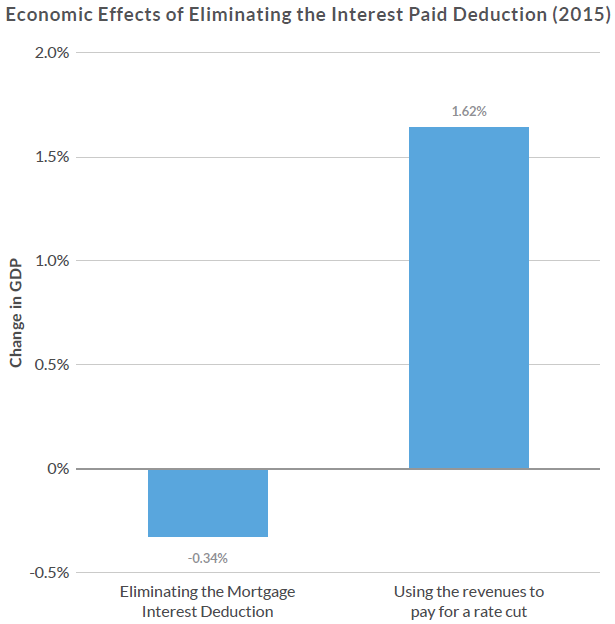
  • Eliminating the mortgage interest deduction would raise $75 billion per year. Reducing individual tax rates by the same amount would grow the economy by 1.61% of GDP over 10 years.
    Capture12
  • Capping itemized deductions at $25,000 would bring in $188 billion per year. Reducing individual tax rates by the same amount would grow the economy by 1.99% over ten years.
    Capture13

Sensible, i.e. revenue neural, tax reform will do wonders for the economy as this study from the Tax Foundation shows. It will bring in more tax revenue to help pay the bills.  It will raise salaries for the already employed.  It will create new jobs for the millions of unemployed and underemployed people who want them.  It will thus reduce income inequality by increasing the wages of people on the bottom. Why is this so hard for so many people to understand?

                               Follow me on Twitter: https://twitter.com/jack_heidel
                     Follow me on Facebook: https://www.facebook.com/jack.heidel.3

Donald Trump’s Tax Plan: More Bad than Good


Republican presidential candidate Donald Trump has just released his tax plan. Some of its basic features are:

  • Lowering and consolidating seven current tax brackets into three: 10%, 20% and 25%.
  • The corporate tax rate would be cut from the current level of 35% to just 15%.
  • The income tax on all businesses would be cut to 15% as well.
  • Taxing carried interest at ordinary income tax rates instead of at the lower capital gains rate.
  • Eliminating the Alternative Minimum Tax as well as the Estate Tax.
    Capture8

The nonpartisan Tax Foundation has analyzed the Trump plan and predicts the following positive long term effects:

  • 11.5% higher GDP,
  • 29% increase in capital investment,
  • 6.5% higher wages and
  • 5.3 million more full-time equivalent jobs.

The tax Foundation also performed an analysis of Jeb Bush’s tax plan and found roughly similar economic benefits except for a lesser number, 2.7 million, of new jobs created. But the Tax Foundation also predicts that the Trump plan would cut tax revenue by $11.98 trillion over ten years on a static basis or $10.14 trillion on a dynamic basis (accounting for economic growth effects of the plan). This compares with a loss of revenue of $3.6 trillion over ten years (static) or $1.6 trillion over ten years (dynamic) for the Bush plan.
In other words, for a substantially larger growth in new jobs under the Trump plan, there is an enormous cost in additional deficit spending.
Conclusion: I have previously criticized the Bush plan for increasing deficit spending and therefore adding to the debt when we should be shrinking it. The Trump plan is much, much worse in this respect, running annual deficits of over $1 trillion per year, moving in exactly the wrong direction.
The Bush tax plan, while needing changes to make it revenue neutral, is far superior to the Trump plan, which simply blows off any concern for deficits and debt.

Jeb Bush’s Tax Plan: Both Good and Bad


Republican presidential candidate Jeb Bush has just released his tax reform proposal, “My Tax Overhaul to Unleash 4% Growth.” It has many good features such as:

  • Lowering and consolidating seven current tax brackets into three: 10%, 25% and 28%.
  • Essentially doubling the standard deduction for most filers, thereby achieving huge simplification for millions of average income filers.
  • Eliminating the state and local income tax deductions and capping all others, except for charitable deductions, at 2% of Adjusted Gross Income.
  • Doubling the Earned Income Tax Credit for childless filers, thus encouraging more low income people to work.
  • Exempting taxpayers over the age of 67 from the employee-side payroll tax, encouraging them to stay in the workforce longer.
  • Cutting the corporate tax rate from 35% to 20%.
  • Allowing 100% immediate expensing for all capital investments, including inventories.
  • Creating a territorial tax system so that multinationals are not taxed on foreign earnings, and therefore incentivized to bring their foreign profits home.
  • Eliminating the deductibility of interest expenses.

The lower individual and corporate tax rates, together with the separate investment and work incentives, will create a significant economic stimulus estimated to raise GDP by at least .5% per year or higher, depending you who ask.
According to the Tax Foundation, however, the plan would reduce federal revenue on a static basis by $3.66 trillion over ten years, and even by $1.6 trillion on a dynamic basis, taking into account the new tax revenue generated by the plan.
CaptureThis is, of course, a huge problem. We badly need to speed up economic growth but we also need to lower, not increase, our annual deficit spending in order to put our debt on a downward path as a percentage of GDP.
The resolution of this quandary is to tighten up on those deductions, such as for mortgage interest, remaining in the code and also lessening the amount of the tax cuts if necessary in order to achieve overall revenue neutrality for the plan.