An Open Letter to Representative Brad Ashford


You’re off to a great start in Congress!  You’ve clearly established that you’re independent minded and that you vote your conscience.  I expected that you would act in this way and that is why I supported you during last year’s election campaign.  We need more people like you in Congress.
As you perhaps know, I am a non-ideological fiscal conservative and social moderate.  I am, like you, mainly interested in finding practical, workable solutions to difficult and complicated problems.  But I do have one guiding principle to which I strongly adhere.  I believe that, as a general rule, every level of government should refrain from spending more money than what it can pay for with tax revenue.
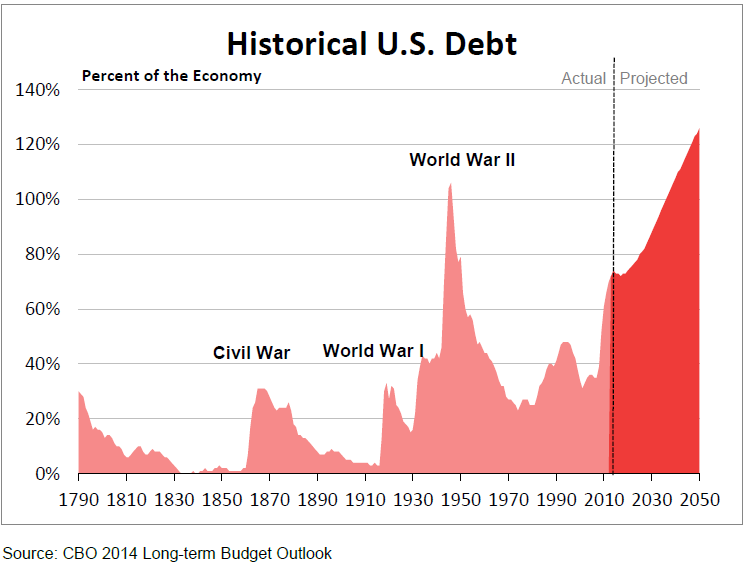
CaptureUnfortunately our federal government has gotten away from this principle in recent years.  This is clearly demonstrated in the above chart which shows an already very large national debt getting much, much worse in the coming years.
There is a movement in the new 114th Congress to address this perilous situation which we have gotten ourselves into.  I am referring to the bills drafted by the Budget Committees of both the House of Representatives and the Senate which would produce balanced budgets over the ten year period, 2015 – 2025.
It was reported in today’s Wall Street Journal that the full House voted yesterday to approve the budget bill by a 228-199 margin but without any Democratic votes.  This means that either you voted against the Budget Bill or you did not vote on it.
I don’t believe that any one vote is so important that it constitutes a decisive litmus test determining my support of a candidate in a future election.  However, as I mentioned above, I feel very strongly that we must greatly shrink our very large budget deficits and that now, not later, is the time to get started on this urgent task.
I hope to be able to support your re-election campaign in 2016 and beyond.  That is why I am writing to you at the present time.

When Liberals Blew It


“It is important and right that all privileges of the law be ours, but it is vastly more important that we be prepared for the exercise of these privileges.”
                                                                       Booker T. Washington, 1856 – 1915

My last two posts have discussed the theme of a new book by Dennis Prager, “Still the Best Hope: why the world needs American values to triumph.” Mr. Prager’s thesis is that there are three competing ideologies for the allegiance of humankind, namely Islamism, Leftism and Americanism and, furthermore, that these three ideologies are incompatible.  Any one of them succeeds at the expense of the other two.
As I said on March 8, Mr. Prager’s broad framework helps me place my own ideological views into perspective.  Here is one example of this. As everyone knows, 2015 is the 50th anniversary of the March from Selma to Montgomery.  But it is also the 50th anniversary of Daniel Patrick Moynihan’s report “The Negro Family: The Case for National Action.”  Nicholas Kristof’s Op-Ed in today’s New York Times, “When Liberals Blew It” reminds us how prescient Moynihan was about a breakdown in family structure and how reviled he was by liberals when he issued his report.  Mr. Kristof points out that:

  • In 2013, 71% of black children were born to an unwed mother (compared to 53% of Hispanic children and 36% of white children), far more than in 1965.
  • Growing up with just one biological parent reduces the chance that a child will graduate from high school by 40%.
  • A father’s absence from the home increases antisocial behavior especially for boys.

CaptureA column by the black author, Jason Riley, in yesterday’s Wall Street Journal, “Drawing the Wrong Lessons from Selma about America today,” points out that the main problem for blacks today is not racial discrimination but rather:

  • A lack of preparation for many jobs which are now available.
  • A black subculture which rejects attitudes and behaviors conducive to upward mobility.
  • That too few blacks are taking advantage of the opportunities now available to them.

In other words, more and more spending on welfare and public services is not what blacks need for further advancement.  Rather it is to stop thinking of themselves as victims and to develop a greater sense of personal responsibility.  This is the American way to get ahead!

Does ‘Middle Class Economics’ Really Work?


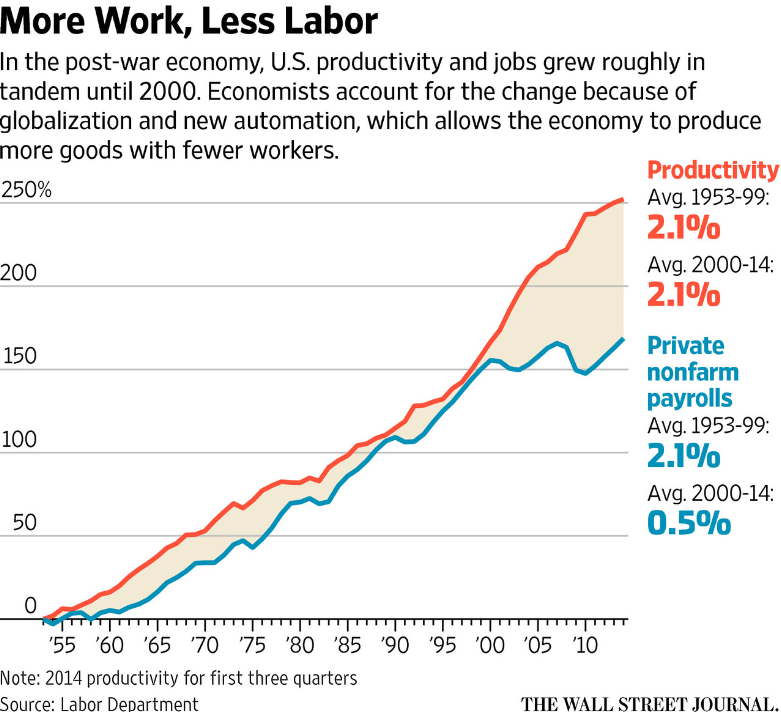
An article in yesterday’s Wall Street Journal, “What Clever Robots Mean for Jobs,”  illustrates the stark fact that “automation is commandeering much middle-class work such as clerk and bookkeeper, while creating jobs at the high- and low-end of the market.  This is one reason the labor market has polarized and wages have stagnated over the past 15 years.”
CaptureThe above chart shows the divergence between productivity growth and payrolls beginning in the year 2000.  It is a vivid portrayal of the “hollowing out” of the middle class which is causing so much grief.
Now let’s turn to a column in today’s New York Times, “What Is Middle-Class Economics,” by the journalist, Josh Barro.  The term, of course, refers to the policies by which President Obama hopes to appeal to the millions of middle-class families with stagnant incomes. According to Mr. Barro, the President’s policy proposals have three facets:

  • Tax and regulatory provisions such as tax credits for childcare, college tuition and a second earner in households where both parents work. Employers would be required to provide paid sick leave and the minimum wage would be raised.
  • Make workers more productive by expanding access to community college.
  • Increase overall economic growth with increased infrastructure spending and new trade agreements.

The problem, as Mr. Barro points out, is that such policies would have only a small effect on the taxes of a middle-income family, amounting to a cut of no more than $150 per year on average.  This is much less than the average family will save from falling gasoline prices.
On the other hand, it is generally understood that stagnant middle-class wages will not rise very much until the labor market becomes tighter as a result of falling unemployment.  Mr. Barro suggests that the government can help this process along in two ways:

  • By the Federal Reserve holding down interest rates, or at least letting them increase only very slowly.
  • With policies to make it easier to work less. The Affordable Care Act does this by decoupling health insurance from full time work. The surge in disability insurance recipients takes people out of the labor market. The rapid retirement of baby-boomers does the same thing.

Unfortunately there are many negative effects from both the Federal Reserve’s easy money policy as well as a shrinking labor participation rate.  I will return to this issue soon!

How Do We Speed Up Economic Growth?


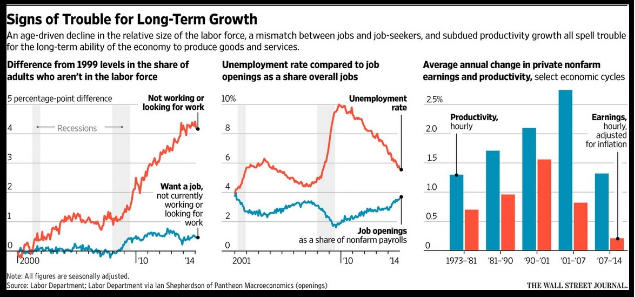
The 2015 Economic Report of the President has just been released.  It shows that the slow growth of productivity is playing a bigger role in squeezing middle class incomes than the rise of economic inequality.
CaptureThe above chart makes some dire predictions:

  • The labor force, which has averaged 1.5% growth since 1950, is likely to grow just .5% a year in coming decades, because any increase in new workers is likely to be swamped out by baby-boomer retirements.
  • Productivity has grown just 1.3% a year since the end of the last expansion in 2007.
  • These two figures together predict an anemic, less than 2% growth, economy going forward.

The President proposes several policies to address this slow growth:

    • Immigration Reform would provide more highly skilled workers for the economy as well as a more efficient guest worker system for low-income labor.
    • Increased Foreign Trade would expand our export economy.
    • An Expanded Workforce could be achieved with a higher Earned Income Tax Credit to boost dual-income households.
    • An increase of Infrastructure spending of 1% of GDP is estimated to boost output by 2.8% after 10 years.
    • Corporate Tax Reform would encourage U.S. multinationals to bring their foreign profits home for reinvestment.

These are good ideas but much more could be done as well:

  • Individual Income Tax Reform, exchanging lower tax rates for all by closing loopholes and deductions would boost spending by middle- and lower-income tax payers.
  • Reforming Social Security and Medicare by setting higher retirement ages would encourage longer work lives.
  • Reforming the Affordable Care Act by removing the employer mandate would boost productivity by making the labor market more efficient.

Faster economic growth will not only reduce unemployment, it will also make it much easier to shrink the deficit as more tax revenue is raised.  This should be one of the very highest priorities for our elected representatives in Washington!

Progress on Medicaid Reform


It is widely understood that the rapid increase in spending for entitlements (Social Security, Medicare and Medicaid) is the main driver of our debt problem.  Anything that can be done to get spending for these programs under control is of great value.
The problem with Medicaid is that a fixed percentage of each state’s costs is paid for by the federal government.  The more a state spends, the more that is contributed by the federal government which is a disincentive for states to control their own spending.  From 1989 to 2013, the share of state budgets devoted to Medicaid rose from 9% to 19%.  This upward trend is a problem for both state and federal government and is clearly unsustainable.
One way to change the spending incentive is to turn Medicaid into a block-grant program whereby the federal government contributes a specific amount of money to each state each year and gives states more leeway in designing their own programs.  States would then have a much bigger incentive to hold down costs and the flexibility to be able to do it.
CaptureProgress is being made in this direction with the use of waivers:

  • Rhode Island received a waiver in 2009 to try out various cost-saving measures such as wellness programs, co-payments, etc. It has been quite successful and very well received.
  • Last year Pennsylvania agreed to expand Medicaid to an additional 500,000 people along with a waiver allowing people above the poverty line to be charged premiums of up to 2% of their household income as well as being charged an $8 copayment for use of emergency rooms.
  • Now Indiana (http://www.wsj.com/articles/indiana-governor-to-expand-medicaid-coverage-1422371729) has agreed to an expansion with a waiver under which beneficiaries above the poverty level would be charged premiums of 2% of income and would be locked out of benefits for six months if they fall behind in their payments.
  • Additional states such as Idaho, Wyoming, Utah, Tennessee, Alabama and Florida are also considering Medicaid expansions and likely will be influenced by the possibility of receiving similar waivers.

Waivers are not as cost effective as block-grant funding but they are an improvement over the existing one-size-fits-all federal rules.  If more individual states are able to show that waivers really do work to reduce costs, this will increase the likelihood of implementing a block-grant system.

Why the U.S. Needs True Health Care Reform


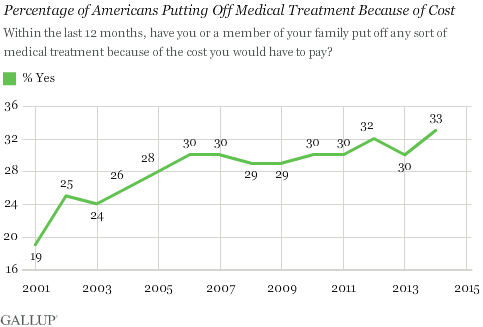
The Affordable Care Act has improved access to healthcare by already enrolling over 7 million Americans who were previously uninsured.  It is estimated that there will be a total of 20 million new enrollees by the end of this decade.
CaptureBut as the above chart from a recent Gallup survey indicates, the cost of healthcare is now a big barrier for an increasing number of people with health insurance.
The University of Chicago economist, Casey Mulligan, discusses the cost issue in a recent Wall Street Journal article “The Myth of ObamaCare’s Affordability” as well as in a new book.  He makes the following points:

  • Although the ACA helps specific populations by giving them a bigger piece of the economic pie, the law diminishes the pie itself by reducing the amount that American’s work and making their work less productive.
  • 35 million men and women currently work for employers who don’t offer health insurance. These tend to be small and midsize businesses with lower paid employees. The result of penalizing businesses for hiring and expanding will be less hiring and expanding.
  • The “29er” phenomenon is a good example of how the law harms productivity. If a business has 50 or more employees who work over 30 hours a week, it is required to offer health insurance. Many employers have thus adopted 29-hour work schedules which lessens overall productivity.
  • Mr. Mulligan estimates that the ACA’s long-term impact will include about 3% less weekly employment, 2% less GDP and 2% less labor income. He also claims that these effects will be visible and obvious in just a few years by 2017!
  • The ACA is thus weakening the economy. For the large number of people who continue to pay for their own healthcare, healthcare is now less affordable.

Conclusion: we need true healthcare reform which addresses cost as well as access and this can be achieved by fixing Obamacare.  It is not necessary to repeal it.  The Manhattan Institute’s Avik Roy has developed a plan to do this: ”Transcending Obamacare.”  Mr. Roy’s Plan would keep the exchanges, end both the individual and employer mandates, and migrate both the Medicare and Medicaid programs onto the exchanges over time.  These features will greatly reduce the cost of American healthcare.  Check it out and see for yourself!

Reforming Remedial Education


Many observers agree that one of the best ways to boost the economy and reduce income inequality is to improve educational outcomes at both the K-12 and postsecondary levels.  One of the main barriers to accomplishing this goal is the huge K-12 achievement gap between students from low-income families and those from middle class families.  This creates a huge need for remedial education in college as shown in the chart below.
CaptureA recent article in the Wall Street Journal, “Remedial Courses in College Stir Questions Over Cost, Effectiveness,”  shows the dramatic increase in the number of undergraduate students taking remedial courses in recent years and also the extent to which these remedial students are receiving financial aid in the form of Pell grants.  The article points out that some states such as Connecticut, Florida and Tennessee are no longer requiring remedial education for students who test poorly.
But the educators Jane Wellman and Bruce Vandal say not so fast in an article “5 Myths of Remedial Education

  • Myth #1. Remedial Education is K-12’s problem. Colleges could do a much better job of specifying clear benchmarks for college success.
  • Myth #2. Remedial Education is a Short-Term Problem. Even if the Common Core curriculum raises high school standards, there will still be a large number of poor performers, as well as older adults returning to school, who will need remediation.
  • Myth #3. Colleges Effectively Determine College Readiness. College placement tests do not provide a precise diagnosis of student skill deficiencies.
  • Myth #4. Remedial Education is Bankrupting the System. Remediation using non-tenured faculty and making heavy use of technology is not expensive and can be very effective. (The UNO Math Department, where I work, is a good example of this.)
  • Myth #5.   Maybe Some Students are Just Not College Material. This is an elitist point of view which minimizes the importance of postsecondary education in today’s economy.

As the article concludes, “Remedial education is the 800-pound gorilla that stands squarely in the path of our national objective to increase the number of adults with a college degree. … Our nation can no longer afford these myths.”

Income Inequality and Rising Health-Care Costs


There seems to be a general consensus on the reality of increasing income inequality in the U.S. and even some agreement on its two main causes: globalization and the rapid spread of technology. The slow growth of the economy since the end of the recession has made the inequality problem that much worse.
CaptureNot surprisingly, slow economic growth in the past five years has led to stagnant wages for many workers.  My last post addressed this problem.  The above chart from the New York Times shows that incomes for top wage earners have been rising in recent years while they have been stagnant for middle- and lower-income workers.
But there is more to it than this.  In yesterday’s Wall Street Journal, Mark Warshawsky and Andrew Biggs point out that, “Income Inequality and Rising Health-Care Costs,” in the years 1999 – 2006, total pay and benefits for low income workers rose by 41% while wages rose by only 28%, barely outpacing inflation.  For workers making $250,000 or more total compensation rose by a lesser 36% while wages grew by a greater 35%.  This apparent anomaly is explained by the fact that health insurance costs are relatively flat across all income categories, thus comprising a much larger percentage of the total pay package of low-income workers than for high-income workers.
Capture1In fact, the Kaiser Foundation has shown that low-wage workers tend to pay higher health insurance premiums, as well as receiving lower insurance benefits, than higher paid workers (see the above chart).
Overall, what this means is that employer provided healthcare is taking a huge chunk out of the earnings of low-income workers which makes income inequality much worse than it would be otherwise. Of course, the cost of healthcare is a huge burden for the entire U.S. economy, currently eating up 17.3% of GDP, twice as much as for any other developed country.
For both of these reasons it is an urgent matter for the U.S. to get healthcare costs under control.  Avik Roy of the Manhattan Institute has an excellent plan to do just this as I have discussed in several recent posts.

How Bad Is Income Inequality and How Do We Fix It?


The latest news on the American economy is mixed. The unemployment rate fell to 5.9% in September but the labor force also fell by 97,000 last month.  The labor participation is now down to 62.7%, a level last seen in 1978.  On the plus side 248,000 new jobs were created but the share of the population employed stayed at 59%, less than its 59.4% level at the end of the recession in June 2009.  In other words, job growth is definitely picking up but not fast enough.
CaptureHow about income inequality?  One simple way of describing and understanding the degree of income inequality in the U.S. is to look at median household income and how it changes over time.  The above chart from the WSJ shows how the median U.S. household income fell from an all-time high of $56,895 in 1999 to $51,939 in 2013.  However it also climbed back up to $56,436 in 2007 before dropping precipitously until 2012.
Capture1The Global Strategy Group discovered in a recent survey that registered voters overwhelmingly rate economic growth as a higher priority than economic fairness.  This means that any policy designed to speed up economic growth is likely to receive favorable support by the electorate.
In a recent post I describe a plan for broad-based tax reform specifically designed to speed up economic growth.  It would involve an across-the-board cut in tax rates totaling about $500 billion per year, but completely paid for by closing loopholes and deductions which primarily benefit the wealthy.  The 64% of taxpayers who do not itemize deductions would receive a tax cut.  And they would likely spend this extra money in their pockets because they are precisely the middle- and lower-income wage earners with falling incomes.
An income tax redistribution like this would greatly reduce inequality but in a way which is designed to give the economy a big boost!

The Truth behind the Latest Job Figures


Mortimer Zuckerman, writing a few days ago in the Wall Street Journal, “The Full-Time Scandal of Part-Time America,” points out that the latest employment figure of 288,000 net jobs created in June is highly misleading.  “Full-time jobs last month plunged by 523,000, according to the Bureau of Labor Statistics.  What has increased are part-time jobs.  They soared by about 800,000 to more than 28 million.” Mr. Zuckerman goes on to say, “Since 2007 the U.S. population has grown by 17.2 million, according to the Census Bureau, but we have 374,000 fewer jobs since a November 2007 peak and are 10 million jobs shy of where we should be.”
CaptureInterestingly, the New York Times discusses the same problem from a different point of view, ”A Push to Give Steadier Shifts To Part-Timers”.   The NYT does recognize that there are now about 7.5 million part-time workers who would prefer full time employment but are unable to find it.  But the emphasis is on giving them more advance notice for changes in work schedules.
The only way that we’ll get what we really need, more jobs, more good jobs and more fulltime jobs, is by faster economic growth beyond the anemic 2.2 average growth rate since the recession ended five years ago.  Here are several ways to accomplish this:

  • The most obvious and immediate thing we should do is to lower the corporate tax rate from its currently highest in the world level of 35%. This will stop the hemorrhaging of U.S. companies moving overseas and encourage multinational corporations to bring their profits home and reinvest them in the U.S.
  • Broad-based individual tax reform, with lower tax rates for all, offset by closing loopholes and shrinking deductions which primarily benefit the wealthy. This will put more money in the hands of the two thirds of Americans who do not itemize their tax deductions. Since these are the middle and lower income wage earners with stagnant incomes, they will spend their extra income thereby giving the economy a big boost.
  • The employer mandate in Obamacare is responsible for some of the shift from fulltime to part-time employment, and should be repealed (it has already been suspended for two years by the Obama Administration).

These are just common sense reforms which should be doable by Congress without a huge ideological fight.  We badly need leadership capable enough to do this!