Trump’s Bark Is Worse than His Bite


The anti-Trump fervor seems to be slowly dying down as his appointees take hold of their agencies and begin to promulgate new policies. I have expected this to happen because of the excellent quality of many of the people he has appointed.
Here are a few recent developments:

  • Interior Secretary Ryan Zinke has said that “the border is complicated as far as building a physical wall” and there are all sorts of problems to be resolved before it can be done.
  • Reality is setting in with regard to Russia policy “given Russia’s continued provocations in terms of weapon’s deployments, overtures to Iran, cyber intrusions and intervention in Ukraine.”
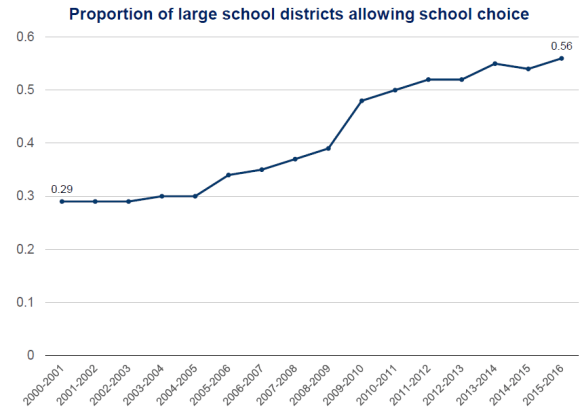
  • The Brookings Institution has just issued a new report showing that school choice options are increasing in the country’s largest school districts. This indicates that Education Secretary Betsy DeVos is in the mainstream by supporting more choice.
  • Coal jobs Trump vows to save no longer exist.  In other words, cancelation of the Obama Clean Power Plan will have little effect on the huge drop in coal use because coal has become so much more expensive than natural gas.
  • Of course, the Trump 2018 Budget Proposal will be heavily modified by Congress but it does contain some good ideas. Agriculture, Foreign Aid and Community Development Block Grants are all ripe for big cuts.
  • The biggest unknown with respect to administrative action concerns trade policy. The question here is what concessions he can get from China and Mexico without starting a disastrous trade war.

What is mainly lacking at this point is any significant action by Congress on the Trump agenda. What will happen with healthcare reform, tax reform and deficit reduction, for example?

Conclusion. Trump is doing fine so far but it is on relatively straightforward issues under his control. Hopefully he will be able to make progress on the bigger issues as well which require working with Congress.

Follow me on Twitter
Follow me on Facebook


The Necessity of Fixing Medicaid


As I have discussed in previous posts, here and here, the American Health Care Act, the GOP replacement for the Affordable Care Act, is a step in the right direction.


One of the best features of the GOP bill is its provisions to revamp the Medicaid program.  The problems of Medicaid are well described by the healthcare expert, Avik Roy, here and here:

  • Medicaid was established in 1965 and now provides healthcare benefits for individuals and families with incomes up to 133% of the federal poverty level.
  • The states pay 40% of the costs on average while only controlling 5% of how the program is operated.
  • The federal Medicaid law mandates a laundry list of benefits which the states must provide. States cannot charge premiums and copays and deductibles are minimal.
  • Medicaid is the largest or second largest line item in nearly every state budget. The only tool states have in controlling costs is to pay doctors and hospitals less than private insurers pay for the same care. This means that fewer and fewer doctors are accepting Medicaid patients.
  • Thus Medicaid enrollees have poor access to healthcare. In fact, their health outcomes are typically no better than for those with no insurance at all.
  • An able-bodied adult on Medicaid receives about $6000 a year in government health-insurance benefits. Yet CBO estimates that five million Americans won’t sign up for Medicaid if the ACA individual mandate is repealed as proposed by the AHCA.
  • AHCA block grants will give states more flexibility to manage Medicaid’s costs in ways which increase access to doctors and other providers. It would also decrease federal outlays for Medicaid by $880 billion in its first decade.
  • AHCA’s goal is to ultimately merge Medicaid for able-bodied low-income adults into the system of tax credits which the AHCA proposes for those above the poverty line.

Conclusion. The AHCA will make Medicaid into a much more efficient, flexible and effective program for serving low-income individuals and families. This represents a first step in the entitlement reform which the U.S. so badly needs.

Follow me on Twitter
Follow me on Facebook


Beating the High Cost of Higher Education and Student Debt


This blog addresses America’s too biggest problems:

  • Slow economic growth averaging just 2% since the end of the Great Recession in June 2009. Faster growth means more jobs and better paying jobs.
  • Massive federal debt now 77% of GDP (for the $14 trillion public debt on which we pay interest) and predicted to continue getting worse without a change in policy. As interest rates go back up to normal historical levels the interest payments on this debt will increase greatly and be a huge drag on the federal budget.

As I have reported recently, college costs are growing much faster than healthcare costs which are growing faster than the cost of living in general.  The excessive costs of education and healthcare are, in turn, holding back economic growth.


Regarding the student loan debt problem:

  • For every increased dollar of student aid, college tuition increases 60 cents.
  • Outstanding student loan debt has risen from $200 billion in 1996 to $1.3 trillion today.
  • The highest default rates on student debt occur for community college students (23%) and for-profit college students (18%).

The economist Richard Vedder has made some excellent suggestions for addressing this whole problem:

  • Simplify the entire federal student air system. There should be only two programs, one grant program (Pell grants) and one federal loan program (Plus loans, tuition tax credits, work study, etc.).
  • Give educational vouchers directly to students to empower recipients to weigh costs more closely. These would be strictly limited to low-income students and would be accompanied by modest academic expectations.
  • Require schools to have skin in the game. Schools with abnormally high loan delinquency rates should have to pay a tuition “tax” to the government to help cover costs.

Conclusion. “Financial aid has caused tuition to skyrocket. If we can’t abolish it, we can at least simplify it.”

Follow me on Twitter
Follow me on Facebook

The Strengths and Weaknesses of the GOP Healthcare Reform Bill


The American HealthCare Act, introduced in the House of Representatives on Monday, begins the process of looking for a replacement and improvement to the Affordable Care Act.  It moves in the right direction but also has some major shortcomings.


The Bill’s strengths are:

  • The Bill discards the ACAs web of mandates and regulations in favor of incentives to buy health insurance in a deregulated market.
  • The Bill replaces the ACA exchanges with refundable tax credits for individuals not covered by employer provided health insurance.
  • The Bill turns Medicaid into a block grant program for states with much flexibility for the individual states to run their own programs. This reverses the current system whereby the federal government matches each state’s spending on Medicaid and is thereby expensive for both state and federal government

The Bill also has major weaknesses:

  • There is no upper limit on the tax exemption for employer-paid premiums. This tax exemption amounts to a total drain of nearly $300 billion a year on U.S. tax revenues and is the biggest single reason why healthcare is so expensive in the U.S.
  • The inadequacy of financial support for the lowest income individuals and families. A $2000 annual tax credit for a minimum wage worker is simply not enough for her/him to be able to afford health insurance.
  • This huge discrepancy between the lavish tax treatment of employer-paid care and stingy tax credits for individuals is a matter of fundamental inequity as well as unsound tax policy. It would be much fairer to give all Americans the same equal tax credit roughly equivalent to the cost of catastrophic healthcare insurance.

Conclusion. The ACA increases access to healthcare insurance but does nothing to control costs. It is imperative for the Republican replacement plan to fix this glaring deficiency.

Follow me on Twitter
Follow me on Facebook

Donald Trump’s Popularity is Steadily Increasing


Like many things about Donald Trump, his approval ratings are contradictory and misleading. The Wall Street Journal reports that:

  • Only 44% of Americans currently approve of President Trump’s job performance (while 48% disapprove) which is historically low for a new President.capture107
  • On the other hand, the percentage of Americans who have positive feelings about him has been steadily increasing ever since he declared his candidacy in June of 2015, and has now reached a high of 43% (see chart). Since his State of the Union speech was generally well received, this rating is likely to go even higher.

Here is my own perspective. As I have said many times on this blog, I believe our country’s two biggest and most urgent problems are:

  • Slow economic growth, averaging just 2% per year since the end of the Great Recession in June 2009. This means fewer jobs, smaller raises for workers and less tax revenue to spend on important national initiatives.
  • Massive Debt, now standing at 77% of GDP (for the $14 trillion public debt on which we pay interest), the highest since right after WWII. The Congressional Budget Office predicts that this debt level will keep on steadily getting worse, without big changes in current policy. It is therefore a huge threat to our national security and prosperity.

I have great confidence that the Trump administration and Congressional allies will put a high priority on faster growth and are likely to be able to achieve it. I can’t yet tell if Trump understands the seriousness of our massive debt.  But the Tea Party and Freedom Caucus members in the House of Representatives do very strongly understand this problem and will insist on addressing it.  I believe that they will be able to persuade the President to support them in doing this.

Conclusion. At this point I am a supporter of President Trump because I think that our national government is moving in the right direction.

Follow me on Twitter
Follow me on Facebook

Is 3% Economic Growth Possible?


Donald Trump was elected President because of strong support from blue-collar workers in the battleground states such as Wisconsin, Michigan, Pennsylvania and Ohio. The American Enterprise Institute scholar, Nicholas Eberstadt, has explained clearly why this happened.  It is largely a result of a slowdown in economic growth in recent years which has hit blue-collar workers especially hard.

capture104
Can this recent slow growth trend be reversed?  The economist, Edward Lazear, has a positive answer to this question in today’s Wall Street Journal.  According to Mr. Lazear:

  • 3% growth is the long term norm. The annual growth rate in the 30 years preceding the 2007 recession was 3.1%. It has averaged just 2% annually since the end of the recession in June 2009.
  • GDP growth is the sum of two components: growth in productivity and in labor hours. Historically productivity has grown at a rate of about 2% per year and labor at about 1%.
  • Nonfarm labor productivity rose by a total of 7% between 2009 and 2016 which amounts to only 1% per year. It rose 18% between 2001 and 2008 or 2.3% per year.
  • Both President Trump and the House Republicans advocate business expensing (immediate tax write-offs for new investment) as an important part of tax reform. It has been estimated that just this one change in policy will induce an increase in GDP of from 5% to 9% over ten years. This would raise GDP from the current 2% annual growth to between 2.5% and 2.9% annually.
  • The Social Security Administration predicts no increase in the U.S. population age 20 to age 64 between 2020 and 2030.
  • But note that the labor participation rate fell during the recession by 2% among Americans between ages 25 and 54, the prime working age. Two drivers of this loss of workers are: 1) a large increase of the disability rolls and 2) the fact that the ACA will likely reduce the number of hours worked by about 2% between 2017 and 2024.
  • Eliminating burdensome business regulations will also help significantly.

Conclusion. There is clearly much that can be done to speed up both labor productivity and the number of hours worked by Americans. President Trump and the Republican Congress have a good shot at increasing economic growth to 3% annually.

Follow me on Twitter
Follow me on Facebook


Why America Needs Charter Schools


“We are the last generation, fighting the last big battle to make true on that – that a child born anywhere in America, from any parents, a child no matter what their race or religion or socio-economic status should have that pathway, should have that equal opportunity, and there is nothing more fundamental to that than education. That is the great liberation.”
U.S. Senator Cory Booker (D, NJ), May 2016
Two days ago Senator Booker voted no on confirming charter school advocate, Betsy DeVos, for Secretary of Education.

capture99
Charter schools are flourishing because poor inner city black parents are desperate to have their children attend a good school and the big city public schools are often very poor quality.
Stanford University recently conducted a study of charter schools in 41 regions around the country and found that:

  • Urban charter schools in the aggregate provide significantly higher levels of annual growth in both math and reading compared to their traditional public school peers.
  • Learning gains for charter school students are larger by significant amounts for Black, Hispanic, low-income and special education students in both math and reading.
  • Despite the overall positive learning impacts, there are urban communities in which the majority of the charter schools lag the learning gains of their traditional public school counterparts, some to distressingly large degrees.

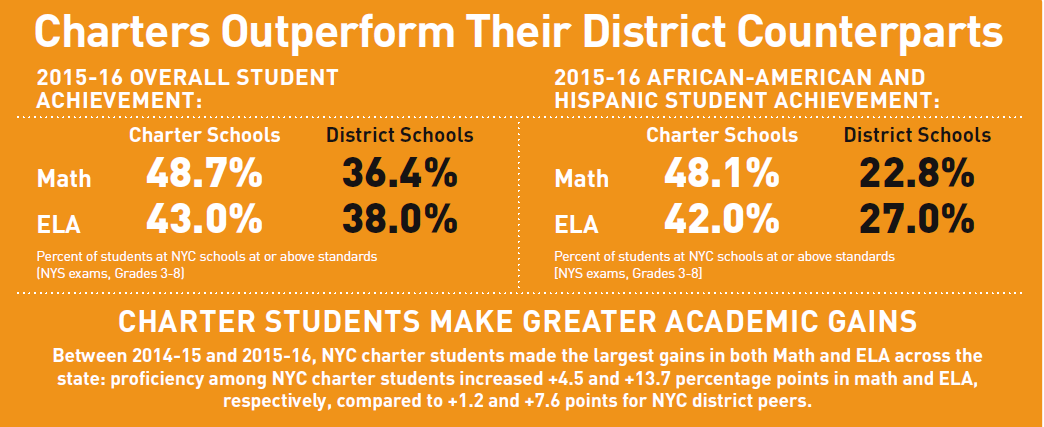
For example, charter schools are very successful in New York City and especially so for African-American and Hispanic students (see chart below).

capture100

Conclusion.  Charter schools work well when they are done right.  They work especially well for minority children in large urban areas.  These are generally the high-risk kids from low-income families who will benefit the most from a little extra help.

Follow me on Twitter
Follow me on Facebook
 

Can We Trust Donald Trump to Do What’s Best for America?


From a reader of my blog:

You are an eternal optimist. Have you factored in these possibilities:

1. Paul Ryan and others will support the Wall and what it costs.
2.
Immigration control will limit much needed manpower.
3.
Trade wars with Mexico and other countries might severely reduce the output of
the USA.
4.
Tax reform will favor the ultra-wealthy, thus not do much to stimulate the
economy, causing a dramatic increase in the debt.
5.
Defense spending will be massive, thus up with the debt.
6.
Charter schools will lack sufficient oversight, thus poor results will follow.

You seem to convey that Trump will execute a strategy much as you think it should be done. I doubt it.

The above outcomes are unlikely for the following reasons:

  • Trump obviously likes being President, will continue to do so, and will hope to be re-elected in 2020. His re-election prospects will depend almost entirely on his boosting economic growth in order to increase the wages of his key blue-collar supporters.capture97
  • The quickest way to speed up growth is through corporate and business tax reform and deregulation. Trump’s entire team of advisors and cabinet secretaries, as well as congressional majorities, agree on this strategy. These things are likely to get done, sooner rather than later.
  • A trade war with Mexico or any other major trading partner (China, Canada, etc.) will badly hurt the economy. Trump knows this as well as anyone and won’t let it happen. A 20% tariff on Mexican imports to pay for a wall will just transfer the cost to American consumers and will be very unpopular. Trump’s people can figure this out.
  • Having 11½ million illegal immigrants in the U.S. is a significant problem and Trump has a mandate to fix it. His plan is to 1) build a wall, 2) deport the 800,000 or so lawbreakers amongst these illegals, and then 3) figure out what to do with the rest. This sounds to me like a reasonable plan and has a good chance of being successfully implemented.Conclusion. I admit to being an optimist. It keeps me going! I’ll respond to the other specifics (debt, charter schools, etc.) in the near future.

    Follow me on Twitter
    Follow me on Facebook
Fixing Obamacare: Keep it Simple and Low Cost


Straightening out healthcare insurance is a high priority for the new Trump Administration and Congress as it should be. The U.S. spends 18% of GDP on healthcare, public and private, twice as much as any other developed country and this percentage is likely to keep on increasing without major changes.

capture
Republican thought is converging, see here and here, on a plan with these broad features:

  • Repeal of both the individual and employer mandates so that health insurance can be individually tailored and purchased at a much lower cost than under the ACA.
  • A Universal (and refundable) tax credit sufficient to pay for catastrophic insurance coverage.
  • Health Savings Accounts to pay for routine healthcare expenses up to the deductible for catastrophic insurance. Such HSAs could be funded, at least initially, with (refundable) tax credits.
  • High risk pools and coverage for pre-existing conditions. It is estimated that 500,000 people with pre-existing conditions would need protection if the ACA is repealed. This would cost about $16 billion annually, much less than the full cost of the ACA.

Conclusion. Such a plan will insure coverage for all Americans who want it. The high deductibility feature, coupled with HSAs, will strongly encourage healthcare consumers to shop around for the best price on routine care.  Such price consciousness by consumers is the only way (short of a single payer system with severe rationing) to get our national healthcare costs under control.
A modification of such a plan, proposed by Senator Bill Cassidy (R, LA) and Senator Susan Collins (R, ME) would give each state the choice of either keeping the ACA or replacing it with a version of the above plan.  This is a poor idea because the ACA has no cost control and this is what is sorely needed.  In other words, the above plan should be made universal, identical for all states.  Let the states provide and pay for supplemental coverage if they wish.

Follow me on Twitter
Follow me on Facebook


Trump as the Anti-Obama


Donald Trump assumes office with perhaps the lowest favorability ratings of any modern president. According to the New York Times,

  • Mr. Trump’s approval rating is only 40% among all adults and just 46% among likely voters.
  • But a recent CNN poll reports that 48% of adults think he’ll do a good job as president and 61% think he’ll bring back well-paying jobs to economically depressed areas.capture97

Contrast this with Barack Obama’s latest poll ratings:

  • According to Gallup Mr. Obama leaves office with an approval rating of 57%.
  • But Rasmussen reports that only 35% of likely voters think the country is heading in the right direction (with 55% saying that we’re headed in the wrong direction).

I interpret this to mean that the country is largely turned off by Mr. Trump’s crude speech and sleazy behavior, while still liking his economic program.  On the other hand, voters like Mr. Obama personally while disapproving of many of his policies and accomplishments.

All of this leaves Mr. Trump in an amazingly good political position:

  • With unemployment currently at a relatively low 4.7% and the economy fully recovered from the Great Recession, even modest reform in tax policy coupled with energy, healthcare and financial deregulation could provide a significant boost to long stalled economic growth.
  • He is criticized for having no clear cut political philosophy but this means he is free to do whatever makes good sense regardless of ideology. This will be a huge advantage in working with both parties to get things done.
  • He has nowhere to go but up in the polls. Such an increase in personal popularity will create the semblance of forward momentum.

Conclusion. The prospects are indeed propitious for Donald Trump to become a transformational president.

Follow me on Twitter
Follow me on Facebook