Economic Growth and Economic Justice II. What Needs to Happen


In today’s fractious political climate, it is at least widely recognized that skilled blue-collar workers are often suffering from stagnant income growth and/or job loss. Unfortunately, the political parties often disagree on how to address this major problem.  There are several different perspectives from which to view the overall situation:

  • Slow economic growth, averaging only 2% per year since the end of the Great Recession in June 2009. From 1950 – 2000 the economy grew at over 3% per year and produced a prosperous American middle class. Now, with strong headwinds from globalization and constantly improving technology, we badly need faster overall economic growth to provide more and better paying middle class jobs.
  • Income inequality. There is increasing income inequality in the U.S. even though the top 25% or so are doing very well. But raising taxes on the wealthy could slow down economic growth by discouraging new investment. In addition, redistribution of tax revenue to lower income Americans will not give them much of a boost.

  • Income insecurity. This is a huge problem for the many blue-collar workers who are struggling to make ends meet. There are a number of specific government actions which could alleviate this enormous societal problem.
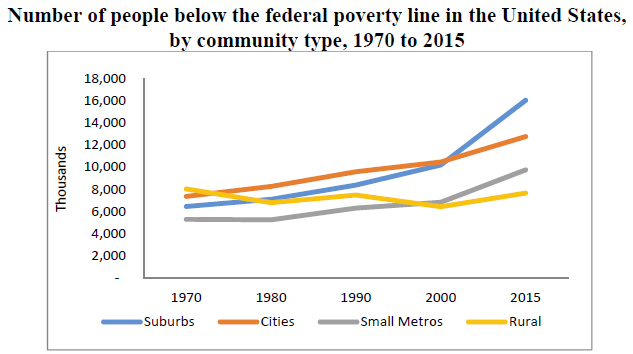
  • Economic justice. Poverty in the U.S. is widely distributed geographically, with almost as much in rural and small town areas as in big cities. This could provide an opportunity for Republicans and Democrats to work together to address a very challenging problem.

Conclusion. Our country has very serious economic and fiscal problems which are not being addressed because of severe partisan infighting in Congress. But slow economic growth, income insecurity and poverty affect a wide variety of people with different political outlooks.  It’s inexcusable to allow partisan bickering to get in the way of finding workable solutions.

Follow me on Twitter
Follow me on Facebook


Economic Growth and Economic Justice I. the Problem

Over and over for the past several years I have been saying on this blog that our country’s two biggest problems are:

  • Slow Economic Growth, averaging just 2% since the end of the Great Recession in June 2012. Such slow growth has led to wage stagnation and job loss for many millions of blue-collar workers.
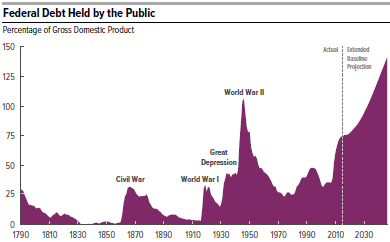
  • Massive debt accumulation, now amounting to 77% of GDP (for our public debt on which we pay interest), the worst it has been since right after the end of WWII. And the Congressional Budget Office predicts that it will continue to get steadily worse without changes in current policy.

Unfortunately, political gridlock in Washington ever since the beginning of the 112th Congress in January 2011 (when the Tea Party took control of the House) has prevented making progress on either of these two problems.  That could perhaps change in the near future with the election of President Trump, at least with respect to faster growth.
But Mr. Trump’s election does not change a fundamental reality.  Many progressives think that 2% growth is the “new normal” or, what’s worse, that any economic growth at all will simply require more fossil fuel use and therefore lead to even faster global warming. Furthermore, while many progressives have little interest in economic growth, they do care very much about economic justice.  They think that the top 1% take home too much income and that, in addition, there is far too much poverty in America.


In today’s Omaha World Herald there is an article about the Human Resources Subcommittee of the House Ways and Means Committee chaired by Rep. Adrian Smith (R, NE).  This subcommittee has jurisdiction over temporary assistance for needy families, food stamps, low-income energy assistance, and unemployment benefits.  It turns out that there is rural and small town poverty almost as much as in urban and suburban areas (see chart).


Conclusion. Poverty exists all over our country and so should be of concern to both Republican and Democratic members of Congress. Perhaps if the two sides can work together on this major issue, they can work together on other important issues as well.  More later!

Follow me on Twitter
Follow me on Facebook

The Magnitude of our Debt Problem


I began writing this blog in November 2012, right after the 2012 national election when Barack Obama was reelected to a second term as President. Under Obama our biggest problems were: 1) slow economic growth (2% annually since June 2009) and 2) massive and rapidly increasing debt, now 77% of GDP.
After the surprise victory of Donald Trump last fall, my perspective has changed a little bit.  Slow growth is still a huge problem.  My last several posts have, in fact, focused on the despair of many blue-collar workers who have been harmed by our stagnant economy in recent years.
Mr. Trump was strongly supported by blue-collar workers last fall and clearly wants to help them out.  Faster economic growth will accomplish this and President Trump is working with the Republican Congress to get this done through tax and regulatory reform.  I’m optimistic that progress will be made along these lines.
But our debt problem has not really been addressed so far by the Trump Administration.  James Capretta from the American Enterprise Institute gives a good summary of where we are:

  • Entitlement Spending is the Problem. In 1972 the federal government spent a combined 4.2% of GDP on Social Security, Medicare and Medicaid. In 2016 spending on these programs was 10.4% of GDP. The Congressional Budget Office predicts that this figure will jump to 13.5% of GDP in 2030 and 15.6% of GDP in 2047 unless current policy is changed.

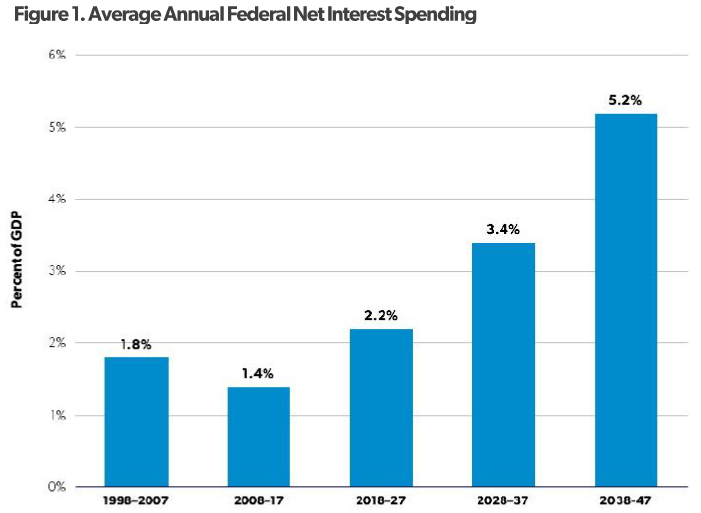
  • The Fiscal Consequences of Interest Rate Normalcy. In 2008 when federal debt was at 39% of GDP, federal spending on net interest payments was 1.7% of GDP. For 2017 net interest payments will be just 1.3% of GDP even though the federal has doubled since 2008. This is due to the abnormally low interest rate of 2.3% at the present time. CBO projects that the interest rate on 10-year Treasury notes will rise to 3% in 2019-2020 and 3.6% for the period 2021-2027.

Conclusion. Right now our huge and rapidly increasing debt is almost “free money” because interest rates are so low. This can’t and won’t last.  As interest rates inevitably climb to more normal levels, interest payments on the debt will rise precipitously.  This will cause much pain by further squeezing spending on many popular programs.  The only sane way to mitigate this highly unpleasant prospect is to shrink deficit spending down to zero as quickly as possible.

Follow me on Twitter
Follow me on Facebook

America’s Huge Challenge: Giving Blue-Collar Workers a Boost


The American economy has been stagnating since the end of the 20th century and has grown especially slowly (2% per year on average) since the end of the Great Recession in June 2009.  This slow growth has various unpleasant causes and consequences:

  • Men without Work. The political economist, Nicholas Eberstadt, has pointed out that the work rate for prime working age (25 – 54) men has dropped from 94.1% in 1948 to 84.3% in 2015. This translates into 9.5 million prime working age men who are not currently in the workforce.
  • Mortality Crisis. The economists, Anne Case and Angus Deaton, show that the mortality rate for working class whites in America, aged 45 – 54, has doubled since 1990, and that these new deaths are largely “deaths of despair.”
  • Complacency.  The economist, Tyler Cowen, makes a strong case that too many Americans are so comfortable in their own worlds that they have become complacent about the structural problems facing American society.
  • Segregation by Class The political scientist Charles Murray has described a separation of American society into a new Upper Class (20% of all Americans) and a new Lower Class (30% of all Americans) with the Upper Class enjoying the four deepest satisfactions of life: family, vocation, community and faith while the Lower Class is largely left out.

What can be done to improve the fortunes of America’s blue-collar workers? There are actually a lot of things:

  • Greatly improve vocational training for the millions of skilled jobs for which there aren’t enough qualified applicants.
  • Revitalize America’s job-generating capacities. More businesses have closed than opened each year since the Financial Crisis.
  • Reverse the perverse disincentives against male work embedded in our social welfare systems. The Earned Income Tax Credit should be extended to single adults without dependents. Eligibility for disability income should be tightened considerably.

  • Come to terms with the enormous challenge of bringing convicts and felons back into society. The huge increase in incarceration rates in recent years has coincided with a dramatic drop in rates for both violent crime and property crime.

Conclusion. It’s a scandal that so many blue-collar workers are struggling to live a fulfilling life. There are many different actions government can take to improve their lot.

Follow me on Twitter
Follow me on Facebook

How Goes the ‘American Project’? II. The Prognosis


Every once in a while we should step back from our country’s everyday problems and look at the bigger picture.  In my last post I pointed out that, while there has been enormous human material progress around the world in the last two hundred years, some prominent thinkers say that the U.S. is now mired in complacency and is at great risk of deteriorating.
In particular, Charles Murray has well described how U.S. society has separated into a new Upper Class (20% of all Americans) and a new Lower Class (30% of all Americans) with totally distinct characteristics and interests. He presents two possible scenarios:

A Hollow Elite, characterized by:

  • The collapse of a sturdy moral code. It has lost self-confidence in the rightness of its own customs and values (marriage, industriousness and civic engagement) and preaches only non-judgmentalism instead.


  • Unseemliness. CEOs make increasingly enormous salaries and receive incredibly huge separation bonuses. Also, hundreds of billions of dollars in government funds are up for grabs as contracts or tax expenditures.
  • Drifting towards the European model of more welfare paid for with higher taxes because paying taxes is a cheap price for a quiet conscience.


A Civic Great Awakening, characterized by:

  • Watching the European model implode. As publicly financed benefits grow, so do the populations who think they need them, and the fewer people there are in the private sector to pay for them. There is no way out of the self-destructive dynamics of the welfare state and America is watching this happen first in Europe.
  • The increasing obviousness of an Alternative. Mr. Murray proposes that our current welfare state be replaced by a guaranteed annual income of $10,000 (in 2002 dollars) for all, phased out at incomes above $25,000. The idea is that such a proposal will become increasingly desirable as our welfare state becomes increasingly unaffordable.
  • The resilience of American ideals. Mr. Murray believes that a civic Great Awakening will take place among the new upper class. He believes that American exceptionalism has a historical basis and that the qualities of industriousness, neighborliness and self-confidence will reassert themselves and put the ‘American Project’ back on track.

Conclusion. Regardless of the specific details of what he foresees, Charles Murray is an optimist and so am I.

Follow me on Twitter
Follow me on Facebook

How Goes the ‘American Project’? I. Background


The main topic of this blog is U.S. fiscal and economic policies and especially, how, and to what extent, they are lacking. But every so often I take a broader perspective.
For example, the Swedish economist, Johan Norberg, has described in detail the remarkable human progress of the past 200 years, starting with the industrial revolution.  The British scholar, Matt Ridley, has given a cogent explanation of what brought about all of this progress.  Conclusion: human life, overall, has improved dramatically in the last 200 years and most likely will continue to improve well into the future.
How are things going in the U.S.?  Not so well, relatively speaking, according to the economist, Tyler Cowen.  He thinks that too many Americans are so self-satisfied with enjoying the fruits of prosperity that as a society we have become complacent about many hidden, but very serious, problems, such as debt, deteriorating life conditions for blue-collar workers, and a huge buildup of internet crime.  This complacency is likely to make America less dynamic in the future.


The eminent political scientist, Charles Murray, has weighed in on this issue with his tour-de-force tome, “Coming Apart: The State of White America 1960 – 2010.”   Mr. Murray describes a new kind of segregation which has developed in the U.S. based on socio-economic class, largely fueled by educational attainment and professional status.  The new Upper Class (20% of all Americans) are largely separated from the rest of society not only by the neighborhoods where they live and their professional employment but also because they are more likely to be married, hardworking and engaged in society.  The new Lower Class (30% of all Americans) has just the opposite characteristics of the Upper Class.
Mr. Murray argues that the four sources of deepest satisfaction in life are: family, vocation, community and faith and that these four main sources of satisfaction have become enfeebled for the Lower Class over the past 50 years.  But the Upper Class is also being hollowed out in other ways.
Conclusion. “Great nations eventually cease to be great,” observes Mr. Murray.  Is America doomed to moral deterioration and decay?  Stay tuned!

How to Counter Political Islam


Let me remind my readers that I am a non-ideological fiscal conservative and social moderate. My two main sources of background information for this blog are the New York Times and the Wall Street Journal both of which I read assiduously on a daily basis.  When they agree on a particular issue, I will probably agree with them.  Otherwise I’m on my own!


In last Saturday’s WSJ there appeared a powerful article, “Ayaan Hirsi Ali, Islam’s Most Eloquent Apostate.”   Ms. Ali explains that “The West’s obsession with ‘terror’ has been a mistake.  Dawa, the subversive, indoctrinating precursor to jihad, is a broader threat.” Here is the gist of her argument:

  • There are 1.6 billion Muslims in the world and at least 10% of them, or 160 million, are Islamists (who practice political Islam). Islamists want to impose Sharia (Islamic law) on society which is fundamentally incompatible with the U.S. Constitution: religious tolerance, the equality of men and women, and other fundamental human rights.
  • The ultimate goal of dawa is to destroy the political institutions of a free society and replace them with the rule of Sharia law. This is accomplished by subversion from within – the abuse of religious freedom in order to undermine that very freedom. The U.S. is in a weak position to combat nonviolent extremism because of the First Amendment which bars Congress from prohibiting the free exercise of religion, etc.
  • There are now 2.6 million Muslims in America and likely to be 6.2 million in 2030. Half say they think of themselves first as Muslims, second as Americans. A fifth of Muslim Americans say there is support for extremism in the Muslim American community.
  • The U.S. government should ally itself with genuine Muslim moderates and reformers, not with “nonviolent” Islamists. The FBI should scrutinize the ideological background and nature of all Islamic organizations. The DHS should deny entry to foreign individuals involved with or supportive of Islamism.

Conclusion. According to Ms. Ali, “We are dealing with a lethal ideological movement. … We have to grasp the gravity of dawa. Jihad is an extension of dawa.  It is dawa by other means.”

Follow me on Twitter
Follow me on Facebook


The Folly of Building a Streetcar System in Omaha


The City of Omaha is now considering building a Streetcar System for an estimated cost of $156 million. Both of the two mayoral candidates have endorsed this proposal.

Here are the basic facts about the project:

  • It would run from TD Ameritrade Park in downtown Omaha to 42nd and Farnam Streets in midtown Omaha, a distance of about four miles. It would cost about $7.5 million per year to operate the line and would generate about $700,000 a year in annual revenue with a fare of $1.25 per ride. Adding a fee of $1.50 per ticket per College World Series event (at TD Ameritrade Park) would generate about $500,000 per year in additional income.

  • The financial assessment of the project by HDR suggests that the Federal Transit Administration could be asked for a grant of $78 million, or one-half of the total cost. The FTA is already contributing $15 million towards a $30 million Bus Rapid Transit system along Dodge Street approved by the City Council. The BRT involves 27 sleek, modern bus stop shelters along the route at a cost of $260,000 each.
  • The FTA has an annual budget of $19 billion. The Trump Administration is asking for a $2.4 billion cut in the FTA budget for 2018.  Congress has not yet taken any action on the Trump Budget proposal. But the FTA budget is clearly funding extravagant local projects around the country and is ripe for a major budget cut.

Conclusion. Omaha is simply not large enough, nor with a sufficiently dense population base, to support a downtown street car system aimed at the tourist trade. It could only be financed with massive federal support at a time when the federal government is rightly trying to cut back on unnecessary and wasteful spending. Don’t do it, Omaha!

The Fading American Dream and Donald Trump


It is now generally accepted that Donald Trump was elected President because of his strong support amongst white blue-collar workers, especially in the battle ground states of Wisconsin, Michigan and Pennsylvania. Mr. Trump was able to persuade these voters that he would be able to raise their stagnant incomes and even bring back the millions of manufacturing jobs which have been lost to automation and globalization.


Now the two economists, Anne Case and Angus Deaton, have shown that mortality rates for white, U.S. non-Hispanics, aged 45 – 54, with a high school degree or less, have doubled since 1990.
Here is the general situation:

  • Overall, U.S. life expectancy at birth has increased from 63 years in 1940 to 79 years in 2010.
  • Life expectancy is still increasing for the college educated as well for U.S. Blacks and U.S. Hispanics. It is also still rising in many other developed countries.
  • The main cause for the rising death rates of the vulnerable group is “deaths of despair” – suicides, drug overdoses and the consequences of heavy drinking.

The authors point out that:

  • It is precisely working class whites whose economic prospects have deteriorated the most in recent years, especially since the financial crisis.
  • The U.S. has moved largely to defined-contribution pension plans with stock market risk in recent years whereas in Europe defined-benefit pensions are still the norm.
  • The current mortality crisis bears a resemblance to the AIDS epidemic which took the lives of 650,000 Americans from 1981 – 2015. However, public awareness of the AIDS crisis was far greater than for the current mortality epidemic.

Conclusion. The basic American dream of home ownership, modest financial and job security and a bright outlook for one’s children has faded for a large class of middle-aged workers. The crisis is manifested in an increase in mortality rates for this vulnerable class.  Donald Trump’s election mandate is to fix this problem but it is a tall order indeed.

Follow me on Twitter
Follow me on Facebook

Keeping Global Warming in Perspective


The evidence for man-made global warming is now overwhelming. For example:

  • The extent of artic summer sea ice is steadily shrinking.
  • The world’s oceans are getting warmer.
  • Spring in the U.S. is coming sooner each year on average.

The three biggest carbon emitters in the world are China, the U.S. and India in that order. But what is also true, and not sufficiently well appreciated, is that carbon emissions in the U.S. are dropping while they are still increasing in China and India:

  • In the 2015 Paris climate agreement, China pledged that it would start reducing carbon emissions by 2030 but, in the meantime, is still continuing to open coal burning power plants.
  • In the U.S. carbon emissions have been steadily decreasing since 2000 (see chart).
  • In India the economy is growing at 7% per year and 240 million people still lack electric power. This means that carbon emissions from coal burning are likely to double in the years ahead.

Coal use in the U.S. will continue to drop with or without enforcement of the Obama era Clean Power Plan because natural gas is now so plentiful and so much less expensive than coal. The best way for the U.S. to continue showing leadership in combatting global warming is for it to adopt a revenue-neutral carbon tax.  This would let the market sort out which type of energy is the cleanest and most efficient in meeting our country’s growing energy needs.  In fact a carbon tax might even be beneficial for the coal industry by creating a strong incentive to develop carbon capture and storage technology.
Conclusion. Most Americans now agree that global warming is real and that this presents a huge threat to human civilization.  It is likely that a revenue-neutral carbon tax will be adopted by our country in the near future.

Follow me on Twitter
Follow me on Facebook