“The Federal Government’s Budget Is on the Road to Hell”


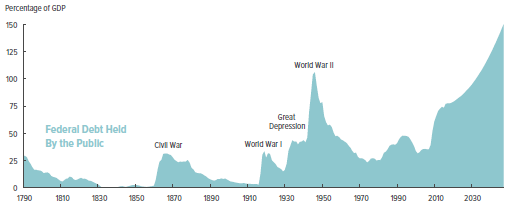
So declared Douglas Holtz-Eakin, former director of the Congressional Budget Office, in March 2011.  At the time, federal debt held by the public (on which we pay interest) stood at 63% of GDP.  Now, just six years later, that ratio stands at 77% and is projected by the CBO to reach 150% by 2047 if current laws remain unchanged.


The CBO has just released its latest (March 2017) report and the debt situation continues to get worse:

  • The interest rate on federal debt has averaged 5.8% over the past 60 years. It is now at an unusually low 2% and the CBO projects that it will climb no higher than 4.4% by 2047. Even with such a conservative projection, the total cost of servicing the debt will rise to almost 1/3 of federal revenue by 2047, compared with just 8% today.

Here are some of the dire consequences of such a large and growing debt:

  • Reduces national savings and income in the long term because more of people’s savings would be used to buy Treasury securities, thus crowding out private investment.
  • Increases the government’s interest costs and thus makes it much more difficult to lower deficits.
  • Reduces the ability to respond to unforeseen events. For example, when the Financial Crisis hit in 2008, public debt stood at 40% of GDP and lawmakers had the flexibility to respond to the crisis with both TARP and a fiscal stimulus. Such costly actions will be much more difficult next time.
  • Increases the chances of a new fiscal crisis if investors become less willing to finance more federal borrowing or demand higher interest rates in return.

Conclusion. The more debt that accumulates and the higher interest rates rise, the more painful it will become to implement a solution. What is really scary is that nothing will be done until a new crisis occurs.  Then we will be forced to act and it will be very painful indeed.

Follow me on Twitter
Follow me on Facebook

Trump’s Bark Is Worse than His Bite


The anti-Trump fervor seems to be slowly dying down as his appointees take hold of their agencies and begin to promulgate new policies. I have expected this to happen because of the excellent quality of many of the people he has appointed.
Here are a few recent developments:

  • Interior Secretary Ryan Zinke has said that “the border is complicated as far as building a physical wall” and there are all sorts of problems to be resolved before it can be done.
  • Reality is setting in with regard to Russia policy “given Russia’s continued provocations in terms of weapon’s deployments, overtures to Iran, cyber intrusions and intervention in Ukraine.”
  • The Brookings Institution has just issued a new report showing that school choice options are increasing in the country’s largest school districts. This indicates that Education Secretary Betsy DeVos is in the mainstream by supporting more choice.
  • Coal jobs Trump vows to save no longer exist.  In other words, cancelation of the Obama Clean Power Plan will have little effect on the huge drop in coal use because coal has become so much more expensive than natural gas.
  • Of course, the Trump 2018 Budget Proposal will be heavily modified by Congress but it does contain some good ideas. Agriculture, Foreign Aid and Community Development Block Grants are all ripe for big cuts.
  • The biggest unknown with respect to administrative action concerns trade policy. The question here is what concessions he can get from China and Mexico without starting a disastrous trade war.

What is mainly lacking at this point is any significant action by Congress on the Trump agenda. What will happen with healthcare reform, tax reform and deficit reduction, for example?

Conclusion. Trump is doing fine so far but it is on relatively straightforward issues under his control. Hopefully he will be able to make progress on the bigger issues as well which require working with Congress.

Follow me on Twitter
Follow me on Facebook


Maybe the GOP Really Is the Stupid Party


The Nobel prize-winning economist, Paul Krugman, more recently turned partisan flack for the New York Times, has occasionally referred to Republicans as “the stupid party.” After the debacle with the House’s American Health Care Act, maybe he is right.  This bill is far from perfect but is a step in the right direction.  Its major virtue is a serious attempt to get Medicaid spending under control.
According to an astute analysis by the Wall Street Journal:

  • The AHCA would put Medicaid on a budget for the first time since its creation in 1965.
  • Medicaid insures more than 72 million people, or one in every five Americans.
  • Medicaid is now the third largest, and fastest growing, program in the federal budget. Federal outlays are now $360 billion per year, more than three times as much as in 2000.
  • The federal government matches between 50% and 74% of state costs for Medicaid recipients, which means that the states have little incentive to control spending by allocating resources toward high quality care for the most vulnerable.
  • A 2013 study by the New England Journal of Medicine found that “Medicaid generated no significant health improvements,” compared to the uninsured.
  • The AHCA would transition federal funding to a per-capita block grant that would grow with an index of medical inflation. In exchange, governors would gain reform flexibility over the current rigid rules.

Conclusion. It is completely nonsensical for the House Freedom Caucus to oppose such an attractive reform plan just because it isn’t perfect. The members of the Freedom Caucus claim to be fiscal conservatives and to support balanced budgets.  And yet they refused to take a simple, practical step to work toward that goal.

Follow me on Twitter
Follow me on Facebook

The United States of Insolvency


To some readers, I am sure, I must sound like a one-note Johnny. I have a fixation on our national debt because it is so massive and so many apparently well-informed people are so complacent about it.  Sometimes I feel like I’m beating my brains out by discussing this issue so often.  But I don’t know what else to do.
I recently came across an article from a year ago in Time Magazine by James Grant, the editor of Grant’s Interest Rate Observer.  Elaborating on Mr. Grant:

  • As recently as 2007 our public debt (on which we pay interest) was $5 trillion and, with an average interest rate of 4.8%, net interest expense was $237 billion. In 2016 we owed $14.1 trillion and paid an average interest rate of 1.8% for an interest payment of $240 billion. In other words, although our public debt has almost tripled in ten years, the interest rate is just over 1/3 of what it was in 2007. So our interest payment hasn’t changed.
  • Interest rates are now starting to head back up. If they return to the 2007 level of 4.8%, then today’s public debt ($14.9 trillion in 2017) would require an interest payment of $715 billion. At the rate of 6.7%, prevailing in the 1990s, today’s debt would require an interest payment of $998 billion. That represents almost 1/3 of today’s total federal revenue.

Here’s a related perspective from Jon Hall who writes for the American Thinker:

  • Most of our debt is financed with 10 year Treasury Notes. “Of the marketable securities currently held by the public as of 9/30/15, $7.4 trillion or 58% will mature within the next four years.” (see GAO chart) In other words, the huge increase in debt over the past 10 years will soon have to be paid for by Treasury. This will almost surely cause more inflation which will lead to a further increase in interest rates.

Conclusion. Unwinding our current debt will require painful cutbacks over a period of years. But right now we are making the problem even worse with continued deficit spending.  How will our increasingly perilous situation ever be reversed?

Follow me on Twitter
Follow me on Facebook

America’s Biggest Problem is Almost under the Radar


I’ve had several posts recently elaborating on the theme of Tyler Cowen’s new book, “The Complacent Class,” that too many Americans have become complacent about the comfortable life which they now enjoy.


Let’s take a different approach today and consider some of the problems which large numbers of Americans really are concerned about:

  • The election of Donald Trump as President. Granted, he just barely squeaked through in the Electoral College with 46% of the popular vote. He makes outlandish statements which have little, if any, basis in fact. But he has appointed many capable cabinet secretaries and other assistants and he listens to them. He adjusts his policies when struck down by the courts. In my opinion he has suffered no major mistakes so far.
  • Increasing income inequality in American society. This is a problem but, as Nicholas Eberstadt has pointed out, the real problem is income insecurity for millions of blue-collar workers. The best solution here is faster economic growth which the Trump Administration and the Republican Congress hope to achieve through tax reform and deregulation.
  • Global Warming. More and more Americans understand the increasing severity of this problem. There is a fair chance that a revenue neutral carbon tax will be implemented in the near future. This would be a big boost toward controlling carbon emissions in the U.S. and would provide more clout in establishing worldwide emission standards as well.
  • A chaotic world. Terrorism will not go away but at least ISIS will soon be defeated as an independent state. Other worldwide threats such as China, Russia and Iran can be managed with a strong U.S. military force undergirded by a strong U.S. economy.

Conclusion. The above problems are considered by large numbers of people to be serious and are therefore being addressed in one way or another. But our biggest problem of all, massive debtis off the radar for much of the political class, including President Trump. It needs to be taken far more seriously than it is before we have another, and much more severe, financial crisis.

Follow me on Twitter
Follow me on Facebook

Things are Looking Good but Can We Afford to be Complacent?


Everybody should read Tyler Cowen’s compelling new book, “The Complacent Class.”  As I have discussed in two recent posts, here and here, Mr. Cowen lays out the thesis that America has lost much of its dynamism in recent years because life has become so comfortable for so many people, especially the professional elites.


But now things are looking even better yet:

  • A global economic upturn is under way, especially in manufacturing.
  • The Federal Reserve is continuing to raise interest rates, confident that fundamental data on employment and inflation (see chart) is looking more and more positive.

  • Progress is being made on fixing the American healthcare system even if it’s not as good as it could be.
  • The Republican Congress and Trump Administration are united in their desire for corporate and business tax reform which will give the American economy a big boost when it gets done.

These trends auger well for the American economy in the immediate future. However there is one very dark cloud on the horizon:

  • Our national debt (the public part on which we pay interest) is now 77% of GDP, the highest since the end of WWII and is predicted by the Congressional Budget Office to keep steadily getting worse without fundamental changes in public policy. In fact, the debt limit, which had been suspended in November 2015, was reinstated by law on March 16. It will have to be raised in the next few months in order to avoid default by the federal government.
  • I fervently hope that the fiscal conservatives in Congress (such as the Republican Study Group and the Freedom Caucus) will insist on real fiscal restraint going forward as their price for voting to raise the debt limit.

Conclusion. We affluent Americans are so wrapped up in enjoying our good fortune that we lose track of a huge problem on the not so distant horizon. Our prosperity is being heavily financed with borrowed money and we will soon have to pay the piper, unless we are willing to bite the bullet.  Do we have the political will to do this?

Follow me on Twitter
Follow me on Facebook


Corporate Tax Reform and the Border Tax


Most informed observers of the U.S. economy agree that the Corporate Income Tax of 35% is too high and should be lowered to a rate which is more competitive with other developed countries. Republican Congressional leaders and the Trump administration have agreed that a 20% rate is about the right level.
Now the question is how to make up the tax revenue lost to the federal government from a lower tax rate.  One idea is to impose a Border Adjustment Tax on imports into the U.S. but exempting exports from such a tax.  Since the U.S. trade deficit is currently running at about $500 billion per year (see chart), a 20% tax on imports offset by a 20% tax credit for exports would raise the necessary $1 billion per year.


This week’s Barron’s points out several disadvantages of a BAT:

  • Economic theory predicts that a 20% BAT would mean that the dollar would rise in value by 20%, offsetting the higher costs of imports. But if this happens, then other industries, such as U.S. tourism, would take a big hit.
  • Other countries could retaliate in ways that would be unfavorable to us and cause a “Trump slump.”
  • If a BAT leads to an increase in exports and a decrease in imports, the $500 billion trade deficit will shrink and so the BAT will bring in less revenue than the predicted $100 billion per year.

The Barron’s article suggests much better ways to make up the $100 billion in tax revenue (on a static basis) which would be lost to a corporate tax rate cut to 20%. For example:

  • A corporate tax rate cut of this magnitude would be revenue enhancing (on a dynamic basis), easily raising an additional $50 billion in tax revenue.
  • The CATO Institute recently compiled a list of corporate welfare programs in the federal budget totaling $100 billion. Eliminating just half of this would save an additional $50 billion.

Conclusion. Cutting the corporate tax rate to 20% from its current level of 35% will contribute significantly to faster economic growth. It should be quite possible to keep such a tax rate cut revenue neutral by cutting back on crony capitalism.

Follow me on Twitter
Follow me on Facebook

The Necessity of Fixing Medicaid


As I have discussed in previous posts, here and here, the American Health Care Act, the GOP replacement for the Affordable Care Act, is a step in the right direction.


One of the best features of the GOP bill is its provisions to revamp the Medicaid program.  The problems of Medicaid are well described by the healthcare expert, Avik Roy, here and here:

  • Medicaid was established in 1965 and now provides healthcare benefits for individuals and families with incomes up to 133% of the federal poverty level.
  • The states pay 40% of the costs on average while only controlling 5% of how the program is operated.
  • The federal Medicaid law mandates a laundry list of benefits which the states must provide. States cannot charge premiums and copays and deductibles are minimal.
  • Medicaid is the largest or second largest line item in nearly every state budget. The only tool states have in controlling costs is to pay doctors and hospitals less than private insurers pay for the same care. This means that fewer and fewer doctors are accepting Medicaid patients.
  • Thus Medicaid enrollees have poor access to healthcare. In fact, their health outcomes are typically no better than for those with no insurance at all.
  • An able-bodied adult on Medicaid receives about $6000 a year in government health-insurance benefits. Yet CBO estimates that five million Americans won’t sign up for Medicaid if the ACA individual mandate is repealed as proposed by the AHCA.
  • AHCA block grants will give states more flexibility to manage Medicaid’s costs in ways which increase access to doctors and other providers. It would also decrease federal outlays for Medicaid by $880 billion in its first decade.
  • AHCA’s goal is to ultimately merge Medicaid for able-bodied low-income adults into the system of tax credits which the AHCA proposes for those above the poverty line.

Conclusion. The AHCA will make Medicaid into a much more efficient, flexible and effective program for serving low-income individuals and families. This represents a first step in the entitlement reform which the U.S. so badly needs.

Follow me on Twitter
Follow me on Facebook


The GOP Can Do Better on Healthcare Reform


The Congressional Budget Office has just released its analysis of the GOP Healthcare Reform Bill, the American Health Care Act, designed to replace the Affordable Care Act.  The Committee for a Responsible Federal Budget has summarized its main features as follows:

  • The AHCA would reduce federal deficits by $337 billion over the next ten years.

  • CBO estimates that there would be 24 million fewer Americans with health insurance under the AHCA as compared with the ACA by 2026, with 14 million fewer Medicaid beneficiaries (see the above chart). The decrease in individuals with employer coverage would result from dropping the employer mandate. The decrease in individual coverages would result from smaller subsidies under the AHCA.

I have previously summarized the AHCA pointing out its strengths and weaknesses:

  • Strengths: discards mandates, fewer regulations, turns Medicaid into block grant program to states.
  • Weakness: huge discrepancy between lavish tax treatment of employer-paid care (no upper limit on tax exemption) and much stingier tax credits for individuals

The U.S. now spends 18% of GDP on healthcare, both public and private, almost twice as much as any other developed country. Such high costs are a big drain on government revenue as well as a drag on economic growth.  The AHCA should take a much bigger step towards controlling the cost of healthcare.  Block granting Medicaid to the states, and giving the states more flexibility in implementation, definitely helps, but it is not enough.
But basic fairness as well as fiscal responsibility requires a major cutback in the tax exemption for employer provided care.  This is essentially a subsidy to employees.  It should have no greater value than the refundable tax credit provided to individuals who purchase health insurance on their own.

Conclusion. A free market healthcare system allows more individual choice and delivers more medical innovation. But our current system is too expensive to be sustainable for much longer.  Either the GOP fixes this problem or a single-payer system will be the inevitable result.

Follow me on Twitter
Follow me on Facebook


Beating the High Cost of Higher Education and Student Debt


This blog addresses America’s too biggest problems:

  • Slow economic growth averaging just 2% since the end of the Great Recession in June 2009. Faster growth means more jobs and better paying jobs.
  • Massive federal debt now 77% of GDP (for the $14 trillion public debt on which we pay interest) and predicted to continue getting worse without a change in policy. As interest rates go back up to normal historical levels the interest payments on this debt will increase greatly and be a huge drag on the federal budget.

As I have reported recently, college costs are growing much faster than healthcare costs which are growing faster than the cost of living in general.  The excessive costs of education and healthcare are, in turn, holding back economic growth.


Regarding the student loan debt problem:

  • For every increased dollar of student aid, college tuition increases 60 cents.
  • Outstanding student loan debt has risen from $200 billion in 1996 to $1.3 trillion today.
  • The highest default rates on student debt occur for community college students (23%) and for-profit college students (18%).

The economist Richard Vedder has made some excellent suggestions for addressing this whole problem:

  • Simplify the entire federal student air system. There should be only two programs, one grant program (Pell grants) and one federal loan program (Plus loans, tuition tax credits, work study, etc.).
  • Give educational vouchers directly to students to empower recipients to weigh costs more closely. These would be strictly limited to low-income students and would be accompanied by modest academic expectations.
  • Require schools to have skin in the game. Schools with abnormally high loan delinquency rates should have to pay a tuition “tax” to the government to help cover costs.

Conclusion. “Financial aid has caused tuition to skyrocket. If we can’t abolish it, we can at least simplify it.”

Follow me on Twitter
Follow me on Facebook