Bush Failures Led to Obama and Obama Failures Led to Trump


As I have previously stated, I voted for Hillary Clinton because Donald Trump is so crude and sleazy even though our country will now greatly benefit from the change which Mr. Trump represents.  This is the way the political process often works.

capture79 Consider that after eight years of George Bush we had:

  • Ongoing war in Iraq and Afghanistan, of which the Iraq war was an unnecessary mistake.
  • $2.5 trillion of additional debt, even after Mr. Bush started out with a budget surplus, compliments of Bill Clinton.
  • An expensive new Medicare Part D prescription drug plan which just makes overall Medicare even less affordable than it already is.
  • The Financial Crisis of 2007-2008 which the Bush Administration could have seen coming if they had been more vigilant.


Under such political circumstances, the 2008 election of the Democratic nominee, Barack Obama, over the Republican nominee, John McCain, was almost inevitable. But then in the next eight years we have experienced:

  • Slow economic growth averaging only 2% per year, ever since the end of the Great Recession in June 2009. The unemployment rate has fallen to 4.9% but there is still a lot of slack in the labor market which holds wages down. This is the main reason for the huge support Mr. Trump had from white blue-collar workers in the election.
  • Massive debt, now 76% of GDP (for the public debt on which we pay interest), the highest since right after WWII and double the debt in January 2009 when Mr. Obama entered office. Such a high debt level means greatly increased interest payments as soon as interest rates go up which they are likely to do anytime. The high annual deficits contributing to the debt mean little budget flexibility for new programs.

Conclusion. Democrats like to say that slow economic growth is “the new normal” which can only be overturned with budget busting new fiscal stimulus. This is a pessimistic point of view which refuses to consider other alternatives.  This is what led to Ms. Clinton’s defeat on November 8.
Follow me on Twitter
Follow me on Facebook

Disruption Involves Taking Chances


I am a fiscal conservative (I want to balance the budget) and a social moderate. I voted for Hillary Clinton for president because Donald Trump is a sleazy person and has such a volatile temperament.  But I’m also in favor of making big changes and Mr. Trump will certainly do this.

capture79As the Economist points out, “his voters took Mr. Trump seriously but not literally, even as his critics took him literally but not seriously.”  The Economist goes on to point out some of the risks involved in making the kinds of changes Mr. Trump is talking about:

    • If Obamacare is repealed, 20 million Americans will lose their health insurance. Yes, but it’s not going to happen this way. Obamacare will end up being modified and improved, not abolished.
  • His tax cuts would chiefly benefit the rich and would greatly increase our national debt. Yes, but the House of Representatives has a much better plan to do this and it is Congress, not Mr. Trump, which will develop a detailed plan.
  • Even if he does not actually deport illegal immigrants, he will foment the divisive politics of race. The illegal immigration problem needs to be solved and Mr. Trump is likely to get this done, with or without a wall.
  • Mr. Trump has demanded trade concessions from China and NAFTA. If he causes a trade war, the fragile world economy could tip into a recession. Blue collar workers, his strongest base of support, have had stagnant incomes for years and deserve some help. If he can increase our exports, blue collar workers will benefit.
  • He wants to reverse the Paris agreement on climate change which would harm the planet and undermine America as a negotiating partner. Global warming is real but the Paris accord does essentially nothing to slow it down. Increased coal use in China and India will more than negate what the U.S. and Western Europe are doing to cut back on fossil fuels.
  • Mr. Trump has demanded that other countries pay more towards their security or he will walk away. NATO members should be doing more on their own and if he can prod them to do this, then NATO will be stronger as a result.


Conclusion. Mr. Trump’s expressed views should be interpreted as initial bargaining positions. They are likely to have the effect of leading to progress on many serious problems which need to be addressed.  The risks involved in the negotiation process are worth taking

Follow me on Twitter
Follow me on Facebook

We Need Fundamental Change and Now We’re going to Get It!


I want to emphasize that I voted for Hillary Clinton on Tuesday because Donald Trump has such a sleazy and mercurial personality. But Mr. Trump was clearly the change candidate and we need change big time.  His strongest base of support is the white working class which has not really recovered from the Great Recession of 2008-2009 and he will surely try to help out these people.

capture79
Here are the changes we need in order of importance:

  • Grow the economy faster. Tax reform, individual and corporate, and regulatory reform are what are most needed. Mr. Trump and the House Republicans are in rough agreement on both of these major initiatives and hopefully the new Republican led Senate will go along. The best kind of tax reform means to lower tax rates and shrink deductions enough to avoid losing tax revenue. This can be accomplished if a real effort is made to do it this way.
  • Begin to shrink our massive debt. This can only be done by major entitlement reform, meaning to control the costs of Social Security, Medicare and Medicaid. Medicare should be transitioned over from a single payer system to a premium support system, consistent with a reformed Affordable Care Act. Healthcare costs can only be contained by giving consumers more skin in the game, meaning higher deductibles supplemented with health savings accounts.
  • More assertive foreign policy. Worldwide peace and stability depend on our own economic and military strength. Right now China, Russia and Iran think they can push us around. President Trump will not let this happen.
  • Trade and immigration policy. Most knowledgeable people agree that international trade is generally beneficial. We simply have to do a better job of retraining American workers who lose their jobs to foreign competition. The key to immigration reform is tougher border security plus an effective guest worker visa program.

Conclusion. The Republican House of Representatives has an excellent plan, “A Better Way,” for American economic, fiscal and social renewal and Mr. Trump is largely supportive of it. This augers well for fundamental progress in the next four years.

Follow me on Twitter
Follow me on Facebook

Election Day 2016: The Fourth Anniversary of this Blog


I have now been writing this blog for four years, beginning right after the presidential election of 2012. I was a candidate in the May 2012 Republican Primary for the 2nd Congressional District of Nebraska.  I campaigned on the platform to “eliminate the deficit.”  I lost to the incumbent Lee Terry who was in turn replaced in office by the Democrat Brad Ashford in 2014.

capture79
The overriding theme of my blog is “how to restore fiscal responsibility to our national government.”   I discuss two fundamental and related issues:

  • Massive Debt now 75% of GDP, the highest level since right after WWII, and predicted by the Congressional Budget Office to keep rising steadily under current policies.
  • Slow Economic Growth averaging just barely 2% per year since the end of the Great Recession in June 2009. Although the unemployment rate is down to a respectable 4.9%, the labor participation rate is also lower than usual. Faster growth would mean more jobs and better paying jobs. It would also mean more tax revenue to shrink our annual deficits.

How should these problems be addressed?  In briefest outline:

  • Balanced Budget Amendment to the Constitution. This is a drastic measure but I see no other way to get the job done. The pressure on Congress is always to create new programs and spend more money, not less. A BBA could be designed in a flexible manner to allow emergency overrides. It could also be phased in by, for example, having an effective date three years after ratification. It so happens that 28 states (out of 34 needed) have now called for a Constitutional Convention to propose such an amendment. (http://bba4usa.org/)
  • Tax Reform, lowering rates for individuals and corporations, paid for by shrinking deductions, would do wonders for encouraging business investment and entrepreneurship, as well as encouraging American multinational companies to bring their foreign earnings back home for reinvestment.

Conclusion. Much more can be done but this would be a very good start.

Follow me on Twitter
Follow me on Facebook

Fiscal Policy after the Election


As the presidential election tightens and the likely margin of victory for either candidate continues to shrink, it becomes ever more apparent that we need a bipartisan approach to solving our most basic problems.  My last post discusses the need for fundamental tax reform to get our economy growing faster to create more and better paying jobs.  Today I remind my readers of the need for better fiscal policies as well to address our massive and steadily deteriorating debt problem.
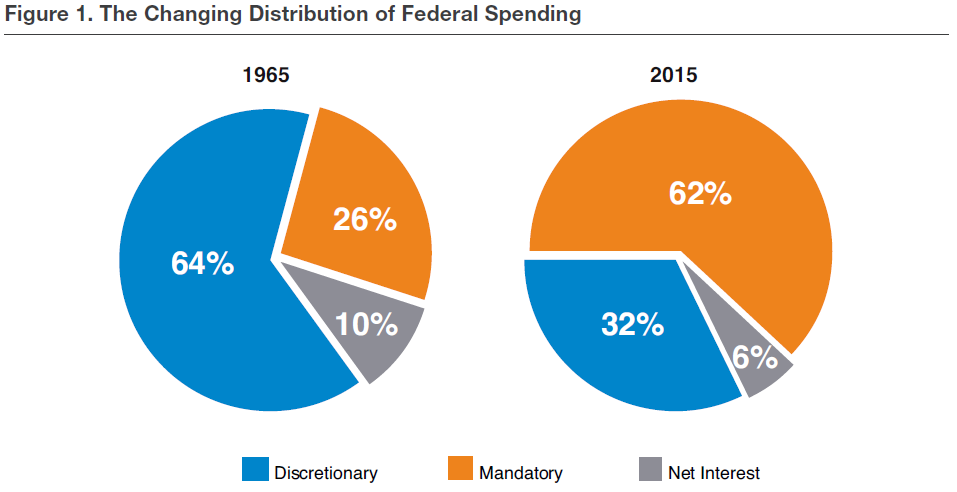
As the American Enterprise Institute,  among many other think tanks, makes abundantly clear, we are spending more and more of our federal budget on entitlements  as opposed to all of the many other federal responsibilities which are lumped together as discretionary spending.  In other words, the only way to fix our deficit and debt problems is to achieve better control over entitlement spending.

capture78
AEI has some excellent ideas on how to do this:

  • Social Security should move towards providing a universal flat benefit, set at the federal poverty level, for all U.S. residents aged 65 and older. Social Security would then become a guarantee against poverty in old age rather than a scheme for partially replacing pre-retirement earnings for middle and higher earning households.
  • Health Care. The Affordable Care Act should be replaced with a less regulated system (i.e. no mandates). The federal tax preference on employer plans could be limited to the cost of catastrophic (high deductible) insurance plus a contribution to health savings accounts. Households without employer coverage would receive a comparable tax credit.
  • Medicare would be converted into a premium support system with a fixed level of support comparable to that provided by employers.
  • Medicaid would be converted into a block grant program for the states based on the fixed, per capita costs for enrolled populations.
  • Other Safety-Net Programs should emphasize work as the key to improved economic prospects plus greater state control over resources in order to encourage innovation.

Conclusion. It should be emphasized as strongly as possible that the purpose of entitlement reform is to preserve and strengthen entitlements, not to weaken or destroy them.  Without such action we are headed for a much worse financial crisis than the one we had in 2008-2009 which will put all government social programs at risk.

Follow me on Twitter
Follow me on Facebook


How to Get Our Country Back On Track


In my last two posts, here and here, I have said that I like some of Donald Trump’s policy ideas but he is too personally repugnant for me to support and vote for.  Hillary Clinton is morally less objectionable than Mr. Trump but her economic policy proposals are unlikely to have much success.
capture66The best hope for our country is to keep the Republicans in control of the House of Representatives.  They have put together an excellent plan, “A Better Way,” for reviving the American economy and boosting the American spirit.  Its main principles are:

  • Poverty. Every capable person is expected to work or prepare for work. Poverty fighting programs will be directed to get people back on their feet. The poor will have more opportunities to succeed at every stage.
  • National Security. It is a top priority to defeat radical Islamic extremism. We must restore American influence, advance free enterprise and expand the community of free nations.
  • The Economy. We need to take a smarter approach that cuts down on needless regulations while making the rules we do need more efficient, especially for our small businesses.
  • The Constitution. Agencies and bureaucracies should be subject to more scrutiny from Congress. Give Congress more say – and the final word – over what is being spent and why it is being spent.
  • Health Care. Individuals should have more control and more choices in order to improve quality and lower costs. No one should have to worry about having coverage taken away regardless of age, income or medical conditions.
  • Tax Reform. The tax code should be simpler, fairer and flatter while remaining progressive. It should be constructed to create jobs, raise wages and expand opportunity for all Americans.

Conclusion. These principles are widely supported by almost all Republicans in Congress and are more important than specific differences on immigration, trade, or entitlement policy.  Their serious consideration depends upon returning a Republican controlled House in 2017.

Follow me on Twitter 
Follow me on Facebook

How Will Hillary Clinton Do on the Economy?


With Donald Trump dropping in the polls, whirling out of control and unwilling to withdraw from the race, my attention now turns to Hillary Clinton and what she is likely to do as President. I divide this discussion into good news and bad news.

capture73
First the good news:

  • A leading democratic economist, Larry Summers, is on record as strongly supporting faster economic growth.  However, he seems to think that public investment (i.e. more public spending) is the best way to achieve this.
  • The House of Representatives is likely to remain in Republican hands after the 2016 election, even if the margin of control is reduced. The Republican House has an excellent plan to boost economic growth and presumably will be able to bargain for pro-growth policies.

Unfortunately, the current Clinton tax plan is anti-growth. As analyzed by the Tax Foundation, her plan would:

  • Give individuals with an AGI over $5 million a 4% tax surcharge. Taxpayers with an AGI of $1 million or more would pay a 30% minimum tax (Buffett Rule). Carried Interest would be taxed at ordinary income rates. Short term capital gains would be taxed at higher rates up to 39.6%. Most itemized deductions would be capped at a tax rate of 28%. Taxes on small businesses and startups would be reduced.
  • Lead to a 2.6% overall lower level of GDP which would lead to lower levels of wages and jobs.
  • Raise $1.4 trillion in new revenue over the next decade on a static basis which would only really produce $663 billion because of slower growth.
  • Devote all of the new revenue to new spending programs and therefore achieve no deficit reduction and more likely an increase in annual deficits.

Conclusion. The Clinton tax plan has some attractive features such as reducing taxes on small business. But overall it would slow economic growth in the name of reducing income inequality.  A Republican House in the new Congress would likely be able to bargain for a much better plan.

Follow me on Twitter
Follow me on Facebook

Donald Trump Should Withdraw from the Presidential Race


Like many other fiscal conservatives I have been overlooking Donald Trump’s moral failings in hopes of electing a president who would be able to disrupt our current economic stagnation and move the U.S. towards faster growth which is the only way to achieve broad-based prosperity.
capture72But at some point we all have to say that enough is enough and the appearance last week of the video with lewd remarks about women is the tipping point for me.  Even though I can no longer support or vote for Mr. Trump, I would like to summarize where I agree (and disagree!) with him on various issues. In decreasing order of importance:

  • Massive Debt. Mr. Trump at least talks about our almost $20 trillion national debt (and large annual deficits) even though he has made no proposals to deal with this problem. Mrs. Clinton has shown even less interest in this issue.
  • Tax Reform. Mr. Trump wants to lower tax rates for both individuals and corporations in order to stimulate economic growth. This is a very good idea as long as the tax rate cuts are made revenue neutral by closing loopholes and shrinking deductions. The Republican House has an excellent plan, “A Better Way” to accomplish just this. Hillary Clinton talks far more about economic inequality than about growth.
  • Regulatory Reform. Mr. Trump specifically mentions both the ACA and Dodd/Frank as being harmful to economic growth whereas Mrs. Clinton defends them.
  • Trans-Pacific Partnership trade deal. Mr. Trump opposes both TPP and NAFTA. Fair trade deals create more jobs than they destroy. Furthermore they produce lower priced products for everyone which boosts the economy. Wage insurance and better retraining programs will help those who lose their jobs due to foreign competition.
  • Immigration Reform. We need to solve our illegal immigration problem and Mr. Trump would probably be able to accomplish this, one way or another.

Conclusion. At this point it is pretty clear that Mrs. Clinton will be our next president. If the Republicans retain control of the House of Representatives, and she is willing to work with them, there is at least a chance to make progress on the growth issue.

Follow me on Twitter
Follow me on Facebook

The Obama Economic Record


The readers of this blog know that I focus on what I consider to be the two biggest problems affecting our economy: 1) slow growth averaging just 2% per year since the end of the Great Recession and 2) our massive debt now equal to 75% of GDP (for the public part on which we pay interest) and predicted to keep growing steadily under current policy.
I have also made it clear that I am not pleased with the economic policies of either of the two main candidates for president, Hillary Clinton or Donald Trump.  Whichever one of them is elected, our best hope for the future is that she or he will have to work with the Republican House of Representatives which has an excellent plan, “A Better Way,”  for renewal.
capture71But, of course, the next president will take up where Barack Obama has left off.  The current issue of the Economist has an essay, “The Way Ahead,” in which Mr. Obama identifies several challenges:

  • Boosting productivity growth. The above chart from his essay shows how much productivity growth has declined in the last ten years. He claims that the corresponding lack of investment is caused by an anti-tax ideology which rejects new funding for public projects, which in turn can be blamed on a fixation on deficits in spite of our skyrocketing debt problem. The House plan correctly identifies tax and regulatory reform as what are needed for progress.
  • Combatting rising inequality. An expanded Earned Income Tax Credit will definitely help here but mainly what is needed is overall faster economic growth.
  • Insuring that everyone who wants a job can get one. Wage insurance and better retraining programs for laid off workers are good ideas. But again, faster economic growth is what is really needed.
  • Building a resilient economy which is primed for future growth. Mr. Obama says that “America should also do more to prepare for future shocks before they occur.” This is exactly why we urgently need to start shrinking our debt now before the shock of higher interest rates leads to huge increases in interest payments on our rapidly growing debt.

Conclusion. Let’s give Mr. Obama credit for avoiding another depression after the Financial Crisis. But his poor policies are to blame for the very slow rate of recovery ever since.

Follow me on Twitter
Follow me on Facebook


Fiscal Irresponsibility: Our Country’s Most Fundamental Problem


As a fiscal conservative, I am worried about our nation’s future. The public debt (on which we pay interest) is now 75% of GDP, the highest level since right after WWII, and growing steadily.  Furthermore, our economy has just barely recovered from the Great Recession and is expanding too slowly to revive widespread prosperity.  Neither of the two main presidential candidates, Hillary Clinton nor Donald Trump, is talking seriously about our huge debt and neither has a credible plan to boost economic growth.

capture70
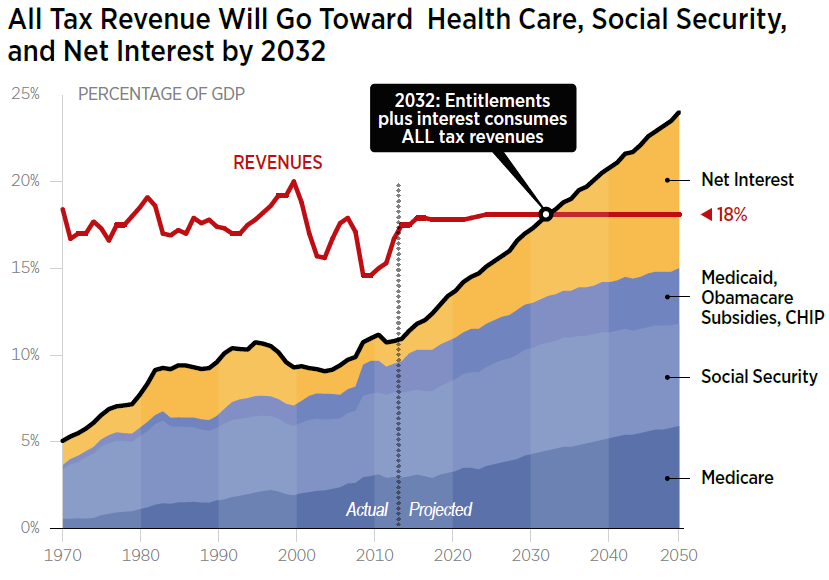
The above chart from the Heritage Foundation is a vivid way of illustrating this problem:

  • Already entitlement spending (Social Security, Medicare and Medicaid), and interest payments on our debt, use up 2/3 of all federal tax revenue. And spending on each of these entitlement programs is growing faster than the economy as a whole. Interest rates will eventually rise from their current rock bottom level. When this happens, interest payments on our growing debt will increase rapidly.
  • In 2032, just 16 years from now, spending on entitlements and interest payments is projected to consume all federal tax revenues, assuming a steady 18% of GDP level for tax revenue.

There are three possible ways to offset this bleak picture:

  • Speed up economic growth. This should, of course, be possible but it will take a major shift in thinking to accomplish.
  • Increase federal tax revenue. Suppose that federal tax revenues were raised by 1% of GDP, or $180 billion per year. This would at least temporarily put our debt on a downward path (as a percentage of GDP). But it would be very hard to accomplish politically. Mrs. Clinton, for example, has proposed raising taxes by $100 billion per year which she wants to spend entirely on new programs rather than reducing our annual deficits.
  • Reform entitlement programs. This is by far the best way to address our debt problem, and the only effective way in the long run.  But, again, it will be very hard to accomplish politically.

Conclusion. If the U.S. cannot get its debt and slow growth problems under control, it risks losing its status as the world’s major superpower. This would be a calamity for both our own national security and the peace and stability of the entire world.

Follow me on Twitter
Follow me on Facebook