The Quality of American Health Care


One of the most common themes on this website is the high cost of American healthcare. What I am saying is that our annual deficits are way too high and that our accumulated debt is increasing too fast.  Furthermore, the only way to get the cost of healthcare entitlements, Medicare and Medicaid, under control, is to get the overall cost of private healthcare under control as well.  And, of course, I support specific policies to do just this.
CaptureIt so happens that I have just had a major interaction with the American healthcare system in Omaha NE where I live.  I go jogging first thing in the morning, five days a week, all year around.  I have done this all my life and have never had a problem – until last Monday morning when I slipped on some ice, fell down and fractured my wrist.  What I did then was:

  • Call off my 8:00 A.M. Calculus class
  • My wife, Sharon, took me to a Minor Medical facility at 8:00 A.M. just as it opened.
  • The facility x-rayed my wrist and determined that I had broken several bones.
  • They then located an orthopedic surgeon who could see me the same day at 2:50 P.M.
  • The surgeon scheduled me for surgery the very next morning.
  • The surgery was successful and I am now recovering.
  • In other words, 30 hours after my accident occurred, I had had an intense inter-action with American medicine and came through with flying colors.
  • To say the least, I am very impressed with the quality of the facilities and healthcare professionals with whom I interacted.

It may cost an arm and a leg for this superb medical treatment but then I have excellent health insurance which I have seldom had to make use of.
Conclusion: Although we must make significant changes in healthcare delivery in the U.S., to make the system more cost efficient, we should try hard to do this without affecting the high degree of quality inherent in the system.

Follow me on Twitter: https://twitter.com/jack_heidel
Follow me on Facebook: https://www.facebook.com/jack.heidel.3

The Big Picture on America’s Fiscal Crisis


The political scientist, James Piereson, categorizes U.S. history, after the founding years, into three primary periods:

  • A Democratic-expansionist regime from 1800 to 1860 which dissolved in the midst of the slavery and secession crisis.
  • A Republican-capitalist regime 1860 to 1930, which was ended by the Great Depression.
  • A Democratic-welfare regime from 1932 until the present, although with faltering support after 1980.

Mr. Piereson makes a persuasive argument that America’s current third regime is in the process of collapsing for three major reasons:
Capture0

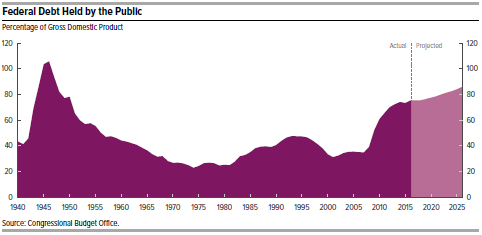
  • Debt. Our public (on which we pay interest) debt today is $13 trillion or 74% of GDP, the highest since right after the end of WWII, and is continuing to climb.
  • Demographics. There are over 46 million Americans aged 65 and older today and this number is growing much faster than the overall population. The same for the number of people on Medicare (48 million) and Social Security (58 million). There will soon be only two workers for each retiree. How are we going to pay for the rapidly increasing costs of old age in the U.S.?
  • Slowing Economic Growth. We know that economic growth has averaged only 2.1% a year since the end of the Great Recession in 2009. The economist Robert Gordon makes a strong argument, here and here, that the rate of economic growth is declining for fundamental reasons which will be very hard to counteract.

There are lots of proposals to reform entitlement programs or to rewrite the tax code to stimulate more economic growth. As Mr. Piereson says, such proposals make sense on paper but they are unlikely to be adopted.  “The clearest obstacle to any preemptive solution is the polarization of the two major political parties.”  Democrats have moved leftward and Republicans have moved rightward.  “Polarization is characteristic of regimes as they begin to tear themselves apart in conflicts which defy resolution within the existing structure of politics.”
Any number of events or developments could throw the system into a terminal crisis which would make it difficult for the U.S. to pay off the many commitments it has made.  Such an upheaval would amount to the “fourth revolution” in our nation’s history.  A serious prospect indeed!

Follow me on Twitter: https://twitter.com/jack_heidel
Follow me on Facebook: https://www.facebook.com/jack.heidel.3

Why the GOP Should Reconcile with Donald Trump II. How to Do It.


As I have stated over and over again on this blog, It Does Not Add Up, my greatest concern for our country is the lack of fiscal responsibility amongst our national leaders.  The public debt (on which we pay interest) is $13 trillion, which is 74% of GDP.  This is way too high for peacetime and, furthermore, it is very likely to just keep getting worse until serious steps are taken to shrink it (as a percentage of GDP).
CaptureIt is my opinion that the Republicans are more serious than the Democrats about fixing this problem.  Therefore I want the Republicans to nominate a presidential candidate who has a good chance of being elected in November.  I don’t know if Donald Trump is that candidate but he is attracting a whole new group of people to the Republican cause.  They are working class whites who have fallen away from the Democratic Party.
Republicans can reach these voters, as Trump is doing, with suitable policies such as:

  • Immigration. Rather than “Comprehensive Immigration Reform” which would put most of our current illegal immigrants on a path to citizenship, we should adopt the principle, “All the immigrants we need but only the immigrants we need.”  A tightly constrained Guest Worker program, enforced with border control and eVerify, would accomplish this.
  • Free Trade. Trade agreements are still possible but need to include provisions like Trade Adjustment Assistance or other programs to help retrain laid-off workers for the millions of well paying, high skill jobs in the U.S. which are hard to fill.
  • Tax Policy. Rather than skewing tax cuts mainly for the wealthy, as most of the Republican candidates propose, they should be applied equally to all income levels, and fully paid for by shrinking deductions which mostly benefit the wealthy. This would put more money in the pockets of all middle income workers and create more and better jobs at the same time by speeding up economic growth.

Conclusion. Donald Trump has lots of negatives as a presidential candidate but Republicans can, and hopefully will, learn a lot from his very successful campaign so far.

Follow me on Twitter: https://twitter.com/jack_heidel
Follow me on Facebook: https://www.facebook.com/jack.heidel.3
Why the GOP Should Reconcile with Donald Trump


I am a non-ideological fiscal conservative. I don’t judge government as being either too large or too small.  I just want to pay for however much government we do have without going into debt.  Such an approach normally leads to political compromise whereby Congress tries to operate efficiently and hold costs down, only raising taxes as a last resort when it is impossible to squeeze any more low priority programs out of the system.
Such common sense used to be a fundamental operating principle, adhered to by both political parties.  Unfortunately in recent years we have moved away from this model.  In fact our public debt (on which we pay interest) has rapidly accumulated to $13 trillion, 74% of GDP, and will continue to grow much higher unless we strongly change our ways.
In some ways our current presidential campaign is following a conventional path.  Both of the major Democratic candidates, Hillary Clinton and Bernie Sanders, want to expand federal programs and raise taxes to pay for the new spending.  The Republican Tea Party candidate, Ted Cruz, is a constitutional and social conservative and wants to cut back on government programs.  The leading Republican establishment candidate, Marco Rubio, supports modest new programs, such as expanding the Earned Income Tax Credit, and also modest tax reform to stimulate the economy.
Capture0The wild card in the presidential race is Donald Trump.  He is a secular populist with unconventional and even contradictory policy views.  He not only leads the Republican field in most polls, he is steadily pulling ahead.  He is doing all this by attracting huge support from working class white voters who have fallen away from the Democratic Party.  In other words, he is potentially expanding the Republican base and therefore should be taken very seriously.
Question. Can a fiscal conservative (who just wants to balance the budget!) but who also wants to address the very serious social problems in American society, support a Donald Trump candidacy for president?  I am struggling with this question.  Stay tuned!

Follow me on Twitter: https://twitter.com/jack_heidel
Follow me on Facebook: https://www.facebook.com/jack.heidel.3
 

Health Care Spending is Driving Budget Deficits


In my last post, “Annual Deficits are Starting to go Back Up,” I refer to a new report from the Congressional Budget Office to show that it is the large annual increases in federal healthcare spending (Medicare, Medicaid, CHIP and Obamacare) which is the main driver of our annual deficit spending which is going to start increasing again unless we do something serious about it.
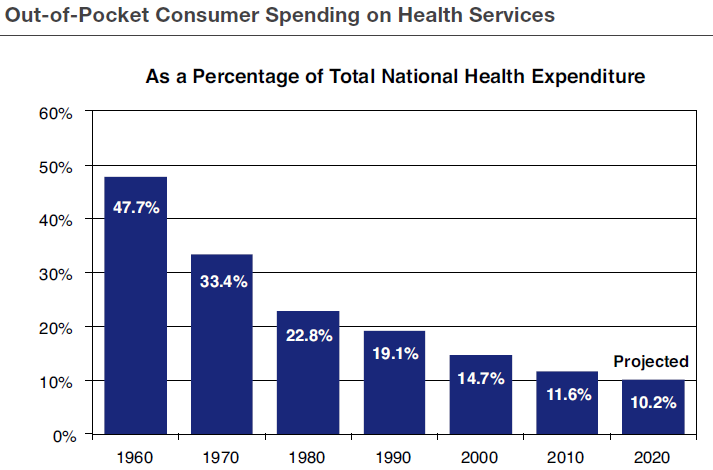
CaptureThe basic problem is, as shown by the above chart, that Americans, in general, don’t have enough skin in the healthcare game, i.e. we don’t pay enough of our health care expenses out of our own pockets, and therefore we don’t directly feel the pain of high and rapidly increasing health care costs.
A group of policy experts from the American Enterprise Institute have come up with a practical plan to address this problem.  Its elements are:

  • Retain employer provided coverage. This is how half of Americans get health insurance. The only change would be an upper limit on the tax preference for employer-paid premiums so that only the most expensive plans would exceed it.
  • Tax Credits. Individuals without employer coverage would get a tax credit with no strings attached to pick any state-approved plan that meets their needs.
  • Continuous coverage protection. As long as people stay insured, they cannot be denied enrollment based on health status.
  • Medicaid reform. The federal government would give states fixed, per-person payments based on historical spending patterns. Able bodied adult and their children could combine Medicaid and the (refundable) federal tax credit to enroll in a private insurance option.
  • Medicare reform. Medicare would provide a fixed level of assistance which seniors would use to purchase a health plan of their own choosing.
  • Expanded Health Savings Accounts. These are intended to be used with catastrophic insurance with a high deductible. HSAs could be established with a one-time $1000 tax credit and unused funds rolled over from one year to the next.

Such a system does not repeal, but rather improves the Affordable Care Act. It keeps the ACA exchanges and introduces cost controls in a flexible manner, i.e. without mandates.  It is the type of system the U.S. needs to get health care costs, and therefore overall deficit spending, under control.

Follow me on Twitter: https://twitter.com/jack_heidel
Follow me on Facebook: https://www.facebook.com/jack.heidel.3

Annual Deficits are Starting to Go Back Up!


As regular readers of It Does not Add Up know well, I am highly alarmed about the large budget deficits and slow economic growth in the U.S. in recent years.  Some people respond that deficits are falling and that we have entered a new era of slow-growth secular stagnation which is unavoidable.
CaptureA new report from the Congressional Budget Office, our most reliable source for objective fiscal and economic information, now predicts that the deficit for 2016 will be $544 billion, a large increase over the $439 billion deficit for 2015.  Furthermore, CBO predicts that for future years deficits will continue to grow, exceeding $1 trillion by 2022. Here is a summary of the CBO predictions:

  • Federal outlays are projected to rise by 6% this year, to $3.9 trillion, or 21.2% of GDP. This represents a 7% rise in mandatory (entitlement) spending, a 3% increase in discretionary spending, and a 14% increase in net interest on the national debt.
  • Under entitlements, Social Security payments will increase by 3% and healthcare (Medicare, Medicaid, CHIP (children’s health) and Obamacare) payments will increase by 11%.
  • Revenues will increase by 4% in 2016, to $3.4 trillion, or 18.3% of GDP.
  • Deficits are projected to increase from 74% of GDP in 2015 to 86% of GDP by 2026.
  • Spending for mandatory programs will increase from 13.1% of GDP in 2016 to 15% of GDP in 2026.

First Conclusion: The spending increases from 2015 to 2016, outlined above, illustrate a clear and alarming trend which is evident in the full ten-year set of CBO data. Discretionary spending will rise but at a sustainable rate of about 3% a year or less.  Mandatory (entitlement) spending will rise at a much faster and unsustainable rate.  It is healthcare spending, i.e. for Medicare, Medicaid, CHIP and Obamacare, and not Social Security, which is driving the rapid increase in mandatory spending.
Second Conclusion:  Although it is government healthcare spending which is driving our rapidly worsening deficit and debt problem, this is just part of the larger problem of the rapidly increasing cost of overall (including private) healthcare spending in the U.S.  This is the basic problem we need to focus on to get both fiscal and economic policy back on the right track.

Follow me on Twitter: https://twitter.com/jack_heidel
Follow me on Facebook: https://www.facebook.com/jack.heidel.3

Another Reason for a Balanced Budget Amendment


I have been writing a lot lately about the need for a Balanced Budget Amendment to the U.S. Constitution. Our public debt (on which we pay interest) is now over $13 trillion and amounts to 74% of GDP.  And this percentage, the highest since the end of WWII, is projected by the Congressional Budget Office to keep growing indefinitely.  Eventually this will lead to another financial crisis, likely much worse than the one we’re still getting over with.
CaptureHere is a vivid example of why it’s so hard for Congress to stop spending more each year than is collected in tax revenue.  Vice President Joe Biden wants to launch a cancer “moonshot”, in honor of his late son Beau who died from brain cancer in May 2015, by “increasing resources – both public and private – to fight cancer.”  This is an apparently attractive but actually poor idea for the following reasons:

  • The annual budget for the National Institutes of Health, which fund medical research, has already been increased by $2 billion for the current 2016 budget year.
  • Major advances in immunotherapy are enabling oncologists to target the surface of cancerous cells instead of using chemotherapy that affects the whole body. But these targeted therapies routinely cost over $100,000 a year per patient.
  • Mr. Biden’s medical advisors are recommending that Medicare start paying for gene sequencing (http://www.nytimes.com/2016/01/14/health/moonshot-to-cure-cancer-to-be-led-by-biden-relies-on-outmoded-view-of-disease.html) to help with these new immunotherapies.

Everyone would like to speed up the war on cancer. But we’re already spending billions of dollars a year on it and cancer researchers are making steady advances.  In other words, we should leave well enough alone on the cancer front and focus on a much more fundamental problem which is already severe.
I am referring, of course, to our excessively large and rapidly growing national debt.  Right now interest rates are at historic lows and so our debt is almost “free money”.  But this is already starting to change and soon interest payments on the debt will be eating us alive.  We’re already in a deep hole but at least we can stop making it any deeper than it already is.
This is exactly what a Balanced Budget Amendment will accomplish.

Follow me on Twitter: https://twitter.com/jack_heidel
Follow me on Facebook: https://www.facebook.com/jack.heidel.3

The Obama Legacy


I have no antagonism for Barack Obama. He was elected because of the unpopularity of the Iraq War and George Bush who started it.  He inherited the Financial Crisis and pulled us out of it without another depression.  He has put us on the road to universal healthcare even though the structure of the Affordable Care Act does little to control costs.
Capture  But overall, the negatives of his presidency outweigh the positives.  Consider the situation we are currently in:

  • Stagnant Economy. The annual rate of growth of GDP since the end of the Great Recession in June 2009 has been an anemic 2% compared to our historical growth rate of 3% since the end of WWII. Although the official unemployment rate is down to a respectable 5%, there are millions of unemployed and underemployed people who have stopped looking for work. Obama and the Democrats in Congress have little interest in the tax reform and deregulatory measures which would boost economic growth.
  • Massive Debt. Our public debt (on which we pay interest) has doubled to over $13 trillion on Obama’s watch. As the Federal Reserve begins to raise interest rates to ward off inflation, interest payments on this debt will increase enormously. It is absolutely imperative to begin to substantially shrink our annual budget deficits. The Democratic Party, under his leadership, has expressed no willingness to do this.
  • Chaotic Middle East. The rise of ISIS in Syria, Iraq and North Africa, and the resulting refugee crisis in Europe is the result of weak U.S. leadership in the Middle East. Peace and stability depends on a strong U.S. presence in all trouble spots around the world. We neglect this responsibility at our peril.
  • Hyper-partisan Political Atmosphere. Stalemate in addressing these and other serious problems has led to the rise of extremist presidential candidates like Bernie Sanders and Donald Trump. Moderate candidates with successful experience in elected office are unable to gain political traction.

Our country is in a big mess. We are being guided by ideology rather than common sense.  I am optimistic by nature.  But it’s awfully easy to be pessimistic about our future.

Follow me on Twitter: https://twitter.com/jack_heidel
Follow me on Facebook: https://www.facebook.com/jack.heidel.3


The Argument for a Balanced Budget Amendment: a Summary


Ever since the end of World War II the strength of the United States has guaranteed world order and stability. As Americans we are especially fortunate to live in such a strong, free and prosperous nation.  But our future wellbeing depends on the soundness of our economy and the integrity of our financial system.   This includes being able to pay our country’s debts in any circumstances.
The public debt (on which we pay interest) is now 74% of GDP, the highest it has been since the end of WWII.  The Congressional Budget Office, our most objective and nonpartisan source for fiscal and budget information, predicts that the debt will continue to rise indefinitely, presumably until we have another financial crisis, which is likely to be much worse than the Great Recession of 2008-09.
Capture0It is almost impossible for Congress to address our debt problem effectively.  Democrats want to spend more money while Republicans want to avoid raising taxes.  The wishes of both can be satisfied only by increasing deficit spending and therefore borrowing more money.  Right now this practice is pain free because interest rates are so low.
But this situation will not last forever and is, in fact, already starting to change.  The Federal Reserve raised short term interest rates by .25% in December 2015 which raises interest payments on the $13 trillion public debt by $33 billion per year.  Warding off inflation will require many more such rate increases in the future.
The only way to force Congress to act on this problem is with a Balanced Budget Amendment to the U.S. Constitution.  27 States (out of a required 34) have called for a Constitutional Convention to propose a BBA.  As more states are added to the list, Congress may decide to propose a BBA on its own.
I have discussed previously how to make a BBA both effective and flexible enough to handle emergencies.  It is likely that the proponents of a BBA would draft it carefully because it would have to be ratified by 38 states in order to take effect.
This is the best argument I can make for a BBA.  I will now move on to other topics!

Follow me on Twitter: https://twitter.com/jack_heidel
Follow me on Facebook: https://www.facebook.com/jack.heidel.3

After Two Years of Steady Job Growth, It’s Time to Bite the Bullet and Balance the Budget!


For the past two weeks I have been I have been complaining about Congress’s irresponsible budget for 2016 and that we should now be pushing hard for a Balanced Budget Amendment to the Constitution.  In my last post I make the case that a flexible BBA is compatible with economic growth and will, in fact, contribute to it once it goes into effect.
CaptureFriday’s job report for December strengthens this argument:

  • In 2015 there was an increase of 2.65 million new jobs only slightly less than 2014’s 3.15 million new jobs, the two best years for job growth since 2000.
  • The current unemployment rate of 5.0% is the best since the end of 2006.
  • Although wage growth at 2.4% for 2015 is not as strong as the early 2000’s, wages have now been climbing 2% faster than price inflation for the past three years.
  • The offsetting negatives are a still slow GDP growth estimated at 2.2% for 2015 and a still very low labor participation rate of 62.6%.

Conclusion:  At some point in the very near future the government needs to stop spending far in excess of tax revenue.  The sooner we recognize this the easier it will be to make the necessary correction.  Our economy is the strongest it has been since the end of the Great Recession in June of 2009.  Getting government spending in better sync with tax collections will be a big challenge and will not happen overnight.  In fact, if a BBA is required to get the job done it will take several years to implement this route to fiscal responsibility.
For all of these reasons now is the time to start moving on this gigantic and festering problem!