Fiscal Irresponsibility: Our Country’s Most Fundamental Problem


As a fiscal conservative, I am worried about our nation’s future. The public debt (on which we pay interest) is now 75% of GDP, the highest level since right after WWII, and growing steadily.  Furthermore, our economy has just barely recovered from the Great Recession and is expanding too slowly to revive widespread prosperity.  Neither of the two main presidential candidates, Hillary Clinton nor Donald Trump, is talking seriously about our huge debt and neither has a credible plan to boost economic growth.
capture70
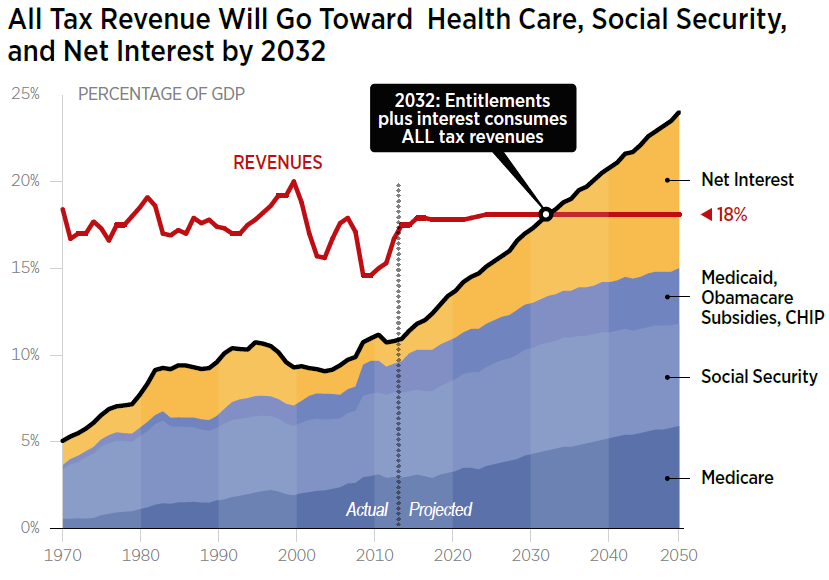
The above chart from the Heritage Foundation is a vivid way of illustrating this problem:

  • Already entitlement spending (Social Security, Medicare and Medicaid), and interest payments on our debt, use up 2/3 of all federal tax revenue. And spending on each of these entitlement programs is growing faster than the economy as a whole. Interest rates will eventually rise from their current rock bottom level. When this happens, interest payments on our growing debt will increase rapidly.
  • In 2032, just 16 years from now, spending on entitlements and interest payments is projected to consume all federal tax revenues, assuming a steady 18% of GDP level for tax revenue.

There are three possible ways to offset this bleak picture:

  • Speed up economic growth. This should, of course, be possible but it will take a major shift in thinking to accomplish.
  • Increase federal tax revenue. Suppose that federal tax revenues were raised by 1% of GDP, or $180 billion per year. This would at least temporarily put our debt on a downward path (as a percentage of GDP). But it would be very hard to accomplish politically. Mrs. Clinton, for example, has proposed raising taxes by $100 billion per year which she wants to spend entirely on new programs rather than reducing our annual deficits.
  • Reform entitlement programs. This is by far the best way to address our debt problem, and the only effective way in the long run.  But, again, it will be very hard to accomplish politically.

Conclusion. If the U.S. cannot get its debt and slow growth problems under control, it risks losing its status as the world’s major superpower. This would be a calamity for both our own national security and the peace and stability of the entire world.

Follow me on Twitter
Follow me on Facebook

Why Slow Economic Growth Is So Dangerous


In my last post I said that Donald Trump won the first presidential debate, in spite of his uneven temperament, because he was more correct on the issues.
One of the biggest problems our country faces is slow economic growth, averaging only 2% per year since the end of the Great Recession in June 2009.  This compares with an average rate of growth of 3.5% from 1950 – 2000.
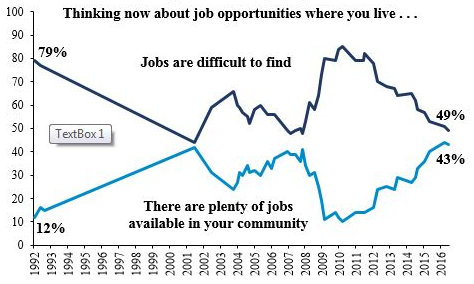
In fact, even the recent job growth we have seen is now leveling off.
capture65Such slow growth is very dangerous long term for many reasons:

  • Massive Debt. Our public debt, on which we pay interest, is now 75% of GDP, the highest it has been since right after WWII. CBO predicts that this percentage will keep getting steadily worse without major policy changes. Faster growth means more tax revenue and therefore smaller annual deficits. It is imperative to put our accumulating debt on a downward path.
  • The Need for More Jobs and Better Paying Jobs. The best way to achieve broad based prosperity, and minimize populist disruption, is to create a tight job market where employers have to compete for employees. This is accomplished by making the economy grow faster.
  • Keeping Ahead of China. In 2009 China’s economy was 1/3 the size of ours; now it is 60% as big. In other words, China will soon surpass us economically if we are unable to grow faster. This would risk losing our worldwide lead in such crucial areas as new technology and financial depth, as well as our superpower status.
  • Reducing Student Loan Debt. The best way we can help former students pay off their college debt is to have good jobs waiting for them when they leave school. The faster our economic growth, the better we can do this.

Conclusion. Both our own individual success in life as well as the overall status of our nation depends upon the availability of opportunity. This is why economic growth is so important and why it is dangerous to let it lag.

Follow me on Twitter
Follow me on Facebook

Donald Trump Needs a More Positive Message


As regular readers of my blog posts know, I am not enthusiastic about either of our two main presidential candidates because neither of them has a good grasp of our two biggest economic problems which are:

  • Slow economic growth, averaging just 2% per year since the end of the Great Recession in June 2009. Faster growth would solve or alleviate many other problems, especially by creating more new jobs as well as delivering faster wage growth for all middle- and lower-income workers.
  • Massive debt now at 75% of GDP, the highest it has been since right after WWII, and projected by the Congressional Budget Office to get steadily worse unless big changes are made in spending and tax policies. Such major changes are difficult to make without presidential leadership.

Hillary Clinton promises “equitable” growth but her policy proposals will lead to a big increase in spending (bad idea) on projects of dubious value in speeding up economic growth. Donald Trump would hurt the economy with immigration controls and trade restrictions.  His proposal for lower tax rates (good idea) needs much improvement to avoid increasing annual deficits.
capture40Mr. Trump’s biggest problem, however, is his negative message about life in America today. Yes, we need stronger border security but we don’t need a Fortress America.  As the American Enterprise Institute has just reported, worker satisfaction is greatly improved since 2009 and workers are now much less anxious about job security than just a few years ago.
There is a really good way for Mr. Trump to sound a more positive note.  He could very easily take up the major themes of the Republican House Plan, “A Better Way” for solving America’s major economic problems.
Conclusion. There is an overwhelming desire for change in America, for new leadership which breaks out of the corruption, cronyism and elitism so rampant in Washington DC today.  But Americans are natural optimists and want a leader who can look forward to a bright future for our country.

Follow me on Twitter
Follow me on Facebook

Why We Should Be Deeply Worried about Our National Debt


My last post is highly critical of the economist and New York Times columnist, Paul Krugman, for encouraging massive new deficit spending to stimulate our under-performing economy.
Debt and the slow growth of our economy are the two main topics of this blog which I have now been writing for almost four years.  How to speed up growth is a complicated and highly charged political issue about which reasonable and well informed people can differ.  However avoiding excessive debt is to me a moral issue whose resolution should not be that difficult, at least in a conceptual sense.
Capture2 I have often used the above chart from the Congressional Budget Office to illustrate our debt problem because it clarifies the problem so vividly.  Here are its main features:

  • Our public debt (on which we pay interest), now about $13 trillion, is 75% of GDP, the highest since right after the end of WWII. And it is projected to keep getting steadily worse under current policy.
  • Note the decline in the debt from the end of WWII until about 1980. This doesn’t mean that the debt was actually paid off but rather that it shrank as a percentage of GDP as the economy grew fairly rapidly during this time period.
  • From 1980 – 2008 the debt level fluctuated and increased somewhat but did not get badly out of control.
  • Debt shot up rapidly with the Great Recession and has been continuing to grow ever since.
  • The current GDP of our economy is about $19 trillion. At a current growth rate of 2.1%, this adds $400 billion of GDP per year. This means that a $400 billion deficit for 2016 would stabilize the public debt at 75% of GDP. But our 2016-2017 deficit is projected to be almost $600 billion (and rising). This is not good enough!

Conclusion. In order to begin to shrink the size of the public debt, it is imperative that annual spending deficits be reduced to well below $400 billion per year. This will be difficult for our political process to achieve but it is the only way to avoid a new and much worse financial crisis in the relatively near future.

Follow me on Twitter
Follow me on Facebook

“A Better Way” for Donald Trump to Make His Case


In my last post, “Donald Trump’s Best Chance to Win in November,” I said that the best way for Mr. Trump to broaden his appeal beyond working-class whites and to have any chance of winning the presidential election is for him to endorse the reform plan, “A Better Way,”  recently developed by the Republican House of Representatives.
Capture9Here is a brief and positive summary of the Trump platform so far:


  • His tax plan is highly pro-growth and will not cost nearly as much as the previously advertised $10 trillion over a decade.
  • He supports legal immigration and simply wants to solve the illegal immigration problem, one way or another.
  • He is not opposed to foreign trade per se but wants to negotiate, from a position of strength, with countries that manipulate their currencies, steal intellectual property or compel companies to disclose trade secrets as a condition of entering their markets.

His policy proposals so described are completely compatible with the House’s “A Better Way” reform plan whose planks are:


  • Poverty. Reward work. Tailor benefits to people’s needs. Improve skills and schools. Demand results.
  • National Security. Defeat the terrorists. Protect the homeland. Defend freedom.
  • The economy. Regulate smarter. End bailouts and cronyism. Put students and workers first.
  • The constitution. Make government more accountable and more representative. Restore constitutional checks on spending.
  • Health Care. More choices and lower costs. Real protections and peace of mind. Cutting edge cures and treatments. A stronger Medicare.
  • Tax reform. Simplicity and fairness. Jobs and growth.


These guiding principles are being fleshed out into complete policy documents. They do indeed represent a better way forward for our national government.  Donald Trump could do far worse than to endorse this comprehensive reform plan developed by the House Republicans.  It would show that he is serious about “Making America Great Again.”

Follow me on Twitter
Follow me on Facebook


The High Cost of U.S. Health Care


As I indicated in my last post, ”Entitlement Spending and the National Debt,” our national debt is much too high and steadily getting worse.  Furthermore, it is entitlement spending, especially Medicare, which is the fundamental driver of our increasing debt.  If we don’t solve this problem relatively soon, we will have another financial crisis on our hands, much worse than the last one in 2008.  When interest rates go up, as they will sooner or later, then interest payments on our accumulated debt will rise precipitously and threaten to bankrupt the nation.
CaptureThe only effective way to control Medicare costs, however, is to control the overall cost of healthcare in the U.S., i.e. for private healthcare.  The above chart shows the nature of this problem.  Right now we are spending 17.4% of GDP on healthcare, public and private, and this is predicted to reach 19.6% of GDP by 2024.  This is almost twice as much as for any other developed country.
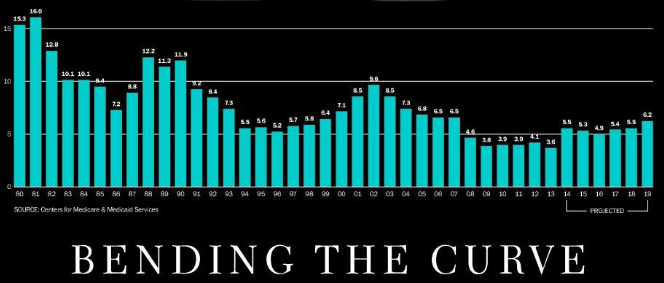
Capture6The Omaha World Herald had an article on Sunday, “Bending the Curve,” purporting to show that cost increases for total national healthcare spending are dropping (see just above).  The problem is that these supposedly low price increases in recent years are still twice the rate of inflation which is now averaging under 2% per year.  This means that even 4% – 5% price increases per year are much too high and need to be curtailed even further.
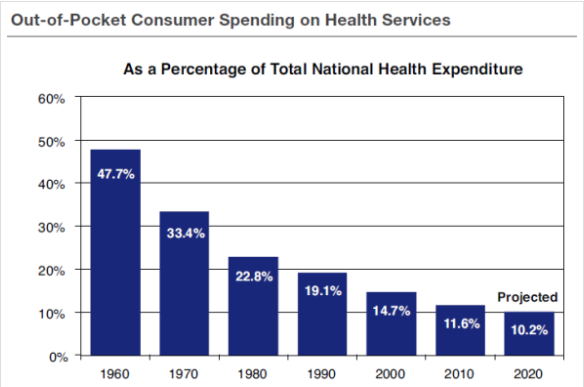
Capture10The fundamental reason why U.S. healthcare is so expensive is that Americans do not have enough “skin in the game.”  The above chart shows that our direct out-of-pocket costs for healthcare have been steadily dropping for the last fifty years as the role of health insurance has expanded.  This means that we simply don’t have enough personal incentive to hold down healthcare spending on our own.
Conclusion: We have to control entitlement spending, especially for Medicare, to get our national debt under control.  But this can only be done by limiting the steep spending increases in overall healthcare, public and private.  How will we be able to do this?  Be patient, we’re getting there!

Follow me on Twitter
Follow me on Facebook

How Progress Has Led to Discord


We were reminded by Robert Samuelson in yesterday’s Washington Post that America has made amazing progress in the last half century.
Consider that in 1960:

  • Men and Women held rigid gender roles.
  • African-Americans were restricted by legal segregation in the South and informal segregation almost everywhere else.
  • Homosexuality was virtually under the radar.
  • There was little environmental regulation.
  • Immigration was not an issue.
  • Defense made up 52% of government spending.

    Capture17

Think about all the (mostly) positive changes which have taken place in the meantime:

  • Women have taken paying jobs by the millions.
  • Racial segregation has been outlawed.
  • Gay rights have been established.
  • Environmental regulation has exploded.
  • Immigration, both legal and illegal, has increased.
  • Social spending has soared.
  • Defense is down to 16% of the federal budget in 2015.

Consider how our national politics is now stalemated:

  • The political system favors extremes.
  • Minorities live largely in big cities where they produce Democratic super-majorities.
  • Rural areas produce Republican super-majorities.
  • Incumbents are insulated from general election challenges which might pull them towards the center but are perpetually vulnerable to primary challenges from extremists who pull them towards the fringes.
  • Ideological purity trumps pragmatism. In the internet and cable-news era, politicians are constantly reassuring their constituents that they haven’t sold out.
  • The center sags and paralysis prevails.

Meanwhile serious national problems are getting much worse and not being addressed. Our public debt (on which we pay interest) is 74% of GDP, the highest since WWII.  The U.S. economy is growing only slowly at the rate of 2.1% per year ever since the end of the Great Recession seven years ago.  Neither presidential candidate has a credible plan to deal with these two most aggravating problems.
As a country we are in a huge mess.  How do we break out of it?  I wish I knew!

Follow me on Twitter
Follow me on Facebook


Can the U.S. Economy Do Better? V. Entitlement Reform


My last several posts, e.g. here, have discussed the question as to whether or not the U.S. economy can grow faster. Even though there are many headwinds to faster growth, there are still various measures to take which will help significantly. Beyond specific policy directions, such as aiding small business and cleaning up and simplifying our tax code, another very important step is to get our fiscal problems, i.e. massive debt, under much better control.
Capture7As made clear in the above chart, there is really only one way to do this.  It is entitlement reform.  In the last 50 years, from 1965 – 2015, mandatory, i.e. entitlement, spending has grown from 26% of the federal budget to 62% and this percentage will just keep growing until something is done to stop it. Along this line, an excellent new report from the American Enterprise Institute, “Increasing the Effectiveness and Sustainability of the Nation’s Entitlement Programs” lays out some basic principles for entitlement reform. They are:

  • Personal Responsibility for Retirement Savings. The idea is to move toward turning Social Security into a universal flat benefit for all U.S. residents age 65 and older. Anyone could supplement this basic income with additional private savings.
  • Market Discipline in Health Care. The idea here is to keep the ACA exchanges with subsidies for low-income households. Employer provided care would have no mandates and a rational and equal tax credit for all. Health Savings Accounts would be liberalized to encourage widespread participation. Both Medicare and Medicaid would provide premium support for basic care. The point is to bolster the consumer’s role in the marketplace in order to slow down the rising cost of healthcare.
  • Promotion of Work for Safety-Net Programs. The federal government spends about $400 billion annually to fight poverty (not counting healthcare programs) with much overlap of federal and state programs. Reform efforts should emphasize work as the key to improved economic prospects as well as greater state control over resources to allow for better coordination of efforts. Two major reform concepts, block grants to states as well as wage subsidies, should be implemented.


We have to get our fiscal house in order, so entitlement reform is not optional. Delay, moreover, could be catastrophic.  If we wait until another crisis hits, then it will no longer be possible to design reforms with gradual adjustments. Now is the time to act!

Follow me on Twitter
Follow me on Facebook

Why Faster Economic Growth Is So Important


The main topic of this blog is addressing America’s two biggest problems which are:

  • Slow economic growth, averaging 2.1% since the end of the Great Recession in June 2009, and
  • Massive public (on which we pay interest) debt, now 74% of GDP and growing, the highest it has been since right after WWII.

In a recent post, “Is America’s Middle Class Really Shrinking?” I showed that middle-income households did very well from 1971 – 2001, while our economy was growing on average at a rate of 3.5% per year.  Middle-income households then stood still from 2001 – 2008, and have lost ground since.
Capture2A vivid example of what has happened in the last 15 years is provided in the article, “My Secret Shame” in the current issue of the Atlantic magazine.  The author describes his own financial hardships supplemented with pertinent data from several sources:

  • In 2013, 47% of Americans responded to a survey that they would have great difficulty coming up with $400 to handle an emergency.
  • The inflation-adjusted net worth of a typical (median level) household in 2003 was $87,992. By 2013 it had declined to $54,500, a 38% drop.
  • A family headed by someone of prime working age, between 24 and 55 years old, and with an income of $50,000, could continue to self-fund its current consumption, if the family were to lose its current income, presuming the liquidation of all financial assets except home equity, for only six days!

As this data clearly shows, many Americans are in a precarious financial situation! The solution to this very serious problem is to speed up the growth of the American economy.  I have discussed how to do this over and over again in previous posts, i.e. here and here.
It is both surprising and disturbing that the presidential candidates are either ignoring this problem or making unserious proposals for how to solve it.

Follow me on Twitter: https://twitter.com/jack_heidel
Follow me on Facebook: https://www.facebook.com/jack.heidel.3

The Fundamental Driver of Our Debt Problem: the Cost of Healthcare


How to grow the economy faster. How to get our rapidly growing national debt under control.  These are the two main problems facing our country which I address over and over again on this blog.  Finding satisfactory solutions to these two problems will determine our future strength and prosperity as a nation.  Today’s discussion is about the major cause of our debt and deficit problem.
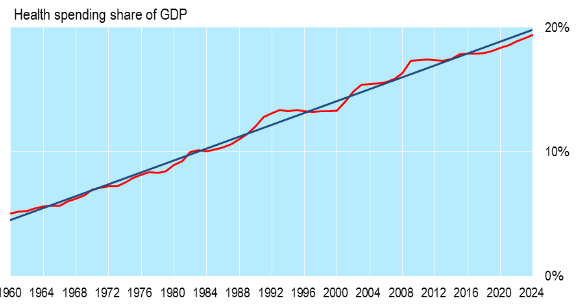
CaptureI recently came across the above chart showing the steady rise of overall American healthcare spending (public and private).  In 1960 it was less than 6% of GDP.  Now it is approximately 18%, a tripling, compared to the overall size of the economy, in just 55 years. Of course it is the cost of public healthcare programs such as Medicare, Medicaid and the Affordable Care Act which directly contribute to our growing deficits and to the accumulated debt.
However we will never be able to limit the cost increases of these public programs until we get the fundamental drivers of private healthcare costs under control. As pointed out (in the chart below) by several scholars from the American Enterprise Institute, the basic reason for the high cost of private American health care is that “we don’t have enough skin in the game” as shown by the chart just below.  We are paying less and less of total healthcare costs out of our own pockets because more costs are paid directly by third party insurers.  This means we have less incentive to control our own healthcare costs.
Capture2The AEI has suggested several reform measures to improve this situation such as:

  • Placing an upper limit on the tax exemption for employer-paid insurance premiums.
  • Expanding the use of Health Savings Accounts to be used in conjunction with high deductible plans.

We have a stark choice in front of us. Either we move in this direction in the near future or we will face another, much worse, financial crisis.  In the latter case we will end up with an inferior healthcare system, much less responsive to our wants and desires.

Follow me on Twitter: https://twitter.com/jack_heidel
Follow me on Facebook: https://www.facebook.com/jack.heidel.3