Global Warming and Debt Are Both Creeping Catastrophes


Three devastating hurricanes have struck the U.S. in recent years: Katrina (2005), Sandy (2012) and now Harvey (2017). Hurricanes and tropical storms are natural events which have occurred since the distant past, long before global warming became a problem.
What has changed is that the oceans are now steadily getting warmer by absorbing much of the heat reflected back to earth by greenhouse gases (see chart).  Warmer water has more latent energy and this makes hurricanes more severe. The warmer the oceans become, the more devastating future hurricanes will be.


It is (past) time to get serious about global warming.  As the world’s strongest country, it is up to the U.S. to provide leadership on this very serious problem.  The best way we can respond is by adopting a (revenue neutral) carbon tax to discourage future carbon emissions as much as possible.  This problem is not going to disappear but it is within our power to limit the damage it causes before it gets a lot worse.
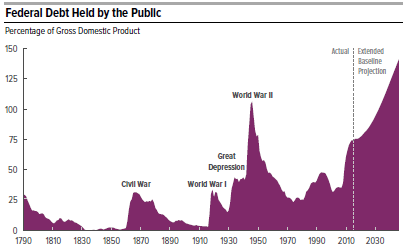
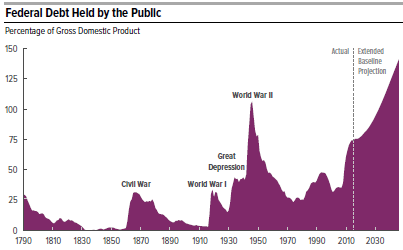
The exact same thing is true about our national debt.  At 77% of GDP (for the public part on which we pay interest), it is the highest it has been since the end of WWII. Right now interest rates are so low that our debt is almost “free money.”  But interest rates will eventually return to more historically normal levels.  When this happens, interest payments on the debt will rise by hundreds of billions of dollars per year.  At that point a severe Fiscal Crisis will not be far behind.
Again, debt is a solvable problem if only our national leaders will take it seriously.  All it requires (so to speak, because it won’t be easy!) is to limit future federal spending in sensible ways.

Conclusion. Both global warming and national debt are serious, urgent problems. The sooner we get started on addressing them, the better off we will be.

Follow me on Twitter 
Follow me on Facebook 

What Do I Mean When I Say I’m a Fiscal Conservative?


Americans are a very fortunate people. We are protected by two oceans and friendly neighbors to our north and south.  We are the strongest country in the world, both economically and militarily.  We provide the world with cutting edge leadership in many areas such as technology, finance, energy production, scientific research and university education.
In short we live in a very successful, prosperous and complex society.  We do have serious problems but they are being addressed by our elaborate legal and governmental processes and structures. Slowly but surely life in America is getting better and better all the time.
Given our country’s size, complexity and dominance in the world, it is inevitable that government will also grow in size and structure in order to take on new responsibilities. It is completely unrealistic to think that we can return to a more limited form of government that existed in the past.
When I say, then, that I’m a fiscal conservative, I am not advocating for less government but merely that we pay for the government that we have, in other words, act in a fiscally responsible manner.


And we are not doing this at the present time:

  • Our national debt, now 77% of GDP (for the public debt on which we pay interest), is the highest since right after WWII. It is predicted by the Congressional Budget Office that it will keep steadily getting worse without major changes in current policy.
  • The urgency of the debt problem is based on the fact that interest rates are now so low that it is almost “free” money. But interest rates will inevitably return to more normal historical levels and, when this happens, interest payments on the debt will skyrocket. Eventually this will lead to a Fiscal Crisis, much worse than the Financial Crisis of 2008.
  • The solution to this problem need not be drastic. Federal spending is growing by 5% per year while tax revenues are growing by 3% per year. If we would just hold spending increases down to 2.5% per year, the federal budget would be balanced in a few years and our debt would start shrinking as a percentage of GDP.

Conclusion. Spending restraint, with very few actual spending cuts, is all that it will take to put our debt problem on a path to solution. Surely we are capable of acting in a fiscally responsible manner like this!

Follow me on Twitter 
Follow me on Facebook 

Should I Run for the U.S. Senate?


For the past almost five years, beginning in November 2012, I have been blogging about fiscal and economic issues facing the United States. With the unemployment rate now down to 4.3%, and the economy growing at 2% annually and likely to pick up speed, our biggest problem by far is an exploding national debt, currently 77% of GDP (for the public debt on which we pay interest), the highest since the end of WWII.
There are two announced candidates so far for the Nebraska Senate seat which becomes open in January 2019:

  • The incumbent, Senator Deb Fischer, a Republican
  • Jane Raybould, Lincoln City Councilwoman, a Democrat.

There is always enormous pressure on members of Congress to maintain or increase spending for popular projects and little pressure to cut anything. In general, Republicans deplore large deficits and debt but are ineffective in implementing fiscal restraint while Democrats simply don’t want to talk about the debt problem at all. I am a non-ideological (registered independent) fiscal conservative and social moderate, highly focused on substantially shrinking our annual deficits over a short time period.


Here are my options for the Senate race:

  • Enter the Republican Primary. I would get almost no traction running against the incumbent Republican in the Primary, even though she is a big spender, and I am antiabortion and support a national 20 week cutoff for most abortions.
  • Run as an independent. This is futile without huge name recognition or financial resources, of which I have neither.
  • Enter the Democratic Primary. The announced candidate has a strong party affiliation which I lack. But she has little chance of defeating Senator Fischer in the general election whereas I could by credibly hammering Fischer as a big spender.

Please respond! Please give me you input on this matter one way or another. My email address is jackheidel@yahoo.com.  Would you support me as a Senate candidate?  Congress badly needs more members who are serious about shrinking our debt and I am such a person.  More later!

Follow me on Twitter 
Follow me on Facebook 


Getting Started on Fiscal Responsibility


This blog is devoted to fiscal and economic issues facing the U.S. Both the Trump Administration and the Democrats are working to speed up economic growth and I believe there is a good chance that this will happen.
However there is not nearly enough interest in addressing an even bigger problem:  our national debt, is now larger, in relative terms, than at any time since the end of WWII.


This is a very difficult political problem because elected representatives would much rather say yes than say no to new programs and more spending.  It is even more difficult to try to restrain the growth of, let alone cut, existing programs.
The Congressional Budget Office has recently published a long list of possible ways to decrease federal spending (or increase federal revenues) over the next ten years. It is interesting to pull out several of these suggestions to see what can be accomplished:

Program                                                                                              10 year savings

  • Eliminate concurrent receipt of retirement pay and disability              $139 billion for veterans.
  • Use an alternative measure of inflation to index mandatory               $182 billion
    programs.
  • Reduce funding for International Affairs Programs.                            $117 billion
  • Limit highway funding to expected highway revenues.                          $40 billion
  • Reduce the size of the federal workforce through attrition                     $50 billion
  • Reduce funding for grants to state and local governments                    $56 billion
  • Impose caps on federal spending for Medicaid                                    $680 billion
  • Increase premiums for Medicare Parts B and D from 25% to              $331 billion 35% of cost.
    Total     $1595 billion

Conclusion. This brief list of budget restraints would reduce deficit spending by about $160 billion per year.   This is significant but not nearly enough compared to the projected deficit of $685 billion for just the 2017 fiscal year alone.  About 2/3 of the savings come from the two entitlement programs of Medicare and Medicaid. The idea here is to give specific examples of the sort of changes which will be necessary to seriously confront our debt problem.

Follow me on Twitter 
Follow me on Facebook 


Why Fiscal Responsibility at the Federal Level Is So Difficult


The United States faces many challenging problems but the biggest one of all is our national debt, right now 77% of GDP, the largest since right after WWII, and predicted by the Congressional Budget Office to keep getting steadily worse without major changes in current policy.
The only practical way to reduce the debt is to start shrinking our annual deficits, $680 billion for the current 2017, down to a much lower level, ideally close to zero, over a limited time period, perhaps ten years or so. This urgent need will, of course, be very difficult to accomplish.
For example:

  • Military spending. The military analyst, Mark Helprin, makes a cogent argument  that the most effective way to defuse the North Korean nuclear threat is for President Trump to ask Congress “for an emergency increase in funding to correct the longstanding degradation of American military power.” This would, among other things, provide for “a vigorous acceleration of every aspect of ballistic-missile defense.”

  • Omaha Rapid Bus Transit. Omaha NE (where I live) is spending $15 million in local funds for a $30 million bus system upgrade, subsidized by the Federal Transit Authority, which has an annual budget of $8.6 billion. The new ORBT will have sleek 60 foot-long buses as well as 27 individual modern bus stop shelters at a cost of $260,000 each. The system will be operational in 2018 and Mayor Jean Stothert says, “I’m looking forward to being one of the first riders.”

Conclusion. Who can argue with upgrading ballistic-missile defense at a time when we are threatened by a madman in North Korea?  And, it is nice for Omaha to have a sleek modern rapid  transit bus system on Dodge Street but should it be 50% subsidized by the federal government at a time when the U.S. is drowning in debt?  There will always be enormous pressure on Congress to increase funding for popular projects.
Who is going to stand up and say no?

Follow me on Twitter 
Follow me on Facebook 

The Major Challenges Facing the U. S. II. National Debt


My last post, “The Major Challenges Facing the United States,” came to the conclusion that, while the U.S. has many big problems to address, our national debt is the biggest problem of all, because it will be so hard to deal with through the political process.
Our total national debt is now $19.9 trillion. The so-called public debt, on which we pay interest, is $15 trillion, or 77% of GDP, the highest it has been since right after WWII.  Furthermore it is predicted by the Congressional Budget Office to keep getting steadily worse, reaching 90% of GDP by 2025 and 150% of GDP by 2047 unless current policy is substantially changed.
Right now our debt is almost “free” money since interest rates are so low.  But when interest rates return to more normal levels, interest payments on the debt will skyrocket by hundreds of billions of dollars per year, likely leading to a new fiscal crisis, much worse than the Financial Crisis of 2008.
The only sane solution to this humongous problem is to start shrinking our annual deficits, this year at about $685 billion, down close to zero over a period of several years.  This will require a painful combination of spending curtailments and perhaps some tax increases as well.


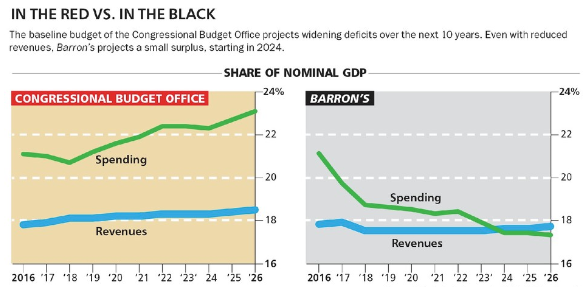
One possible way to accomplish this herculean task has been laid out by Barron’s economic journalist Gene Epstein, see here and here.  Mr. Epstein’s plan would balance the budget in ten years by decreasing projected spending by $8.6 trillion, with 60% of spending curtailments coming from the entitlement programs of Social Security, Medicare and Medicaid and the rest from both military and domestic discretionary programs.
It needs to be strongly emphasized that under the Epstein plan spending would not actually decrease from one year to the next, but would rather grow at a slower rate, from $3.9 trillion in 2016 to $4.7 trillion in 2026.  His plan would decrease the public debt from 77% of GDP today to 58% in 2026.

Conclusion. The U.S. faces the very unpleasant problem of excessive debt which will just keep getting worse and worse without making some relatively unpleasant adjustments in the way that the federal government spends money. The sooner we get started in this process the better off we will be.

Follow me on Twitter 
Follow me on Facebook 

How to Achieve Sensible Tax Reform


Experts across the political spectrum agree that the U.S. tax code is a huge mess and needs to be reformed as well as simplified.  It is also generally accepted that lower tax rates will lead to faster economic growth.
As Congress turns its attention to tax reform, Senate Democrats have stated the basic principles which they would like to see included in any changes which are made:

  • Increase the wages of working families. This could be accomplished by lowering tax rates for all individuals across the board, paid for by eliminating (or at least shrinking) many of the personal deductions in the tax code. The approximately two thirds of all taxpayers who do not itemize deductions would then receive a tax cut, equivalent to a wage increase.
  • Promote domestic investment and improve middle class job growth. Lower tax rates will give businesses and entrepreneurs a bigger incentive to invest in business expansion and therefore grow the economy faster and create more new jobs.

  • Modernize our outdated business and international tax system. Our corporate tax rate at 35% is the highest in the developed world and, at the same time, produces below average revenue (see chart). Another reform would be to adopt business expensing (immediate tax write-off for new investment). Again, all such changes should be paid for by eliminating loopholes and shrinking deductions.
  • Any rewrite of the tax code must be deficit neutral. As important and valuable as tax reform is, it has to take into account our country’s most fundamental problem: our huge and rapidly growing national debt and therefore end up being deficit neutral overall.

Conclusion. The above principles, stated by the Senate Democrats, represent a sound approach to reforming the U.S. tax system. I hope that the Republicans are willing to recognize the validity of these proposals and include the Democrats in developing a bipartisan tax reform plan.

Follow me on Twitter 
Follow me on Facebook 

The Democrats and the Economy II. A Path Forward


On Monday the Democratic Congressional leadership held a rally in rural Berryville, Virginia. They laid out a program designed to appeal to the middle class and blue-collar workers who voted for Donald Trump.  However many of their proposals involve expensive government programs and therefore would add significantly to the national debt.


What is needed is a greater emphasis on free-market ways of helping middle- and low-income workers such as:

  • Increasing basic economic growth which has stalled to a relatively slow 2% per year of GDP since the end of the Great Recession in June 2009. For example:
  • Revenue neutral tax reform, lowering rates for both individuals and corporations, paid for by closing loopholes and shrinking deductions, would have many benefits. It would stimulate business investment, create new demand by lowering the taxes paid by the approximately 2/3 of taxpayers who do not itemize deductions, and provide an incentive for multinational corporations to bring their foreign profits back to the U.S. for reinvestment.
  • Targeted deregulation of the financial sector by exempting main street banks from the onerous requirements of the Dodd-Frank Act would enable these smaller banks to lend more money to small businesses.
  • Fundamental healthcare reform to lower costs from the current 18% of GDP to the approximate 12% average of other developed countries. This would save the American economy $1 trillion annually which could be spent far more productively. The Democrats are on the right track here by refusing to accept Republican half measures.
  • Improve educational opportunities such as early childhood education for low-income families, expanded career education and job training in high school and community colleges, and more emphasis on income-based repayment for student college debt. There would be some cost involved here.
  • Modest increase in the national minimum wage from the current level of $7.25 per hour to perhaps $10 per hour and then index it to inflation going forward. The Democratic proposal for a national $15 per hour minimum wage would put too many people out of work.

Conclusion. This collection of proposals involves both Democratic and Republican ideas and should be implementable with a bipartisan effort.

Follow me on Twitter 
Follow me on Facebook 


The Democrats and the Economy


The Democratic Party is starting to wake up. Donald Trump was elected President because he was able to appeal to blue-collar workers who feel left behind in today’s high tech global economy.
Yesterday the Democratic Congressional leadership held a rally in rural Berryville, Virginia to lay out an economic program to try to appeal to these very same Trump voters.


Such a program, would, for example:

  • Increase people’s pay by lifting the national minimum wage to $15 per hour and also creating jobs with a $1 trillion infrastructure plan.
  • Reduce their everyday expenses by providing paid family and sick leave as well as breaking up large monopolies which can raise prices without restraint. Also empowering Medicare to negotiate lower drug prices for older Americans.
  • Provide workers with the tools they need for the 21st century economy by giving employers, especially small businesses, a large tax credit to train workers for unfilled jobs.

Unfortunately, there are problems with most of these ideas. In Seattle even a $13 per hour minimum wage has significantly reduced minimum wage work. The national minimum wage should be raised but to a more modest level.
There is no demonstrated need for a large-scale publicly funded infrastructure program and it would add hugely to the national debt.
A jobs program to maintain the employment rate for prime-age workers without a bachelor’s degree at the 2000 level of 79% and at a living wage of $15 per hour plus benefits would cost $158 billion per year.


Conclusion. Yes, blue-collar workers are hurting.  Yes, some of the ideas suggested above would help them get ahead.  But many would also increase already large deficit spending and therefore add dramatically to the national debt.  What is needed is a combination of free market initiatives and carefully targeted government programs.  Stay tuned!

Follow me on Twitter 
Follow me on Facebook 


It’s Time for a Bipartisan Approach to Healthcare Reform


The Affordable Care Act was passed by a Democratic Congress in 2010 with no Republican support. It expands access to healthcare but does nothing to control costs which have now reached 18% of GDP and climbing.
The current Republican Senate bill to replace the ACA does attempt to control costs but is unable to attract enough support to pass.
The problem is to achieve both broad access and much lower costs at the same time.  In general, Democrats prefer a single payer system while Republicans want to retain a free market approach.  So compromise will be required.


For example:

  • The tax exemption for employer provided health insurance should be replaced by a universal (and refundable) tax credit for all limited to the cost of catastrophic health insurance (with a high deductible). This will preserve expanded access as well as requiring everyone to pay attention to costs.
  • Tax preferred health savings accounts for routine healthcare expenses should be authorized and further subsidized for low-income families through the ACA exchanges.

  • Medicaid (for poverty-level families) should be put on a fixed federal budget to control runaway costs. States should be given much greater flexibility to direct resources to those with the greatest needs.
  • Redesign of Medicare. Medicare is currently being subsidized by the federal government (after FICA taxes and premiums paid) at over $400 billion per year.  Introducing a defined contribution element into this single payer program will help to hold down costs.

  • Pre-existing Conditions can be covered with suitable enrollment windows and state-run high-risk pools.

Conclusion. The ACA has achieved nearly universal access to healthcare in the U.S. But costs continue to rise sharply.  A universal tax credit combined with health savings accounts for the private market combined with a defined contribution single payer Medicare system has a good chance of getting overall healthcare costs under much better control.

Follow me on Twitter 
Follow me on Facebook