Why the National Debt Is Such a Threat to the U.S.


In my last post I discussed several commonly held myths about the national debt, along the line that it is a fairly minor problem that can easily be solved sometime in the future if we decide that it is important enough to do so.
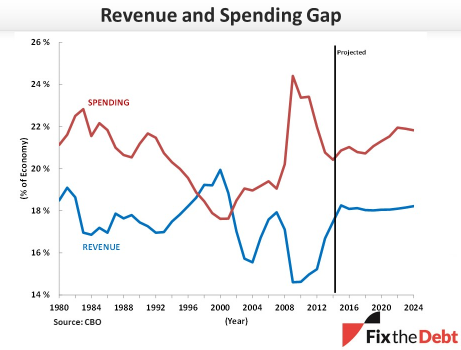
CaptureThe above chart shows that the debt is already very large by historical standards and that it is projected (by the Congressional Budget Office) to just keep getting worse if we continue on our current path of excessive borrowing to pay our bills.
The national organization, “Fix the Debt” lays out very clearly the reasons why our ever-growing debt level is so harmful:

  • It causes lower wages and fewer job opportunities. The debt will “crowd out” productive investments in people, technology and new ventures. The CBO estimates that wages will grow more slowly if debt is on an upward path compared to a downward path. This will amount to an average $7000 wage cut 25 years from now in the year 2040.
  • It leaves less room for investment in infrastructure, research and the next generation. A growing debt means higher interest payments. The CBO projects that interest payments could nearly quadruple from $220 billion in 2013 to about $800 billion in 2024. That leaves far less for investments in education, infrastructure, research, etc.
  • It increases the likelihood of a fiscal crisis. Failure to get the national debt under control could precipitate a crisis where investors are no longer willing to loan money to the government at affordable rates. This could mean large investment losses, tanking markets, mass unemployment, rapid inflation, etc.
  • It means a missed opportunity to grow the economy. Deficit reduction legislation presents an opportunity to enact pro-growth tax reform, improve programs to reward work, re-orient spending to important investments, and capture the economic benefits of putting the debt on a sustainable path.


Let’s hope and pray that our national leaders appreciate the urgent nature of the debt problem and have the political courage to do something serious about it!  
Straight Talk about the National Debt


The deficit for fiscal year 2014-2015 just ended is “only” $483 billion, about 2.7% of current GDP, and some observers are saying this means that our deficit and debt problems are now under control and we should stop fretting so much about them.
CaptureThere is a nonpartisan outfit in Washington DC, “Fix the Debt,” which focuses on this very problem and they’re saying not so fast.  In their document, “Common Myths about the Debt,” they debunk several false impressions about the national debt:

  • Myth: Deficit levels are falling and therefore debt is no longer a concern.
  • Fact: Over the next decade our debt is on track to grow about $8 trillion (see above chart). Its growth will accelerate after 2018 and will exceed the size of the entire economy by 2035.
  • Myth: Deficit reduction is just code for austerity which will ultimately hurt the economy.
    Fact: A comprehensive and gradual deficit reduction plan can replace austerity with targeted and pro-growth reforms which promote economic recovery and accelerate long-term wage growth.
  • Myth: Deficit reduction will harm low-income and vulnerable populations.
  • Fact: Every recent bipartisan deficit reduction plan has included progressive reforms that ask more from those who can afford it and protect low-income programs.
  • Myth: The debt can be solved with faster economic growth.
  • Fact: Economic growth must be part of the solution, but it can’t solve the debt problem alone. Productivity growth would have to be 50% higher over the next quarter century just to hold debt to its current record-high levels.
  • Myth: Taxing the wealthy more will solve the debt problem.
  • Fact: Our debt problems are too large, and the top 1% too few, to solve the entire problem by raising taxes on the wealthy.

Conclusion: Our debt problem is so large that it can only be solved by stern measures, such as tax reform, including reducing tax breaks, and also spending reform to slow the growth of entitlement programs. Stay tuned for further discussion of this critical problem!

Why It Is Imperative to Lower the U.S. Corporate Tax Rate


Several large U.S. corporations have recently announced that they are planning to merge with foreign companies and move their corporate headquarters to a low tax country such as Ireland or Great Britain.  The Obama Administration proposes to disallow such tax inversions by requiring that after such a merger at least 50% of the stock of the new company would have to be foreign owned.  Such a regulatory fix is unlikely to solve a much more fundamental problem.
CaptureThe Tax Foundation has just published a new study, “Tax Reform in the UK Reversed the Tide of Corporate Tax Inversions,” describing a similar situation in Great Britain just a few years ago and what was done to reverse it.  Basically GB took two actions:

  • Implementing a territorial tax system where profits are only taxed in the country where they are earned, and
  • Lowering the corporate tax rate from 28% in 2010 to 21% in 2014 and 20% in 2015. The GB rate had already been somewhat lower than the U.S. rate since the early nineteen-eighties.

These two changes in the corporate tax code have had a dramatic effect. First of all, the number of corporations in GB has been increasing steadily.  By 2017 GB is likely to overtake the U.S. in total number of corporations.
Capture1Secondly, GB actually raises more corporate tax revenue than the U.S. and has been doing so for some years. It should be clear from this discussion that the U.S. should significantly lower its corporate tax rate.
Capture2The biggest problem in doing this is public opinion.  The organization Wallet Hub has just published its “2014 Tax Fairness Survey” which shows that only 10% of the population believes that taxes should be higher on wages than on investment income, whereas 33% thinks the reverse.  An equal tax rate on both is preferred by 57% of respondents.
Capture3This will make it politically difficult, for example, for the U.S. to match GB’s 20% maximum rate on corporations since even middle class U.S. taxpayers pay a tax rate of 25% or higher.  However it might be possible to abolish the corporate tax altogether if dividends and capital gains were then taxed at the same rate as wage income.
The most important thing, however, is to significantly lower the corporate tax rate, one way or the other, in order to incentivize U.S. multinational corporations to keep more of their business and profits in the U.S.

Income Inequality and Rising Health-Care Costs


There seems to be a general consensus on the reality of increasing income inequality in the U.S. and even some agreement on its two main causes: globalization and the rapid spread of technology. The slow growth of the economy since the end of the recession has made the inequality problem that much worse.
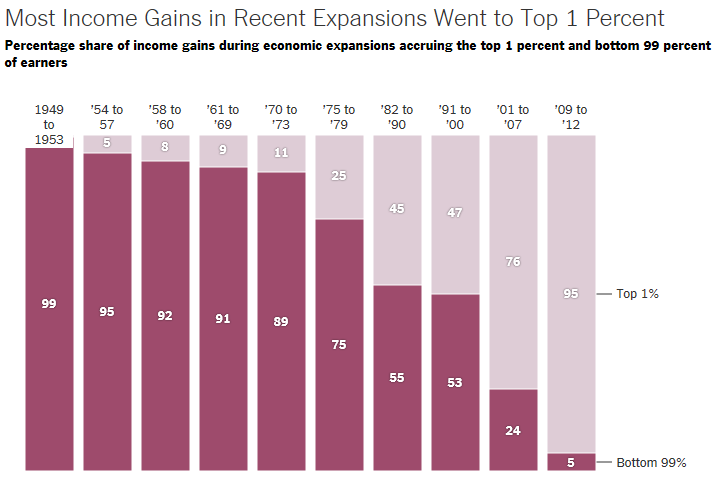
CaptureNot surprisingly, slow economic growth in the past five years has led to stagnant wages for many workers.  My last post addressed this problem.  The above chart from the New York Times shows that incomes for top wage earners have been rising in recent years while they have been stagnant for middle- and lower-income workers.
But there is more to it than this.  In yesterday’s Wall Street Journal, Mark Warshawsky and Andrew Biggs point out that, “Income Inequality and Rising Health-Care Costs,” in the years 1999 – 2006, total pay and benefits for low income workers rose by 41% while wages rose by only 28%, barely outpacing inflation.  For workers making $250,000 or more total compensation rose by a lesser 36% while wages grew by a greater 35%.  This apparent anomaly is explained by the fact that health insurance costs are relatively flat across all income categories, thus comprising a much larger percentage of the total pay package of low-income workers than for high-income workers.
Capture1In fact, the Kaiser Foundation has shown that low-wage workers tend to pay higher health insurance premiums, as well as receiving lower insurance benefits, than higher paid workers (see the above chart).
Overall, what this means is that employer provided healthcare is taking a huge chunk out of the earnings of low-income workers which makes income inequality much worse than it would be otherwise. Of course, the cost of healthcare is a huge burden for the entire U.S. economy, currently eating up 17.3% of GDP, twice as much as for any other developed country.
For both of these reasons it is an urgent matter for the U.S. to get healthcare costs under control.  Avik Roy of the Manhattan Institute has an excellent plan to do just this as I have discussed in several recent posts.

Economic Expansion Is Not Enough


The Washington Post reporter Robert Samuelson gives our economy today a B-, because the unemployment rate has inched down to 6.1%, fulltime employment is up to 105.8 million in 2013 from 99.5 million in 2010, and full-time women’s pay reached a high of 78% of men’s pay in 2013.  The big negative, of course, is that median household income was $51,939 in 2013, down from $56,436 in 2007, just before the financial crisis.
The Bard College economist Pavlina Tcherneva, as summarized by the reporter Neil Irwin in yesterday’s New York Times, shows what has gone wrong with economic and monetary policy since the end of the Great Recession in June 2009. The American Recovery and Reinvestment Act of 2009 (an $850 billion stimulus package) did boost the economy but it primarily aided “the skilled, employable, highly educated, and relatively highly-paid wage and salary workers.”
Capture2On the other hand the Federal Reserve’s quantitative easing policies have kept interest rates remarkably low and have thereby caused investors to buy stocks rather than bonds in order to get higher returns.  This has artificially boosted stock prices and has been especially advantageous to the top 10% and, even more so, the top 1%.
CaptureWhat is needed, according to Ms. Tcherneva, is a targeted, bottom-up approach to fiscal policy, which provides more and better paying jobs directly to middle- and lower-income wage earners.  Her suggestion is for public works jobs, public service employment, green jobs, etc., all of which would require large infusions of federal money thereby worsening the federal deficit.
A much better approach would be broad based tax reform, lowering tax rates across the board, paid for by closing the loopholes and deductions which primarily benefit the rich.  Since the 64% of taxpayers who do not itemize deductions would receive an effective pay boost, this would amount to a tax reform program targeted to exactly the middle- and low-income wage earners who have not yet recovered from the recession.  These folks would most likely spend their extra income, thus further boosting the economy (see my previous post).

Poverty and the Minimum Wage


Americans are a generous and kind-hearted people. We are more than willing to go to bat for the less fortunate among us.  The question is how to do it effectively.  A post six months ago, “A balanced and Sensible Anti-Poverty Program,” laid out four principles for an effective anti-poverty program from Robert Doar of the American Enterprise Institute.  They are:

  • work requirements for welfare recipients
  • work incentives such as the Earned Income Tax Credit
  • fostering married, two-parent families
  • business growth and investment to create more jobs

There is currently much interest in , and public support for, raising the minimum wage at both the state and national levels.  This is viewed by the general public as an effective way of addressing poverty.
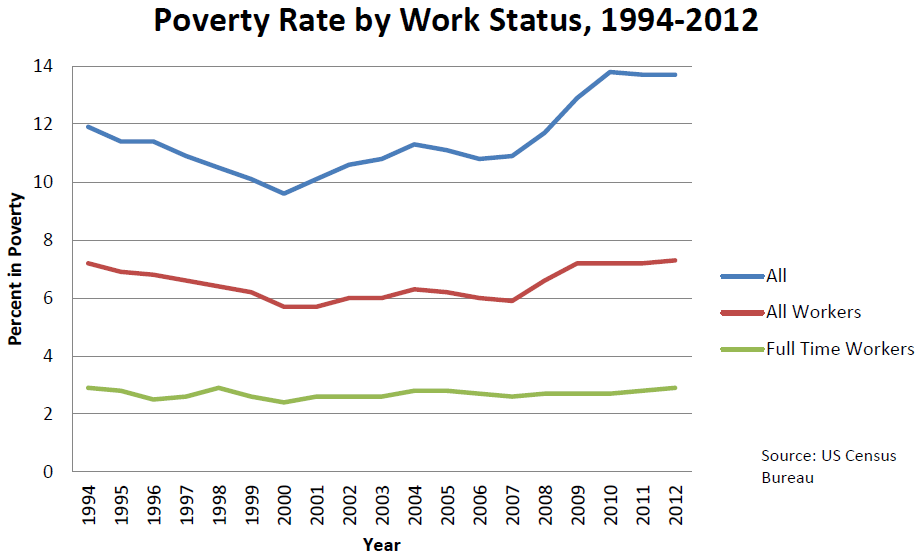
CaptureHowever a new report from Mr. Doar makes clear that simply holding a real job, even with low pay, is what makes the biggest difference as to whether or not someone is able to rise above poverty.  Even though the overall poverty rate in the U.S. is about 14%, the poverty rate for fulltime workers is only 3% and even for part-time workers it is just 7% (see the above chart).
Capture1Furthermore, as detailed in the second above chart, the total income (including selected benefits) of a low-income earner, at $8/hour, with two dependent children, and working fulltime, is $30,204, well above the poverty line.
Conclusion: yes, poor people need public assistance but it is equally important to work with them to find and hold a job, regardless of hourly wage.  Not only will this meet their basic material needs, it will also put them on track to become self-supporting, productive citizens.

Let’s Raise Nebraska’s Minimum-Wage but Not the Whole Country’s


In his State of the Union address last January, President Obama proposed raising the national minimum wage to $10.10 per hour from its current level of $7.25 per hour. The Congressional Budget Office has estimated that this would raise the wages of 16.5 million workers but also put at least 500,000 out of work. At a time of high unemployment, with an estimated 24 million people either unemployed or underemployed, this would be a bad tradeoff.
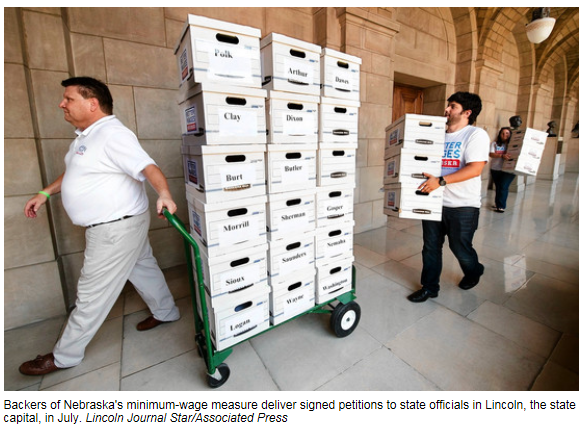
CaptureThe Wall Street Journal reports, “Some Republicans Back State Minimum-Wage Increases,” that five states, including Nebraska where I live, have minimum-wage proposals on the ballot this year. In Nebraska the minimum-wage would increase in two steps to $9.00/hour from $7.25.  Nebraska’s unemployment rate is currently 3.6%, and it is estimated that there are only 27,000 people in the state being paid the minimum wage.  In other words, Nebraska actually has a labor shortage and it is unlikely that a mild increase in the minimum wage will put very many people out of work.
Capture2A minimum wage contributes to fairness but not to growth.  Both are important but growth is the more important of the two.  A minimum-wage increase in Nebraska will increase fairness without hurting economic growth and so I support this.
At the national level, an increase in the minimum wage would increase fairness but also hurt economic growth (by causing substantial unemployment) and so I oppose it.

Which Is More Important: Increasing Growth or Decreasing Inequality?


The progressive Global Strategy Group has recently released a new survey report “Focus on Growth to Frame Priorities” with a valuable message for all political candidates, left, right and center.
CaptureGSG surveyed 3000 registered voters earlier this year and discovered that they overwhelmingly rate economic growth as a higher priority than economic fairness, economic justice, expanding the middle class, increasing wages or decreasing income inequality.  In fact, economic growth trumped all of these alternative policy strategies by wide margins as shown below.
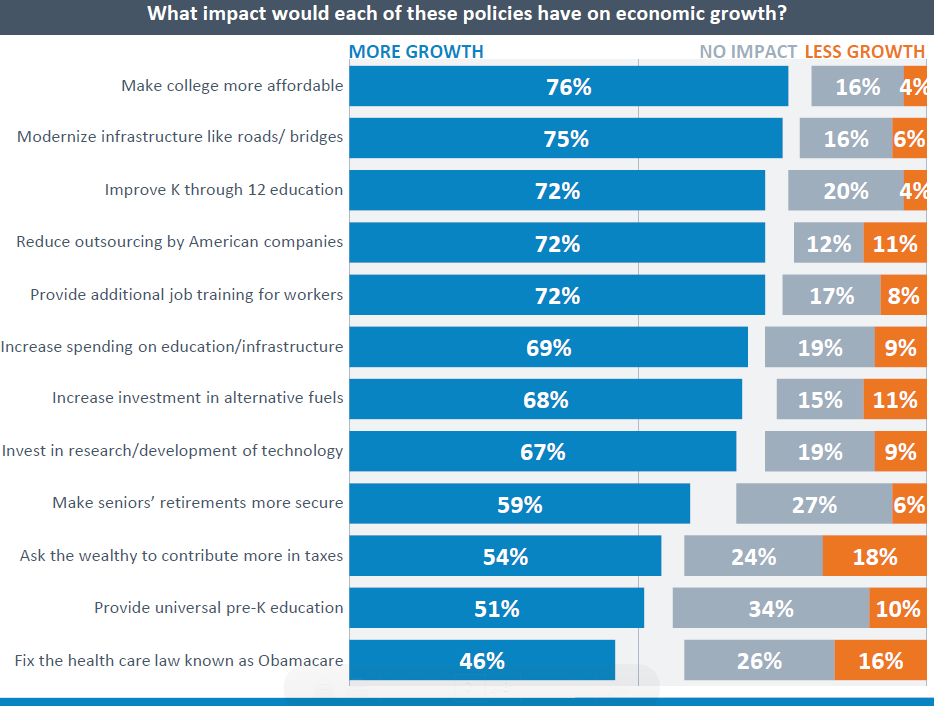
Capture1GSG then goes on to list various possible growth strategies in order of voter popularity such as making college more affordable, modernizing infrastructure, improving K-12 education and others (see below). This list of possible growth strategies is made up mostly of new spending programs.  The less costly might be doable by reforming existing spending programs.  But expensive new programs simply will not fly in today’s high deficit environment.
Capture2What is needed is a growth strategy which does not require new spending.  The obvious choice is tax reform.  For example, the fourth item in the above chart, reduce outsourcing by American companies, could be addressed by reforming corporate taxes.
But an even better growth strategy is individual tax reform whereby tax rates are lowered across the board, paid for by shrinking the many loopholes and deductions which primarily benefit the wealthy.
I described such a plan in detail in a previous post, but here is a brief summary: 64% of taxpayers do not itemize their deductions.  This means that any reduction in tax rates will put money in their pockets.  Since these are primarily the same middle- and lower-income workers with stagnant incomes, they will likely spend most of their increased pay, thus giving the economy a big boost.
In summary, the GSG report provides ammunition for political candidates of all ideological stripes.  Let’s have a contest to see which party can be the most pro-growth.  The winner will be the American people!

Another Voice for Abolishing the Corporate Income Tax: Sheila Bair


My last post “Real Tax Reform: Abolish the Corporate Income Tax,” gives six substantial reasons for abolishing the U.S. corporate income tax.  As shown in the table below, many American companies are keeping large percentages of their total cash balances overseas in order to avoid paying the very high U.S. corporate tax rate of 35% on these funds.
Capture1Sheila Bair, former chair of the Federal Deposit Insurance Corporation from 2006 – 2011, has recently endorsed the same idea in “Why Getting Rid of the Corporate Income Tax Makes Sense”.  Ms. Bair’s recent book, “Bull by the Horns,” is one of the best books written about the financial crisis.
Ms. Bair makes many of the same points as in my last post including the suggestion that in return for totally eliminating this tax, both dividends and capital gains should be taxed at the same (higher) rates as for ordinary earned income.  She points out that applying ordinary tax rates to realized investment income would make up only about $90 billion of the approximately $300 billion annual cost of eliminating the corporate tax.  She suggests that the remaining $210 billion could be raised by implementing Martin Feldstein’s proposal to cap individual tax deductions, excluding for charitable contributions, at 2% of adjusted gross income.
As she says, “We are on an unsustainable path.  Caught between eroding corporate revenue on one side and low tax rates for wealthy investors on the other, middle and upper-income wage earners are being squeezed – and there are only so many of us.  At some point we might start thinking about moving too.”
Keep in mind the fundamental reason for this proposal: to incentivize U.S. companies to bring their foreign earnings back home for reinvestment and distribution of profits to shareholders (who will then be taxed on this income).  This will give our economy the large and permanent boost which it so badly needs to regain its former vigor.

Real Tax Reform: Abolish the Corporate Income Tax


Several large U.S. corporations have recently announced that they are planning to move their headquarters to a low tax company such as Ireland or Great Britain, in order to reduce the high corporate taxes which they now have to pay. Many observers agree that the best way to address this problem is to lower the corporate tax rate down to an internationally competitive rate of about 20% to 25%.  Such a rate cut would be paid for by closing the loopholes and deductions which many corporations now enjoy.
CaptureThe Business Insider reporter, Danny Vinik, makes a very good argument for going further and completely eliminating the corporate income tax for the following reasons:

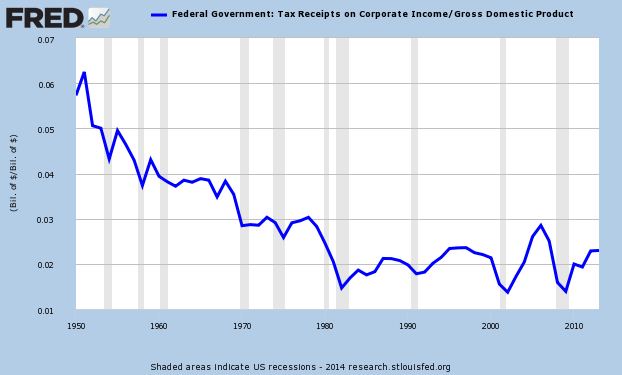
  • Corporate taxes don’t collect that much revenue. As shown above the revenue from this tax has dropped to about 2% of GDP which is about $300 billion at the present time. This is roughly 10% of total annual federal tax revenue.
  • Tax capital gains and dividends at the same rate as earned income. This would make up for the lost revenue and is justified because there would no longer be double taxation of corporate earnings.
  • The corporate tax is not progressive. It is now paid for by both workers (with lower wages) and shareholders. Eliminating this tax (and replacing it with higher taxes on dividends and capital gains) makes the tax more progressive.
  • Corporations waste huge amounts of money trying to reduce their tax bill.  What they now spend on tax lawyers and lobbyists could be put to more productive use.
  • The current system disadvantages new businesses. It’s the old firms which have collected all the deductions. New firms start out paying the full 35% rate which puts them at a large competitive disadvantage.
  • It will make our financial system safer. Since debt payments are tax deductible and equity financing is not, debt financing is currently incentivized. The elimination of the corporate tax would end this preference of debt over equity.

Taking this action would not only have all of these benefits, it would make the U.S. the most desirable place in the world to locate a business.  We would experience a huge economic boom, creating millions of new jobs.  It would end our present economic funk and put us back on a rapid growth trajectory.   What are we waiting for!