Entitlement Spending and the National Debt


I discuss two fundamental economic and fiscal problems on this website:

  • The slow growth of our economy, only 2.1% per year since the end of the Great Recession in June 2009. This is largely responsible for stagnant wages for middle- and low-income workers, which is in turn responsible for the rise of the populist presidential candidates Bernie Sanders and Donald Trump.
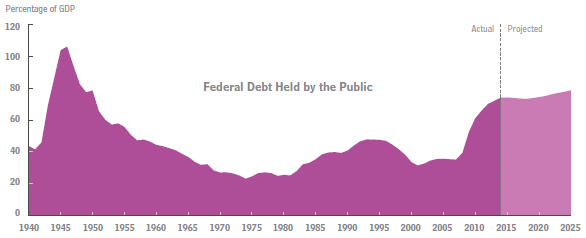
  • Our massive national debt, now 74% of GDP for the so-called public part, on which we pay interest. This is the highest it has been since right after WWII.
    Capture2

Slow economic growth gets more public attention because of its direct and negative effect on so many people. However massive debt is more of an existential problem.  Right now our debt is almost “free” money because interest rates are so low.  But with debt predicted (by the Congressional Budget Office, for example) to keep climbing steadily under current policy (see the first chart) and with the inevitability of increased interest rates in the future, interest payments on the public debt are bound to rise precipitously.
Capture4The second chart just above (from the Concord Coalition) shows that interest payments on the debt will likely soon become the leading source of growth in federal spending.  But perhaps surprising is that the three non-interest sources of spending growth are the entitlement programs, Medicare, Social Security and the combined Medicaid, CHIP and ACA exchange subsidies.  All other government spending will decrease in relative terms.
Capture3Is it not readily apparent from this data that the only way to curtail a huge fiscal crisis in the not so distant future is to get entitlement spending under much better control?  The last chart, just above, (from the Trustees of SS and Medicare) shows the growth in general fund revenue required for Medicare and SS going forward.  In 2016 the discrepancy is 2.1% of GDP which amounts to $401 billion.  The discrepancy will double by 2040.  Of course, OASDI (SS) and HI (Medicare Part A) have trust funds paid into by payroll taxes.  But these trust funds are already paying out more than they take in and will be exhausted in a few years.

Conclusion. Spending on entitlement programs must be brought under much better control. How to do this will be the topic of my next post.
Follow me on Twitter
Follow me on Facebook

Why Economic Growth is Slowing Down


The two main themes on this website, “It Does Not Add Up,” are that the U.S. national debt is too high and that our economy is growing too slowly.  How can we shrink the debt (as a percentage of GDP) and how can we make the economy grow faster?  I make use of all sources of information which shed light on these two fundamental issues.
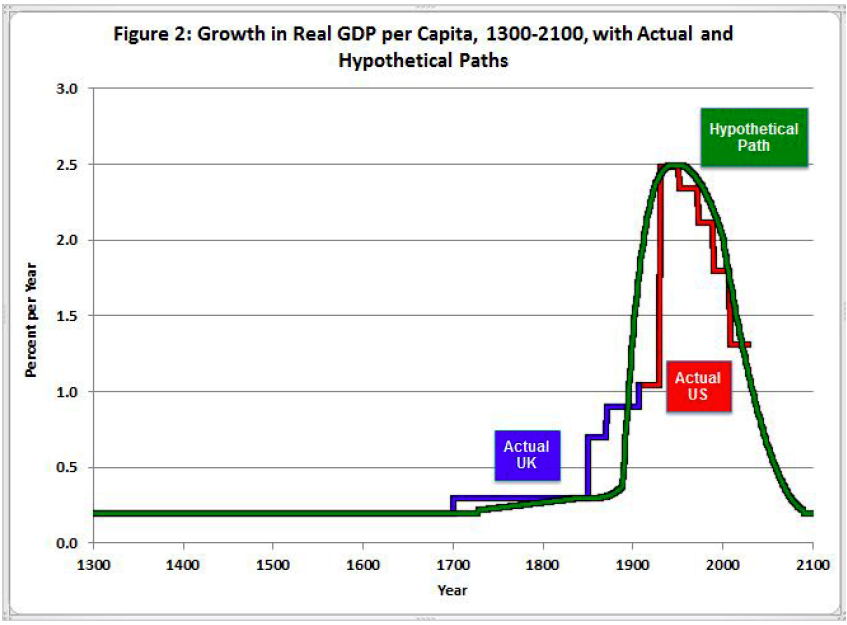
CaptureToday I briefly discuss the work of the Northwestern University Economist Robert Gordon, summarized in his new book, “The Rise and Fall of American Growth.”  His basic thesis, see the above chart, is that human civilization experienced essentially no economic growth up until about 1700, then slow growth occurred mainly in the UK and US up until about 1870 followed by explosive growth mainly in the US up until about 1970.  Since 1970 growth has slowed way down except for a brief spurt from 1994 – 2004.
According to Mr. Gordon, these growth periods were caused by Industrial Revolution #1 (steam, railroads), IR #2 (electricity, internal combustion, modern plumbing, communications, petroleum), and IR #3 (computers, internet, mobile phones), all of which led to productivity growth spurts which have by now largely run their course. Not only are we out of industrial revolutions but there are, in addition, stiff headwinds working against economic growth.  For example:

  • The First Headwind: Rising Inequality. Downward pressure on the wages of the bottom 90%. Increased inequality at the top. Educational outcomes strongly correlated with socio-economic status.
  • The Second Headwind: Education. Stagnation in high school graduation rates and poor performance on international tests measuring achievement. High debt levels for college graduates.
  • The Third Headwind: Demography. The labor participation rate has dropped form 66.0% in 2007 to 62.6% today, only half caused by baby boomer retirements.
  • The Fourth Headwind: Repaying debt. The public debt, on which interest is paid, is now 74% of GDP and is predicted by the CBO to steadily increase. This will inevitably lead to either higher taxes or slower growth in future transfer payments.
  • The Fifth Headwind: Social deterioration at the bottom of the income distribution. Increasing number of children are born out of wedlock for high school graduates and dropouts, much higher for blacks than for whites. For mothers aged 40, the percentage of children living with both biological parents declined from 94% in 1960 to 34% in 2010.
  • Other Headwinds. Globalization and Global warming.

Mr. Gordon makes a voluminous case for the slowing down of economic growth, the basic reasons why this is happening, and the social forces which are making it worse. Next: How should public policy respond to this huge challenge?

Follow me on Twitter: https://twitter.com/jack_heidel
Follow me on Facebook: https://www.facebook.com/jack.heidel.3


Annual Deficits are Starting to Go Back Up!


As regular readers of It Does not Add Up know well, I am highly alarmed about the large budget deficits and slow economic growth in the U.S. in recent years.  Some people respond that deficits are falling and that we have entered a new era of slow-growth secular stagnation which is unavoidable.
CaptureA new report from the Congressional Budget Office, our most reliable source for objective fiscal and economic information, now predicts that the deficit for 2016 will be $544 billion, a large increase over the $439 billion deficit for 2015.  Furthermore, CBO predicts that for future years deficits will continue to grow, exceeding $1 trillion by 2022. Here is a summary of the CBO predictions:

  • Federal outlays are projected to rise by 6% this year, to $3.9 trillion, or 21.2% of GDP. This represents a 7% rise in mandatory (entitlement) spending, a 3% increase in discretionary spending, and a 14% increase in net interest on the national debt.
  • Under entitlements, Social Security payments will increase by 3% and healthcare (Medicare, Medicaid, CHIP (children’s health) and Obamacare) payments will increase by 11%.
  • Revenues will increase by 4% in 2016, to $3.4 trillion, or 18.3% of GDP.
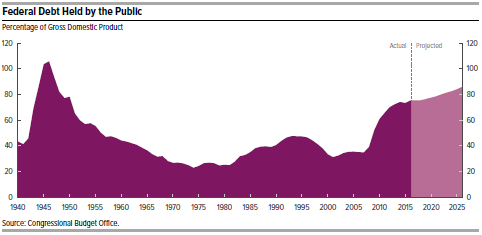
  • Deficits are projected to increase from 74% of GDP in 2015 to 86% of GDP by 2026.
  • Spending for mandatory programs will increase from 13.1% of GDP in 2016 to 15% of GDP in 2026.

First Conclusion: The spending increases from 2015 to 2016, outlined above, illustrate a clear and alarming trend which is evident in the full ten-year set of CBO data. Discretionary spending will rise but at a sustainable rate of about 3% a year or less.  Mandatory (entitlement) spending will rise at a much faster and unsustainable rate.  It is healthcare spending, i.e. for Medicare, Medicaid, CHIP and Obamacare, and not Social Security, which is driving the rapid increase in mandatory spending.
Second Conclusion:  Although it is government healthcare spending which is driving our rapidly worsening deficit and debt problem, this is just part of the larger problem of the rapidly increasing cost of overall (including private) healthcare spending in the U.S.  This is the basic problem we need to focus on to get both fiscal and economic policy back on the right track.

Follow me on Twitter: https://twitter.com/jack_heidel
Follow me on Facebook: https://www.facebook.com/jack.heidel.3

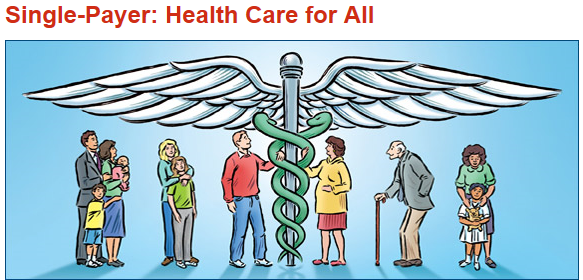
Lowering the Cost of American Healthcare III. Single Payer?


My last two posts, here and here, argue that the high costs of American healthcare, almost double what other developed countries pay per-capita, has two fundamental causes which must be addressed:

  • Very low out-of-pocket costs as a result of the tax exclusion for employer provided care.
  • The very expensive, and rapidly growing, government entitlement programs of Medicare and Medicaid.
    Capture4

It is often suggested that the best way to get these high costs under control is for the U.S. to adopt a single-payer, government run, healthcare system, like many other developed nations have done. Writing in yesterday’s Wall Street Journal, the policy analyst, Nathan Nascimento, makes a persuasive, and well referenced, counter argument to this suggestion:

  • The State of Vermont recently backed away from implementing a single payer system because of the very high tax increase which would have been required, more than doubling Vermont’s annual budget.
  • The State of Colorado will vote a year from now on a petition-supported single payer proposal, ColoradoCare, which would be paid for by a $26 billion annual state tax increase and is therefore unlikely to pass.
  • In Canada, which has a single payer system, the average wait between a general practitioner’s referral and delivery of treatment was more than four months in 2013.
  • Our own Veterans Affairs hospital system, a single payer system on an annual budget, is failing thousands of veterans who often die while waiting for treatment.
  • Medicare, an open ended single payer entitlement system, now costing almost $600 billion per year, is one of the main causes of our burgeoning, out of control, national debt.

Conclusion: For the U.S. to move to a national single payer system would be very risky and very costly. It is far better to wait and see if Colorado or some other state is willing to take such a leap of faith and then see how it works out in that context.

Follow me on Twitter: https://twitter.com/jack_heidel
Follow me on Facebook: https://www.facebook.com/jack.heidel.3

Lowering the Cost of American Healthcare II. Entitlements


My last post emphsizes that any solution to our nation’s long term debt problem must include reining in the cost of American healthcare.  There are two major drivers to this problem as is made clear by a new report from the American Enterprise Institute, “Improving Health and Health Care: An Agenda for Reform.”
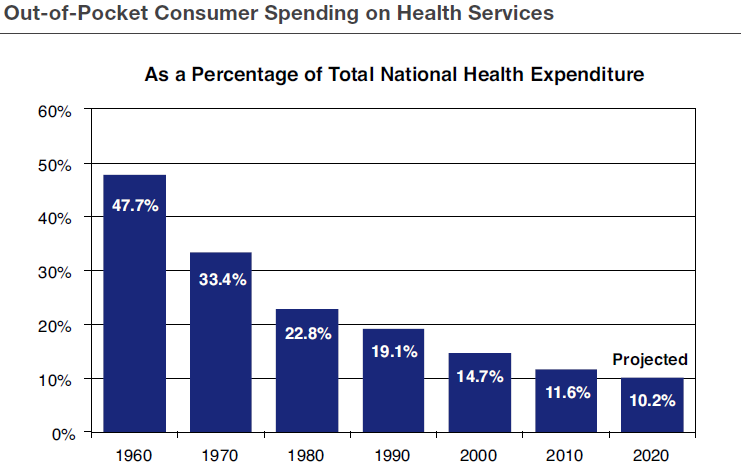
Capture1First of all, out-of-pocket consumer spending on healthcare has been steadily declining for many years. The less we pay directly for our own healthcare, the less incentive we have to control costs.
Capture2Secondly, the cost of healthcare entitlement spending, for Medicare and Medicaid , is growing rapidly as a percentage of GDP.  Such a rapid increase is unsustainable and must be curtailed. Here is what the AEI report recommends for doing this.

  • Medicaid. It serves two groups of people: 1) able bodied adults and their children and 2) the disabled and elderly. The federal government should make fixed, per-capita payments to the states based on historical spending patterns for these two groups. The able-bodied adults and children would get the same (refundable) federal tax credits as everyone else supplemented by Medicaid payments. The states would be totally responsible for the second group.
  • Medicare. The current system would be gradually migrated to a premium support system which would provide enough to pay for a choice of competing insurance options. The eligibility age would gradually rise to 67, consistent with Social Security.
    Capture3
  • Health Savings Accounts. HSAs are tax-preferred vehicles for saving for medical expenses until the (perhaps high) deductible amount is reached. Their use is growing rapidly. A one-time $1000 federal tax credit for establishing an HSA would increase their number even more. Their use should be expanded into Medicaid and Medicare as well.

Such reforms as these can significantly lower the cost of providing healthcare to the poor, the elderly and everyone else as well. If we don’t do something along these lines, we will eventually end up with a government run single payer system much to our detriment.


Follow me on Twitter: https://twitter.com/jack_heidel
Follow me on Facebook: https://www.facebook.com/jack.heidel.3


It’s Easy to be Pessimistic about America’s Future


As I remind readers from time to time, this blog is concerned with America’s fundamental fiscal and economic problems: a slow economy, massive debt, and increasing income inequality. Largely because of these apparently intractable problems, more and more people are becoming pessimistic about the future of our country.
CaptureAlthough I am by nature an optimist, these matters weigh on me as well:

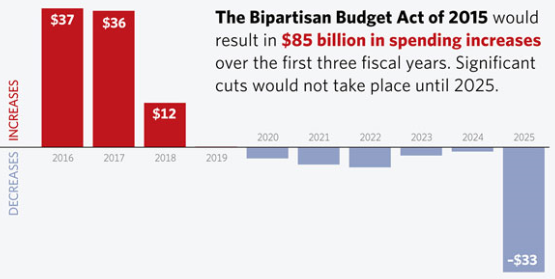
  • The just introduced “Bipartisan Budget Act of 2015” is a sell-out to the status quo. It breaks the agreed upon sequester spending limits by $112 billion over two years with essentially no attempt to create long term spending restraint.
  • As pointed out recently by the Washington Post’s Robert Samuelson, the presidential candidates are talking mainly about new entitlements (the Democrats) or tax cuts (the Republicans). In both cases this represents a flight from reality.
  • Entitlements: The number of people aged 65 or older will increase from 15% of the population today to 22% of the population in 2040. The cost of Social Security, Medicare and Medicaid will jump from 6.5 % of GDP today to 14% of GDP in 2040. We simply must control these costs by raising eligibility ages for SS and Medicare and increasing premiums for wealthier recipients.
  • Economic Growth: Annual growth has averaged only 2% of GDP since the end of the Great Recession in June 2009. Slow growth means weaker gains in wages, more unemployment and larger spending deficits. This can be fixed long term with honest tax reform, but not with unrealistic tax cuts.

Conclusion: Isn’t it obvious that we need political candidates who will speak forthrightly with the people about the need for addressing these humongous problems? Americans aren’t dumb.  They will respond to straight talk from their supposed leaders.   

Follow me on Twitter: https://twitter.com/jack_heidel
                    Follow me on Facebook: https://www.facebook.com/jack.heidel.3

Cutting the Federal Budget, an Example: The Highway Trust Fund


As an advocate of cutting federal spending, people sometimes ask me exactly what I would cut to save money and lower the deficit. I have two standard answers to this question:

  • Often I will respond, it is up to Congress to figure this out. The important thing is to shrink the deficit one way or another. It doesn’t matter from a fiscal point of view exactly what is cut.
  • Another answer I like to give is that with the sequester already slowing down discretionary spending, we should concentrate on finding savings in entitlement programs like Social Security, Medicare and Medicaid.

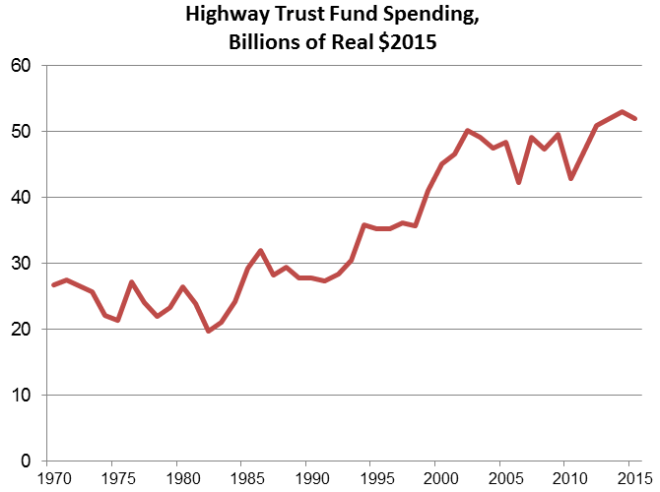
While both of these answers have validity in a general sense, nevertheless I do look for ways to cut back on discretionary spending as well. Here is a good idea from Reason magazine’s Veronique de Rugy, “Let States Build Their Own Highways.” The rationale is very simple. The federal gasoline tax of 18.4 cents/gallon brings in about $40 billion per year which goes into the Highway Trust Fund. But the HTF is spending $53 billion per year, meaning that federal gas tax revenue is being supplemented by $13 billion from general revenues. This additional $13 billion per year can be viewed as an unjustified federal expense merely adding to the deficit.
Capture2The way to address this issue is to:

  • Abolish the federal gasoline tax of 18.4 cents/gallon as of some specific date in the future, say in a year from the time such a law is enacted.
  • Turn over all responsibility for highway construction to the states.
  • States can then decide individually how much of the federal gasoline tax they wish to continue as a state gasoline tax in order to finance their own highway funding.
  • Minimal federal guidelines could be maintained if desired to insure uniform quality control by the states.

Of course, a $13 billion annual budget savings could be looked at as a drop in the bucket, not nearly large enough to make a sizable dent in the federal deficit (latest projection for fiscal year 2015: $426 billion). That would be too cynical. There are undoubtedly many other smart ways to cut back federal spending. I am constantly looking for them!

The Second Republican Presidential Debate


Although I am a registered Independent, I lean strongly conservative on fiscal and economic issues. I hope the Republican Party ends up with a nominee who can make a compelling case for fundamental reform.
CaptureHere is my take on last night’s debate and the current state of the race.

  • Rand Paul. He stands up strongly for the Tenth Amendment (State’s Rights) but he is much too isolationist to take over after eight years of Obama.
  • Mike Huckabee. His social conservatism appeals to evangelicals but he has a weak grasp of economic and fiscal issues.
  • Marco Rubio. He is certainly a gifted political communicator. He is able to talk tough while also appearing moderate and reasonable at the same time. But some of his policy ideas are gimmicky.
  • Ted Cruz. He claims to be a true conservative because he won’t compromise on his basic principles, even if they lead to government shutdown. As such he is much too radical for my taste.
  • Ben Carson. I don’t see what his attraction is outside of a compelling personal story. His grasp of issues is quite weak.
  • Donald Trump. Leading in the polls, he is the wild card for the 2016 election cycle. As much as he disgusts me, his performance is improving. He has pledged to support the eventual party nominee, and not run as an independent. He also hurled fewer insults in the second debate than in the first.
  • Jeb Bush. Policy-wise, with his detailed tax plan and generally moderate views, he is outstanding. But it’s not clear that he can overcome the populist, anti-elite mood of the electorate.
  • Scott Walker. His outstanding record in Wisconsin gave him an early boost. But he hasn’t made the transition to national policy issues very well.
  • Carly Fiorina. She expresses herself in a crisp manner and has a good, general grasp of the issues. She’s rising in this campaign but still has a long way to go.
  • John Kasich. He has a superb background as a former Congressman and now as a very successful two term governor of Ohio. He expresses compassion for ordinary people. He deserves to climb in the polls but will he?
  • Chris Christie. He’s tough talking but his record in New Jersey isn’t that great. His obesity and reputation as a bully are turnoffs for me.

In short, I don’t want Trump to be the Republican nominee but who is going to emerge from the pack to defeat him? It isn’t clear if anyone will be able to do this.

The Slow Growth Economy We’re Stuck In


We have very high debt and Paul Krugman says in “Debt Is Good” that we need more! The Congressional Budget Office’s latest report this week, “An Update to the Budget and Economic Outlook: 2015 – 2025” predicts slow economic growth for the next ten years, averaging 2.1% per year (see chart below).
CaptureUnfortunately, high debt and slow growth are a deadly, self-reinforcing, combination. Today’s Wall Street Journal has a chart (pictured below) showing clearly how budget deficits are likely to increase over the next ten years. The public debt (on which we pay interest) is predicted to grow from 74% of GDP today to 77% of GDP in 2025, increasing by a total of $7 trillion over this time period.
Capture1Here is another connection between slow growth and high debt:

  • Slow Growth means higher than necessary unemployment and under-employment as well as minimal raises for employed workers. The resulting economic slack leads to
  • Low Inflation. But low inflation means that the Federal Reserve can maintain
  • Low Interest Rates to try to encourage more borrowing to stimulate the economy. This means, in turn, that Congress can run up huge deficits without having to pay much interest on this almost “free” money. This eventually leads to:
  • Massive Debt. But what happens when inflation does take off, which has happened before and is likely to happen again? Then the Federal Reserve is forced to raise interest rates quickly and we are stuck with huge interest payments on our accumulated debt. And meanwhile entitlement spending on Social Security, Medicare and Medicaid is also growing rapidly. At this point debt increases very rapidly which leads to a severe
  • Fiscal Crisis.

Of course things don’t have to happen like this. Congress might become more responsible and either cut spending and/or raise taxes and start shrinking our huge deficits. Or perhaps slow growth really is the new normal and interest rates will remain low indefinitely. But slow growth is not pain free; there are many millions of unemployed and under-employed Americans who want to work and whose lives are stunted otherwise.
Slow growth is a very destructive path to be following. We badly need to adopt policies to speed it up!

How to Avoid a New, and Much Worse, Financial Crisis


Is it possible for the U.S. to effectively address its enormous debt problem in today’s contentious political environment? Two weeks ago I discussed in “America’s Fourth Revolution” why the political scientist James Piereson thinks this is impossible. He is very persuasive but I think he is too pessimistic.
CaptureSince then I have discussed several different things we should do to turn around this perilous situation:

  • If spending for just Medicare and Medicaid (two very expensive entitlement programs) alone fell by 25% over ten years, as a percentage of GDP, and then stayed in line with GDP after that, the U.S. would actually have a budget surplus in 2040.
  • Just recognizing the magnitude of our debt problem would do wonders in public awareness.
  • If the Tea Party were able to grow beyond a protest movement and unite the country behind a majoritarian agenda of work, mobility and opportunity, it would be much more effective in achieving its fiscally conservative goals.
  • Another significant way to save money, and get better results at the same time, is to turn over more and more programs to the states. A good way to do this is with block grants to the states for federal programs in such areas as welfare, education and Medicaid. This would give the states more flexibility to get the job done in an efficient and cost saving manner.

What we need to do to turn our debt situation around is to greatly shrink our annual deficits below their current level of about $450 billion per year. If the debt is growing slower than the economy, then it will shrink as a proportion of the economy. This is what happened after WWII (see above chart) and it needs to happen again now!