Can America’s “Fourth Revolution” Be Avoided?


My last post, “America’s Fourth Revolution,” presented a persuasive argument by the political scientist, James Piereson, that our currently dysfunctional political system will be unable to solve our most fundamental problems of massive debt, accompanied by a rapidly aging population and slowing economic growth. This will result, according to Mr. Piereson, in a severe crisis leading to a fourth revolution, overthrowing the New Deal liberal consensus which has prevailed since 1932.
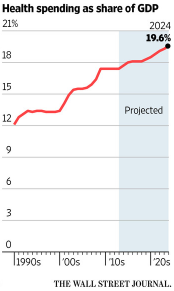
It is commonly understood that entitlement spending: Social Security, Medicare and Medicaid, is the main driver of our rapidly growing national debt. A recent report from the Centers for Medicare and Medicaid Services, summarized in the Wall Street Journal, shows that U.S. healthcare spending is likely to rise from just under 18% today to 19.6% of GDP in 2024.
Capture2Barron’s editor, Thomas Donlan, has just reported that the Director of the Congressional Budget Office, Keith Hall, stated in a recent hearing of the Senate Budget Committee that if spending for Medicare and Medicaid, as a percentage of GDP, fell by 25% over ten years, and then stayed in line with GDP after that, the U.S. would have a budget surplus of 2% of GDP in 2040 instead of the otherwise projected deficit of 6.6% of GDP. Furthermore debt held by the public would fall to 24% of GDP, a remarkable achievement.
This is significant because one country, The Netherlands, spends 12% of GDP on healthcare, and every other country in the world (except for the U.S.) spends less than 12%.
Conclusion: all the U.S. needs to do, so to speak, is to bring healthcare costs in line with the rest of the world and our entire deficit spending problem would be solved! Nobody is claiming that this will be easy but it certainly is within the realm of possibility. It is also far superior than waiting to act until we have another fiscal crisis and thus risking a huge change, a revolution, in our way of life.

America’s Fourth Revolution


The Manhattan Institute’s James Piereson has written a fascinating new book, ”Shattered Consensus: The Rise and Decline of America’s Postwar Political Order” in which he argues that the New Deal liberal consensus has broken down and will soon be replaced by a new model containing several specific features. The coming new model will be the result of a Fourth Revolution of comparable scope to the first three:

  • A Democratic-expansionist regime from 1800 until 1860 which dissolved in the midst of the slavery and secession crisis.
  • A Republican-capitalist regime from 1860-1930, which was brought down by the Great Depression.
  • A Democratic-welfare regime from 1932 until the present, although with faltering support after 1980.

America’s third regime is in the process of fading out or collapsing for three reasons:

  • Debt. The national debt of $18 trillion today, at about 100% of GDP, is comparable to the debt at the end of WWII. But once the war ended the government cut spending and stopped borrowing and the U.S. economy grew at 4% for the next 20 years. Nothing comparable to this major debt reduction is in sight today.
  • Demography. Today there are about 160 million people in the U.S. workforce of whom 120 million have full time jobs. The workforce will grow by 1 million per year for the next ten years while the number of people turning 65 will grow at nearly twice that rate. The nation will soon reach a point where 150 million working people will be paying payroll taxes to support 80 million people on Social Security and Medicare. Political leaders are doing nothing to address this looming crisis.

    Capture5

  • Slowing Economic Growth. The chart above shows how the U.S. economy has been slowing since the 1960’s. Since the end of the Great Recession in 2009, GDP has grown at only 2.2% and is likely (CBO) to continue growing indefinitely at this slow rate under current policies. The second chart shows the enormous difference between 2% growth and, for example, even 3% growth over time.

    Capture6Why don’t Congress and the President deal with these problems now, before they reach the point of crisis?   It’s because Congress has become increasingly polarized, with Democrats having moved leftward and Republicans moving rightward. Polarization is characteristic of regimes as they begin to tear themselves apart in conflicts which defy resolution within the existing structure of politics.
    My approach on this blog is that these very severe problems can be solved by politicians working together in a cooperative way. Mr. Piereson makes a very persuasive case that this is not likely to happen and that it will take a huge new crisis, a revolution, to straighten things out.
    I hate to say so but he may be right.

The Root of Greece’s Problem (and Ours)


Will it be the Euro or Drachma for Greece?  It’s down to the wire as Greece and the European Union negotiate the necessary conditions for Greece to remain in the Eurozone.  I have devoted several recent posts to the Greek fiscal crisis, pointing out the parallels between the Greek situation and our own.
Greece needs a bailout because its public debt is nearly 180% of GDP.  Our own public debt is “only” 74% of GDP at the present time but is predicted by the CBO to reach 175% of GDP by 2040, just 25 years from now.  Furthermore, Greece is currently receiving very favorable lending conditions from the European Central Bank, much better than are likely to apply in the U.S. in the long term.  This means we’re likely to have another deep crisis on our hands much sooner than 25 years from now.
CaptureConsider the data in the above charts from today’s Wall Street Journal.  It shows that Greece is spending 14.4% of GDP on pensions, more than any other major European country.  Furthermore, the efficiency of its VAT revenue collection is the poorest in the EU.  In other words, Greece has a very high rate of entitlement spending and has a poor tax collection system to support it.
Capture1In a general sense the U.S. is in a similar situation.  Today we spend about 13% of GDP on mandatory, i.e. entitlement, programs, compared to a total tax revenue level of 18% of GDP.  Just entitlement spending alone is projected to rise to 18% of GDP by 2050, unless changes are made.
Just as Greece needs to tighten up on pension spending, improve revenue collection and get its economy growing faster, the U.S. needs to tighten up on entitlement spending and speed up its stagnant economic growth as well.
We’re not yet as bad off as Greece is today.  But we’re headed in that direction with no one to bail us out when we get there!

How to Fix Disability Insurance


The Trust Fund for Social Security Disability Insurance will run out of money by the end of 2016.  If no changes are made, all SSDI benefits will have to be reduced to 81% of scheduled benefits after that.  Congress must act to avoid this outcome.  The easiest fix would be to merge SSDI into the larger Social Security program in which case both SSDI and SSI would run out of money about 2033.
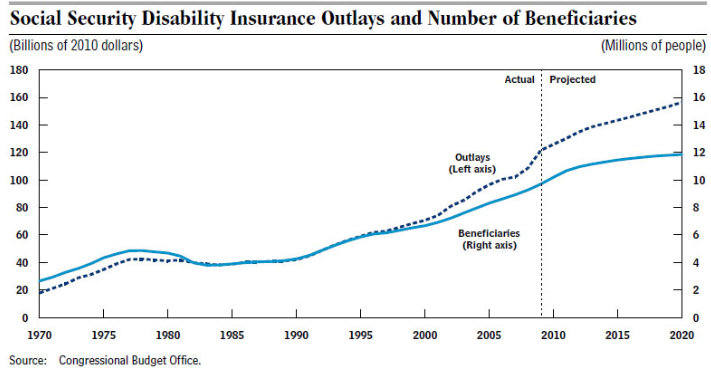
CaptureBut as the Manhattan Institute’s Scott Winship points out in National Affairs, “How to Fix Disability Insurance,”  “the looming insolvency of the SSDI Trust Fund offers a rare opportunity to fundamentally reform SSDI” to better target assistance to those with debilitating impairments who truly need this support. The share of adults age 25 to 64 receiving SSDI benefits has tripled from 1.6% to 5% between 1970 and 2010 during a time when a shift from manufacturing, agriculture and mining to service work has reduced physical demands on workers.
Mr. Winship suggests the following reforms be implemented in the SSDI program:

  • Raise the 1.8% (out of the total 12.4% of the payroll tax going to SS) going to SSDI slightly to solve the immediate problem.
  • Expand the support options available to able-bodied men and women who can work, at least for a significant number of hours.
  • Reduce the number of people applying for benefits. For example, by increasing employer incentives for taking stricter safety measures, accommodating and rehabilitating those who become disabled and making greater use of claims management.
  • Use a stricter definition of disability. For example, mental and musculoskeletal conditions may be amenable to treatment.
  • Make it less attractive and more difficult to receive benefits for those who, while impaired, are able to work. Conditions likely to improve would be automatically subject to review after a short period of time.
  • Facilitate work among those with serious impairments who would still like to work. The point here is to make sure they benefit from working without feeling threatened with possible termination of benefits.

The point is that there are many practical steps which can be taken to make SSDI more cost efficient while preserving it for those who truly need it.  This is a good example of the sort of changes that need to be made in all entitlement programs to shore them up for future generations by bringing their huge costs under control.

Should We Raise Taxes or Cut Spending?


Tax Day is a good time to remind ourselves about our perilous fiscal situation.  With a public debt (on which we pay interest) of $13 trillion and with annual deficits of just under $500 billion adding to the debt each year, we have a huge problem which is not being adequately addressed by Congress.  The solution is to either raise taxes or cut spending or do a combination of both.
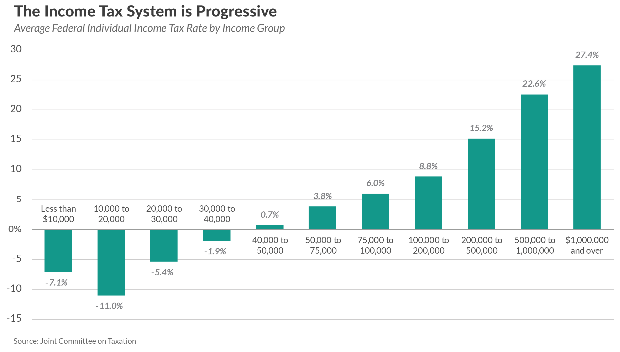
CaptureIs it feasible to raise taxes, presumably on the rich?  The problem in doing this is that our tax code is already very progressive as indicated by the above chart. The top 20% already pay 84% of all income taxes.  It’s just not feasible to expect to be able to raise their taxes by a very large amount.  In addition, Middle- and lower-income people are in a tight fiscal situation, because of the slow economy, and can hardly be expected to see their own taxes increase.
Capture1The alternative to raising taxes is to cut spending and there are many opportunities to do this.  The organization Citizens Against Government Waste has just identified a collection of government programs whose elimination would save $639 billion in the first year alone.  Taxpayers for Common Sense has a long list of potential spending cuts which would save $267 billion in the first year.
Amazingly, neither of these lists of possible cuts includes any mention of entitlement programs.  Before very long, major savings in entitlement programs must certainly be achieved in order to put the federal government on a sustainable fiscal course.
In fact, spending should be trimmed all across the board, wherever possible, in order to get our annual deficits on a steadily downward course.  It is critical for this process to get under way as soon as possible and to continue until fiscal balance is achieved by entirely eliminating deficit spending altogether.

The Republican Budgets Focus on Entitlement Savings


Last week, both the House and the Senate passed ten year budget plans which would bring the federal budget into balance by 2025.  I have devoted several recent blog posts to discussing these budget proposals and how they address our very serious debt and deficit problems.
CaptureThere are several important points to make:

  • Under both of these Republican plans, overall spending will continue to increase by an average of 3.3% per year, from $3.8 trillion in 2016 to just over $5 trillion in 2015. The President’s budget would increase spending to $6.17 trillion by 2025 and would achieve no balance between spending and revenue.
  • Most of the savings in the Republican budgets, as indicated in the above chart, come from the mandatory (entitlement) programs of Social Security, Medicare and Medicaid. Medicare would be transformed into a subsidy program along the lines of the exchanges set up under the Affordable Care Act. Medicaid would be turned into a block grant program administered by the states. Social Security would be studied by a bipartisan commission to recommend operating efficiencies.
  • Other social welfare programs would be affected to a much smaller extent. For example, the Supplemental Nutrition Assistance Program (SNAP), or Food Stamps, has seen a growth of recipients of 69% between 2008 and 2013 while the poverty rate increased by just 16.5% during the same period. The Republican budgets would block grant Food Stamps to the states in order to achieve operating efficiencies.
  • It is true that both the House and Senate budgets would increase military spending by about 10%. But so would the President’s budget and we live in a very dangerous world. Military defense is one of the most very basic functions of our federal government.

Our country is in dire fiscal condition with large annual deficits projected indefinitely into the future, contributing to an exploding national debt.  It is heartening that our political system is responding to this threat to our future security and prosperity.  Let’s hope that House and Senate majorities continue to keep a sharp focus on the urgent task of fiscal restraint.

It’s Paul Krugman Who Is Being Irresponsible!


The New York Times columnist, Paul Krugman, writes provocatively on fiscal and economic issues and is well-known as a liberal icon.  Usually I ignore his diatribes.  But his column yesterday, “The Long-Run Cop-Out” goes way overboard.
CaptureI will refute several of the statements from this column.

  • “Think about it: Faced with mass unemployment and the enormous waste it entails, for years the beltway elite devoted all most all its energy not to promoting recovery, but to Bowles-Simpsonism – to devising “grand bargains” that would address the supposedly urgent problem of how we’ll pay for Social Security and Medicare a couple of decades from now.” Worrying about our enormous and rapidly increasing national debt, does not mean ignoring our sluggish economy and the high unemployment it causes. The way to increase economic growth is to enact broad based tax reform by lowering tax rates, offset by closing loopholes and limiting deductions. This will further boost the economy in the same way that lower gasoline prices is already doing.
  • “Many projections suggest that our major social insurance programs will face financial difficulties in the future (although the dramatic slowing of increases in health costs makes even that proposition uncertain).” Healthcare costs dropped to 4.1% in 2014 but this is still more than double the inflation rate of 1.7%. This isn’t nearly good enough.
  • “Why, exactly, is it crucial that we deal with the threat of future benefit cuts by locking in plans to cut future benefits?” The point is to protect benefits, not curtail them. If we act now, to increase revenue and/or slow down the growth of entitlement spending, then we won’t have to cut future benefits.
  • “So why the urge to change the subject (from austerity) to structural reform? The answer, I’d suggest, is intellectual laziness and lack of moral courage.” $6 trillion added to our debt in the last six years is profligacy, not austerity. It is immoral to burden future generations with such massive new debt.
  • “In today’s economic and political environment, long-termism is a cop-out.” Preparing for the future is just plain common sense. Should we ignore festering problems like global warming, illegal immigration and increasing poverty until they get much worse? Of course not. We should address these problems now and get our debt under control at the same time.  

Status Quo on the Budget Is Not Good Enough II. Look at the Big Picture!


In my last post, “Status Quo on the Budget Is Not Good Enough,” I discussed a report from the outgoing chair of the Senate Budget Committee, Patty Murray (D-WA), and explained how it epitomizes the lack of progress made on the massive debt problem which has developed since the Great Recession of 2008 -2009.
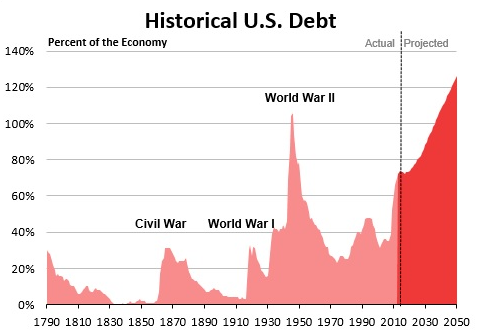
CaptureThe basic problem is that Senator Murray’s analysis simply does not recognize the seriousness of our debt problem as shown in the above chart.  Right now our public debt (on which we pay interest) is “sitting” at 74% of GDP for a year or two, before it continues its rapid increase.  This projection assumes an historically “normal” growth rate of 3% and no new recessions, neither of which assumption is assured.  It also assumes that the sequester budget cuts and new top tax rate of 39.6% stay in effect.  In other words it is a best case scenario based on current policy.
Breaking it down, the debt will continue to increase because annual deficits will continue to exceed the rate of growth of the economy.  The main driver of these increasing deficits is the cost of the health care entitlements of Medicare and Medicaid.  Medicare costs will increase rapidly because of the aging of the American people.  Medicaid costs will increase rapidly because: 1) more low-income people are being covered by the ACA and 2) since the recession there are more low-income people to be covered.  I certainly support expanded healthcare coverage but we have to figure out how to pay for it!
How do we contain the increasing costs of Medicare and Medicaid?  We do it by controlling the overall rapid growth (at twice the rate of inflation) of healthcare costs in general, i.e. for private healthcare. How do we do this?  See a couple of my recent posts either here or here.
Senator Murray, along with many other progressives, argues that we need more deficit spending in order to stimulate the economy and create new jobs.  More jobs are badly needed but more deficit spending is the wrong way to get them.  Then how?  With tax reform among other things.
Based on the outcome of the 2014 elections, I am optimistic that something along the lines of what I have just described will be tried by the next Congress.  We’ll soon find out!

Fix the Debt


Recently I have had several posts about our national debt, for example, “Why the National Debt Is Such a Threat to the U.S.,” showing graphically that our current public debt at 74% of GDP is very high by historical standards and rising rapidly under current fiscal policies.
CaptureYesterday I attended a workshop in Washington D.C. put on by Fix the Debt.  All expenses were paid and, in return, the attendees agree to make at least three presentations to local community groups during the following year.  This means that I will soon be sending out a letter to such groups as Kiwanis and Rotary Clubs around the Omaha area where I live, offering my services as a speaker at one of their meetings.  The purpose is to build more public awareness of the threat of a huge and growing national debt to the long-term welfare of our country. Here is a summary of talking points from the workshop:

  • The deficit for the 2013-2014 fiscal year is almost $500 billion.
  • Under current fiscal policies the debt will increase to 270% of GDP by 2080.
  • Reasons for our debt problem:
  1. An aging population which means expanded Social Security spending
  2. Healthcare costs are growing for both Medicare and Medicaid
  3. Interest costs will grow rapidly as the economy recovers and interest rates rise
  • All bipartisan reform plans call for both spending cuts and revenue increases.
  • The benefits of taking action are:
  1. Increased budget flexibility
  2. Lower exposure to changes in interest rates
  3. Reduced risk of another financial crisis
  • The longer we wait:
  1. The older our population gets
  2. The higher the debt will rise
  3. The less time we have to phase in changes
  4. The slower our economy will grow
  5. The fewer tools we will have to fix it
  • How do we bring debt under control?
  1. Enact policies that grow the economy
  2. Health care cost containment
  3. Spending cuts
  4. Tax reform and tax expenditure cuts

Let me know if you’d like a speaker on this topic at your club!

How to Shrink the Deficit: Control Entitlement Spending by Fixing Obamacare


Our country faces two major fiscal and economic problems:

  • How to boost the economy in order to put more people back to work.
  • How to either increase tax revenue or better control spending in order to shrink the deficit.

My last post, “The Great Wage Slowdown and How to Fix It” makes a specific tax reform proposal to cut tax rates for all by shrinking tax deductions for the wealthy.  This would put tax savings in the hands of millions of wage earners with stagnant incomes, who would likely spend it, thereby boosting the economy.
CaptureAs the above chart clearly shows, there is only one realistic way to shrink the deficit.  We have to do a better job of controlling entitlement spending (Social Security, Medicare and Medicaid.)  As a practical matter, this means we have to cut back the cost of American healthcare in general, both public and private.
The Manhattan Institute’s Avik Roy has come up with an attractive Plan for doing just this, “Transcending Obamacare.” Mr. Roy’s proposal is to:

  • Repeal the individual mandate. Insurers are encouraged to design policies of high quality tailored to individual need. By lowering the cost of insurance for younger and healthier individuals, the Plan will expand coverage without a mandate.
  • Repeal the employer mandate, thereby offering employers a wider range of options for subsidizing employees insurance.
  • Keep the exchanges to provide broad access as well as subsidies for those with low incomes.
  • Migrate the Medicaid population onto the exchanges.
  • Raise the Medicare eligibility age by 4 months per year indefinitely. Over time this will maintain future retirees on exchange-based or employer sponsored health plans.

By gradually moving the Medicaid and Medicare recipients onto the exchanges, both of these very large populations will receive equal quality coverage to everyone else, delivered in a cost effective manner.  Mr. Roy estimates that the Plan will expand coverage by 12 million above Obamacare levels by 2025 and reduce the deficit by $8 trillion over 30 years.
This is the sort of major healthcare reform which we need to get entitlement spending under control!