
The Challenges of American Health Care


America is facing great challenges in healthcare. Our national health expenditure is $3.1 trillion per year, 17.4% of GDP, and is projected to reach 19.6% of GDP by 2024.   Some 34% of Americans are obese (BMI>30), far more than in any other country. Their medical expenses will soar in the years ahead.  Medicaid now covers over 70 million low-income people at a cost of $500 billion per year.  Medicare spends $615 billion per year on the 42 million Americans over age 65.
CaptureThe Hoover Institution’s Scott Atlas has just published “Restoring Quality Health Care: a six-point plan for comprehensive reform at lower cost.”  He claims that his plan will save $2.75 trillion over a decade for private healthcare and an additional $1.5 trillion per decade for federal healthcare programs such as Medicare, Medicaid and the Affordable Care Act.
The elements of his plan are to:

  • Expand Affordable Private Insurance by allowing all insurers to offer high deductible, limited-mandate catastrophic coverage (LMCC) to all citizens, which would be owned by individuals and portable.
  • Establish and Liberalize Universal Health Savings Accounts (HSA) for all citizens, individually owned and portable.
  • Instill Appropriate Incentives with Rational Tax Treatment of Health Spending equal for all, whether individual, self-employed or employer-based, requiring LMCCs for all.
  • Modernize Medicare for the 21st Century by establishing a private insurance option with defined-benefit premium support based on regional benchmarks featuring cash rebates to individual HSAs if premium is less than benchmark, otherwise additional cost paid by enrollee.
  • Overhaul Medicaid and Eliminate the Two-Tiered System for Poor Americans by permitting all insurers to offer LMCC plans to entire state population as well as setting up government seeded HSAs for all Medicaid enrollees.
  • Strategically Enhance the Supply of Medical Care While Ensuring Innovation by stimulating private retail clinics and loosening practice restraints on nurse practitioners and physician assistants.


A plan along these lines would go a long way towards both improving the quality and lowering the costs of American healthcare.

Follow me on Twitter
Follow me on Facebook
Lowering the Cost of American Healthcare II. Entitlements


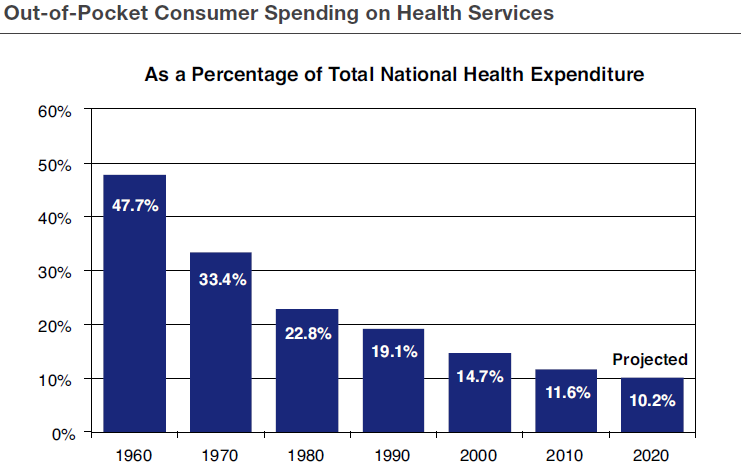
My last post emphsizes that any solution to our nation’s long term debt problem must include reining in the cost of American healthcare.  There are two major drivers to this problem as is made clear by a new report from the American Enterprise Institute, “Improving Health and Health Care: An Agenda for Reform.”
Capture1First of all, out-of-pocket consumer spending on healthcare has been steadily declining for many years. The less we pay directly for our own healthcare, the less incentive we have to control costs.
Capture2Secondly, the cost of healthcare entitlement spending, for Medicare and Medicaid , is growing rapidly as a percentage of GDP.  Such a rapid increase is unsustainable and must be curtailed. Here is what the AEI report recommends for doing this.

  • Medicaid. It serves two groups of people: 1) able bodied adults and their children and 2) the disabled and elderly. The federal government should make fixed, per-capita payments to the states based on historical spending patterns for these two groups. The able-bodied adults and children would get the same (refundable) federal tax credits as everyone else supplemented by Medicaid payments. The states would be totally responsible for the second group.
  • Medicare. The current system would be gradually migrated to a premium support system which would provide enough to pay for a choice of competing insurance options. The eligibility age would gradually rise to 67, consistent with Social Security.
    Capture3
  • Health Savings Accounts. HSAs are tax-preferred vehicles for saving for medical expenses until the (perhaps high) deductible amount is reached. Their use is growing rapidly. A one-time $1000 federal tax credit for establishing an HSA would increase their number even more. Their use should be expanded into Medicaid and Medicare as well.

Such reforms as these can significantly lower the cost of providing healthcare to the poor, the elderly and everyone else as well. If we don’t do something along these lines, we will eventually end up with a government run single payer system much to our detriment.


Follow me on Twitter: https://twitter.com/jack_heidel
Follow me on Facebook: https://www.facebook.com/jack.heidel.3


How Can We Achieve a Free Market in Healthcare?


My last post, “Why Is American Healthcare So Expensive?” suggests that we don’t have enough “skin in the game” because most costs are paid for by third party insurance companies.  One way to alleviate this problem is to subsidize insurance coverage only for catastrophic care with a high deductible and to encourage health savings accounts to pay for routine healthcare expenses.
CaptureBut the University of Chicago’s John Cochrane points out in “After the ACA: Freeing the market for health care” that getting to a true free market in healthcare “will be a long hard road” because “both supply and demand must be freed.”

  • Health care supply. Cost reduction only comes from new entrants into a business, not reform of old businesses. But in 36 states, for example, every new hospital or even major purchase requires a Certificate of Need issued by Hospital Equalization Boards which have explicit mandates to defend the profitability of existing hospitals.
  • Health care demand. True “need” is simply not a well-defined concept when a third party is paying the bills. The consumer must pay a lot closer to the full marginal cost of healthcare, or perhaps receiving the full financial benefits of any economies which he is willing to accept.

What are the objections to establishing a free market system?

  • The homeless and mentally ill, etc. Charity will always be needed for those who fall through the cracks. This doesn’t require a nanny state for the rest of us.
  • Adverse selection. In a free market sick people are more likely to buy insurance and healthy people to forgo it. Sick people would pay more but “health status” insurance and guaranteed renewability will mitigate this problem.
  • Shopping paternalism, i.e. people faced with serious illnesses are incapable of making cost-based decisions. These people and their families will simply have to learn to shop around. In a competitive market, a hospital which routinely overcharges cash customers will be “creamed by Yelp reviews.”

Conclusion.  There are only two ways to get health care spending under control.  A single payer system with rigid regulations and severe rationing or else a deregulated free market system where individuals have primary responsibility for their own care.  Americans are likely to prefer the second option if given a clear choice.

Why Is American Healthcare So Expensive?


The U.S. spends almost 18% of GDP on healthcare costs, double what any other developed county spends.
CaptureThere are many reasons for our excessive healthcare spending.  For example:

  • As illustrated in the above chart, many medical procedures are far more expensive here than in other countries.
  • Profit levels in the healthcare industry are often very high, for example: 16.4% for pharmaceuticals, health-care information 9.4%, home healthcare firms 8.5%, medical labs 8.2% and generic drug makers 6.5%.
  • Health insurers, on the contrary, have a very low profit margin, (2.2% in 2009), and so can hardly be blamed for the high cost of healthcare.

The Affordable Care Act greatly expands access to healthcare but does very little to control costs.  The Manhattan Institute’s Avik Roy has outlined a plan, “Transcending Obamacare: A Patient Centered Plan for Near-Universal Coverage and Permanent Solvency” which would reform Obamacare by making it more like two very successful and low cost consumer-driven plans, those in Switzerland and Singapore.
These two countries feature government sponsored health savings accounts, backed up by insurance for catastrophic care.  What happens is that out-of-pocket spending for healthcare per individual is higher in Switzerland and Singapore than it is in the U.S., as indicated in the chart below.
Capture1In other words, the real reason for our high cost of healthcare is that Americans don’t have enough “skin in the game.”  We have very little incentive to hold down the cost of our own care because it is mostly paid for by third party insurance companies.
As the cost of healthcare continues to climb, such changes are already beginning to creep into the health insurance market place.  Private companies are raising the deductibles on the insurance plans which they subsidize.  The bronze, silver, gold and platinum plans on the ACA exchanges differ largely by the level of the insurance deductible.
Avik Roy’s plan referred to above in essence speeds up the process of converting the ACA into an efficient, consumer-driven healthcare system by making it more flexible and therefore more adaptable to market forces.

What Will True Healthcare Reform Look Like?


My last post, “Progress on Medicaid Reform,” discusses innovations that several states have adopted to improve the delivery of Medicaid and to make it more cost efficient. But what we really need is a complete overhaul of American healthcare, including the Affordable Care Act, as I have also recently discussed, in order to eliminate perverse marketplace incentives as well as to achieve real cost control.
CaptureAn excellent discussion of what real healthcare reform would look like is given by John Goodman in, “Healthcare Solutions for Post-Obamacare America.” Mr. Goodman gives six principles for commonsense reform:

  • Choice. People should be free to choose a health plan that fits individual and family needs, rather than one designed by bureaucrats in Washington. This means no mandates, either for individuals or employers.
  • Fairness. Any subsidy should be in the form of a fixed sum tax deduction or credit and everyone should get it as long as they obtained credible private health insurance. The amount of the subsidy would be comparable to the cost of Medicaid enrollment.
  • Universal Coverage. Since some people will turn down the offer of a tax credit, unclaimed credits can be used to reimburse safety net healthcare institutions.
  • Portability. Portability insurance should be available to employees in case they change jobs or become self-employed.
  • Patient Power. Health Savings Accounts need to be made more available and also more flexible so that they can wrap around any third-party insurance plan, as indicated in the above chart.
  • Real Insurance. Under ACA millions of people are losing access to out-of-network providers. People should be allowed to purchase “change-of-health-status insurance” in case they develop expensive-to-treat conditions.

The ACA addresses the access problem for healthcare but has little effect on the cost problem.  American healthcare, both public and private, is way too expensive.  This is why fundamental change is still needed.