Rising Prosperity around the World


My last post responds to a reader who is pessimistic about the future of our country and in fact of the whole world.  He thinks that the environment is deteriorating, that rapid economic growth is unsustainable and that there is too much income inequality between high and low wage earners.
My response to him is to refer to the recent book, “The Rational Optimist: how prosperity evolves” by Matt Ridley.  Mr. Ridley persuasively argues that not only has the human race made huge strides in recent times but that this progress is intrinsic to evolved human nature and is likely to continue indefinitely:

  • Since 1800 the population of the world has multiplied six times, yet average life expectancy has more than doubled and real income has risen more than nine times.
  • Between 1955 and 2005, the average human on earth earned nearly three times as much money (adjusted for inflation), ate one-third more calories of food, and could expect to live one-third longer, all this while world population doubled.
  • The rich have got richer but the poor have done even better. For example, the Chinese are ten times as rich, one-third as fecund, and 28 years longer-lived than fifty years ago. (Also see the above chart).
    Capture31
  • The spread of IQ scores has been shrinking steadily – because the low scores have been catching up with the high ones. This is known as the Flynn effect.
  • The four most basic human needs – food, clothing, fuel and shelter – have grown markedly cheaper during the past two centuries.
  • The most notorious robber barons of the late 19th century: Cornelius Vanderbilt, John D. Rockefeller, and Andrew Carnegie, got rich by making things cheaper.
  • Exchange and specialization, not self-sufficiency, is the route to prosperity.

Conclusion. As long as human beings are free to engage in exchange (trade) and specialization (acquisition of skills), prosperity will continue to evolve and human life will become better and better.

Follow me on Twitter
Follow me on Facebook

The U.S. Middle Class Is Growing, Not Shrinking


One of the topics I discuss on this blog is income inequality (here, here, and here).  An interesting article in yesterday’s Wall Street Journal, “Upper Middle Class Sees Big Gains, Research Finds,” is highly pertinent to the inequality issue.
Capture1As can be seen in the above chart, the percentage of people in the middle class or above has greatly expanded between 1979 and 2014.  Furthermore, the basic research on this issue,by Stephen Rose at the Urban Institute, shows very clearly (in the chart below) what is happening: the higher is a family income, the faster it is increasing.
Capture3The best policy response to this phenomenon should be clear.  Rather than trying to decrease inequality with higher taxes on the wealthy, we should be trying to boost the less wealthy into higher income classes. The way to accomplish this is to:

  • Grow the economy faster with broad-based tax reform (lower tax rates paid for by shrinking deductions), immigration (guest worker) reform, (fair) trade expansion, and regulation reform (to help more small businesses get started). This will create more jobs and better paying jobs.
  • Improve education with early childhood education (to get minorities off to a better start in school), boosting high school graduation rates above the current 80% average (with better career and vocational education) and making college more affordable by putting more resources into community colleges and scholarships for low-income students.
  • Combat social inequality. The fraction of children with a single parent is the best predictor of upward economic mobility. The lower-income class marriage rate has dropped from 84% in 1960 to 48% in 2010. Policy should therefore focus on removing the marriage penalty in all government programs.

The basic forces of globalization and growing technology use are driving this societal change. The best way to respond is to enable more people to benefit from these basic trends.

Follow me on Twitter
Follow me on Facebook

Can the U.S. Economy Do Better? II. It Won’t Be Easy


In my last post, “Can the U.S. Economy Do Better?” I laid out the view of the Hoover Institution economist John Cochrane that a few basic changes such as deep tax reform, a thorough overhaul of social programs, more educational competition and regulatory simplification would go a long way towards perking up the economy.
Capture6The banker and financial analyst, Satyajit Das, presents a contrary point of view in, “The Age of Stagnation: Why Perpetual Growth is Unattainable.”  According to Mr. Das:

  • The Global Financial Crisis (GFC) was not part of the normal boom and bust cycle, but rather the collapse of the postwar economic expansion under the weight of four main factors: high debt levels, large global imbalances, excessive financialization and an unsound build-up of future entitlements.
  • The economy risks becoming trapped in a QE-forever cycle. A weak economy leads to expansionary fiscal measures and Quantitative Easing (QE). If the economy responds then interest rates will go up and lead to a debt crisis. If the economy does not respond, then there is pressure for additional stimuli.
  • The economist Robert Gordon predicts that the future U.S. growth rate, adjusted for six big headwinds (demographics, declining educational attainment, rising inequality, effects of globalization, environmental costs, and debt overhang) may only be .2%, well below the 2.1% growth rate of the past few years.
  • The GFC may signal the zenith of globalization. The U.S. could function successfully as a closed economy, with foreign trade making up only 15% of GDP. The European Union and China could also turn inward. The rise of autarky and nationalism is a dangerous cocktail.
  • Financialization drives inequality. QE and low interest rates encourages high-income households to increase investments and therefore boosts the stock market. The increasing cost of healthcare, higher education and childcare is a big burden on low-income households.
  • Financial repression is increasingly accompanied by political repression which engenders lack of trust which in turn drives political disengagement and social disorder.

Ouch, ouch, ouch! This is a very negative assessment of the U.S. economic and social scene today.  But I report the views of Mr. Das because they are reality based and need to be dealt with.

Follow me on Twitter
Follow me on Facebook

Reviving the Working Class Without Building Walls


The strangest aspect of the current presidential campaign is the staying power of the highly unconventional and controversial candidate Donald Trump. There is wide agreement that the secret of his success is his strong appeal to the members of the white working class whose incomes have been in decline for many years.
The plight of the working class is often viewed in the context of the overall increase in income inequality in the U.S.  My last two posts, here and here, are part of that discussion.
Mr. Trump appeals to these disaffected voters by vowing to wall off Mexico and cut back on foreign trade.  But it may be possible to “Revive the Working Class Without Building Walls” as Eduardo Porter suggests in the New York Times.  According to Mr. Porter, what are needed are new government programs such as wage insurance or direct government employment.
CaptureAlternatively we could meet the illegal immigration and trade protectionism problems in a much more growth oriented way as follows:

  • Immigration Reform. Set up an adequate Guest Worker program to serve only those businesses and industries which can demonstrate that they are unable to recruit enough local workers to meet their employment needs. Once the Guest Worker program is functioning properly, eVerify would be enforced to weed out unauthorized illegal workers and deport them back to their home countries. At the same time the number of H1-B visas would be expanded in order to retain more of the highly skilled foreigners getting advanced degrees in the U.S.
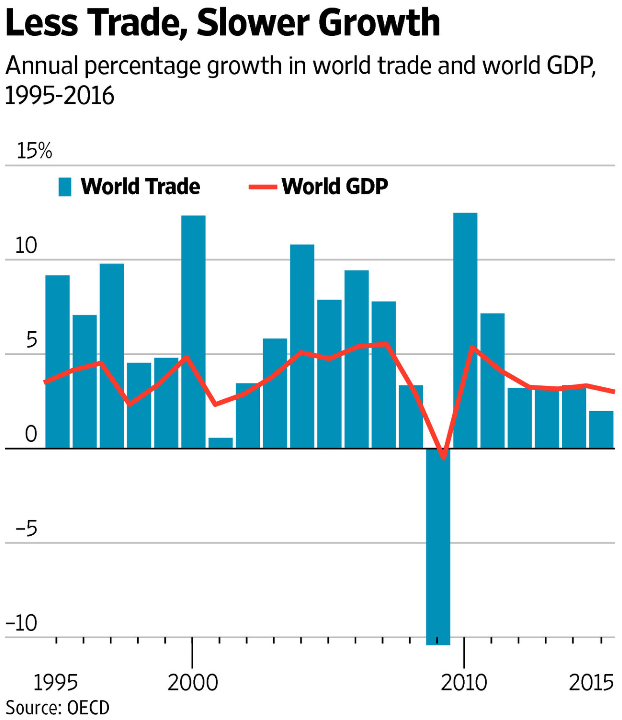
  • Foreign Trade. As the above chart shows, there is a close connection between world trade and world economic growth. And clearly the U.S. economy benefits from world-wide economic growth. The way to balance off job losses caused by foreign trade is with more effective trade-adjustment assistance and job retraining programs.

Whether or not Mr. Trump receives the Republican presidential nomination or is elected to be president in November, we should address the real grievances of his supporters in ways that benefit the entire economy.

Follow me on Twitter: https://twitter.com/jack_heidel
Follow me on Facebook: https://www.facebook.com/jack.heidel.3


Surprise! It Is Progressives Who Drive Income Inequality


The economist Lawrence Lindsey has an Op Ed in yesterday’s Wall Street Journal  analyzing Census Bureau data here, and here showing that income inequality rose more under Bill Clinton than under Ronald Reagan.  It also has risen much more under Barack Obama than under George W. Bush.
Capture6Here is the explanation for this:

  • Cheap money is a boon to those who have access to it.
  • Bill Clinton, George W. Bush and Barack Obama all presided over bubble economies fueled by easy monetary policy. But the effects of the Bush housing bubble were more evenly distributed than for the Clinton stock market bubble or the Obama credit bubble.
  • In 1968 government transfer payments totaled $53 billion or roughly 7% of personal income. By 2014, these had climbed to $2.5 trillion or 17% of personal income. Despite the redistribution of a sixth of all income, inequality is far higher today than in 1968.
  • Two earner households have become the backbone of the American middle class.
  • When families with children making between $20,000 and $50,000 attempt to have a second earner go back to work, the effective tax rate on the extra earnings, including lost government benefits, is between 50% and 80%. This “working class trap” is increasing income inequality and keeping the income of these households lower than they would otherwise be.
  • During the first six years of the Obama presidency, the number of two-earner households declined, while the number of single-earner households rose by 2.6 million and the number of no-earner households rose by 5 million. In other words, two-thirds of the increase in the number of households under Obama is accounted for by households with no one working. This is the reason the middle class has shrunk and that inequality is increasing.
  • A recent Brookings Institution study shows that boosting the top tax rate from 39.6% today to 50%, and redistributing the additional $95 billion in tax revenue to the bottom 20% of wage earners would reverse only 20% of the increase in income inequality under Obama.

As Mr. Lindsey concludes, “Attacking the rich and running against inequality may be a sensible political strategy. But in the end the programs to implement this strategy make the problem worse.”

Follow me on Twitter: https://twitter.com/jack_heidel
Follow me on Facebook: https://www.facebook.com/jack.heidel.3

What Defines a (Fiscal) Conservative?


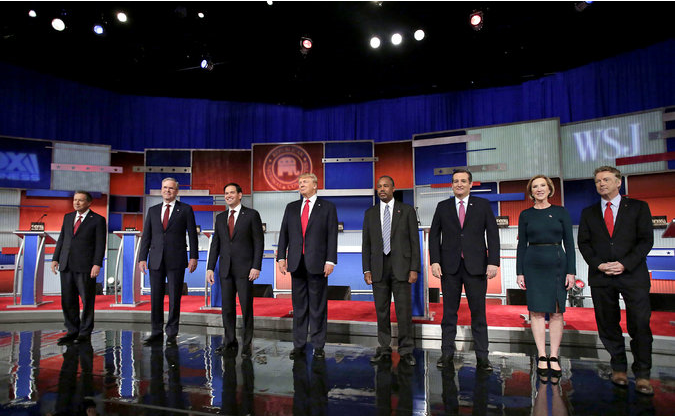
After four debates among the Republican presidential candidates, differences between them are becoming clearer.  The New York Times has an interesting article about this in today’s paper, “G.O.P. Fight Is Now a Battle Over What Defines a Conservative.”
CaptureHere are my views on the four issues discussed:

  • A Wall or a Path? We need to solve our illegal immigration problem and the key is to set up a viable guest worker program. The fact is that our economy needs foreign workers for many jobs which require hard physical labor such as in agriculture, meatpacking and construction trades. If businesses are able to bring in immigrants when sufficient domestic labor is not available, then other issues such as border security and verifying legal status can easily be resolved.
  • The U.S. Place in the World. U.S. leadership makes the world a safer place. This means we need a strong military presence all around the world as well as active alliances, trade and military, with many other countries.
  • Of Banks, Bailouts and Blame. The cause of the financial crisis was the bursting of the housing bubble, in turn caused by an unrealistic government housing policy as well as lax enforcement of existing regulations. Blaming greedy bankers is a copout. The Dodd-Frank Law is overkill which creates a drag on the economy by hampering smaller financial institutions and community banks. The best way to control large banks is to increase their capital requirements.
  • Who Should Get Tax Cuts? The main purpose of tax reform should be to boost the economy without increasing deficit spending. The way to do this is with across the board cuts in tax rates, paid for by closing loopholes and shrinking deductions. Here are some details. The 64% of taxpayers who do not itemize deductions will get an immediate tax cut and income inequality will be greatly reduced.

Getting the answers to these issues correct will have a large effect on the future wellbeing of our country.  The Republican presidential candidates should be commended for grappling with them in a productive manner.


I Am One of Paul Krugman’s “Very Serious People”


There is a stark contrast between the fiscal and economic policies being proposed by the presidential candidates from the two different parties. The Democrats want to tax the rich to reduce income inequality while the Republicans want major tax reform in order to speed up economic growth.
CaptureI favor the latter approach as long as it does not increase deficit spending.  The Keynesian economist Paul Krugman mocks deficit hawks like me as “Very Serious People.”  But in my “serious” view we have a choice between two very different paths for our economic future:

  • Slow Growth. Continue on our present path of slow 2% annual growth. The official unemployment rate has dropped to 5% but slack in the economy caused by the low labor participation rate keeps raises low and millions still unemployed or under-employed. The slow economy also keeps inflation and interest rates low. This permits Congress and the President to shrug off deficit spending and debt accumulation because it’s virtually “free money,” being borrowed at very low interest rates.   Our present course not only prolongs income inequality but also allows the debt to keep ramping up indefinitely. The longer this continues, the greater will be the disruption when inflation and interest rates do eventually return to normal historical levels.
  • Faster Economic Growth.   There are many things we can do to speed up economic growth. Tax reform is first and foremost but deregulation (relax Obamacare and Dodd-Frank), trade expansion (pass TPP) and immigration reform (with an adequate guest worker program) would also help. But, contrary to what the Republican presidential candidates say, tax reform must be revenue neutral to be sustainable. That way the economic growth it produces will lower deficit spending rather than increasing it.  This is critical because economic growth will create new jobs and raise pay for existing jobs, thereby creating inflationary pressure. Inflation will lead to higher interest rates which in turn will make our debt much more expensive than it is now.

Conclusion. We can make our economy grow faster if we simply put our mind to it. But then inflation and interest rates will go up and interest payments on the debt will become an increasing burden on society.  This is why it is so important to put our debt on a downward path as a percentage of GDP.  We can make it happen if we want to.

A Fiscal Conservative with a Social Conscience


My last two blogs were “Why racism exists in America” and “Educare and the Academic Achievement Gap.”  I often describe myself as a fiscal conservative but it would be more accurate to say that I am a fiscal conservative with a social conscience.
Capture0By this I mean:

  • First and foremost I want to shrink our annual federal budget deficits enough so that our national debt begins to decline as a percentage of GDP. Right now the public debt (on which we pay interest) is at 74% of GDP which is the highest it has been since the end of WWII. This high level of debt is unsustainable and will inevitably lead to a new and much worse financial crisis if it is not put on a downward path.
  • Closely related to the first goal is the need to get our economy growing faster than the 2% average rate of growth since the end of the Great Recession in June 2009. This will have the twin benefits of producing more tax revenue which will make it easier to shrink our annual budget deficits as well as creating more and better paying jobs for everyone.
  • A third goal is to reduce income inequality. The best way to do this is not with more income redistribution from those with higher incomes to those with lower incomes but rather by achieving faster economic growth which will raise incomes for all. Yet another critical way of making American society more equal is to focus on:
  • Reducing social inequality. There are many different forms of social inequality  in our society but let’s focus on one of the most severe aspects: black-white racism.  America will be a more peaceful and prosperous country if we can reduce the glaring inequalities between the two races.

I am sufficiently optimistic to think it is possible to make progress on all of these fronts at the same time. It won’t be easy but momentum is slowly but surely building in this direction.

Social Inequality vs Income Inequality


There is today in the U.S. much concern about income inequality and I have devoted many posts to this topic recently such as “Are economics and Social Progress Related to Each Other?”,How to Expand Economic Mobility”, and “Richer and Poorer.”
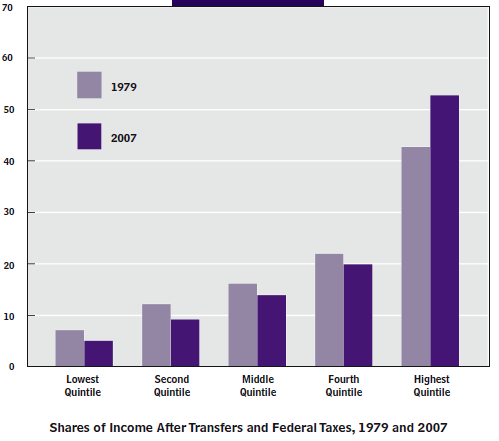
CaptureThe above CBO chart shows that income inequality has not changed much in the last 30 years once government transfers and federal taxes are taken into account. Along the same line, the Manhattan Institute’s Oren Cass makes a strong case in, “The Inequality Cycle,” that Americans should be paying at least as much attention to the social aspects of inequality as to the economic aspects.
For example:

  • As Charles Murray shows in “Coming Apart,” (http://www.amazon.com/Coming-Apart-State-America-1960-2010/dp/030745343X) the upper class has remained stable with respect to marriage rates (94% in 1960, 84% in 2010), civic involvement, and trust in society while for the lower class marriage rates (84% in 1960, 48% in 2010 and dropping), civic involvement and public trust have all declined significantly.
  • Children in the lower classes are five times more likely to face abuse, violence, addiction and the death or imprisonment of a parent.
  • By the time they reach kindergarten, 72% of middle class children know the alphabet compared with only 19% of poor children.
  • The fraction of children with a single parent is the best predictor of upward economic mobility in a particular region, whereas the level of income inequality is not a significant predictor.

Mr. Cass suggests that public policy should focus on these social problems at least as much as on income inequality. For example:

  • Education reform should be focused on both ends of the K-12 spectrum: early childhood education to ensure that all children are ready to learn when they get to school and better vocational education in high school so that graduates can find a good job if they’re not going to college.
  • Remove onerous regulations on the workplace so that employers are not pushed unnecessarily into independent contractor arrangements.
  • The federal government should be more supportive of marriage (e.g. with tax policy), and the participation of religious organizations in the delivery of public social services (to improve their quality).

Conclusion: Being poorly raised does more to cut off opportunity than being raised poor.

The Pope, the United Nations and Global Poverty


This is a big week in the U.S. Pope Francis is coming here and the UN will convene a conference in NYC to endorse international development goals for the next 15 years. As I explained in a recent post, “The Dung of the Devil,” the Pope should pay more attention to the recent accomplishments of free enterprise in decreasing the amount of poverty and economic inequality around the world.
In an article just a few days ago in the Wall Street Journal, Bjorn Lomborg, the Director of the Copenhagen Consensus Center, explains that the U.N. is likely to endorse 169 targets for global investment for the next 15 years. Mr. Lomborg demonstrates with cost-benefit analysis that focusing on just 19 of these goals would accomplish far more than adopting everything on the U.N.’s much longer list.
Capture1Here are a few of Mr. Lomborg’s items:

  • Completing the World Trade Organization’s Doha agreement would return $2000 for every dollar spent to retrain and compensate displaced workers.
  • The elimination of fossil fuel subsidies would be worth $15 for every dollar spent in direct support of the very poor who are unable to afford higher fuel prices. By contrast, trying to drastically increase the production of renewable energy would return less than a dollar for every dollar spent because renewable forms of energy remain so expensive.
  • Tripling access to preschool in sub-Saharan Africa would have benefits worth more than $30 for every dollar spent because of improved future earnings. On the other hand, efforts to improve exams and teacher accountability are much harder to achieve and the benefits would only amount to $5 for every dollar spent.
  • Other actions: boosting agricultural yields, cutting indoor air pollution with clean cook stoves, increasing access to family planning, fighting malaria and combatting malnutrition are other examples where investment would lead to big dollar returns.

Conclusion: Free enterprise economics has done much in recent years to eliminate poverty and inequality around the world. Additional public and private investment, focusing on just a relatively few major goals, can accomplish even more.