A Much Better Way to do Tax Reform


My last two posts, here and here, have pointed out the folly of the tax plans of the presidential candidates from both parties:

  • The Republican plans would stimulate the economy but at a cost of huge increases in the national debt, even using dynamic scoring to take into account the growth effects of these plans.
  • Raising the top tax rate to 50%, a Democratic idea, would bring in $100 billion per year, but this is not enough to either make a big dent on budget deficits or lower income inequality appreciably.
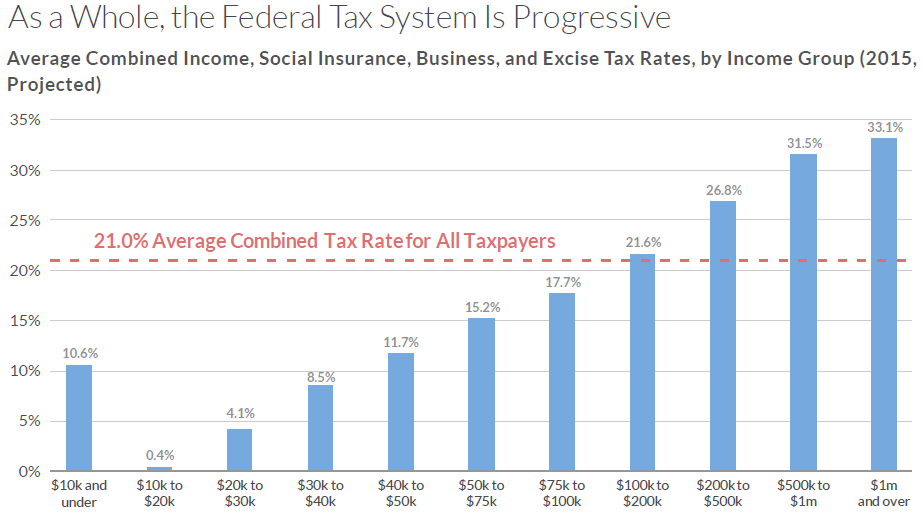
    CaptureThe Tax Foundation has just published an excellent guide to income tax policy which makes several good suggestions for using tax reform to boost the economy:
  • Eliminating the deduction for state and local taxes would raise $81 billion per year. Using this revenue to reduce individual income tax rates would grow the economy by 1.77% of GDP over 10 years.
    Capture11
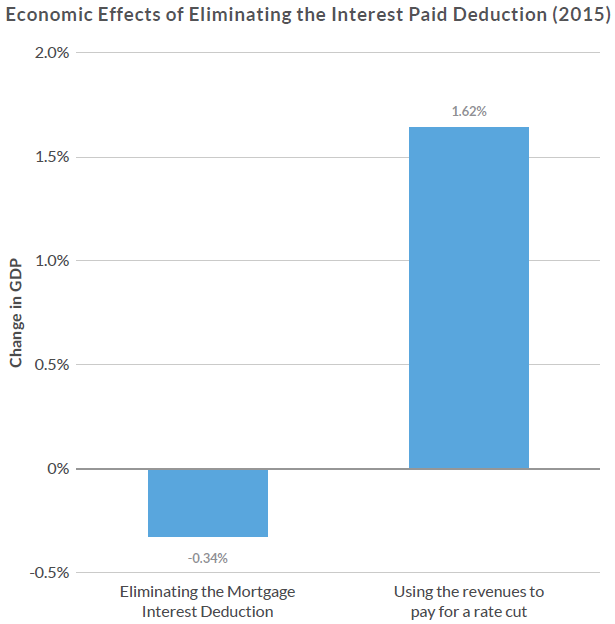
  • Eliminating the mortgage interest deduction would raise $75 billion per year. Reducing individual tax rates by the same amount would grow the economy by 1.61% of GDP over 10 years.
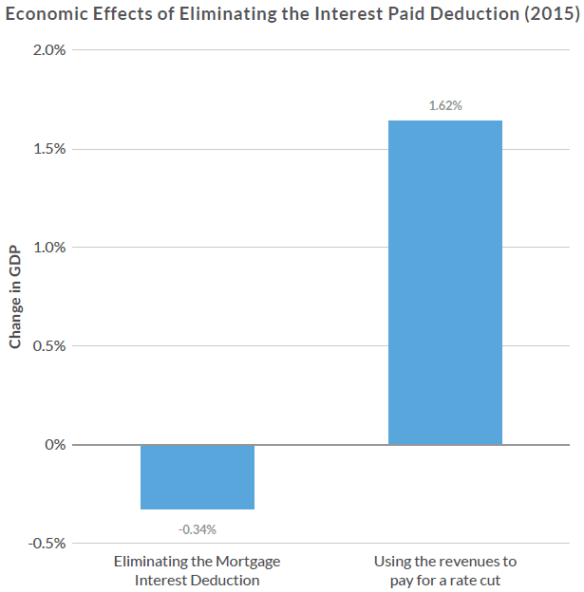
    Capture12
  • Capping itemized deductions at $25,000 would bring in $188 billion per year. Reducing individual tax rates by the same amount would grow the economy by 1.99% over ten years.
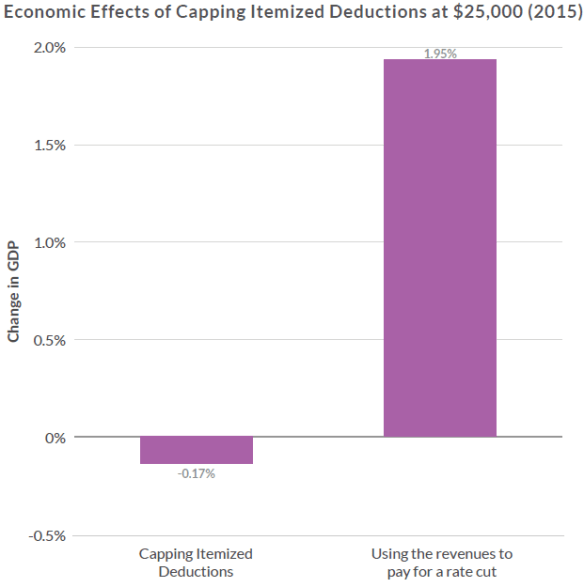
    Capture13

Sensible, i.e. revenue neural, tax reform will do wonders for the economy as this study from the Tax Foundation shows. It will bring in more tax revenue to help pay the bills.  It will raise salaries for the already employed.  It will create new jobs for the millions of unemployed and underemployed people who want them.  It will thus reduce income inequality by increasing the wages of people on the bottom. Why is this so hard for so many people to understand?

                               Follow me on Twitter: https://twitter.com/jack_heidel
                     Follow me on Facebook: https://www.facebook.com/jack.heidel.3

The Republicans Need to Get Real about Tax Reform


The Republican presidential candidates have been releasing tax plans and they have been analyzed by the nonpartisan Tax Foundation. It turns out that most of these plans lose revenue over a ten-year period even on a so-called dynamic scoring basis where the stimulatory effects of the plan are taken into effect.  Such callous disregard for the huge annual deficits we are now running, and our huge accumulated national debt, is totally unacceptable especially from the political party which bills itself as being fiscally responsible.
CaptureThe left-leaning New York Times points this out yesterday in its lead editorial, “Why the Republican Tax Plans Won’t Work.”  According to the NYT:

  • Tax Revenues will need to increase by 40% over the next 10 years just to keep federal spending even with inflation and population growth.
  • Further additional revenues will be needed to pay for health care for the elderly, transportation systems, climate change and likely increased interest payments on the national debt.
  • Thus taxes will have to go up and can only be imposed realistically on the wealthy who have had the biggest income gains in recent years.
  • Democratic presidential candidates do propose tax cuts but only for low- and middle-income Americans.
  • Democrats are calling for new taxes on financial transactions.
  • Democrats also propose to raise wages, support higher minimum wages, support unions and expand profit-sharing and employee ownership.

This is the program the Democrats will be pushing if they win the presidency next year. It has some attractive features but the likely overall outcome will be increased deficit spending, a rapidly increasing debt and a continued stagnant economy.
Meaningful tax and regulatory reform will both be needed to get the economy growing faster than the 2% average of the past six years.  Any credible tax reform program simply must be at least revenue neutral so that, combined with spending restraint, it will put our national debt on a downward path.

Follow me on Twitter: https://twitter.com/jack_heidel
                   Follow me on Facebook: https://www.facebook.com/jack.heidel.3

It’s Easy to be Pessimistic about America’s Future


As I remind readers from time to time, this blog is concerned with America’s fundamental fiscal and economic problems: a slow economy, massive debt, and increasing income inequality. Largely because of these apparently intractable problems, more and more people are becoming pessimistic about the future of our country.
CaptureAlthough I am by nature an optimist, these matters weigh on me as well:

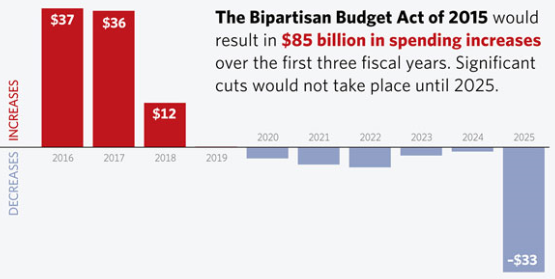
  • The just introduced “Bipartisan Budget Act of 2015” is a sell-out to the status quo. It breaks the agreed upon sequester spending limits by $112 billion over two years with essentially no attempt to create long term spending restraint.
  • As pointed out recently by the Washington Post’s Robert Samuelson, the presidential candidates are talking mainly about new entitlements (the Democrats) or tax cuts (the Republicans). In both cases this represents a flight from reality.
  • Entitlements: The number of people aged 65 or older will increase from 15% of the population today to 22% of the population in 2040. The cost of Social Security, Medicare and Medicaid will jump from 6.5 % of GDP today to 14% of GDP in 2040. We simply must control these costs by raising eligibility ages for SS and Medicare and increasing premiums for wealthier recipients.
  • Economic Growth: Annual growth has averaged only 2% of GDP since the end of the Great Recession in June 2009. Slow growth means weaker gains in wages, more unemployment and larger spending deficits. This can be fixed long term with honest tax reform, but not with unrealistic tax cuts.

Conclusion: Isn’t it obvious that we need political candidates who will speak forthrightly with the people about the need for addressing these humongous problems? Americans aren’t dumb.  They will respond to straight talk from their supposed leaders.   

Follow me on Twitter: https://twitter.com/jack_heidel
                    Follow me on Facebook: https://www.facebook.com/jack.heidel.3

Combating the Politics of Distrust


My last post, “The Politics of Distrust” presents the view that the main reason for the divisiveness of today’s politics is “the stubborn torpor of the American economy.” If this is true then the solution is obvious: speed up economic growth!
CaptureA couple of weeks ago the economist Alan Blinder, a Hillary Clinton advisor, had an Op Ed in the Wall Street Journal, “A Fairness Agenda for Winning Over Angry Voters” with which I largely agree. Here are the highlights of Mr. Blinder’s fairness agenda:

  • A labor market tight enough to leave employers scouring the land for workers, the best tonic for workers the world has ever known. Mr. Blinder does say that looser purse strings by Congress would help create more demand but it is simply too risky to keep running up our already enormous national debt. Eventually interest rates will return to normal and interest payments on the debt will skyrocket.
  • Raising the federal minimum wage would be an enormous help for wage earners at the bottom. Many states and cities are doing this on their own which is a better way to go because of huge regional differences.
  • Increase the Earned Income Tax Credit, especially for childless workers. A very good way to incentivize work.
  • More Vocational Training and Apprenticeships. Strengthening community colleges and career education in high schools would go a long way to accomplish this.
  • Provide quality pre-K education for families who can’t afford it. Early childhood education for children from low-income families is another very good idea.
  • The tax code is a national disgrace. The corporate tax may be even more complex, inefficient and unfair than the personal tax. The mantra of tax reformers has always been: broaden the base, lower the rates. Amen!

What Mr. Blinder is calling a fairness agenda turns out to be a growth agenda in disguise. I would add a few more items like deregulation to encourage entrepreneurship and business expansion but basically Mr. Blinder has suggested an attractive program for economic growth which should appeal to a broad collection of political interests.

Follow me on Twitter: https://twitter.com/jack_heidel
Follow me on Facebook: https://www.facebook.com/jack.heidel.3

Dodd-Frank Is Hurting the Recovery!


The Federal Reserve Bank plays an important role in our economy by trying to keep inflation low and stable but also by trying to make recessions less severe by increasing the money supply when the unemployment rate is high. My last post, “What the Federal Reserve Can and Can’t Do” emphasizes that, as Ben Bernanke says, “the Fed has little or no control over long term fundamentals,” such as economic growth which depends on increases in productivity which, in turn, are heavily influenced by fiscal and regulatory policy.
Capture8The American Enterprise Institute’s Peter Wallison explains very clearly in “The slow economic recovery explained,” why, for example, the Dodd-Frank Act of 2010 is having a harmful effect on economic growth:

  • Regulatory burdens imposed by Dodd-Frank have been particularly harsh for community banks, with $10 billion or less in assets; 98.5 % of U.S. banks fall into this category. Since Dodd-Frank was enacted in 2010, community banks’ share of banking assets has shrunk by 12%.
  • According to the Small Business Administration, there were approximately 23 million small businesses (with fewer than 500 employees) in 2012, compared to 18,500 firms with more than 500 employees. Large businesses have access to capital markets whereas small businesses rely on local banks for their credit needs.
  • Regulatory costs affect small banks more than large banks because the costs are fixed, independent of size of the institution. When the Consumer Financial Protection Bureau sends out voluminous regulations on mortgage lending, for example, then extensive legal fees, compliance officers and technology retooling must be paid for up front.
    Capture
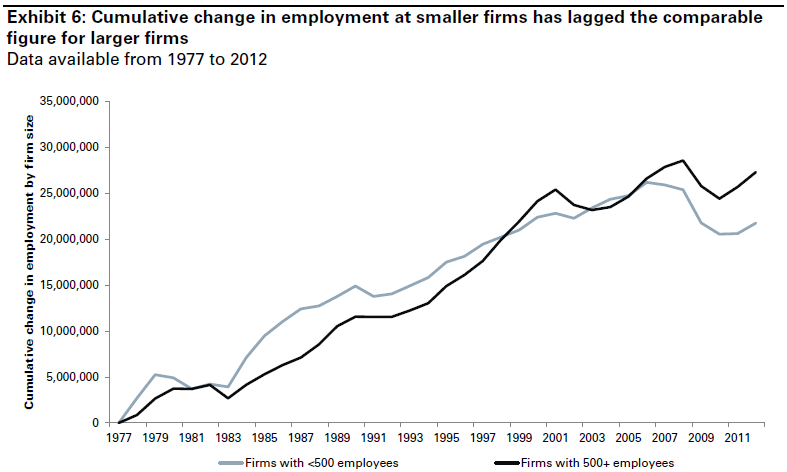
  • A recent report from Goldman Sachs, “The Two-Speed Economy,” shows that large firms have grown faster than usual after 2010 while small firms have grown much slower than usual (see chart above).

Conclusion. Monetary policy alone, as conducted by the Federal Reserve, cannot return our economy to good health. This can only be accomplished by increasing productivity which is aided by smart fiscal and regulatory policy. Dodd-Frank is an example of regulatory policy which is hurting economic growth by having a harmful effect on main street banks.                                 

What the Federal Reserve Can and Can’t Do


I have a good impression of Ben Bernanke, chair of the Federal Reserve from 2006-2014. Partly because he comes across as being both competent and honest and partly because Sheila Bair, chair of the Federal Deposit Insurance Corporation from 2006-2011, and whom I greatly admire, gives him high marks in her book, “Bull by the Horns,” about the financial crisis.
CaptureMr. Bernanke has an excellent Op Ed in yesterday’s Wall Street Journal, “How the Fed Saved the Economy,” clearly describing what the Federal Reserve both can and can’t do. What it can do is:

  • Make recessions less severe. The unemployment rate has been steadily dropping and now is apparently almost back to normal at 5.1% even though the relatively low labor-force participation rate and lack of wage pressure indicate remaining weakness.
  • Keep inflation low and stable. The Fed’s expansionary monetary policy has helped bring down unemployment without igniting inflation whose underlying rate is currently only 1.5%.

Mr. Bernanke states that “the Fed has little or no control over long-term economic fundamentals – the skills of the workforce, the energy and vision of entrepreneurs, and the pace at which new technologies are developed and adapted for commercial use.” He goes on to say that “further economic growth will have to come from the supply-side, primarily from increases in productivity. … Fiscal-policy makers in Congress need to step up” by adopting policies to:

  • Improve worker skills. (how about immigration reform, better vocational education, reforming SSDI and expanding the EITC to boost incentives to work)
  • Foster capital investment. (how about both individual and corporate tax reform and relaxing Dodd-Frank regulations on main street banks)
  • Support research and development. (how about making life easier for entrepreneurs with fewer regulations)

Mr. Bernanke has a very good handle on our current financial situation. The Federal Reserve has done and is doing its job. It’s time (long past time!) for fiscal policy makers (i.e. Congress and the President) to adopt policies, such as above, to speed up economic growth.

Donald Trump’s Tax Plan: More Bad than Good


Republican presidential candidate Donald Trump has just released his tax plan. Some of its basic features are:

  • Lowering and consolidating seven current tax brackets into three: 10%, 20% and 25%.
  • The corporate tax rate would be cut from the current level of 35% to just 15%.
  • The income tax on all businesses would be cut to 15% as well.
  • Taxing carried interest at ordinary income tax rates instead of at the lower capital gains rate.
  • Eliminating the Alternative Minimum Tax as well as the Estate Tax.
    Capture8

The nonpartisan Tax Foundation has analyzed the Trump plan and predicts the following positive long term effects:

  • 11.5% higher GDP,
  • 29% increase in capital investment,
  • 6.5% higher wages and
  • 5.3 million more full-time equivalent jobs.

The tax Foundation also performed an analysis of Jeb Bush’s tax plan and found roughly similar economic benefits except for a lesser number, 2.7 million, of new jobs created. But the Tax Foundation also predicts that the Trump plan would cut tax revenue by $11.98 trillion over ten years on a static basis or $10.14 trillion on a dynamic basis (accounting for economic growth effects of the plan). This compares with a loss of revenue of $3.6 trillion over ten years (static) or $1.6 trillion over ten years (dynamic) for the Bush plan.
In other words, for a substantially larger growth in new jobs under the Trump plan, there is an enormous cost in additional deficit spending.
Conclusion: I have previously criticized the Bush plan for increasing deficit spending and therefore adding to the debt when we should be shrinking it. The Trump plan is much, much worse in this respect, running annual deficits of over $1 trillion per year, moving in exactly the wrong direction.
The Bush tax plan, while needing changes to make it revenue neutral, is far superior to the Trump plan, which simply blows off any concern for deficits and debt.

Jeb Bush’s Tax Plan: Both Good and Bad


Republican presidential candidate Jeb Bush has just released his tax reform proposal, “My Tax Overhaul to Unleash 4% Growth.” It has many good features such as:

  • Lowering and consolidating seven current tax brackets into three: 10%, 25% and 28%.
  • Essentially doubling the standard deduction for most filers, thereby achieving huge simplification for millions of average income filers.
  • Eliminating the state and local income tax deductions and capping all others, except for charitable deductions, at 2% of Adjusted Gross Income.
  • Doubling the Earned Income Tax Credit for childless filers, thus encouraging more low income people to work.
  • Exempting taxpayers over the age of 67 from the employee-side payroll tax, encouraging them to stay in the workforce longer.
  • Cutting the corporate tax rate from 35% to 20%.
  • Allowing 100% immediate expensing for all capital investments, including inventories.
  • Creating a territorial tax system so that multinationals are not taxed on foreign earnings, and therefore incentivized to bring their foreign profits home.
  • Eliminating the deductibility of interest expenses.

The lower individual and corporate tax rates, together with the separate investment and work incentives, will create a significant economic stimulus estimated to raise GDP by at least .5% per year or higher, depending you who ask.
According to the Tax Foundation, however, the plan would reduce federal revenue on a static basis by $3.66 trillion over ten years, and even by $1.6 trillion on a dynamic basis, taking into account the new tax revenue generated by the plan.
CaptureThis is, of course, a huge problem. We badly need to speed up economic growth but we also need to lower, not increase, our annual deficit spending in order to put our debt on a downward path as a percentage of GDP.
The resolution of this quandary is to tighten up on those deductions, such as for mortgage interest, remaining in the code and also lessening the amount of the tax cuts if necessary in order to achieve overall revenue neutrality for the plan.

The Moral Case for Free Enterprise


Capitalism is under attack around the world as Greek socialists complain about their hard- hearted EU creditors, American liberals such as Bernie Sanders and Elizabeth Warren push the Democratic Party to the left, and Pope Francis compares the excesses of global capitalism to the “dung of the devil.”
CaptureOne of my favorite economic commentators is Arthur Brooks, President of the American Enterprise Institute.  One of his books is “The Road to Freedom: How to Win the Fight for Free Enterprise,” which examines the most important economic issues facing the United States from a moral point of view.  For example:

  • Getting the U.S. Economy Growing Again. Weak economic growth means the end of opportunity in America. Furthermore, weak growth disproportionately hurts those who most need new economic opportunities: the poor. One strategy says that the key to restarting economic growth is the state: more stimulus, more taxes, more borrowing. A second strategy says the source of economic growth is free enterprise: tax reform, less government regulation, policies that make it easier for entrepreneurs to succeed, and a smarter immigration policy.
  • Putting America Back to Work. Jobs are not just a source of money for Americans; they are a ticket to earned success. High unemployment is unfair because it robs people of their potential fulfillment. It is especially harmful to the poor and the young. The key to job creation is to get the economy growing faster.
  • Getting the United States Out of Debt. Unless the U.S. reduces deficits, it will have just three choices: steal from future generations, inflate the currency to lower the value of the debt or refuse to pay those to whom it owes the money. All of these options are immoral because they are unfair: they harm others who have done no harm to America. Three points here: 1) we have out-of-control entitlement spending, 2) debt crises are more successfully dealt with through spending reductions than with tax increases and 3) there are no quick fixes.

Considering basic economic and fiscal issues from a moral perspective adds an important new dimension to the discussion.  We might disagree on the details of how to proceed but it is imperative to take effective action of some kind!

Fixing the Debt: Creating a Greater Sense of Urgency II. An Example


My last post, ”Fixing the Debt: Creating a Greater Sense of Urgency,” expresses my dismay that our huge debt problem does not receive enough serious attention from the American people.  Yes, most Americans deplore the national debt and the deficit spending that leads to it, but it only too seldom affects how they vote for candidates for federal office, thus giving a pass to the big spenders in Congress.
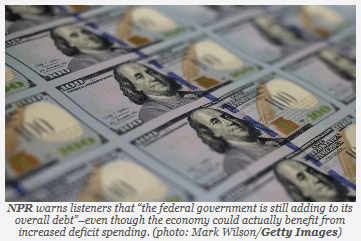
CaptureHere is a good example of this refusal to take the debt seriously.  The advocacy group FAIR (Fairness and Accuracy in Reporting) ridicules NPR for addressing this problem, “Look a Deficit: How NPR Distracts You From Issues That Will Actually Affect Your Life.”  Here is what FAIR is saying:

  • Interest on the national debt is projected to be only 2% of GDP in 2016 and 3% of GDP in 2024, which is tiny. (But this is because the interest rate for the debt is now abnormally low, approximately 1.7%).
  • If the Fed keeps interest rates low, then interest on the debt will continue to stay low indefinitely and so the debt will continue to be a trivial problem. And the President appoints 7 of the 12 voting members of the Fed Open Market Committee which sets interest rates.
  • The reason the Fed raises interest rates is to slow the economy and keep people from getting jobs.  (Actually the real reason is not to keep people from getting jobs but to keep inflation under control. Once inflation takes off, it is very difficult to bring it back down as we painfully discovered in the late 70s and early 80s).
  • Anyhow, if the Fed raises interest rates to keep the labor market from tightening, as it did in the late 1990s, this would effectively be depriving workers of the 1.0 – 1.5 percentage points in real wage growth they could expect if they were getting their share of productivity growth. (A rise in interest rates need not choke off economic growth which is primarily affected by supply and demand. Fiscal policy (tax rates and spending), established by Congress, has a far greater effect on the rate of economic growth than does monetary policy).


If our debt is not soon placed on a sustainable downward path, we will soon have another financial crisis, much worse than the Great Recession of 2008.  This will affect everyone’s life in a substantial and very unpleasant way.