Response to a Persistent Critic


You keep saying that we need lower tax rates to boost the economy but what makes you think this will help? Businesses are sitting on piles of cash. They have plenty of money to invest in expansion. What they need are more customers. The basic problem is not enough demand for more goods. This is what is holding back the economy. It doesn’t much matter what the tax rates are. If the demand and customers are there, businesses will spend their own money or borrow as much money as they need, at low interest rates, to produce all the products they can sell.                                                                                                                Anonymous Critic

I have several responses to this criticism:

  • First of all I want to make it clear that all cuts in tax rates must be offset by shrinking or eliminating tax preferences.   So there will be no loss of tax revenue. Two thirds of all taxpayers take the standard deduction and will therefore automatically benefit from lower tax rates. This will put tens of billions of new dollars into the hands of middle class wage earners who will spend most of this money because they have tight budgets. This will give the economy a big boost.
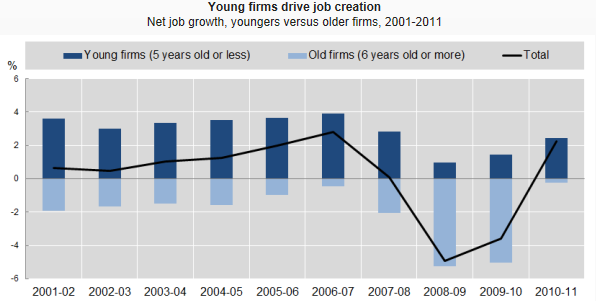
  • As I discussed in my blog post from October 26, 2013 “Where are the Jobs? II. How to Create More of Them,” most net new job creation comes from businesses less than one year old, the true “startups.” New business owners are typically not wealthy, with lots of personal tax deductions. They need all the financial resources they can muster. Lower tax rates will save them money and therefore help them get their new business going.
    Capture
  • In general, tax deductions such as for mortgage interest, municipal bond interest payments, state and local taxes, etc. benefit the wealthiest tax payers.  Therefore the lowering of tax rates, offset by shrinking tax deductions, represents a shift of funds from the wealthier to the less wealthy. This will at least slow down the increase of inequality which afflicts the modern world.
Conclusion: Lower tax rates will put more money in the hands of people who will spend it, thereby boosting the economy by creating more demand, provide support for entrepreneurs starting new businesses (which will create more jobs) and lessen income inequality. All in all this represents major progress!

Soaring Profits, Too Few Jobs and Low Interest Rates


“Low interest rates aren’t working, but we need a debate about what will,” declares The Wall Street Journal’s William Galston yesterday in “Soaring Profits but Too Few Jobs”. “Corporate profits after taxes in the fourth quarter of 2013 rose to an annual level of $1.9 trillion – 11.1% of GDP, a postwar high. Meanwhile, total compensation – wages and benefits – fell to their lowest level of GDP in at least 50 years.”
Capture“Businesses are sitting on tons of cash . . . and they’re choosing to invest their capital in hardware, rather than hiring. The reason: they believe that investing in technology is likely to have a better effect on sales than hiring more people.” Furthermore, “today’s (low) interest- rate regime lowers the cost of capital – and therefore of capital investment relative to labor.”
Meanwhile,” Republicans are banging away at the Affordable Care Act while Democrats are busy scheduling votes on a grab bag of subjects designed to boost turnout from the party’s base in the fall elections. The economic problems we face are getting lost in the partisan din.”
We are in a very tough situation. Raising interest rates might give a marginal boost to hiring more workers over capital investment but it will also greatly increase interest payments on our massive and rapidly increasing national debt. And meanwhile we have a stagnant economy with millions of people either unemployed or underemployed. What should we do?  How about

  • Boosting the economy with lower individual and corporate tax rates, paid for by cutting back on tax preferences. This will especially help small businesses grow and hire more employees. It will also encourage multinational corporations to bring their foreign profits back home for reinvestment.
  • Addressing rising income and wealth inequality by establishing an annual 1% wealth tax on individual assets in excess of $10 million. This will raise about $200 billion per year and could be used to set up a huge infrastructure improvement program to put millions of people back to work.

Interest rates will eventually return to normal levels of 5% or so and this will create a big squeeze on the federal budget. So we also need to get federal spending under control as soon as possible. But this is a separate issue.
Just boosting the economy and putting people back to work while addressing inequality in a very visible way will get us started on a path to recovery.

How Do We Break Out of Our Economic Rut?


The U.S. economy is in a rut. On the one hand, growth is stagnant, unemployment is high and huge deficits are leading to massive debt. On the other hand our population has an increasing number of retirees and also an increasing number of low income (often immigrant and minority) service workers. These groups demand more services in the form of entitlements and social welfare programs. In a democracy these needs are hard to deny. Is it possible to better stimulate the economy, alleviate inequality and shrink deficit spending at the same time?   I believe it is!
Capture 

  • Stimulating the economy. The best way to do this is to lower both individual and corporate tax rates in a revenue neutral way by eliminating, or at least greatly reducing, tax preferences. Faster growth of GDP will both reduce unemployment and bring in more tax revenue and thereby lower the deficit.
  • Reducing inequality. I join many others to propose a large scale, government funded, infrastructure development program, badly needed for its own sake, but also as a way of putting hundreds of thousands, if not millions, of people back to work. However, and this is essential, it has to be paid for by a major new source of revenue. My own preference is to establish a new tax, on the assets of very wealthy people, say with a net worth of $10,000,000 or more. An asset tax of between one and two percent per year would bring in several hundred billion dollars and also represents a highly visible way of reducing inequality without adversely affecting the economy.
  • Shrinking the Deficit. One of the biggest problems with many federal programs is that there is neither built in quality control nor cost control. There is little incentive for either Congress or federal bureaucrats to set priorities and control costs. A good way to change this system is to devolve many federal programs back to the states where such controls do exist. I will have more to say about this in future posts.

Big changes are needed at the federal level to get our economy back on track and put people back to work. There are ways to do this and we simply need leaders with enough vision and determination to get the job done!

Do We Need a New School of Economics?


“Consider the following scenario. You are an airline pilot charged with flying a planeload of passengers across the Atlantic. You are offered the choice of two different aircraft. The first aircraft has been prepared by chief engineer Keynes and the second by chief engineer Hayek.
You have to choose which plane to use, so naturally you ask the advice of the two engineers. Keynes urges you to use his aircraft, offering a convincing explanation of why Hayek’s plane will crash on take-off. Hayek urges you to use his aircraft, offering an equally convincing explanation of why Keynes’s plane will crash on landing.

At loss as to which plane to choose, you seek the advice of two leading independent experts – Karl Marx and Adam Smith. Marx assures you that it does not matter which aircraft you choose as both will inevitably suffer catastrophic failure. Similarly, Smith also reassures you that it does not matter which aircraft you choose, as long as you allow your chosen craft to fly itself.”
Thus begins a fascinating new book, “Money, Blood and Revolution: How Darwin and the doctor of King Charles I could turn economics into a true science,” by the fund manager and economist, George Cooper.
CaptureMr. Cooper sets up a circulatory model of democratic capitalism whereby rent, interest payments and profits flow from low income people at the bottom of the pyramid to the wealthy at the top. And then tax revenue (collected mostly from the wealthy) is redistributed downward in the form of government programs.
According to Mr. Cooper, the financial crisis was caused by a combination of lax regulation and excessive credit and monetary stimulus. The question is what to do about it. Mr. Cooper says:

  • Stop adding to the problem. High student debt and high mortgage debt are still being supported by government programs.
  • Change the course of the monetary river. Quantitative easing does not work because it just puts money into the hands of the wealthy and they have no incentive to spend it.
  • Change the course of the fiscal river. Instead put money into the hands of the people at the bottom of the pyramid with expanded government spending on infrastructure (paid for by taxing the wealthy).

Without endorsing all of Mr. Cooper’s suggestions, he nevertheless has many good ones and expresses them in a highly entertaining style!

The Long Run and the Short Run


“I agree with you that something must be done now. The trick is what will work the best in the short term to trigger the agreement between the fiscal conservatives and the modern liberals to cut costs and balance the budget that we both agree on. We can agree to disagree on the solution details but I hope you are successful in achieving the short term goals you are working tirelessly on.
Just as big a question is what will work the best in the long run to prevent it from happening again. I will continue to work on changing the intellectual environment that I see as a precondition to solidifying your short-term gains and preventing a re-occurrence.”
Capture
These are the words of my Omaha libertarian friend, David Demarest, with whom I have an ongoing dialogue.  He wants to cut back and limit the scope of government.  I’m willing to have a more expansive government as long as we’re willing to pay for it.
The secret to solving many of our current problems (stagnant economy, high unemployment, massive debt, increasing inequality) is to grow our economy faster.  The best way to accomplish this is by boosting investment and entrepreneurship with broad-based tax reform, by lowering tax rates for both individuals and corporations, paid for by eliminating deductions and closing loopholes.
But some people think that lowering tax rates means lower taxes on the rich.  To counteract this perception, and at the same time to raise additional tax revenue to lower the deficit, I propose to  levy a new wealth tax of 1% of assets with an exemption of $10 million per person to make sure that the tax only applies to the “truly wealthy.”
I believe that a program along these lines is the best way to get our economy back on track.  But, at the same time we need to figure out how to avoid falling back into another slow growth, high debt trap anytime soon.
A good way to achieve long run protection is with a balanced budget amendment.  It would need to be flexible, allowing for emergencies, and also phased in over several years to allow citizens and legislators time to make the necessary adjustments to spending and taxes.

Do We Really Need a Wealth Tax?


Our dire fiscal and economic problems are crying out for a bold solution.  We need to simultaneously stimulate our economy to grow faster and create more jobs, raise sufficient tax revenue to pay for our growing spending commitments, and address a widening inequality gap which threatens to undermine the basic principles of a free and just society.  How are we going to accomplish all of these tasks at the same time?
It seems to me that the best way is to thoroughly reform our income tax system based on the following principles:

  • Lower tax rates on marginal income to encourage more investment and entrepreneurship.  Such changes can be made revenue neutral by eliminating deductions, loopholes and other tax preferences.  This would apply to corporations as well as individuals.
  • Establish a new low percentage (1% – 2%) wealth tax with a relatively high personal exemption ($5 million – $10 million).  This would bring in approximately $200 billion per year to be used for reducing the deficit.  Equally as important it would be a visible sign that the wealthy are making a significant contribution towards solving our fiscal problem.  This will make it more acceptable to lower marginal tax rates on income in order to boost economic growth.

Fiscal conservatives often oppose any increase in tax revenue because, they think, it is likely to be used for new spending rather than for lowering the deficit.  One way to overcome this concern is to pass a Balanced Budget Amendment to the Constitution. This would make it much harder to increase spending.  The problem is that it will be very hard for Congress to pass such an amendment and have it ratified by ¾ of the states.
But something has to be done.  The longer we wait and the more debt we build up, the more painful it will be to extract ourselves when the next crisis occurs as it surely will.

Considering a Wealth Tax for the U.S.


What should a country do when it has

  • Massive accumulated debt and annual deficits predicted to grow indefinitely.
  • A rapidly growing population of retirees heavily dependent on expensive entitlement programs such as Social Security and Medicare.
  • A national Congress which is unwilling to make significant spending cuts for fear of offending powerful constituent groups.
  • Growing income inequality and wealth inequality.
  • A stagnant economy and high unemployment which makes inequality worse.
  • An inefficient income tax system which does not take in enough tax revenue to pay the bills.

The best response by far is to implement broad-based, pro-growth, tax reform.  I have often discussed how to make major changes to our current income tax system.  I have also described an attractive way to introduce a consumption tax, the so-called Graetz Plan.
CaptureAnother way to reform taxes is to introduce a wealth tax.  The economist Ronald McKinnon has described a way to do this in a Wall Street Journal column, “The Conservative Case for a Wealth Tax”.  His plan is to implement a federal wealth tax in addition to the federal income tax.  It would consist of a flat tax of about 3% imposed on household wealth in excess of a $3 million exemption which would exclude 95% of the population.  In addition to bringing in a significant amount of new revenue each year, which is its principal objective, it would serve the purpose of making a flatter, pro-growth, income-tax system more palatable to people who are concerned about inequality, and therefore to a much wider audience.
The economics journalist, Daniel Altman, recently reported in the New York Times, “To Reduce Inequality, Tax Wealth, not Income” that American household wealth totaled more than $58 trillion in 2010.  The most recent issue of Forbes Magazine reports that there are now 492 billionaires in the U.S. with a total wealth of $2.3 trillion.  A 2% tax on the wealth of just these billionaires alone would raise $46 billion.  A 0.5% tax on the wealth of all Americans would raise $290 billion annually.  These examples show that a “moderate” wealth tax could bring in a significant amount of new tax revenue which would make a big dent in shrinking our annual deficit.
We have to do something and do it quickly.  The problem will occur when interest rates return to their normal level as they surely will before long.  When this happens, interest payments on our national debt will sky rocket.  It’s going to be painful regardless, but let’s try to head for the softest landing we can manage!

Wealth and Taxation


As I reported in my last blog post a few days ago, wealth inequality in the United States and the rest of the developed world is growing rapidly and is likely to get much worse in the foreseeable future.   This is happening because income from wealth, i.e. the return on investment, typically grows faster than wages and GDP.  As income inequality also grows, and top wage earners have more and more money to invest, then the gap between investment income and wage income will become even wider.  There is nothing wrong with this and the more money that is reinvested in our economy, the faster it will grow and the more jobs that will be created.
At the same time that huge new wealth is being created we have an archaic tax system in the U.S. which is not only incredibly complicated and inefficient, but also discourages investment because the top individual and corporate rates are so high.  And it doesn’t collect enough tax to pay our bills.  We have huge deficits already and the CBO says that they’ll just keep getting worse.
Making government operate more efficiently with less spending is highly desirable but will only go so far.  Every government program has a constituency of supporters who complain when their own program is targeted for cuts.  And the biggest and most expensive, the entitlement programs of Social Security and Medicare, have the largest constituency of all, over 50 million retirees at the present time and growing rapidly as the baby boomers retire at the rate of 10,000 per day.
This huge crunch can only be resolved by fundamental tax reform.  Several different ways have been proposed to do this:

  • Reform the current income tax system by broadening the base, lowering rates and eliminating deductions and loopholes to pay for it.  The problem with this approach is that no one wants to give up their own deductions (for mortgage interest, charitable contributions, employer provided healthcare, state and municipal taxes, etc.)
  • Introduce a consumption tax such as the Graetz Plan which I described in my January 7, 2014 post.  It would establish a 14% Value Added Tax on consumption, supplemented by a lower but still progressive tax on incomes over $100,000.  It would avoid being regressive on low wage workers by using an Earned Income Tax Credit to offset the Payroll Tax.
  • Introduce a wealth tax.

Sorry, I’m over my (self-imposed) word limit already.  I’ll describe a possible wealth tax in my next post!

Does Tax Reform Have a Future?


My post on February 27, “A Breath of Fresh Air” praises the new tax reform proposal from the House Ways and Means Committee which both lowers and consolidates tax rates in a revenue neutral way as well as greatly simplifying the tax code.  It would be a big step in the right direction.  But the Washington Post’s Robert Samuelson makes a good case in ”Does Tax Reform Have a Future?” that the House bill does not go far enough.
CaptureMr. Samuelson argues that if we’re going to eliminate tax deductions and loopholes, and thereby alienate lots of special interest groups, in order to get lower tax rates, then we should avoid half measures and eliminate virtually all deductions in order to get the lowest possible rates.  In other words, eliminate the mortgage interest deduction rather than just limiting it, eliminate deductions for charitable contributions as well as deductions for state and local taxes.  Eliminate the deduction for employer provided healthcare (which by itself would go a long way towards reforming healthcare.)
Mr. Samuelson would retain only the Earned Income Tax Credit (which encourages low-income people to work) and also the tax preference for contributions to retirement accounts (without which most Americans wouldn’t save for retirement.)
We badly need broad based tax reform to stimulate our economy.  Douglas Holtz-Eakin, the former director of the Congressional Budget Office, has estimated “Reforming Taxes, Goosing the Economy”, that even the imperfect House tax reform proposal would raise GDP by .5% annually for 10 years and create 500,000 new jobs each year over this time period.
Full-fledged tax reform, a la Samuelson, would provide an even greater stimulus but let’s at least do something to put the millions of unemployed and underemployed people back to work and reduce our staggering budget deficits!

Where Have All the Raises Gone?


In yesterday’s New York Times an editorial asks the question “Where Have All the Raises Gone?”, pointing out that wages for college graduates have been stagnant since 2001 (see the chart below.)  A report referred to in the NYT editorial suggests that as the information technology revolution has matured, employer demand for cognitive skills has waned and so some college graduates have had to take lower paying jobs, displacing less educated lower skilled workers in the process.  This makes sense and, of course, new hiring has slowed down even more as a result of the recession.
CaptureThe question then becomes, what, if anything can government do to counteract and overcome this trend?   According to the NYT, “what’s needed to raise pay are policies like a higher minimum wage, trade pacts that foster high labor and regulatory standards, and more support for union organizing.”
Of course there is another point of view and it is expressed very well in yesterday’s Wall Street Journal by Mortimer Zuckerman, the Chairman and Editor-in-chief of U.S. News and World Report, “Fight Inequality With Better Paying Jobs”. Mr. Zuckerman declares that “income inequality isn’t so much the problem as income inadequacy.  A more robust economy, stoked by growth-oriented policies from Washington, would help produce the jobs and opportunities that millions of Americans need to climb the economic ladder.”  He suggests that what is needed is:

  • Lower corporate tax rates so that American multinational companies will bring their foreign earnings back home.
  • Get healthcare costs under control (Obama Care doesn’t do this).
  • Cut back on unnecessary regulations to encourage more business investment.
  • Train more skilled workers.  The National Federation of Independent Businesses reports that 38% of its members have job openings they can’t fill.
  • Restore H1-B visa levels to the higher levels of earlier years – 195,000 per year compared to only 65,000 today.  Skilled immigrants start many new businesses and this is the biggest source of new job creation.

In other words there are lots of things the federal government can do to boost the economy.  As Mr. Zuckerman says, “The political system is failing us.  Washington doesn’t seem to be listening as our political parties are focused more on ideological conflict than the good of the country.”