Election Day 2016: The Fourth Anniversary of this Blog


I have now been writing this blog for four years, beginning right after the presidential election of 2012. I was a candidate in the May 2012 Republican Primary for the 2nd Congressional District of Nebraska.  I campaigned on the platform to “eliminate the deficit.”  I lost to the incumbent Lee Terry who was in turn replaced in office by the Democrat Brad Ashford in 2014.

capture79
The overriding theme of my blog is “how to restore fiscal responsibility to our national government.”   I discuss two fundamental and related issues:

  • Massive Debt now 75% of GDP, the highest level since right after WWII, and predicted by the Congressional Budget Office to keep rising steadily under current policies.
  • Slow Economic Growth averaging just barely 2% per year since the end of the Great Recession in June 2009. Although the unemployment rate is down to a respectable 4.9%, the labor participation rate is also lower than usual. Faster growth would mean more jobs and better paying jobs. It would also mean more tax revenue to shrink our annual deficits.

How should these problems be addressed?  In briefest outline:

  • Balanced Budget Amendment to the Constitution. This is a drastic measure but I see no other way to get the job done. The pressure on Congress is always to create new programs and spend more money, not less. A BBA could be designed in a flexible manner to allow emergency overrides. It could also be phased in by, for example, having an effective date three years after ratification. It so happens that 28 states (out of 34 needed) have now called for a Constitutional Convention to propose such an amendment. (http://bba4usa.org/)
  • Tax Reform, lowering rates for individuals and corporations, paid for by shrinking deductions, would do wonders for encouraging business investment and entrepreneurship, as well as encouraging American multinational companies to bring their foreign earnings back home for reinvestment.

Conclusion. Much more can be done but this would be a very good start.

Follow me on Twitter
Follow me on Facebook

Clinton Is Not As Bad As Trump


I’ve been saying for several months that I would endorse one of the two main presidential candidates before the election and that “Donald Trump Should Withdraw from the Presidential Race” because of his personal sleaziness and that, in any case, I could not vote for him.
But it is worse than this.  As the Wall Street Journal stated recently, “Mr. Trump would start out with more than half of the country disliking him, and most of his advisors lack governmental experience.  Too many blunders or an early recession (especially one caused by trade restrictions) could cause voters to sweep out the GOP Congress in 2018, setting up a return to an all-progressive government in 2020.” In other words the disaster of 2009-2010, when President Obama had a filibuster-proof Congress, could easily happen all over again.

capture79
Mrs. Clinton has said that she wants, ”higher taxes, more spending on entitlements, more subsidies and price controls in ObamaCare, more regulations on business, more limits on political speech, and more enforcement of liberal cultural values on schools and churches.”  The likely result of such an agenda would be more lost years of slow economic growth.  And “the costs of slow growth are corrosive.  Flat incomes lead to more social tension and political enmity.  The fight to divide a smaller pie would get uglier in a country that once was accustomed to rising possibilities.”  This is a highly conceivable result of four years of a Clinton presidency.
Conclusion. I am not exactly enthusiastic about Mrs. Clinton.  But she is predictable and much less risky than Mr. Trump.  As long as the House of Representatives remains under Republican control, which is very likely, Mrs. Clinton will have to negotiate with it to implement much of her agenda.  This could conceivably lead to bipartisan progress on such major issues as tax reform and entitlement cost control.

Follow me on Twitter
Follow me on Facebook


How to Get Our Economy Back on Track III. Tax Reform


Both political parties, both presidential candidates, most prominent economists and economics journalists, in other words, most opinion makers, favor faster economic growth. I have had several recent posts on this topic, here and here, pointing out especially the need to increase the rate of growth of worker productivity which in turn is heavily influenced by the rate of new business investment.
One of the most valuable policy changes in this respect is tax reform, with lower marginal rates paid for by closing loopholes and shrinking deductions. The Republican House of Representatives has developed an excellent plan, “A Better Way,” which includes such extensive tax reform.

capture77
The American Enterprise Institute has recently analyzed the House plan and describes the positive impact it would have on our economy:

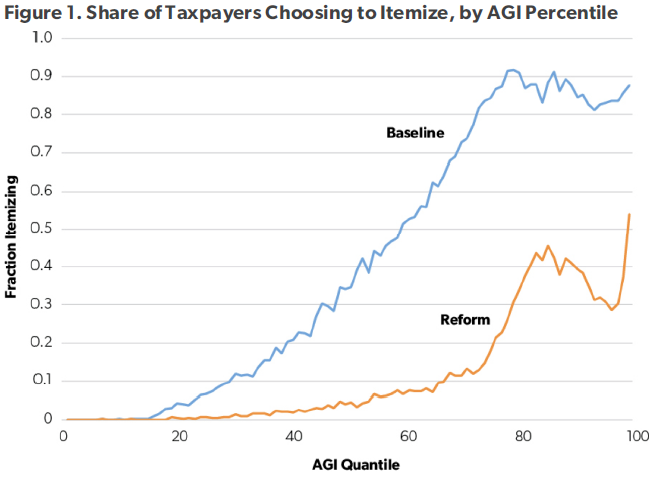
  • Simplification. The seven current individual tax rates would be reduced to just three: 12%, 25% and 33%. All deductions would be eliminated except for mortgage interest and charitable contributions. The standard deduction would be almost doubled. A 50% exclusion for capital gains, dividends and interest income would lower those tax rates in half.
  • Business taxes. The corporate tax rate would be cut from 35% to 20%, again by eliminating most deductions, and a territorial system adopted whereby taxes are only paid in the country where business is conducted. Immediate expensing for new investment would replace multiyear depreciation.
  • Effects. Base broadening by eliminating deductions will add 6.5 million new taxpayers. The number of taxpayers taking the standard deduction will increase by 37 million (from 70% to 95%). Total tax revenue will decrease by $227 billion over ten years. The effective marginal tax rate is slightly lower for most income groups.

Conclusion. The overall lower tax rates will boost economic growth. The ten year loss of tax revenue, while relatively small, is still a detriment and should be eliminated by shrinking the remaining mortgage interest deduction (which primarily benefits the wealthy).

Follow me on Twitter
Follow me on Facebook

How to Get Our Economy Back On Track II. Entrepreneurship!


As many commentators, including myself, have pointed out, we need faster economic growth in order to create more and better paying jobs and also to bring in more tax revenue to shrink our huge budget deficits.
The rate of economic growth equals the growth of labor productivity plus the growth of employment.  The problem is that both productivity growth and the labor force participation rate have dropped steeply in recent years.

capture63
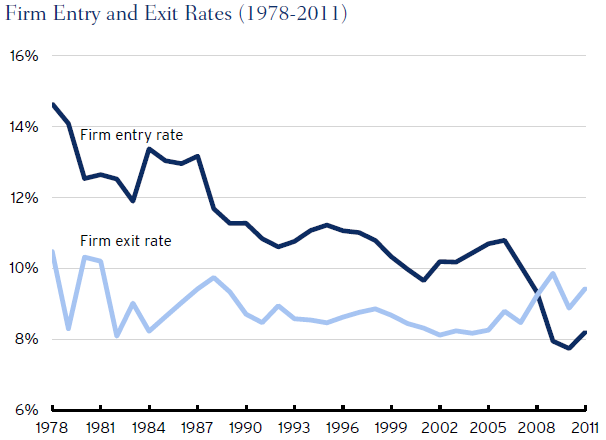
As I have pointed out in previous posts, the U.S. economy has become less entrepreneurial in recent years in the sense that there are now more firms going out of business than new firms going into business.
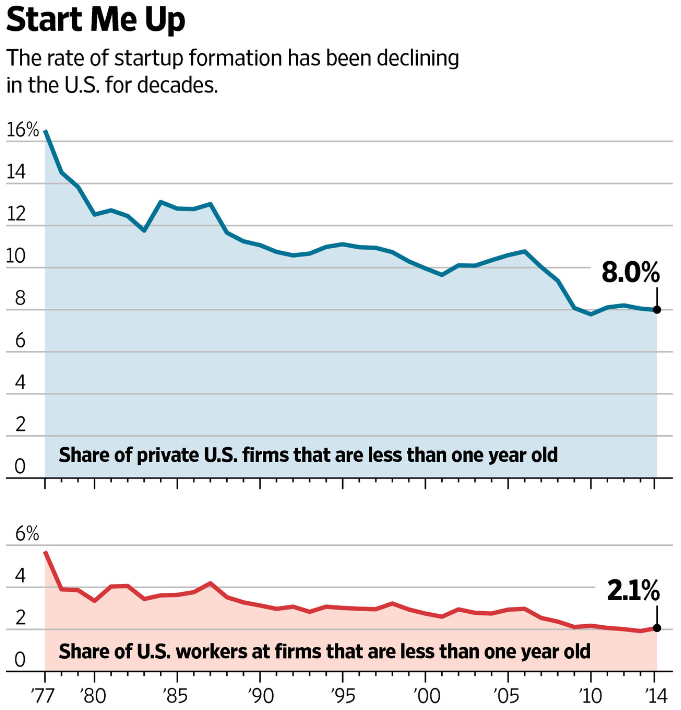
An article in yesterday’s Wall Street Journal has another way of looking at this.  The rate of startup formation has been declining in the U.S. for decades (as shown just below). It is obvious that figuring out how to boost entrepreneurship would do a lot to spur economic growth.

capture75
This can be accomplished with:

  • General growth measuresTax reform (lower marginal rates paid for by shrinking deductions), regulatory reform and simplification, maximum free trade to open markets, immigration reform to bring in more skilled workers, entitlement reforms to prevent a debt explosion.
  • Business tax incentives. Immediate write-off (i.e. expensing) of business investment. This encourages more investment by eliminating the need for depreciation over an arbitrary number of years. It is paid for by eliminating the deduction for interest expense to finance such investment.

Conclusion. Lots of voices are saying that technological innovation is slowing down and that only fiscal stimulus by the government can speed up growth.  Such pessimistic views will predominate unless the private sector is given the tools it needs to achieve growth in the most productive way.

Follow me on Twitter
Follow me on Facebook


How to Get Our Economy Back On Track


My last several posts have expressed dissatisfaction with both presidential candidates and the hope that whoever wins in November (very likely Hillary Clinton) will work with the Republican House of Representatives to implement its “A Better Way” plan for national renewal.
In particular, faster economic growth would produce more jobs and better paying jobs and hence is highly desirable.  As many people, including myself,  have pointed out, it is low productivity growth caused by low business investment, which is largely responsible for slow economic growth.
The economist John Taylor has an excellent analysis of this problem.  He points out that the rate of economic growth equals the growth of labor productivity plus the growth of employment.

capture73
He then shows that:

  • Productivity growth slowed from the mid-1960s until the early 1980s, then increased until the mid-2000s, and has slowed way down in the past ten years.
  • The labor force participation rate has dropped dramatically since the Great Recession but only a small part of this drop off was caused by demographic trends (i.e. more retirees).

    capture72Such relatively long cycles of productivity growth and decline (longer than normal business cycles) suggests that government policy is having a major effect on economic performance. According to Mr. Taylor, what is needed is:

  • Tax reform to lower tax rates to improve incentives for work and investment.
  • Regulatory reform to prevent regulations which fail cost-benefit tests.
  • Free trade agreements to open markets.
  • Entitlement reforms to prevent a debt explosion.
  • Monetary reform to restore predictability in financial markets.

Conclusion. Mr. Taylor makes a very strong case that faster economic growth is not only possible but even achievable in the short run if our national leaders would just make some common sense policy changes.

Follow me on Twitter
Follow me on Facebook


Can U.S. Economic Growth Be Speeded Up?


It is widely recognized and deplored, see here and here, that economic growth in the U.S. has been very slow, averaging only 2% per year, since the end of the Great Recession in June 2009.
The Federal Reserve has taken unprecedented steps to limit the severity of the recession by holding down both short term and long term interest rates.  But these efforts are only partially working and are, unfortunately, having a number of negative effects as well.
It also has been made quite clear that the problem is supply side and not demand side.  This is because, on the one hand, wages are beginning to rise more quickly and consumers are spending more money but, on the other hand, business investment is shrinking which is leading to slow productivity growth.
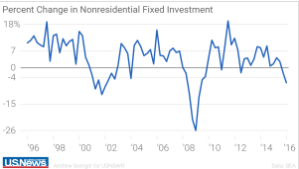
Capture38The American Enterprise Institute’s James Pethoukoukis has just provided new data  on the current weakness of business investment as illustrated in the above chart. Furthermore he quotes the economist, Robert Gordon, who has clearly described the many headwinds holding back the U.S. economy to the effect that:

“The American tax code exerts a downward pressure on capital formation and therefore on economic growth. It is now 30 years since the passage of comprehensive federal tax reform in the U.S.  In the intervening years, nearly every developed country has reformed its tax codes to make them more competitive than that of America.  Meanwhile the U.S. has allowed its tax code to atrophy.”

Conclusion. Yes, economic growth can be speeded up. But monetary policy won’t do the trick.  Congress must intervene with the right changes to fiscal policy, i.e. lowering tax rates for both individuals and corporations, paid for by closing loopholes and shrinking deductions.

Follow me on Twitter
Follow me on Facebook

The Economic Damage Caused by Very Low Interest Rates


As is well known, the Federal Reserve’s main tool in responding to the Financial Crisis in 2007 – 2009 has been quantitative easing (to lower long term interest rates) and direct reduction of the Federal Funds Rate (to lower short term interest rates). These measures definitely limited the severity of the Great Recession resulting from the Financial Crisis.  But the recession ended in June 2009, more than seven years ago.
Capture37In the meantime the continuation of such low interest rates is having many detrimental effects such as:

  • Pension funds, both public and private, have become greatly underfunded,  creating crises especially for state and local governments with defined contribution plans.
  • Retirement plans for millions of seniors have been upset by erosion of savings.
  • Inequality has increased as affluent stock owners benefit from the rapid increase of asset prices as investors reach for yield.
  • An immense misallocation of capital towards bond issuers at the expense of small business is taking place.
  • Federal debt is soaring as low interest rates make it much easier for Congress to ignore large budget deficits.
  • The next recession, when it inevitably arrives, will leave the Fed in a bind. The only tools remaining are a new round of quantitative easing (additional bond purchases) and even lower (i.e. negative) interest rates.
  • The Fed’s dual mandate of low unemployment (currently 4.9%) and price stability (low inflation) is being met but is accompanied by anemic GDP growth averaging only 2% since the end of the Great Recession. Such slow economic growth is largely responsible for the populist revolt in the 2016 presidential race.

Conclusion. Monetary policy can only accomplish so much. It is critical for the Fed to wind down its $4.5 trillion balance sheet as its bond holdings mature and to keep raising short term interest rates.  This will force Congress to step up to the plate with the changes in fiscal policy which are needed to stimulate economic growth.

Follow me on Twitter
Follow me on Facebook

The Democrats Are Half Right (and Half Wrong!) on the Economy


In my opinion both of the two main presidential candidates have overall poor economic plans.  But at least several major Democratic figures such as Hillary Clinton, the NYT columnist Thomas Friedman, and the economist Larry Summers do understand the importance of economic growth.
In particular, says Mr. Summers, “What is unfortunate is that many (progressives), in their eagerness to focus on fairness, neglect the single most important determinant of almost every aspect of economic performance – the rate of growth of total income, as reflected in the gross domestic product.”
Furthermore,

  • More growth means more employment. For each 1 point increase in adult male employment, the employment of young black men rises by 7%.
  • More growth reduces the need for desperation monetary policies that risk future financial stability.
  • If U.S. growth continues to have a 2% ceiling, it is doubtful if we will achieve any of our major national objectives. If we can boost growth to 3%, interest rates will normalize, middle-class wages will rise faster than inflation, debt burdens will continue to melt away and the power of the American example will be greatly enhanced.
  • The question is not whether business success is desirable. The question is how it can be achieved.

All of the above is very positive on the part of Mr. Summers. But then he adds, “What is needed is more demand for the product of business.  This is the core of the case for policy approaches to raising public investment and increasing workers’ purchasing power.”  In other words Mr. Summers is ignoring that:

  • Our national debt is huge and growing way too fast.
  • Wages are now increasing fairly rapidly which increases demand by itself.

    Capture27

  • Investment in new business structures, equipment and intellectual property has now fallen for three quarters in a row.

    Capture28

Conclusion. The way to achieve the faster rate of growth which Mr. Summers (and almost everyone else) wants is not more public investment but rather more private investment. The House Republicans have a plan to accomplish exactly this.

Follow me on Twitter
Follow me on Facebook

What Should Brexit Mean for the U.S.?


My two main sources of information for this blog are the New York Times and the Wall Street Journal. In particular I am always eager to read Eduardo Porter’s weekly column, Economic Scene, in the NYT.  He frames the issues very well, even though I often disagree with him on the details.
Capture17Yesterday’s column, “In Brexit and Trump, a Populist Farewell to Laissez-Faire Capitalism,” points out the similarities in the white working class support for both Brexit and for Donald Trump.  It then goes on to advocate for what the economist Larry Summers refers to vaguely as “responsible nationalism.”
I couldn’t agree more with Mr. Porter and Mr. Summers that we need policies to boost the fortunes of blue collar workers, and here are some good ways to do it:

  • Tax reform to put more disposable income in the pockets of middle- and lower-income workers, to support job creators, and to provide a big incentive for American multinational companies to bring their earnings back home for reinvestment.
  • Immigration Reform. The key here is a rigorous Guest Worker Visa program to provide immigrant employees for businesses who are unable to hire enough qualified domestic workers. At the same time, a strict eVerify enforcement system would also be established to catch illegal immigrants and deport them.
  • Free and Fair Trade. Free trade among nations has lifted hundreds of millions of people out of poverty worldwide, as well as benefitting all Americans with lower prices. What we have failed to do is to adequately help displaced workers retrain for the millions of high skilled jobs available in the U.S. which go unfilled for lack of qualified applicants.

Conclusion. Our country faces severe problems. If we don’t get deficit spending under greater control, we risk a new and more severe financial crisis.  If we can’t create more and better paying jobs for the modestly educated, we will be faced with Trump-like demagogic candidates for president every four years. It will be a huge challenge for us to extricate ourselves from this mess in a peaceful manner.

Follow me on Twitter
Follow me on Facebook

Why Free Trade Is So Important


My blog “It Does Not Add Up” addresses our country’s two major problems:

  • Slow Economic Growth, only 2.1% annually for the past seven years and
  • Massive Debt, now 74% of GDP, the highest it has been since the end of WWII.

These two problems are, of course, closely related.  Faster growth would bring in more tax revenue and reduce our annual deficits.  Shrinking the debt, as a percentage of GDP, will demonstrate that the world’s strongest economy will not falter when interest rates inevitably return to more normal (and higher) levels.
Capture5There is a strong correlation between trade and world-wide economic growth as shown in the above chart.  A recent Gallop poll found that 58% of Americans consider foreign trade an opportunity for economic growth and only 34% view it as a threat.  Not surprisingly, the opponents are lower-income, blue-collar workers who are the most vulnerable to economic change.  Consider:

  • It is technology, not trade, which is behind the loss of manufacturing jobs. Between 2000 and 2010, employment in manufacturing fell by 5.6 million. But productivity growth accounted for 85% of the job loss. Only 13% resulted from trade.
  • Since trade is not the underlying cause of job loss, protectionism is not the solution. If, for example, the U.S. imposes 45% tariffs on imports from China, production would merely shift to other low-wage developing countries in Asia. Pretty soon we’d have a massive trade war.
  • Trade Adjustment Assistance consists of extended unemployment compensation as well as retraining programs. This program misses the millions more who are unemployed due to technological change. Furthermore, extended unemployment compensation leads to deterioration of work skills. A better way to help displaced workers is to expand the Earned Income Tax Credit which supplements all low-income work.
  • NAFTA is a huge economic and foreign policy success. Trade between the U.S. and Mexico has greatly increased sine 1994 and 40% of the value of imports from Mexico consists of content originally made in the U.S. Furthermore NAFTA has promoted the growth of a large middle class in Mexico.
  • Starting in 2001 when China became a WTO member, U.S. companies became more interested in foreign investment in China and other countries and offshoring has proliferated since then. Substantially reducing the corporate tax rate would bring many of these foreign operations back to the U.S.

Trade is win-win for everyone except the production workers who lose their jobs to foreign competition. We can clearly do much more to help them maintain their standard of living.

Follow me on Twitter
Follow me on Facebook