We Need More Low-Skilled Immigrant Labor, Not Less


Our economy is chugging along at 2% annual growth of GDP, not spectacular but not awful either. The unemployment rate has dropped to 4.3%, and low-wage earners are beginning to see decent pay raises. Furthermore there are good indications that GDP growth may rise in the near future to at least 2.5%, see here and here.
As growth increases, unemployment continues to drop, and wages increase more quickly, severe labor shortages in certain job categories are likely to develop.  As the New York Times economics reporter, Eduardo Porter, points out, “The Danger from Low-Skilled Immigrants: Not Having Them.”


Consider:

  • Eight of the fifteen occupations expected to experience the fastest growth – personal care and home health aides, food preparation workers, janitors and the like – require no schooling at all.
  • Low-skilled immigration does not just knock less-educated Americans out of their jobs, it often leads to the creation of new jobs – at better wages.
  • The strawberry crop in California owes its existence to cheap immigrant pickers. They are sustaining better paid American workers in the strawberry patch to market chain who would have to find other employment if the U.S. imported the strawberries directly from Mexico.

  • The benefits of immigration come from occupational specialization. Immigrants concentrated in more manual jobs free up natives to specialize in more communication-intensive (English speaking) jobs.
  • The average American worker is more likely to lose than to gain from immigration restrictions. Halting immigration completely would reduce annual economic growth by .3%.
  • The Pew Research Center estimates that about 30,000 unauthorized immigrants work in Nebraska, 3.2% of Nebraska’s total labor force. They are heavily represented in a handful of industries, making up 18% of Nebraska’s construction workers, 9% of production workers, and 5% of farm laborers.  With an unemployment rate hovering around 3%, the Nebraska economy would be severely stressed without these immigrant workers.

Conclusion. Both in Nebraska and nationwide, the U.S. economy has a strong need for immigrant workers. An adequate guest worker visa program is badly needed to provide legal status to these workers who are so critical to the success of the U.S. economy.

Follow me on Twitter 
Follow me on Facebook 

 

An Optimistic View of the U.S. Economy


The current economic expansion, beginning in June 2009, is now one of the longest in recent years.  Furthermore, low-wage workers are beginning to see bigger gains in pay.  Since the rate of inflation is still remarkably low, under 2% annually, the expansion may well continue for some time.


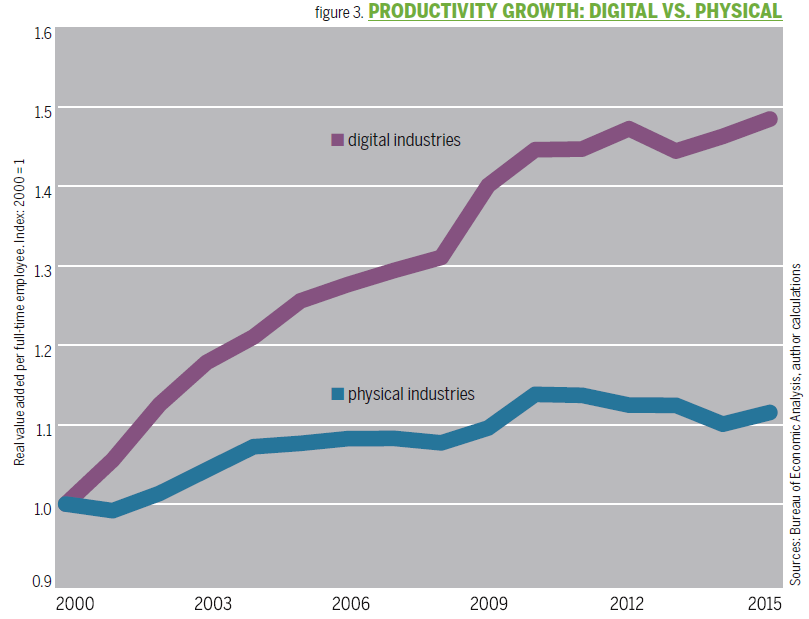
The primary negative factor is the relatively slow rate of growth averaging just 2% since June 2009.  But two economists, Michael Mandel and Bret Swanson, have just issued a remarkable report, “The Coming Productivity Boom,” on behalf of the Technology CEO Council, predicting that the diffusion of information technology into physical industries is likely to boost economic growth to 2.7% over the coming 15 years.
Consider:

  • The next waves of the information revolution – interconnecting the physical world and infusing it with intelligence – are beginning to emerge. Increased use of mobile technologies, cloud services, artificial intelligence, big data, inexpensive and ubiquitous sensors, computer vision, virtual reality, robotics, 3D additive manufacturing and 5G wireless technology are on the verge of transforming the traditional physical industries – healthcare, transportation, energy, education, manufacturing, agriculture, retail and urban travel services.
  • At 2.7%, productivity growth in the digital industries over the past 15 years has been strong, compared with only an anemic .7% annual growth in productivity in the physical industries.

  • The digital industries, which account for 25% of U.S. private sector employment and 30% of private sector GDP, make 70% of all private sector investments in information technology.
  • This “information gap” means that the physical economy is operating well below its potential, dragging down growth and capping living standards.
  • The coming transformation could boost annual economic growth by .7% over the next 15 years. This would add $2.7 trillion to annual economic output by 2031.
  • Policy changes will be needed to achieve maximum growth. Better tax policy can encourage more domestic investment. Regulators will have to embrace innovation and technological change.

Conclusion. “The information age is not over. It has barely begun. … But launching this new productivity boom demands a new, pro-innovation focus of public policy.”  In turn it will lead to an increase of wages and salaries to workers of $8.6 trillion over the next 15 years.

Follow me on Twitter 
Follow me on Facebook 


Making the World Safe for Democracy


One hundred years ago, in 1917, President Woodrow Wilson asked Congress to declare war on Germany “to make the world safe for democracy.”  Pax Americana, the relative peace and stability which has lasted since the end of WWII, is due to the overwhelming economic and military strength of the United States.
The Chinese population at 1.3 billion is four times as large as the U.S. population.  Its economy is growing much faster than ours and will surpass ours in 10 or 15 years.  There is little, if anything, the U.S. can do to prevent this from happening.


China is a non-free, non-democratic, totalitarian state.  We hope that it will remain peaceful towards the U.S. as its economic strength, and eventually also its military strength, surpasses our own, but it would be risky to assume this for sure.
What then should we do to prepare for the day when we are no longer the dominant power on earth?  In my opinion, our best preparation for this inevitable day is to make democracy as strong as possible around the world.


In this respect, look at the latest report from Freedom House which measures the state of freedom around the world on an annual basis.

  • In the past 30 years the percentage of free countries has increased from 34% to 45% and the percentage of non-free countries has declined from 32% to 25%.
  • In the past 10 years, the number of free countries has declined from 47% to 45% while the number of non-free countries has increased from 23% to 25%. In other words democratic progress has been stagnant for the past ten years.

Conclusion.  Democracies rarely go to war against one another.  Other democratic countries are our best friends and so we want more of them.  But there is nothing simple or obvious in figuring out how to accomplish this.

Follow me on Twitter 
Follow me on Facebook 

How to Achieve Sensible Tax Reform


Experts across the political spectrum agree that the U.S. tax code is a huge mess and needs to be reformed as well as simplified.  It is also generally accepted that lower tax rates will lead to faster economic growth.
As Congress turns its attention to tax reform, Senate Democrats have stated the basic principles which they would like to see included in any changes which are made:

  • Increase the wages of working families. This could be accomplished by lowering tax rates for all individuals across the board, paid for by eliminating (or at least shrinking) many of the personal deductions in the tax code. The approximately two thirds of all taxpayers who do not itemize deductions would then receive a tax cut, equivalent to a wage increase.
  • Promote domestic investment and improve middle class job growth. Lower tax rates will give businesses and entrepreneurs a bigger incentive to invest in business expansion and therefore grow the economy faster and create more new jobs.

  • Modernize our outdated business and international tax system. Our corporate tax rate at 35% is the highest in the developed world and, at the same time, produces below average revenue (see chart). Another reform would be to adopt business expensing (immediate tax write-off for new investment). Again, all such changes should be paid for by eliminating loopholes and shrinking deductions.
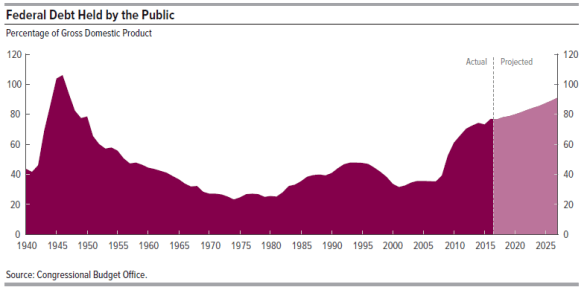
  • Any rewrite of the tax code must be deficit neutral. As important and valuable as tax reform is, it has to take into account our country’s most fundamental problem: our huge and rapidly growing national debt and therefore end up being deficit neutral overall.

Conclusion. The above principles, stated by the Senate Democrats, represent a sound approach to reforming the U.S. tax system. I hope that the Republicans are willing to recognize the validity of these proposals and include the Democrats in developing a bipartisan tax reform plan.

Follow me on Twitter 
Follow me on Facebook 
Moving Forward on Healthcare Reform: Emphasize Cost Control


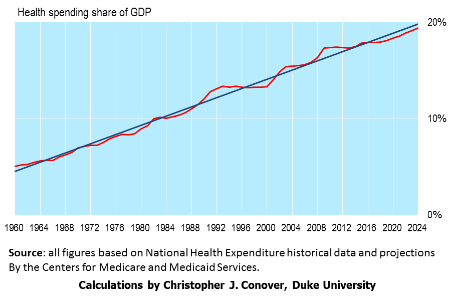
Now that the Republicans have failed to replace the Affordable Care Act with a poor substitute, it is likely that a bipartisan plan will emerge.  Both sides want changes in the existing structure of the ACA.  The Democrats want to hold down the rapidly growing costs for individuals who purchase insurance through the exchanges.  The Republicans want to hold down the overall cost of American healthcare which now exceeds 18% of GDP.


There should be plenty of room for compromise:

  • Medicaid. The Centers for Medicare and Medicaid Services project that under the House bill, which caps federal spending growth for Medicaid and saves hundreds of billions of dollars, total Medicaid enrollment will stay roughly constant above 70 million for the next decade, compared to 55 million before the ACA was enacted.
  • A Bipartisan Problem Solvers Caucus would fund cost-sharing payments to insurers, proposes curtailing the mandate on employers to provide health insurance to their workers, advances states’ ability to band together into regional compacts for selling insurance across state lines, and expands the opportunity for states to experiment with different ways of providing coverage.
  • Medicare. Just letting Medicare negotiate for drug prices and reducing the variation in the costs for post-acute care would provide huge savings, without even addressing inefficiencies in Medicare’s basic design.

Conclusion. The above plan holds down the cost of insurance purchased by individuals on the exchanges as well as taking significant steps to control the costs of both Medicare and Medicaid. It doesn’t address the huge inefficiency of employer provided care but nevertheless represents a big step forward towards implementing cost control in healthcare.

Follow me on Twitter 
Follow me on Facebook  

The Origins of Trumpism IV. The White Working Class


The U.S. political and cultural establishment is constantly bemoaning the election of Donald Trump as President and is convinced that it will hurt our country. He was elected because of his strong support from blue-collar workers.
I’m not so much afraid that he’ll be a disaster as that he will be ineffective in addressing our country’s many urgent problems.  Primarily I am trying to understand, here and here, why he was elected and what this means for the future.


Here is another clue.  The book “White Working Class: overcoming class cluelessness in America,” by Joan Williams, describes clearly who constitutes the white working class (WWC) and how it differs fundamentally from the class of professional and managerial elites (PME). Here is a brief outline of her argument:

  • Definitions. The top 1% (in income) are the wealthy, the top 20% are PME, the next 50% are the working class and the bottom 30% are the poor. The median income of a working class family is $75,000 while the median income of a poor family is $22,500.
  • The PME are order givers and value sophistication, boundary breaking and creativity. The WWC are order takers and value stability and dependability.
  • Why does the working class resent the poor? The poor get welfare benefits while the working-class may have rigid, highly supervised jobs which are often boring and repetitive which makes their work psychologically challenging. They do not receive welfare.
  • Why does the working class resent professionals? Elites seek out novelty, irony and polish while the working class seeks out stability and sincerity. The WWC often see the PMC as phony.
  • Is the working class sexist? For working class women becoming a homemaker signals a rise in status. For PME women this entails a fall in status.
  • Don’t they understand that manufacturing jobs aren’t coming back? This is more or less true but too pessimistic. There is a severe shortage for Americans trained for middle-skill jobs requiring some post-secondary education but not a four year college degree.

Conclusion.  This description should be understood as a general overview of the differences between the WWC and the PME (with many individual and particular exceptions). As such it helps in explaining why Donald Trump received such a large share of the WWC vote.  

Follow me on Twitter 
Follow me on Facebook 


The Democrats and the Economy II. A Path Forward


On Monday the Democratic Congressional leadership held a rally in rural Berryville, Virginia. They laid out a program designed to appeal to the middle class and blue-collar workers who voted for Donald Trump.  However many of their proposals involve expensive government programs and therefore would add significantly to the national debt.


What is needed is a greater emphasis on free-market ways of helping middle- and low-income workers such as:

  • Increasing basic economic growth which has stalled to a relatively slow 2% per year of GDP since the end of the Great Recession in June 2009. For example:
  • Revenue neutral tax reform, lowering rates for both individuals and corporations, paid for by closing loopholes and shrinking deductions, would have many benefits. It would stimulate business investment, create new demand by lowering the taxes paid by the approximately 2/3 of taxpayers who do not itemize deductions, and provide an incentive for multinational corporations to bring their foreign profits back to the U.S. for reinvestment.
  • Targeted deregulation of the financial sector by exempting main street banks from the onerous requirements of the Dodd-Frank Act would enable these smaller banks to lend more money to small businesses.
  • Fundamental healthcare reform to lower costs from the current 18% of GDP to the approximate 12% average of other developed countries. This would save the American economy $1 trillion annually which could be spent far more productively. The Democrats are on the right track here by refusing to accept Republican half measures.
  • Improve educational opportunities such as early childhood education for low-income families, expanded career education and job training in high school and community colleges, and more emphasis on income-based repayment for student college debt. There would be some cost involved here.
  • Modest increase in the national minimum wage from the current level of $7.25 per hour to perhaps $10 per hour and then index it to inflation going forward. The Democratic proposal for a national $15 per hour minimum wage would put too many people out of work.

Conclusion. This collection of proposals involves both Democratic and Republican ideas and should be implementable with a bipartisan effort.

Follow me on Twitter 
Follow me on Facebook 


The Democrats and the Economy


The Democratic Party is starting to wake up. Donald Trump was elected President because he was able to appeal to blue-collar workers who feel left behind in today’s high tech global economy.
Yesterday the Democratic Congressional leadership held a rally in rural Berryville, Virginia to lay out an economic program to try to appeal to these very same Trump voters.


Such a program, would, for example:

  • Increase people’s pay by lifting the national minimum wage to $15 per hour and also creating jobs with a $1 trillion infrastructure plan.
  • Reduce their everyday expenses by providing paid family and sick leave as well as breaking up large monopolies which can raise prices without restraint. Also empowering Medicare to negotiate lower drug prices for older Americans.
  • Provide workers with the tools they need for the 21st century economy by giving employers, especially small businesses, a large tax credit to train workers for unfilled jobs.

Unfortunately, there are problems with most of these ideas. In Seattle even a $13 per hour minimum wage has significantly reduced minimum wage work. The national minimum wage should be raised but to a more modest level.
There is no demonstrated need for a large-scale publicly funded infrastructure program and it would add hugely to the national debt.
A jobs program to maintain the employment rate for prime-age workers without a bachelor’s degree at the 2000 level of 79% and at a living wage of $15 per hour plus benefits would cost $158 billion per year.


Conclusion. Yes, blue-collar workers are hurting.  Yes, some of the ideas suggested above would help them get ahead.  But many would also increase already large deficit spending and therefore add dramatically to the national debt.  What is needed is a combination of free market initiatives and carefully targeted government programs.  Stay tuned!

Follow me on Twitter 
Follow me on Facebook 
 

The Right Way to Deregulate Wall Street


The economy has been chugging along at about 2% annual GDP growth ever since the end of the Great Recession in June 2009. Unemployment has been steadily dropping and is now a fairly low 4.4%.  Low wage earners are now even beginning to see bigger gains in pay.
Most people would like to speed up economic growth even more.  Tax reform will help in this regard but so will sensible deregulation.  Barron’s has an excellent article this week about deregulating Wall Street by William D. Cohan.


According to Mr. Cohan:

  • GDP growth is highly correlated with bank lending.
  • The Dodd-Frank Act, passed by Congress in 2010, has disproportionately burdened community banks, despite their having no role in the financial crisis.
  • More than 1700 U.S. banks have disappeared since Dodd-Frank was passed.
  • Senator John Kennedy (R, LA) has introduced a bill which would exempt community banks and credit unions with assets of less than $10 billion from the Dodd-Frank Act.
  • As a result of Dodd-Frank, big banks are now required to have more capital and less leverage. Today a bank’s assets would have to fall about 7% before a bank’s capital would be wiped out, as opposed to only 2% in 2008.  This makes them safer.
  • Prior to 1970 the Wall Street partnership structure ensured that bankers had plenty of skin in the game – essentially their full net worth was on the line every day.
  • Today bankers and traders are rewarded for taking risks with other people’s money. Mr. Cohan recommends that the top 500 traders and executives at every big bank have a significant portion of their net worth on the line.

Conclusion. Mr. Cohan’s program would not only give a big boost to the economy by enabling community banks to lend more freely but would also make our financial system safer by requiring top financiers to have skin in the game.

Follow me on Twitter 
Follow me on Facebook 


It’s Time for a Bipartisan Approach to Healthcare Reform


The Affordable Care Act was passed by a Democratic Congress in 2010 with no Republican support. It expands access to healthcare but does nothing to control costs which have now reached 18% of GDP and climbing.
The current Republican Senate bill to replace the ACA does attempt to control costs but is unable to attract enough support to pass.
The problem is to achieve both broad access and much lower costs at the same time.  In general, Democrats prefer a single payer system while Republicans want to retain a free market approach.  So compromise will be required.


For example:

  • The tax exemption for employer provided health insurance should be replaced by a universal (and refundable) tax credit for all limited to the cost of catastrophic health insurance (with a high deductible). This will preserve expanded access as well as requiring everyone to pay attention to costs.
  • Tax preferred health savings accounts for routine healthcare expenses should be authorized and further subsidized for low-income families through the ACA exchanges.

  • Medicaid (for poverty-level families) should be put on a fixed federal budget to control runaway costs. States should be given much greater flexibility to direct resources to those with the greatest needs.
  • Redesign of Medicare. Medicare is currently being subsidized by the federal government (after FICA taxes and premiums paid) at over $400 billion per year.  Introducing a defined contribution element into this single payer program will help to hold down costs.

  • Pre-existing Conditions can be covered with suitable enrollment windows and state-run high-risk pools.

Conclusion. The ACA has achieved nearly universal access to healthcare in the U.S. But costs continue to rise sharply.  A universal tax credit combined with health savings accounts for the private market combined with a defined contribution single payer Medicare system has a good chance of getting overall healthcare costs under much better control.

Follow me on Twitter 
Follow me on Facebook