The Origins of Trumpism


Everyone is trying to figure out what Donald Trump is all about and I am no exception. My last two posts, here and here, compare his positives and negatives and what he is doing well so far and also not so well.
The American Enterprise Institute’s political economist, Nicholas Eberstadt, has an article in the current issue of Commentary, “Our Miserable 21st Century,” describing very cogently the economic and social conditions which have led to the election of Donald Trump as President of the United States. Says Mr. Eberstadt:

  • The year 2000 marks a grim historical milestone for our nation. The warning lights have been flashing for 15 years and now these signals are impossible to ignore.
  • First of all, the estimated net worth of American households has more than doubled between 2000 and 2016, from $44 trillion to $88 trillion (see below).capture103
  • At the same time the recovery from the crash of 2008 has been singularly slow and weak. By late 2016 per capita output was just 4% higher than in late 2007. In effect the American economy has suffered something close to a lost decade (see below).capture104
  • Then there is the employment situation. Between 2000 and 2016 the work rate for Americans aged 20 and older declined by 4% from 66% to 62%. To put this in different words: if our nation’s work rate today were back up to its start-of-the-century highs, 10 million more Americans would currently have paying jobs (see below).capture105
  • Half of all prime working-age male labor-force dropouts (totaling 7 million men) take opioid medication on a daily basis, typically paid for by Medicaid. In fact, 53% of prime-age males not in the labor force are enrolled in Medicaid.
  • Of the entire un-working prime-age male Anglo population in 2013, 57% were collecting disability benefits.
  • Currently 17 million men in America have a felony conviction somewhere in there past. This amounts to one of every eight adult males in the country. It is difficult for felons to find work and therefore to become productive members of society.

Concludes Mr. Eberstadt, “The abstraction of inequality doesn’t matter a lot to ordinary Americans. The reality of economic insecurity does.  The Great American Escalator is broken – and it badly needs to be fixed.  With the election of 2016, Americans within the bubble (of affluence) finally learned that the 21st century has gotten off to a very bad start in America.  Welcome to the reality.  We have a lot of work to do together to turn this around.”

Follow me on Twitter
Follow me on Facebook


A Tale of Two Trumps II. Which Is the Real One?


From a reader of my blog:

One thing you should think about (very seriously) is whether Trump is set to become an autocrat and whether the institutions in the US are able to prevent this. There is the constitution, laws and norms (by which all Presidents or all Presidents for the vast majority) have conformed to. Trump is a master at recognizing the norms and blowing them off. The truth matters and when Trump says the press is the enemy of the people, you need to think about this. Very scary. Maybe, perhaps likely, our democracy is very fragile and not able to contain him. When I think of economic progress, my first thought is how long it took the Germans to overcome Hitler’s rule, 50-60 years. You seem to be willing to cut him a break, thinking our institutions will contain him. I think the German intelligentsia in the 30’s felt the same way about Hitler.

capture103

 My last post, “A Tale of Two Trumps,” compared what Trump is doing well with what he is doing poorly and how he has modified some of his extreme rhetoric. Of course the truth matters but the truth is highly subjective.  To say that the press is “an enemy of the people” is asinine but Trump has made a lot of outrageous statements and will surely continue to do so.  I simply ignore them.  He backs down when it matters.
I think it is farfetched (for the time being) to compare Trump to Hitler.  Hitler arose in a Germany devastated by WWI, with terrible economic conditions including extreme hyper-inflation.  The U.S. is still the world’s overwhelmingly dominant superpower and enjoys the highest level of prosperity in the world.
Trump was elected because this prosperity is enjoyed most prominently by the elite professional class.  He has convinced blue-collar workers that he will be able to improve their lot.  If he succeeds his grossness won’t matter.  In the meantime the courts will continue to slap him down when he steps out of line.

Follow me on Twitter
Follow me on Facebook


A Tale of Two Trumps


I have mixed feelings about Donald Trump. I didn’t vote for him because of his crude and sleazy behavior.  But I like some of the things he is doing.  Barron’s frames the issue well in its cover story this week, ”A Tale of Two Trumps,” by John Kimelman.

capture103
On the positive side he has:

  • Been a successful real estate developer and serial entrepreneur who favors lower taxes and fewer regulations for many industries, especially energy, financial services and healthcare.
  • Made many good appointments such as Mnuchin for Treasury, Tillerson for State, Pruit for EPA, Price for HHS, Cohn for Chief Economic Advisor, Ross for Commerce, etc.

But on the negative side he has:

  • Issued a badly executed travel ban on immigrants from seven Mideast nations which has now been withdrawn.
  • Belittled the leaders of Mexico and Australia.
  • Torn up the Trans Pacific Partnership negotiated by President Obama
  • Threatened to withdraw from NAFTA which supports hundreds of thousands of jobs in the U.S.

On the other hand he has dialed back some of his extreme rhetoric by

  • Meeting with President Obama after the election.
  • Deferred to Defense Secretary Matson on the undesirability of waterboarding.
  • Accepted the “One China” policy in a telephone conversation with Chinese Premier Xi Jinping.

What remains to be seen is whether or not he can:

  • Make better trade deals with Mexico and China without starting a trade war which would badly hurt our economy.
  • Enact tax rate cuts and a $1 trillion infrastructure program without making deficits worse than they already are.
  • Work with his deficit hawk Budget Director Mulvaney to establish a plan to eventually achieve a balanced budget.

Conclusion. I personally remain optimistic that his good instincts will lead to faster economic growth and that his disruptive instincts will be sufficiently restrained by Congress and the courts so that they will not do major harm.

Follow me on Twitter
Follow me on Facebook


Nebraska Senator Deb Fischer Is a Big Spender


Senator Fischer is up for re-election in 2018 and she starts out a recent fund raising letter (see below) as follows: “My goals are clear: stronger national defense, safer roads and bridges, healthcare that is accessible and affordable, protection of our fundamental liberties, less government, and a fairer, simpler tax code.” Here’s the breakdown:

  • First, and most important: national security.
  • Second, our roads and bridges must be repaired and rebuilt.
  • Third, Obamacare must be repealed and replaced.
  • Fourth, our fundamental liberties must be protected.
  • Fifth, government must shrink and the tax code must be simpler and fairer.

I don’t disagree with the specifics of any of these five goals but rather where the emphasis is placed. Her first two goals are to greatly increase spending for both the military and for infrastructure projects.  Her last goal is to shrink the federal government which is a good idea but very hard to accomplish in practice.

capture99
Here is the basic problem our national debt (the public part on which we pay interest) is now at 77% of GDP, the highest it has been since right after WWII, and steadily getting worse.  Right now this approximately $14 trillion debt is essentially “free” money because interest rates are so low.  But when interest rates inevitably rise to more normal levels, interest payments on the debt will soar by hundreds of billions of dollars per year and eat much more deeply into tax revenue.
It should be a very high priority for Congress to establish a plan to bring government spending more closely in line with tax revenue.  I have previously described how this could be accomplished over a ten year period without cutting hardly anything but simply using restraint for spending increases.

Conclusion. If Senator Fisher feels that it is necessary to make big spending increases in areas such as national defense and infrastructure repair, then she should be equally adamant about the need to hold down the growth of government spending overall.

Follow me on Twitter
Follow me on Facebook

capture100

capture101


Donald Trump and Foreign Policy


“Speak softly and carry a big stick”              President Theodore Roosevelt, 1858 – 1919

Donald Trump was elected President because of his strong support from white blue-collar workers who feel left behind in the modern world of globalization and rapid technological change. While the President has to work with Congress to implement new economic and fiscal policies, he has almost free rein in conducting foreign policy.

capture99
There are major international issues that President Trump will have to deal with such as:

  • Rapid Chinese economic growth and assertion of power in Southeast Asia. Also currency manipulation and over-protection of domestic industry against foreign imports.
  • Russian assertion of power in Eastern Europe and the Middle East make it a dangerous adversary. All the more so since the Russian population is in decline and its economy is stalled under Putin.
  • Iran’s nuclear ambitions are only temporarily halted under the Iranian nuclear deal of 2015. Iran continues to support terrorism in Syria and elsewhere in the Middle East.
  • The defeat of ISIS and the containment of terrorism all around the world but especially in the Middle East.
  • Support of our democratic allies in hotspots around the world such as Japan and South Korea in Asia as well as our NATO allies in Europe.

Ever since WWII when the U.S. emerged as the sole superpower, the world has benefitted from overwhelming U.S. economic and military strength. The resulting “Pax Americana” has resulted in a long lasting period of relative peace and stability. But U.S. military strength is not automatic nor does it occur in a vacuum.  It depends fundamentally on the underlying strength of the U.S. economy which has been growing at the very slow rate of 2% annually since the end of the Great Recession in June 2009.

Conclusion. If we want continued peace and stability around the world, then we need faster economic growth to better support the U.S. effort to project strength.

Follow me on Twitter
Follow me on Facebook

What Donald Trump Is Doing Right


Amid the steady and intense criticism of President Trump, he is actually doing a lot of things right, as pointed out by the Hudson Institute’s Christopher DeMuth:

  • He has picked highly qualified and independent-minded assistants such as Jim Mattis for Defense (who considers Russia to be a threat), Rex Tillerson for State (who has urged action on climate change) and Mike Mulvaney for Budget Director (who wants entitlement reform). Mr. Trump has tweeted that “I want them to be themselves and express their own thoughts, not mine.”

    capture99

  • For a president to have strong willed assistants is in the best American tradition: Washington (with Jefferson, Madison and Hamilton), Lincoln (with Chase, Seward and Stanton), Roosevelt (with Acheson, Marshall and Stimson), and Reagan ( with Baker, Shultz and Weinberger) all wanted their cabinet members to engage in vigorous discussion about fundamental policy.
  • Trump forgoes ideology for simple cross-partisan principles such as America First, safety from terrorism and violent crime and better jobs and schools for the poor and working class, and defiance of self-serving elites.
  • He is comfortable with controversy and dissent and often incites it to advantage. His tweets and pronouncements can be outrageous and overstated but they demonstrate a healthy skepticism toward ossified orthodoxy and are designed to stimulate debate rather than to close it down.
  • His biggest mistake so far, the ill-advised travel ban for immigrants put on hold by a judicial Temporary Restraining Order, has been taken in stride by his administration while they reconsider how to proceed.

Conclusion. Ever since Mr. Trump’s election to the presidency, I have been saying  that his ultimate success in office depends on whether or not he can address our country’s two biggest problems: 1) slow growth and 2) massive debt.  At this point I am optimistic that he will succeed in doing these things.

Follow me on Twitter:
Follow me on Facebook:

Why America Needs Charter Schools


“We are the last generation, fighting the last big battle to make true on that – that a child born anywhere in America, from any parents, a child no matter what their race or religion or socio-economic status should have that pathway, should have that equal opportunity, and there is nothing more fundamental to that than education. That is the great liberation.”
U.S. Senator Cory Booker (D, NJ), May 2016
Two days ago Senator Booker voted no on confirming charter school advocate, Betsy DeVos, for Secretary of Education.

capture99
Charter schools are flourishing because poor inner city black parents are desperate to have their children attend a good school and the big city public schools are often very poor quality.
Stanford University recently conducted a study of charter schools in 41 regions around the country and found that:

  • Urban charter schools in the aggregate provide significantly higher levels of annual growth in both math and reading compared to their traditional public school peers.
  • Learning gains for charter school students are larger by significant amounts for Black, Hispanic, low-income and special education students in both math and reading.
  • Despite the overall positive learning impacts, there are urban communities in which the majority of the charter schools lag the learning gains of their traditional public school counterparts, some to distressingly large degrees.

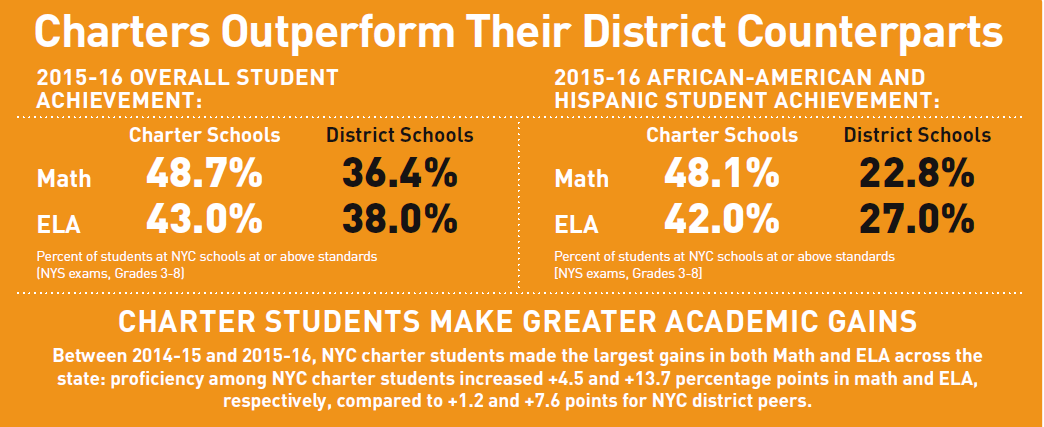
For example, charter schools are very successful in New York City and especially so for African-American and Hispanic students (see chart below).

capture100

Conclusion.  Charter schools work well when they are done right.  They work especially well for minority children in large urban areas.  These are generally the high-risk kids from low-income families who will benefit the most from a little extra help.

Follow me on Twitter
Follow me on Facebook


Why I Am Optimistic about President Trump


I voted for Hillary Clinton last November. Not because I liked her program.  I was voting against Donald Trump.  He is crude, sleazy and a terrible narcissist.  I preferred John Kasich, Governor of Ohio, in the Republican Primary.  But he didn’t make it.  I voted for Mitt Romney in 2012 but he didn’t make it either.
The question now is whether or not the Trump Administration will effectively address our country’s two biggest problems, both of which are very serious and need urgent attention:

  • Slow economic growth, averaging just 2% per year since the end of the Great Recession in June 2009. Faster growth means a tighter labor market which in turn means more workers and higher wages. This in turn means less inequality. Furthermore, it is the United States’ dominant economic strength which assures world peace and stability. The Chinese economy, now half the size of ours, will catch us eventually. But stronger U.S. growth will delay this and enable us to cope with it better when it happens.
  • Massive Debt. The public debt of $14 trillion (on which we pay interest) is now 77% of GDP, (https://itdoesnotaddup.com/2017/01/31/trump-needs-a-wall-of-fiscal-discipline/) the highest since the end of WWII and steadily getting worse. With current low interest rates the debt is now essentially “free” money. But what will happen when interest rates return to normal historical levels? At this point interest payments on the debt will rise precipitously and become a huge drain on the budget. We can’t prevent this from happening but we can lessen the impact by acting now.

Will the Trump Administration take these two problems seriously?

  • For sure on economic growth. His re-election chances in four years depend largely on the fortunes of his base of blue-collar workers. His appointments at Treasury (Mnuchin), HHS (Price), and EPA (Pruitt) all support the tax reform and deregulation needed to get this done. I am confident that Trump will avoid a disastrous trade war.capture99
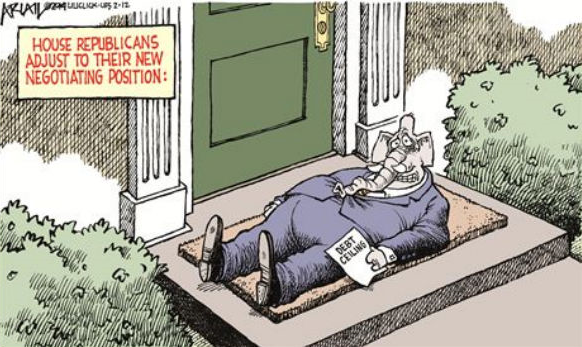
  • The debt. This is trickier because Trump has said he won’t touch Social Security or Medicare. My optimism is based on the fact that the Debt Ceiling will be re-imposed on March 16 at its level on that date. This will give Congress just a few months to raise the ceiling to a higher level. It is likely that the many fiscal conservatives in the House will insist, in return, for some sort of spending restraint such as a ten-year plan to balance the budget.

Conclusion. We’re not out of the woods yet. But there is a clear path showing the way forward.

Follow me on Twitter
Follow me on Facebook


The Trump Critics Need to Calm Down


The New York Times editorial page is unremittingly hostile towards Donald Trump. My last post reports on an essay in the Atlantic magazine, “How to Build an Autocracy,”  arguing that Trump will seize dictatorial power if he can get away with it.  Now the foreign policy expert Elliot Cohen, whose work I greatly admire, argues that the Trump regime will probably end in some disastrous calamity such as a terrible global recession or war. This is overreaction.

capture99
Several of Trump’s executive orders in the first two weeks are very positive:

  • New Iran Sanctions for conducting ballistic missile tests contrary to agreement. This also implies that the Trump Administration will probably not tear up the Iranian Nuclear Agreement signed in July 2015.
  • Rolling back overly restrictive Dodd-Frank regulations. The financial crisis was not caused by greedy bankers but rather by the bursting of the housing bubble fed by too many government-mandated subprime mortgages. The Dodd-Frank Act is aimed at Wall Street banks but is hurting too many Main Street banks.
  • Federal Regulations. Requiring that at least two regulations be repealed for each new one implemented. This is a gimmick but it is still a move in the right direction.

There are, of course, at least two that are ill conceived:

  • The travel ban to the U.S. from seven predominantly Muslim countries was rushed out without careful vetting but has now been blocked by U.S. District Judge James Robart in Seattle.
  • Revamping the National Security Council by removing the chairman of the Joint Chiefs of Staff and replacing him by his chief strategist Steve Bannon. This gives too much influence to an inexperienced amateur.

Conclusion. The American people are taking a clear risk with such an unconventional populist President. But we have huge problems to solve, especially economic (slow growth) and fiscal (massive debt). A President Clinton would not have addressed them effectively. I am quite confident that President Trump will address them.  Furthermore his supporters and their representatives in Washington are capable of restraining him if necessary.

Follow me on Twitter
Follow me on Facebook

What, if Anything, Will Restrain Donald Trump?


The Atlantic magazine has just released a remarkable essay written by the political commentator, David Frum, entitled, “How to Build an Autocracy.”  Says Mr. Frum, “Donald Trump will not set out to build an authoritarian state.  His immediate priority seems likely to be to use the presidency to enrich himself.  But as he does so, he will need to protect himself from legal risk.  Being Trump, he will also inevitably wish to inflict payback on his critics.  Construction of an apparatus of impunity and revenge will begin haphazardly and opportunistically.  But it will accelerate.  It will have to.”

capture99
Let’s assume that Mr. Frum is correct that Trump’s top priority is to enrich himself.  What will stop him from doing this?  A recent column in the New York Times points out that:

  •  54% of registered voters in congressional districts represented by Republicans view Mr. Trump favorably compared with only 42% who view him unfavorably.
    In these same districts, 87% of registered Republicans view Mr. Trump favorably.
  • In other words, the Republican dominated Congress is unlikely to strongly oppose his sleazy and self-enriching behavior.

But there are other constraints on what he does in office:

  • As I said in a recent post in order for Mr. Trump to be reelected in 2020, he will need to substantially speed up economic growth in order to increase the wages of his key blue-collar supporters. He clearly wants to accomplish this.
  • On the other hand, the conservative Republican base, including its representatives in the House such as the Freedom Caucus, will simply not support huge increases in deficit spending for anything (except an emergency) including infrastructure, the military or unfunded tax cuts.
  • In fact, Rep Mick Mulvaney (R, SC), a deficit hawk, has been nominated to become the Trump Administration’s Budget Director. In March the debt ceiling will have to be raised. I expect the many fiscal conservatives in Congress to insist on significant fiscal restraint (e.g. a ten year plan to balance the budget) as a tradeoff for raising the debt ceiling.

Conclusion. Just because Republicans are tolerant of Mr. Trump’s personal behavior does not mean he can successfully ignore the strong Republican desire for fiscal restraint.

Follow me on Twitter
Follow me on Facebook