Life in America: Opportunity or Inequality?


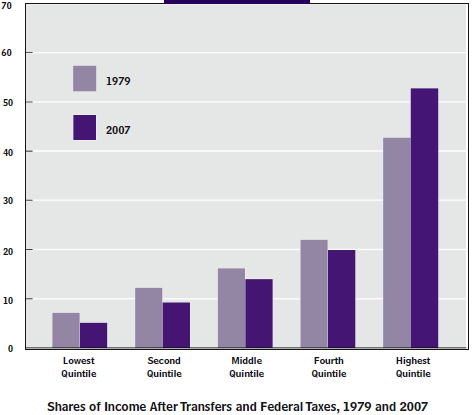
How bad is income inequality in the U.S. and what should be done about it?  This is a question of great current interest with many different points of view.  The chart just below from the Congressional Budget Office shows the extent of income inequality and also shows that it has gotten somewhat worse between 1979 and 2007, just before the onset of the Great Recession.  And we know that our stagnant economy has made it worse yet between 2007 and the present.
CaptureBut now look at the chart (below) from the U.S. Census Bureau of the distribution of household income in the U.S. in 2012.  The chart shows the median income of about $51,000 and then has a very long tail to the right.  This means that there are large numbers of households making large incomes of all different sizes.  It makes no particular sense to distinguish the top 1% (who make $380,000 or more) from the bottom 99%.
Capture1The point is that there is huge opportunity in the U.S. to do very well financially whether or not one makes it into the top 1%.
In an earlier post, “Growth vs Equitable Growth,” I reported on the agenda of the Washington Center for Equitable Growth, a progressive think tank.  In order to achieve “equitable growth” they advocate:

  • Improving educational outcomes at all levels, pre-K – 12+.
  • Running a “high pressure” economy in order to tighten the labor market.
  • Expand the Earned Income Tax Credit especially for workers without children.

I couldn’t agree more.  This is an excellent plan to create more prosperity for more people.  It’s much more plausible in the U.S. to make poor people richer than to make rich people poorer.

Can the U.S. Economy Grow Faster?


The U.S. economy has grown at the rate of only 2.2% since the end of the Great Recession in June 2009.  This is much slower than the average rate of growth of 3% for the past fifty years.
CaptureThe economists Glenn Hubbard and Kevin Warsh, writing in the Wall Street Journal, “How the U.S. Can Return to 4% Growth,” point out that:

  • After the severe recession of 1973-1975, the economy grew at a 3.6% annual real rate during the 23 quarters that followed.
  • After the deep recession of 1981-1982, real GDP growth averaged 4.8% in the next 23 quarters.
  • Recent research has shown that steep recoveries typically follow financial crises.

The economist John Taylor, also writing in the WSJ, “A Recovery Waiting to Be Liberated,” explains that the growth of the economy, i.e. growth of GDP, equals employment growth plus productivity growth.  He then points out that:

  • Population is growing about 1% per year. However the labor-force participation rate has fallen every year of the recovery, from 66% in 2008 to 62.9% in 2014. Even turning this around slightly would increase employment growth above the 1% figure coming from population growth alone.
  • Although productivity growth has hovered around 1% for the past five years, this is less than half of the 2.5% average over the past 20 years.

Given the strong headwinds of globalization and ever new technology affecting the U.S. economy, we especially need new policies such as:

  • Fundamental tax reform directed at increasing the incentives for work and driving investment in productive assets.
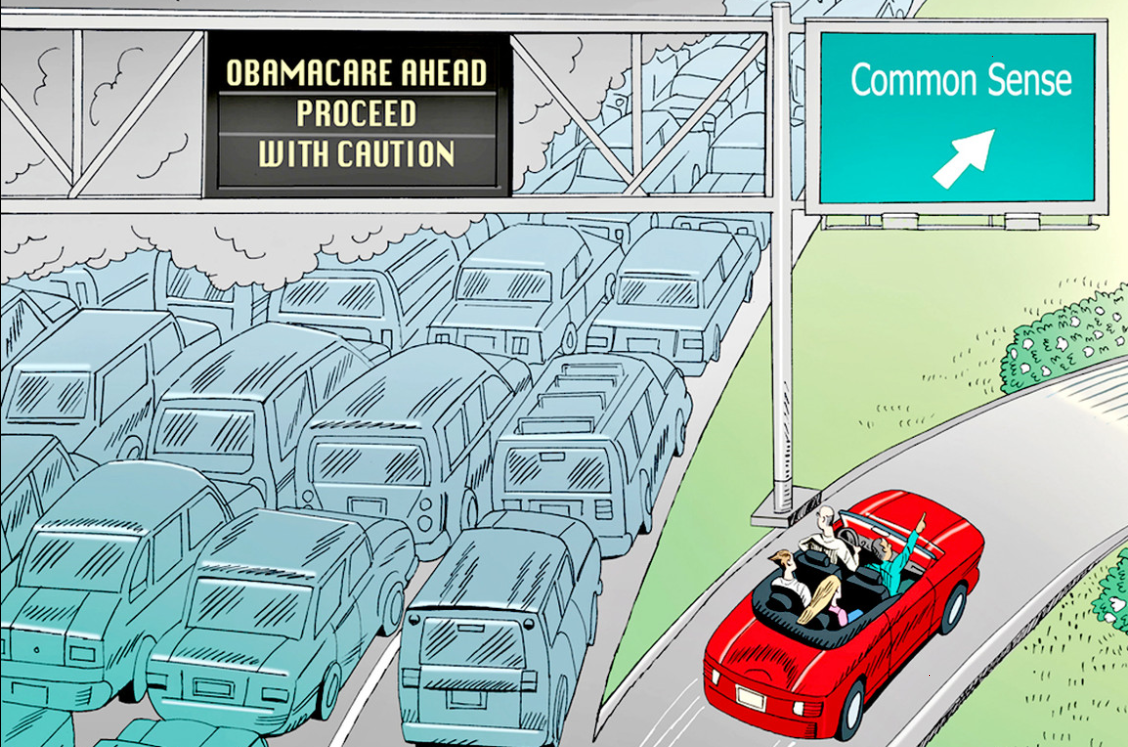
  • Regulatory reform that balances economic benefits and costs (e.g. lightening the burdens of Obamacare and Dodd-Frank).
  • Trade agreements to break down barriers to open global markets.
  • Education policies to prepare all young people for productive careers.

In other words, rather than accepting our current situation as “the new normal” or as unalterable “secular stagnation,” we need to “give growth a chance”!

Letting Young People Drift and the Liberal Disconnect


The New York Times had an excellent lead editorial on Sunday, “The Cost of Letting Young People Drift,” describing how 5.5 million young Americans, ages 16 – 24, are neither working nor in school.  “At a time when the economy is requiring workers to have higher levels of skills, one in seven of America’s young adults can’t even get started.”
CaptureThe NYT editorial is based on new research, “Zeroing In on Place and Race: youth disconnection in America’s cities” performed by Measure of America.  The report points out that the problem has gotten much worse since the Great Recession in 2008, as shown in the chart below.
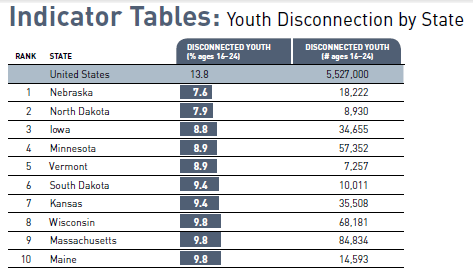
Capture1It also breaks down the youth disconnection rate by state.  For example, Nebraska (7.6%), North Dakota (7.9%) and Iowa (8.8%) have the lowest percentages, while Mississippi (18.5%), West Virginia (19.6%) and Louisiana (19.8%) have the highest percentages (as shown below).
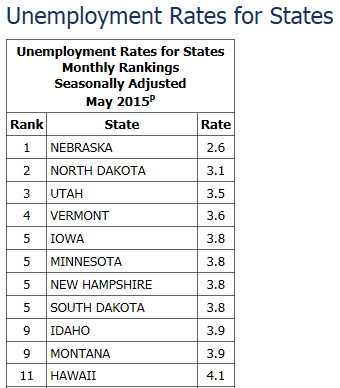
Capture2Capture3But also look at the latest “Unemployment Rates for States” published by the Bureau of Labor Statistics.  There is a very close connection between a state’s unemployment rate and its youth disconnection rate, as shown below. In other words, one of the best ways to keep young people connected is to give them a better chance of finding a job.
Capture4Capture6But it requires faster economic growth to provide more jobs.  Just yesterday the NYT had an editorial, “Obstacles to Economic Growth,” lamenting our very slow rate of economic growth of about 2.2% for the past six years.  According to the NYT, “What’s needed most is public and private investment in the economy sufficient to support strong growth and rising productivity.”  The editorial then goes on to berate Congress for being more interested in budget cuts than in new spending programs to stimulate the economy.  According to the NYT, “the pathway to prosperity is clear for leaders who will dare to take it.”
The NYT thus recognizes the need for more private investment to stimulate the economy but has no apparent interest in policy measures to encourage it.  How can a news organization as sophisticated as the NYT be so passionate about wanting to improve society and so clueless about the best way to do it?

Why Obamacare Should Be Fixed and not Repealed


The Supreme Court will soon render an opinion in King v. Burwell challenging the implementation of the Affordable Care Act.  If the Court agrees with the plaintiffs, then anyone receiving health insurance through one of the federal exchanges operating in 33 states is not eligible to receive a subsidy.  Several Committees in the House of Representatives are proposing to take such an opportunity to make improvements to the ACA.
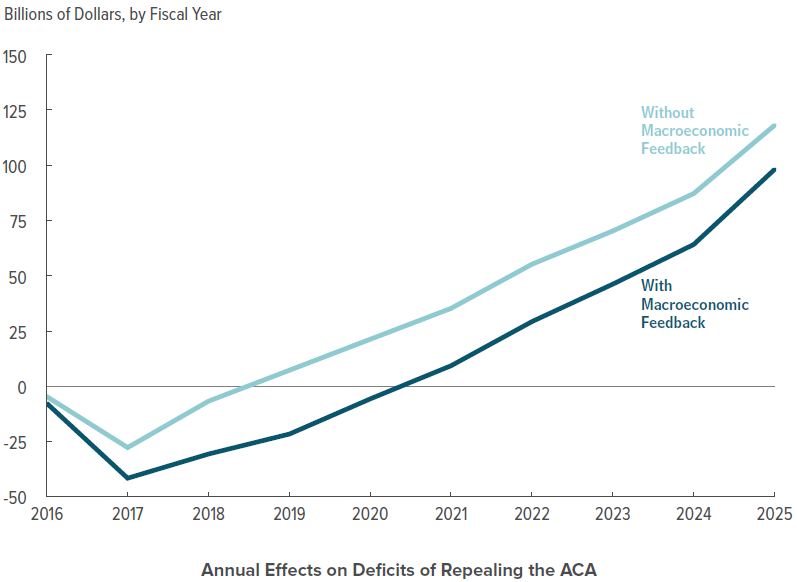
CaptureIn addition, the Congressional Budget Office has just released a report on the “Budgetary and Economic Effects of Repealing the Affordable Care Act,” indicating that repeal of the ACA would add $137 to the deficit over 10 years.  This is because the loss of ACA imposed new tax revenues and spending cuts to Medicare would exceed the amount of money spent to expand insurance coverage.
The economist John Goodman has an excellent new book, “A Better Choice: Healthcare Solutions for America,” describing several basic changes which would greatly improve the ACA.  In summary they are:

  • Replace all of the ACA mandates and tax subsidies with a universal (and refundable) tax credit which is the same for everyone. This is the fairest way to subsidize healthcare for all and it also removes the huge market distortion provided by employer provided health insurance which is tax exempt. The tax credit would be about $2500 per individual and $8000 for a family of four, the approximate cost of catastrophic health insurance and also the average cost of Medicaid.
  • Replace all of the different types of medical savings accounts with a Roth Health Savings Account (after-tax deposits and tax-free withdrawals).
  • Allow Medicaid to compete with private insurance, with everyone having the right to buy in or get out.
  • Keep the ACA exchanges which would be required to provide change-of-health status insurance for the protection of the chronically ill.

Changes such as these would dramatically lower the cost of American healthcare by making all of us directly responsible for the cost of our own healthcare.  They would also virtually eliminate the perverse market effects of the ACA which encourage companies to cut back on numbers and working hours of employees.  This in turn would speed up the growth of our stagnant economy!

The Fiscal Time Bomb Is Still Ticking!


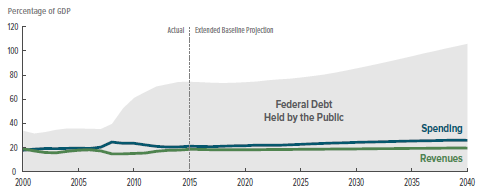
The Congressional Budget Office is by far the most objective source of detailed information about the federal budget, playing a valuable role in the super-charged political atmosphere of Washington D.C.  It has just released a new annual report, “The 2015 Long-Term Budget Outlook,” projecting our fiscal health for the 25 year window, 2015-2040, based on current policy. It is a scary scenario indeed.
CaptureAs shown in the above chart, our public debt (on which we pay interest) has increased from 38% of GDP at the beginning of the Great Recession in 2008 to 74% today.  Although it will remain steady at this high level for about five years, it will then resume a steady increase, reaching a level of about 100% of GDP by 2040.
As many observers, including myself, have pointed out, when interest rates eventually return to their normal historical level of around 5%, interest payments on this huge, and rapidly increasing, debt will double or triple from their current low level, causing a very painful budget shortfall.
Simple prudence suggests that the only responsible course of action is to put our debt on a downward path, as a percentage of GDP, in order to minimize this looming problem to the greatest possible extent.
Capture1CBO gives some useful guidelines for what is required to do this:

  • Just to keep the debt at its current value of 74% of GDP by 2040 would require an annual 6% increase in revenue or a 5½% decrease in spending. This would amount, for example, to a $210 billion spending cut for 2016.
  • To reduce the debt to 38% of GDP by 2040, its average over the past 50 years, would require an annual 14% increase in revenues or a 13% decrease in spending. The spending cut for 2016 would be $480 billion.

These examples show the enormity of the fiscal mess we have gotten ourselves into.  Under current policy it will require a big effort just to stay even with where we are right now, without showing any debt reduction over the next 25 years!
Our only hope is to change current policy.  But how?

An Off-Ramp from Obama Care


The Supreme Court will soon render an opinion in King v. Burwell, challenging the implementation of the Affordable Care Act which stipulates that subsidies can only be paid “through an Exchange established by the State.”  If the plaintiffs are upheld, it will mean that anyone receiving health insurance through one of the federal exchanges operating in 33 states is not eligible to receive a subsidy.  It will be necessary for Congress to intervene to fix a problem like this.
CaptureThree committee chairs in the House of Representatives, John Kline, Paul Ryan and Fred Upton, are proposing to take such an opportunity to improve the Affordable Care Act along the following lines:

  • First of all, making health insurance more affordable by ending both the individual and employer mandates, and giving choices back to the states, individuals and families.
  • Secondly, supporting Americans in purchasing the coverage of their choosing. For example, people could save money by buying insurance across state lines.
  • Finally, many existing features of the ACA would be retained. Children could stay on their parents policies until age 26. Lifetime limits on benefits would be prohibited. People with existing conditions would be protected. Renewability would be guaranteed. Insurance would be decoupled from employment by offering equal (perhaps, age adjusted) tax credits for all.

There remains the practical problem of providing immediate assistance to the approximately 5 million people currently receiving subsidies through the federal exchanges, while larger scale changes are being worked out by Congress.  The American Enterprise Institute has proposed a simple way for Congress to do this as follows:

  • Enact a short-term extension of subsidies for current enrollees.
  • States with federal exchanges could immediately set up a state exchange if they wished.
  • People with preexisting conditions and/or continuous coverage would be protected.

Both quality control and cost control are badly needed to make the ACA sustainable for the long run.  Given the right decision in King v. Burwell, these two plans outline a possible way to accomplish this.

Light at the End of the Tunnel


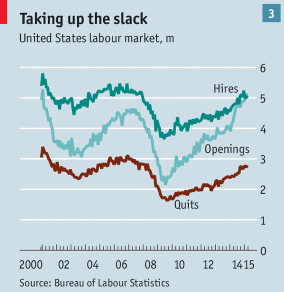
The Bureau of Labor Statistics has just reported very good news in its monthly Job Openings and Labor Turnover Survey.  For the first time since 2000, the number of job openings now exceeds the number of new hires, as shown in the chart just below.  This means that wages will start to grow faster as employers have to compete harder for new workers.
Capture1This is an early indication that our economy will likely soon resume a faster rate of growth than its average of 2.3% since the end of the Great Recession in June of 2009.  There will be many benefits.  The unemployment rate should continue to keep heading downward from its current level of 5.5%.  More unemployed and underemployed workers will be able to find satisfactory jobs.  The labor participation rate should start to head back up from its historically low current state.
The Federal Reserve is likely to begin raising short term interest rates sooner rather than later in order to keep inflation in check before it has a chance to heat up.  In other words we may be breaking out of the ambiguous state of slow-growth secular stagnation in which we have been trapped for six years.
All of this is very good news as long as Congress realizes that it is now even more urgent than ever to put our massive public debt of $13 trillion on a downward path, compared to the total economy, before interest rates begin to rise substantially and eat us alive with interest payments on this huge debt.
In this regard the Budget Plan approved by Congress just this Spring, which will lead to a balanced budget over ten years, looks very attractive indeed.  It will be a mammoth job to achieve such a milestone in fiscal restraint, but doing so will lead to a more secure and prosperous future for all Americans.

How to Expand Economic Mobility


My blog addresses the three main economic and fiscal issues facing the U.S. today: slow growth, economic inequality and massive debt. Today I focus on inequality by referring to a recent article by the Manhattan Institute’s Scott Winship, “Up: Expanding Opportunity in America.” Mr. Winship observes that there has been little change in upward mobility over the past three generations.  Furthermore the U.S. has upward earnings mobility rates quite comparable to Canada and the Scandinavian countries, which are generally regarded as having strong economies.
CaptureNevertheless he makes several suggestions for attempting to boost upward mobility in the U.S. as follows:

  • Proposal 1: Wage War on Immobility through an Opportunity, Evidence and Innovation Office and an Opportunity Advisory Commission. OEIO would fund and evaluate an array of demonstration projects at the state and local levels. It would consolidate many already existing programs and have a budget of $20 billion per year.
  • Proposal 2: Experiment with Promising and Innovative Approaches to Mobility Promotion. Examples are: text-messaging strategies such as READY4KLanguage ENvironment Analysis, and Converting Large Schools with High Drop-out Rates into Small Personalized Schools.
  • Proposal 3. Block-Grant Means Tested Programs and Send Them Out to the States. Such a proposal has recently been made by the House Budget Committee.
  • Proposal 4. Encourage Employment through Work Subsidies. This is already being done with the Earned Income Tax Credit.
  • Proposal 5. Encourage Delayed and Planned Childbearing through Tax Incentives. The idea is to promote marriage by expanding the current Child Tax Credit of $1000 per child for single parents to perhaps $4000 per child for married parents, but for low-income families only.
  • Proposal 6. Reform the Social Security Disability Insurance Program. The share of adults age 25 to 64 receiving SSDI benefits has tripled from 1.6% in 1970 to 5% in 2010. Reform of this program would put many able-bodied men and women back to work and save lots of money, some of which could be used to fund the above programs.

Conclusion:  Increasing upward mobility is one very good way to combat economic inequality.  Mr Winship provides an excellent discussion of several new as well as already established ways of accomplishing this goal.

How to Fix Disability Insurance


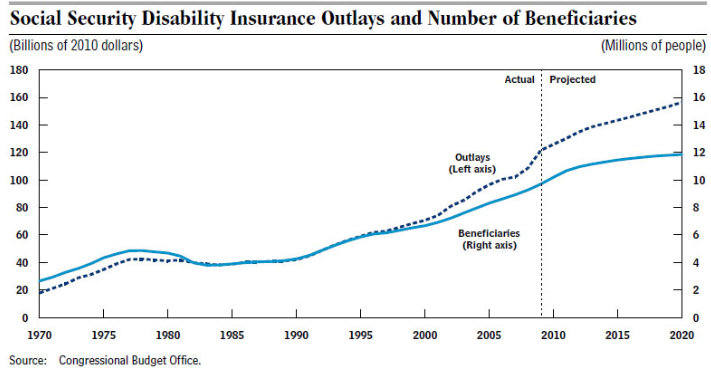
The Trust Fund for Social Security Disability Insurance will run out of money by the end of 2016.  If no changes are made, all SSDI benefits will have to be reduced to 81% of scheduled benefits after that.  Congress must act to avoid this outcome.  The easiest fix would be to merge SSDI into the larger Social Security program in which case both SSDI and SSI would run out of money about 2033.
CaptureBut as the Manhattan Institute’s Scott Winship points out in National Affairs, “How to Fix Disability Insurance,”  “the looming insolvency of the SSDI Trust Fund offers a rare opportunity to fundamentally reform SSDI” to better target assistance to those with debilitating impairments who truly need this support. The share of adults age 25 to 64 receiving SSDI benefits has tripled from 1.6% to 5% between 1970 and 2010 during a time when a shift from manufacturing, agriculture and mining to service work has reduced physical demands on workers.
Mr. Winship suggests the following reforms be implemented in the SSDI program:

  • Raise the 1.8% (out of the total 12.4% of the payroll tax going to SS) going to SSDI slightly to solve the immediate problem.
  • Expand the support options available to able-bodied men and women who can work, at least for a significant number of hours.
  • Reduce the number of people applying for benefits. For example, by increasing employer incentives for taking stricter safety measures, accommodating and rehabilitating those who become disabled and making greater use of claims management.
  • Use a stricter definition of disability. For example, mental and musculoskeletal conditions may be amenable to treatment.
  • Make it less attractive and more difficult to receive benefits for those who, while impaired, are able to work. Conditions likely to improve would be automatically subject to review after a short period of time.
  • Facilitate work among those with serious impairments who would still like to work. The point here is to make sure they benefit from working without feeling threatened with possible termination of benefits.

The point is that there are many practical steps which can be taken to make SSDI more cost efficient while preserving it for those who truly need it.  This is a good example of the sort of changes that need to be made in all entitlement programs to shore them up for future generations by bringing their huge costs under control.

What’s Wrong With U.S. Manufacturing Policy


The Brookings Institution’s Martin Baily has an informative article, “what’s wrong with U.S. manufacturing policy,” in a recent issue of the Wall Street Journal.
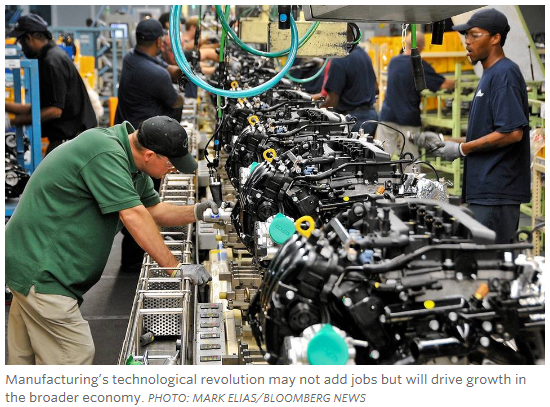
Capture1Says Mr. Baily, “Of the 5.7 million manufacturing jobs that disappeared in the 2000s, only 870,000 have returned so far, according to the Bureau of Labor Statistics, and the claim that millions more are coming back is nothing more than a myth. … If the U.S. is serious about promoting a recovery in manufacturing, it will stop measuring success by the number of people employed in the sector and start supporting the technological advancements that are making factories more productive, competitive and innovative.”
CaptureAccording to Mr. Baily the technological shift taking place is powered by three developments:

  • The internet of things in which machines are able to communicate with each other.
  • Advanced manufacturing including 3-D printing, new materials and more accurate digital logistics.
  • Distributed innovation in which crowdsourcing is used to find solutions to technical challenges more quickly.

Such advances must be supported even if it means putting robots in place of workers.  It follows that:

  • there will still be good jobs in manufacturing for those with big data, programming and other specialized skills
  • a shortage of qualified workers means we want highly qualified immigrants to stay in the U.S. instead of returning to their home countries
  • propping up uncompetitive jobs with tax breaks and subsidies won’t work for long and just interferes with introducing a lower corporate tax rate to drive new investment
  • new trade agreements strengthen U.S. manufacturing by reducing foreign barriers to U.S. goods
  • Displaced workers Should be supported with retraining programs especially through community colleges
  • Government can further help with infrastructure improvements and expedited permitting processes.

Conclusion:  U.S. manufacturing will continue to thrive in a rapidly changing environment as long as it is properly supported with intelligent government policies.