A Major Difficulty of True Healthcare Reform


As my regular readers know I am focused primarily on two major national problems:

  • Speeding up economic growth to create more jobs and better paying jobs, and
  • Getting our national debt under control by reducing our annual budget deficits so that our debt will shrink over time as a percentage of GDP.

The evidence continues to persuade me that entitlement spending in general and the cost of healthcare in particular will play the biggest role in solving these two problems. My last post points out that healthcare, higher education and housing are all drags on family expenses but that the cost of healthcare has by far the largest negative effect on our economy.
The United States spends 18% of GDP (and climbing) on healthcare, both public and private, twice as much as any other developed country.  This enormous expense must be reduced but how will it happen?  The Affordable Care Act has increased access to healthcare but has not bent the cost curve.
Now the Republicans (President-elect Trump and Congress) want to repeal the ACA and replace it with something less restrictive and less expensive.   A popular alternative is health insurance which has:

  • High deductibles typical of catastrophic coverage in order to hold down the cost of insurance.
  • Tax credits to defray the cost of insurance.
  • Tax preferred health savings accounts to pay for routine expenses below the deductible.

    capture96

Unfortunately it’s not this simple. Today’s New York Times has a credible Op Ed by Drew Altman, CEO of the Henry Kaiser Family Foundation, “The Health Care Plan Trump Voters Really Want,” which reports on a series of focus groups set up by Kaiser after the election to quiz Trump voters about healthcare. What Kaiser learned about Trump voters is that:

  • In the pre-ACA market, they liked their ability to buy lower-cost plans which met their needs.
  • They want lower drug costs and improved access to cheaper drugs.
  • The very last thing they want in healthcare reform is higher out-of-pocket costs.

Conclusion. What Trump voters are looking for in healthcare reform is quality healthcare at a low cost. This is also the Republican ideal.  But the high deductible plus health savings account combination is going to be a hard sell to many Trump voters.

Follow me on Twitter
Follow me on Facebook


Getting American Health Care Straightened Out II. Medicare


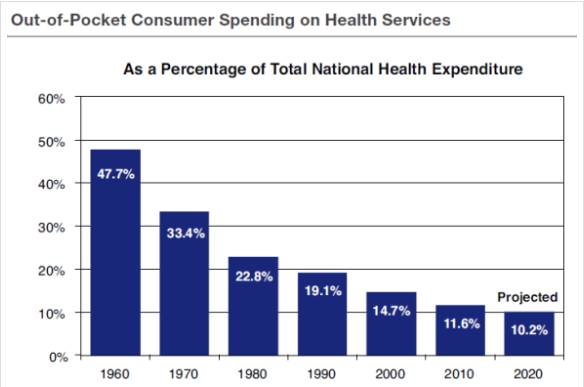
One of the major problems facing the United States today is the high cost of healthcare. We spend almost 18% of GDP on healthcare, both public and private, almost twice as much as any other developed country.  A big reason for the high cost is the low out-of-pocket consumer spending on health services in the U.S. 
My last post discusses a general plan, involving catastrophic health insurance and health savings accounts, for getting the overall cost of healthcare under control.

capture82Once we have a handle on the overall problem, we then need to focus on the cost of the Medicare entitlement program for retirees.  The problem here is easy to understand.  In just 15 years enrollment in Medicare will increase to over 80 million beneficiaries from 57 million today.  Likewise there are 3.1 workers per beneficiary today and there will be only 2.4 in 2030 (see above chart).

capture4
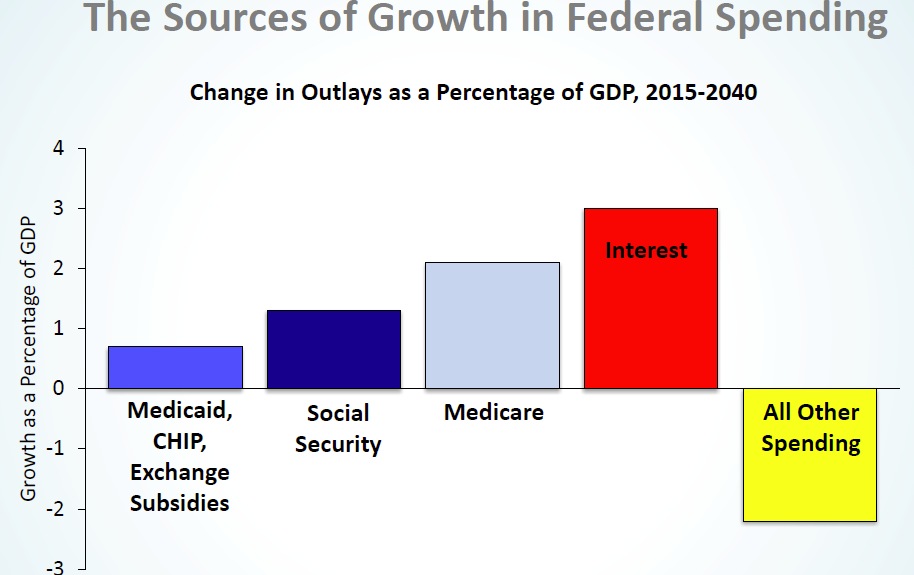
The second chart demonstrates that Medicare will be the major component of increases in federal spending in the coming years (with the other entitlements of Social Security and Medicaid following right behind).
So the question is: how do we control Medicare spending within the context of overall health-care reform?  Here is a proposal from James Capretta of the American Enterprise Institute:

  • Medicare recipients would receive fixed payments toward the coverage option of their choice, based on their age, income and health status. The traditional Medicare program would be one of the choices. Enrollees choosing less costly coverage options would see a reduction in their premiums.
  • Premium payments would be comparable to subsidies and tax credits received from the reformed Affordable Care Act.
  • Privately run managed care plans provide benefits at far less cost than traditional Medicare. Beneficiaries would share in the savings.

Conclusion. It needs to be emphasized as strongly as possible that the point of Medicare reform is to lower costs to both individuals and the government, sa that Medicare can be preserved indefinitely into the future.

Follow me on Twitter
Follow me on Facebook
How to Improve Obamacare and Lower It’s Costs


I have been making the case for some time now that the rapidly increasing costs of U.S. health care, especially for the entitlement programs of Medicare and Medicaid, is the fundamental cause of our exploding national debt, and therefore these costs must be curtailed.  The only way to fix this problem is for Americans to have more “skin in the game” regarding these costs.
Capture10My last post, “The Inherent Instability of Obamacare,” discusses the separate but related problem that the Affordable Care Act is actuarially unsound because it misprices the basic risks involved in health insurance.  This is why costs on the exchanges are going up so fast which, in turn, leads to fewer enrollees.
A good way to address this double whammy of problems is to use a plan developed (mostly) by the American Enterprise Institute in December, 2015.  The main features are:

  • ACA Mandates, for both individuals and employers, would be abolished.
  • Retain tax preferences for employer-paid premiums, with an upper limit comparable to the cost of catastrophic health insurance.
  • Provide refundable tax credits to households without access to employer coverage, gradually replacing subsidies provided by ACA exchanges.
  • Persons with pre-existing conditions would have continuous coverage protection.
  • Medicare would migrate to a defined contribution, refundable tax credit model as above, with eligibility gradually rising to age 67.
  • Medicaid would be financed with block grants to the states and would supplement the refundable tax credit model.
  • Health Savings Accounts, to accompany high deductible plans, would be encouraged with a one-time federal tax credit matching enrollee contributions.
  • Health Care for Veterans would be integrated into mainstream care.

Summary. Abolishing the mandates means that coverage levels and price would be actuarially determined in the market place. Equal tax credits for insurance and help in setting up health savings accounts ensure fairness and widespread accessibility.  The overall free market model will guarantee both low cost and the greatest possible degree of flexibility, innovation and quality of care.

Follow me on Twitter
Follow me on Facebook
 

The Inherent Instability of Obamacare


The recent announcement by Aetna Insurance Company that it will exit the health insurance market in most of the states where it now operates raises a fundamental question about the stability of the Affordable Care Act. As shown by the following map  from yesterday’s New York Times, it appears that at least five states with 17% of the American population will have only one health insurer to choose from next year.
Capture33As the Wall Street Journal’s Greg Ip points out in a recent article, “the problem isn’t technical or temporary, it is intrinsic to how the law was written”  Specifically:

  • Insurance is supposed to price risk but the ACA changed this. Insurers can no longer charge or exclude coverage for pre-existing conditions, charge men and women different rates, or charge older customers more than three times as much as the young.
  • For example, a 64-year-old consumes six times as much health care as the average 21-year-old. Adhering to the 3-to-1 maximum ratio, the insurer would have to greatly overcharge the 21-year-old than his actual cost and/or greatly undercharge the 64-year-old.
  • The rational response for unsound pricing is for young and healthy customers to stay away and sick, older customers to flock to the exchanges. ACA mechanisms to prevent this type of behavior aren’t working very well.Capture32
  • One example of this is that the ACA exchanges, which provide income-based subsidies for those without employer provided health insurance, are mainly attracting those people just slightly above the poverty line who get the biggest subsidies (see chart).

I have pointed out many times that the cost of health care, especially for the entitlement programs of Medicare and Medicaid, is the fundamental driver of our exploding national debt and therefore must be curtailed.  But now, in addition to the cost problem, we are discovering that the ACA also has a fundamental access problem as well. Big changes are clearly needed in the ACA.  More details later!

Follow me on Twitter
Follow me on Facebook

The Challenges of American Health Care II. Specific Problems to Overcome


My last post, “The Challenges of American Health Care,” describes the huge demographic and cost pressures facing American healthcare  and lays out a comprehensive reform plan by the Hoover Institution’s Scott Atlas to address them.  Today I will give more details about these pressures on both private care as well as care subsidized by the Affordable Care Act.
Capture6For example:

  • The cost of providing health care to an average American family surpassed $25,000 for the first time in 2016, $1,155 higher than last year, and triple the cost in 2001.
  • A significant cost driver is the rapid growth in what health plans and insured people are paying for prescription drugs, now comprising $4,270 annually, or 17% of the total.
  • 80% of healthcare costs come from just 20% of the population.
  • The insurance company United Healthcare announced that it is withdrawing from most ACA exchanges because it lost $475 million on plans sold in 2015 and expects to lose another $650 million in 2016.
  • Overall $2.5 billion was lost by insurance companies on the exchanges in 2014. The government’s “risk corridors” program is insufficiently funded to reimburse these losses to the insurance companies involved.
  • The fundamental problem is politicization of the marketplace. Insurers were pressured to set premiums low initially to ensure that the rollout was not a flop. Now premiums are increasing rapidly to cover the initial losses. Households with income over 250% of poverty already find the plans offered on the ACA exchanges unattractive.

Conclusion: The overall rapid increases in the cost of healthcare, public and private, is unsustainable for individuals, families, employers and government. Something has to give.  We need a total reform of healthcare spending in the U.S.  Many good suggestions have been made for how to do this.  Now is the time to act!

Follow me on Twitter
Follow me on Facebook


Lowering the Cost of American Healthcare


It is well understood that entitlement spending (Social Security, Medicare and Medicaid) is the biggest driver of our very serious long term debt problem.  Furthermore the high costs of Medicare and Medicaid can’t be separated from the high cost of American healthcare in general.  In other words, getting the cost of national health spending  under control is a fundamental fiscal and economic issue.
Capture1A major reason for this high cost is the tax exclusion of employer provided healthcare.  American out-of-pocket spending on healthcare is only 11% of the total as compared to 26% in Switzerland or 52% in Singapore, two examples of countries with efficient free-market systems.  Americans have little incentive to hold down the cost of their own care because it is mostly paid for by third party insurance companies.
The Affordable Care Act (aka Obamacare) expands access to healthcare but does nothing to control overall costs.  This means that any changes made to the ACA should be aimed at preserving access but making healthcare much more cost efficient.  This can be accomplished by

  • Keeping the Exchanges. The exchanges were set up to expand access for the uninsured and provide subsidies for those who couldn’t otherwise afford health insurance. This is the best feature of the ACA and should be retained.
  • Repealing the mandates for both individuals and employers. Mandates mean that benefits have to be strictly defined, uniform for all, and therefore more expensive. Employers are burdened by extra regulations which affect hiring and growth decisions.
  • Replacing the employer tax exclusion with a uniform tax credit for all. The credit would be about $2500 per person, the cost of high deductible catastrophic care. Employers could still provide insurance to employees but the tax deduction would be limited to the amount of the tax credit. The self-employed would get the same tax credit and it would also be refundable for those with low-incomes.

The American Enterprise Institute’s James Capretta describes how a transition could be made from the current ACA to such a new system.

Follow me on Twitter: https://twitter.com/jack_heidel
Follow me on Facebook: https://www.facebook.com/jack.heidel.3

Status Quo on the Budget Is Not Good Enough II. Look at the Big Picture!


In my last post, “Status Quo on the Budget Is Not Good Enough,” I discussed a report from the outgoing chair of the Senate Budget Committee, Patty Murray (D-WA), and explained how it epitomizes the lack of progress made on the massive debt problem which has developed since the Great Recession of 2008 -2009.
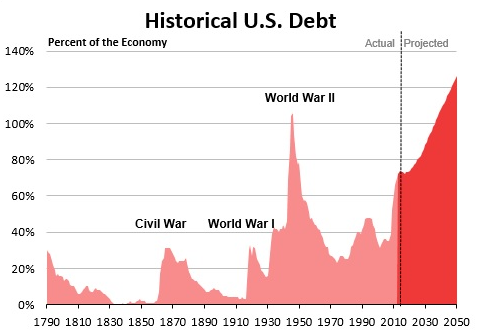
CaptureThe basic problem is that Senator Murray’s analysis simply does not recognize the seriousness of our debt problem as shown in the above chart.  Right now our public debt (on which we pay interest) is “sitting” at 74% of GDP for a year or two, before it continues its rapid increase.  This projection assumes an historically “normal” growth rate of 3% and no new recessions, neither of which assumption is assured.  It also assumes that the sequester budget cuts and new top tax rate of 39.6% stay in effect.  In other words it is a best case scenario based on current policy.
Breaking it down, the debt will continue to increase because annual deficits will continue to exceed the rate of growth of the economy.  The main driver of these increasing deficits is the cost of the health care entitlements of Medicare and Medicaid.  Medicare costs will increase rapidly because of the aging of the American people.  Medicaid costs will increase rapidly because: 1) more low-income people are being covered by the ACA and 2) since the recession there are more low-income people to be covered.  I certainly support expanded healthcare coverage but we have to figure out how to pay for it!
How do we contain the increasing costs of Medicare and Medicaid?  We do it by controlling the overall rapid growth (at twice the rate of inflation) of healthcare costs in general, i.e. for private healthcare. How do we do this?  See a couple of my recent posts either here or here.
Senator Murray, along with many other progressives, argues that we need more deficit spending in order to stimulate the economy and create new jobs.  More jobs are badly needed but more deficit spending is the wrong way to get them.  Then how?  With tax reform among other things.
Based on the outcome of the 2014 elections, I am optimistic that something along the lines of what I have just described will be tried by the next Congress.  We’ll soon find out!

Is Health Care Spending Really Under Control?


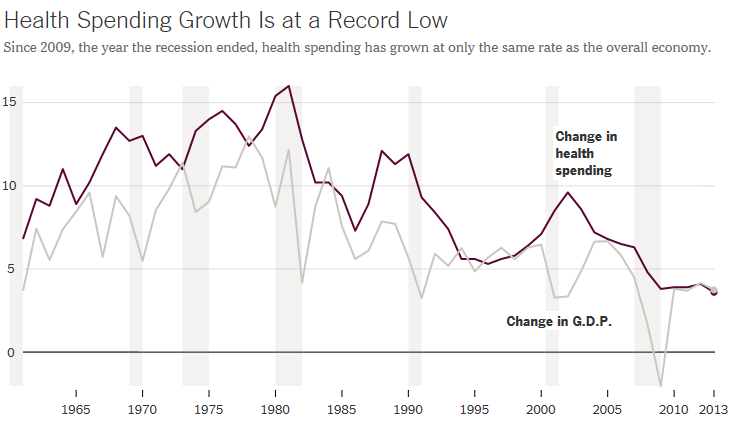
The New York Times has two recent articles about health care spending, “Good News inside the Health Spending Numbers” and “The Battle over Douglas Elmendorf – and the Inability to See Good News.”  These two articles focus on the fact, clearly evident in the chart just below, that the rate of increase in overall health care spending has slowed down since 2009.  In fact health care spending has been a constant 17.4% of GDP for the past four years, while it increased by 1.9% of GDP in the four years before that.  More precisely, health care spending rose by 3.6% in 2013, down from 4.1% in 2012.
CaptureIt is, of course, very good news that increases in health care spending have dropped dramatically since the recession in 2007-2009, but is it really surprising that this has happened in the midst of so much economic pain, with a very high rate of unemployment as well as stagnant incomes for most Americans?  In fact, even in these circumstances, health care spending is still growing at twice the rate of inflation, which has been under 2% during this same time period.
A more realistic view of health care spending has just been presented to the Health Subcommittee of the House Committee on Energy and Commerce by Marc Goldwein, from the non-partisan Committee for a Responsible Federal Budget, a Washington D.C. think tank focused on fiscal responsibility.  Mr. Goldwein makes the following points:

  • Despite the recent slowdown in health care spending, it remains incredibly important that policymakers pursue reforms to reduce future projected health care costs.
  • Policymakers should focus first and foremost on health care “benders” that would improve incentives in order to slow the overall growth of health care spending.
  • Policymakers should next look to health cost “savers” which reduce federal costs by better allocating resources within the federal health programs.
  • Given the aging of the population, health reforms will be necessary but not sufficient to put the debt on a sustainable long-term track.

Slowing down the rate of growth of health care is going to be a huge challenge for our national leaders.  I will elaborate on how to do this in forthcoming blog posts.

Why the U.S. Needs True Health Care Reform


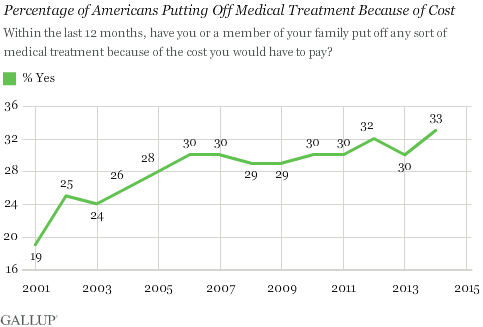
The Affordable Care Act has improved access to healthcare by already enrolling over 7 million Americans who were previously uninsured.  It is estimated that there will be a total of 20 million new enrollees by the end of this decade.
CaptureBut as the above chart from a recent Gallup survey indicates, the cost of healthcare is now a big barrier for an increasing number of people with health insurance.
The University of Chicago economist, Casey Mulligan, discusses the cost issue in a recent Wall Street Journal article “The Myth of ObamaCare’s Affordability” as well as in a new book.  He makes the following points:

  • Although the ACA helps specific populations by giving them a bigger piece of the economic pie, the law diminishes the pie itself by reducing the amount that American’s work and making their work less productive.
  • 35 million men and women currently work for employers who don’t offer health insurance. These tend to be small and midsize businesses with lower paid employees. The result of penalizing businesses for hiring and expanding will be less hiring and expanding.
  • The “29er” phenomenon is a good example of how the law harms productivity. If a business has 50 or more employees who work over 30 hours a week, it is required to offer health insurance. Many employers have thus adopted 29-hour work schedules which lessens overall productivity.
  • Mr. Mulligan estimates that the ACA’s long-term impact will include about 3% less weekly employment, 2% less GDP and 2% less labor income. He also claims that these effects will be visible and obvious in just a few years by 2017!
  • The ACA is thus weakening the economy. For the large number of people who continue to pay for their own healthcare, healthcare is now less affordable.

Conclusion: we need true healthcare reform which addresses cost as well as access and this can be achieved by fixing Obamacare.  It is not necessary to repeal it.  The Manhattan Institute’s Avik Roy has developed a plan to do this: ”Transcending Obamacare.”  Mr. Roy’s Plan would keep the exchanges, end both the individual and employer mandates, and migrate both the Medicare and Medicaid programs onto the exchanges over time.  These features will greatly reduce the cost of American healthcare.  Check it out and see for yourself!

Is A Free Market Possible in Health Care?


With a total national debt of $17.8 trillion, of which close to $13 trillion is public debt (on which we pay interest), it is easily understood that the U.S. has a very serious fiscal problem. At the present time the public debt is 74% of GDP and this already high percentage is predicted by the Congressional Budget Office to keep growing indefinitely.
The biggest driver of spending growth going forward is the cost of healthcare.  For example just the three programs, Medicare ($492 billion), Medicaid ($280 billion) and Veterans Healthcare ($54 billion), cost a total of $826 billion per year in federal dollars.  And these costs are all increasing rapidly.  Of course, private healthcare spending, currently about $2 trillion per year, is also growing rapidly.  Overall, the U.S. spends 17.3% of GDP on healthcare spending, public and private, almost twice as much as any other developed country.
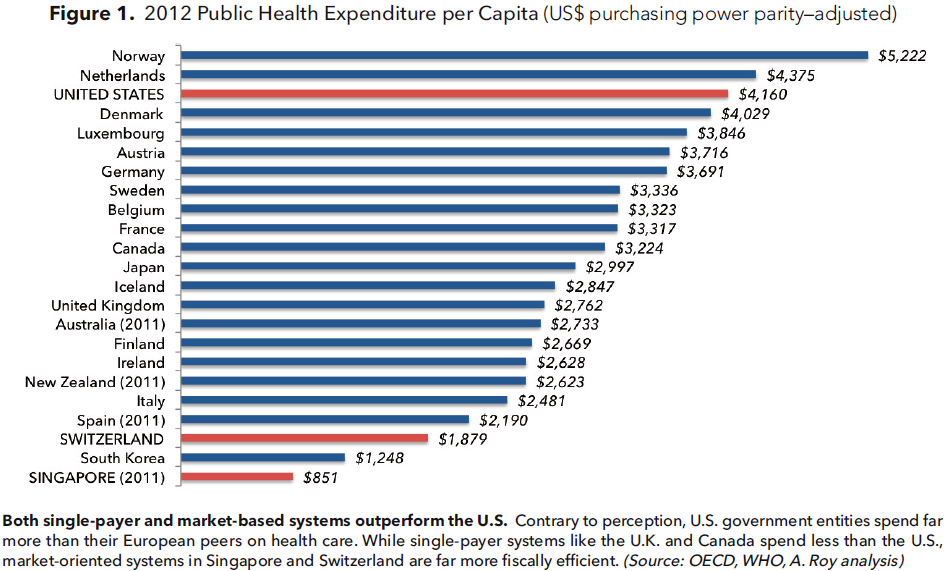
How are we going to address this enormous cost issue going forward? The Affordable Care Act (aka Obamacare) doesn’t do it.  What it does do is to provide healthcare to more people under our current model of employer provided health insurance with Medicare for the elderly and Medicaid for the poor.  It is this model which is broken and must be reformed. Basically we have two choices for how to do this.  Either we switch over to a “single payer” system like most of the other developed countries have or we establish a far more efficient free market system.
Capture  As the above chart shows, right now we have a composite system and it is just not cost-effective. There are plenty of experts who claim that a free market cannot work in healthcare.  For example, the tax lawyer, Edward Kleinbard, in a new book, “We Are Better than This: how government should spend our money” argues that what a free market gives us is:  unavoidable controversy for excluded pre-existing conditions, moral hazard for risky behavior, uncertain premiums for permanent insurance, fragmented healthcare markets, monopoly provider organizations leading to price opacity, very high administrative costs, etc.
Capture1The Manhattan Institute’s Avik Roy has a different point of view.  In his proposal, “Transforming Obamacare,” (http://www.manhattan-institute.org/pdf/mpr_17.pdf) he points out that there are two countries, Switzerland and Singapore, which operate highly regarded free-market healthcare systems at very low public cost. Stay tuned for further discussion!