Is America’s Middle Class Really Shrinking?


For several years now Americans have been having a lively debate about income inequality and the supposedly shrinking middle class. The American Enterprise Institute scholar, Mark Perry, has an enlightening new post on this topic.
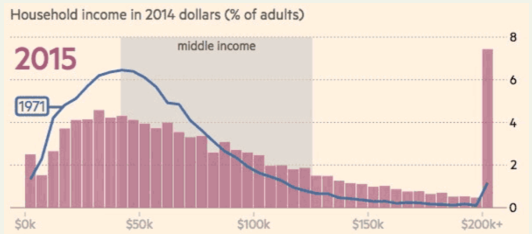
Capture0The AEI has produced a vivid graphic showing that the American Middle Class (defined as the middle 50% of Americans by household income) has dramatically increased in income from 1971 through 2001 but has been stagnant since the Great Recession in 2008-2009.
Capture1He has other charts showing that both the Low-Income group and the Middle-Income group have been shrinking since 1971 precisely because the High-Income group (defined to be households with $100,000 or more in income in constant 2014 dollars) has been growing so rapidly. Isn’t it obvious what we need to do to restore confidence to the Middle Class?  Clearly we need to speed up economic growth.  For example we could:

  • Implement broad-based tax reform. Lower the rates for both individual and corporate taxes, paid for by closing loopholes and limiting deductions. Better yet, shift from taxing income to taxing consumption.
  • Remove roadblocks to innovation by making it easier to start new businesses.
  • Improve K-12 education, especially for low-income kids who need extra help. Enhanced early childhood education, more emphasis on career (vocational) education, and charter schools in big cities are the way to get this done.
  • Make attending college more affordable. There are many good schools around the country which are not expensive to attend (the University of Nebraska at Omaha where I teach is one of them). College students and their families should make it a top priority to avoid huge debt. Attending a prestigious (and expensive) institution is simply not necessary to get a good education.

There are other more controversial ways to speed up economic growth such as increasing international trade and reforming our broken immigration system. But just the measures above will go a long way and shouldn’t be that difficult to implement.

Follow me on Twitter: https://twitter.com/jack_heidel
Follow me on Facebook: https://www.facebook.com/jack.heidel.3

The Fundamental Driver of Our Debt Problem: the Cost of Healthcare


How to grow the economy faster. How to get our rapidly growing national debt under control.  These are the two main problems facing our country which I address over and over again on this blog.  Finding satisfactory solutions to these two problems will determine our future strength and prosperity as a nation.  Today’s discussion is about the major cause of our debt and deficit problem.
CaptureI recently came across the above chart showing the steady rise of overall American healthcare spending (public and private).  In 1960 it was less than 6% of GDP.  Now it is approximately 18%, a tripling, compared to the overall size of the economy, in just 55 years. Of course it is the cost of public healthcare programs such as Medicare, Medicaid and the Affordable Care Act which directly contribute to our growing deficits and to the accumulated debt.
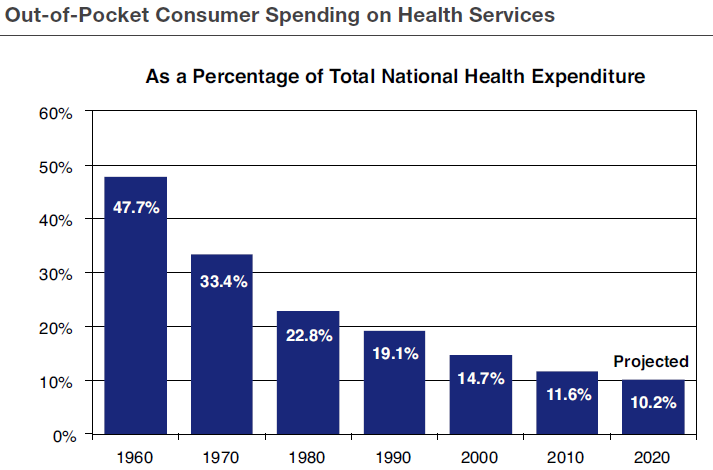
However we will never be able to limit the cost increases of these public programs until we get the fundamental drivers of private healthcare costs under control. As pointed out (in the chart below) by several scholars from the American Enterprise Institute, the basic reason for the high cost of private American health care is that “we don’t have enough skin in the game” as shown by the chart just below.  We are paying less and less of total healthcare costs out of our own pockets because more costs are paid directly by third party insurers.  This means we have less incentive to control our own healthcare costs.
Capture2The AEI has suggested several reform measures to improve this situation such as:

  • Placing an upper limit on the tax exemption for employer-paid insurance premiums.
  • Expanding the use of Health Savings Accounts to be used in conjunction with high deductible plans.

We have a stark choice in front of us. Either we move in this direction in the near future or we will face another, much worse, financial crisis.  In the latter case we will end up with an inferior healthcare system, much less responsive to our wants and desires.

Follow me on Twitter: https://twitter.com/jack_heidel
Follow me on Facebook: https://www.facebook.com/jack.heidel.3
Health Care Spending is Driving Budget Deficits


In my last post, “Annual Deficits are Starting to go Back Up,” I refer to a new report from the Congressional Budget Office to show that it is the large annual increases in federal healthcare spending (Medicare, Medicaid, CHIP and Obamacare) which is the main driver of our annual deficit spending which is going to start increasing again unless we do something serious about it.
CaptureThe basic problem is, as shown by the above chart, that Americans, in general, don’t have enough skin in the healthcare game, i.e. we don’t pay enough of our health care expenses out of our own pockets, and therefore we don’t directly feel the pain of high and rapidly increasing health care costs.
A group of policy experts from the American Enterprise Institute have come up with a practical plan to address this problem.  Its elements are:

  • Retain employer provided coverage. This is how half of Americans get health insurance. The only change would be an upper limit on the tax preference for employer-paid premiums so that only the most expensive plans would exceed it.
  • Tax Credits. Individuals without employer coverage would get a tax credit with no strings attached to pick any state-approved plan that meets their needs.
  • Continuous coverage protection. As long as people stay insured, they cannot be denied enrollment based on health status.
  • Medicaid reform. The federal government would give states fixed, per-person payments based on historical spending patterns. Able bodied adult and their children could combine Medicaid and the (refundable) federal tax credit to enroll in a private insurance option.
  • Medicare reform. Medicare would provide a fixed level of assistance which seniors would use to purchase a health plan of their own choosing.
  • Expanded Health Savings Accounts. These are intended to be used with catastrophic insurance with a high deductible. HSAs could be established with a one-time $1000 tax credit and unused funds rolled over from one year to the next.

Such a system does not repeal, but rather improves the Affordable Care Act. It keeps the ACA exchanges and introduces cost controls in a flexible manner, i.e. without mandates.  It is the type of system the U.S. needs to get health care costs, and therefore overall deficit spending, under control.

Follow me on Twitter: https://twitter.com/jack_heidel
Follow me on Facebook: https://www.facebook.com/jack.heidel.3
Lowering the Cost of American Healthcare II. Entitlements


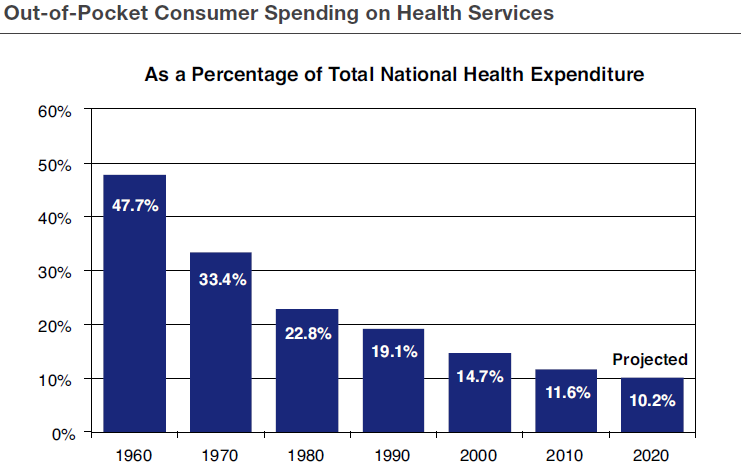
My last post emphsizes that any solution to our nation’s long term debt problem must include reining in the cost of American healthcare.  There are two major drivers to this problem as is made clear by a new report from the American Enterprise Institute, “Improving Health and Health Care: An Agenda for Reform.”
Capture1First of all, out-of-pocket consumer spending on healthcare has been steadily declining for many years. The less we pay directly for our own healthcare, the less incentive we have to control costs.
Capture2Secondly, the cost of healthcare entitlement spending, for Medicare and Medicaid , is growing rapidly as a percentage of GDP.  Such a rapid increase is unsustainable and must be curtailed. Here is what the AEI report recommends for doing this.

  • Medicaid. It serves two groups of people: 1) able bodied adults and their children and 2) the disabled and elderly. The federal government should make fixed, per-capita payments to the states based on historical spending patterns for these two groups. The able-bodied adults and children would get the same (refundable) federal tax credits as everyone else supplemented by Medicaid payments. The states would be totally responsible for the second group.
  • Medicare. The current system would be gradually migrated to a premium support system which would provide enough to pay for a choice of competing insurance options. The eligibility age would gradually rise to 67, consistent with Social Security.
    Capture3
  • Health Savings Accounts. HSAs are tax-preferred vehicles for saving for medical expenses until the (perhaps high) deductible amount is reached. Their use is growing rapidly. A one-time $1000 federal tax credit for establishing an HSA would increase their number even more. Their use should be expanded into Medicaid and Medicare as well.

Such reforms as these can significantly lower the cost of providing healthcare to the poor, the elderly and everyone else as well. If we don’t do something along these lines, we will eventually end up with a government run single payer system much to our detriment.


Follow me on Twitter: https://twitter.com/jack_heidel
Follow me on Facebook: https://www.facebook.com/jack.heidel.3


Avoiding World War III


What happened in Paris could also easily happen in London, New York City or Washington D.C. and soon will if our President does not adequately respond to the threat of terrorism.  As the Wall Street Journal declared yesterday, “For seven years Mr. Obama has used the unpopularity of the Iraq war as a shield for his retreat from anti-terror leadership and the Middle East.”
CaptureThe American Enterprise Institute’s Danielle Pletka informs us that:

  • NATO aircraft scrambled more than 500 times in 2014, with only a few exceptions, in reaction to Russian incursions into NATO member airspace.
  • In 2014, Japan scrambled aircraft almost 1000 times, with all but a few of these incidents attributed to either Russian or Chinese warplanes.
  • Russian bombers entered US airspace 10 times in 2014, double the previous average.

Ms. Pletka also suggests how we should respond to four years of carnage in the Middle East:

  • The first step is to actually have a strategy, rather than a series of reactive tactics and incremental escalations.
  • The second step is to build a coalition with sub-state and national partners that we trust and that trust us to stick with the job.
  • The good news is that there is still time to lead a decisive war against ISIS.
  • There is no need to launch broadsides against all Muslims, the Syrian people and refugees in general. It is Islam extremists who are attacking us, not mainstream Islamists.

The world is a dangerous place and we have many enemies.  On this website I am mostly focused on our own fiscal and economic problems which are very serious and need to be dealt with in a timely manner.  However the immediate safety and security of our country is the highest priority of all and, on occasion, takes precedence over everything else.  Now is a time for such heightened vigilance.


Dodd-Frank Is Hurting the Recovery!


The Federal Reserve Bank plays an important role in our economy by trying to keep inflation low and stable but also by trying to make recessions less severe by increasing the money supply when the unemployment rate is high. My last post, “What the Federal Reserve Can and Can’t Do” emphasizes that, as Ben Bernanke says, “the Fed has little or no control over long term fundamentals,” such as economic growth which depends on increases in productivity which, in turn, are heavily influenced by fiscal and regulatory policy.
Capture8The American Enterprise Institute’s Peter Wallison explains very clearly in “The slow economic recovery explained,” why, for example, the Dodd-Frank Act of 2010 is having a harmful effect on economic growth:

  • Regulatory burdens imposed by Dodd-Frank have been particularly harsh for community banks, with $10 billion or less in assets; 98.5 % of U.S. banks fall into this category. Since Dodd-Frank was enacted in 2010, community banks’ share of banking assets has shrunk by 12%.
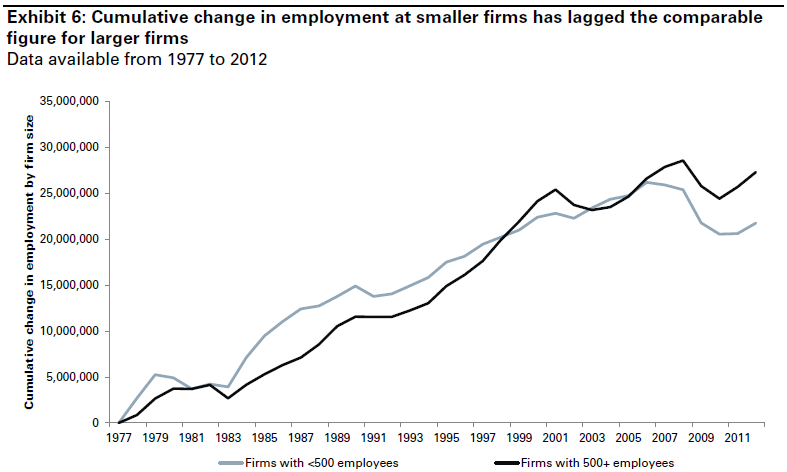
  • According to the Small Business Administration, there were approximately 23 million small businesses (with fewer than 500 employees) in 2012, compared to 18,500 firms with more than 500 employees. Large businesses have access to capital markets whereas small businesses rely on local banks for their credit needs.
  • Regulatory costs affect small banks more than large banks because the costs are fixed, independent of size of the institution. When the Consumer Financial Protection Bureau sends out voluminous regulations on mortgage lending, for example, then extensive legal fees, compliance officers and technology retooling must be paid for up front.
    Capture
  • A recent report from Goldman Sachs, “The Two-Speed Economy,” shows that large firms have grown faster than usual after 2010 while small firms have grown much slower than usual (see chart above).

Conclusion. Monetary policy alone, as conducted by the Federal Reserve, cannot return our economy to good health. This can only be accomplished by increasing productivity which is aided by smart fiscal and regulatory policy. Dodd-Frank is an example of regulatory policy which is hurting economic growth by having a harmful effect on main street banks.                                 

“The Dung of the Devil”


My last post, “The Moral Case for Free Enterprise,” was motivated in part by a recent speech of Pope Francis comparing the excesses of global capitalism to the “dung of the devil.”
Capture2The scholar Mark Perry of the American Enterprise Institute has just published an interesting chart (just below) demonstrating an 80% reduction in world poverty in the 36 year period from 1970 to 2006.  He quotes AEI President Arthur Brooks that “if you love the poor, if you are a good Samaritan, you must stand for the free enterprise system, and you must defend it, not just for ourselves but for people around the world.  It is the best anti-poverty measure ever invented.”
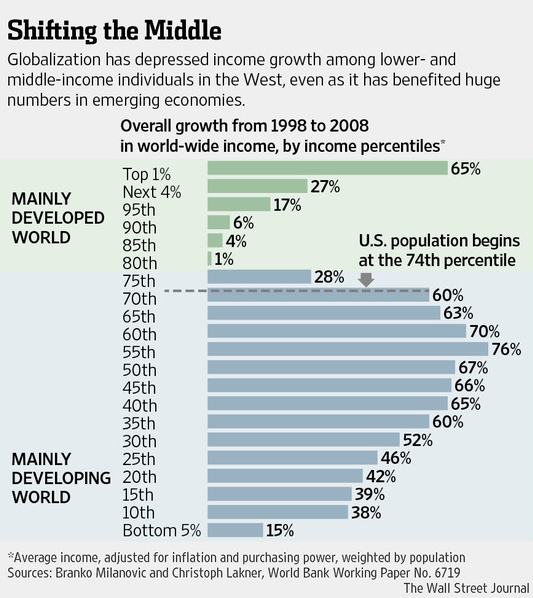
CaptureIn a previous post, a year and a half ago, “A Global Perspective on Income Inequality,”  I referred to another chart (just below) to demonstrate the massive growth of income in the developing world.  To a large extent this is the result of economic globalization shifting low-skill employment from the developed world to the developing world where the cost of labor is less expensive. As Arthur Brooks says, “It was globalization, free trade, the boom in international entrepreneurship.  In short, it was the free enterprise system, American style, which is our gift to the world.
Capture1So, yes, the world as a whole is now much better off but American workers have paid a price for the global shift in low-skill work.  The answer is not to impede globalization but rather to:

  • Speed up the growth of our own economy in order to raise wages and provide more jobs for the unemployed and underemployed.
  • Improve K-12 educational effectiveness and expand career educational opportunities to better prepare present and future workers for the many new high-skill jobs being created all the time.

The world is changing rapidly but there are effective ways for the U.S. to adapt if only we have the good sense to move forward!

The Moral Case for Free Enterprise


Capitalism is under attack around the world as Greek socialists complain about their hard- hearted EU creditors, American liberals such as Bernie Sanders and Elizabeth Warren push the Democratic Party to the left, and Pope Francis compares the excesses of global capitalism to the “dung of the devil.”
CaptureOne of my favorite economic commentators is Arthur Brooks, President of the American Enterprise Institute.  One of his books is “The Road to Freedom: How to Win the Fight for Free Enterprise,” which examines the most important economic issues facing the United States from a moral point of view.  For example:

  • Getting the U.S. Economy Growing Again. Weak economic growth means the end of opportunity in America. Furthermore, weak growth disproportionately hurts those who most need new economic opportunities: the poor. One strategy says that the key to restarting economic growth is the state: more stimulus, more taxes, more borrowing. A second strategy says the source of economic growth is free enterprise: tax reform, less government regulation, policies that make it easier for entrepreneurs to succeed, and a smarter immigration policy.
  • Putting America Back to Work. Jobs are not just a source of money for Americans; they are a ticket to earned success. High unemployment is unfair because it robs people of their potential fulfillment. It is especially harmful to the poor and the young. The key to job creation is to get the economy growing faster.
  • Getting the United States Out of Debt. Unless the U.S. reduces deficits, it will have just three choices: steal from future generations, inflate the currency to lower the value of the debt or refuse to pay those to whom it owes the money. All of these options are immoral because they are unfair: they harm others who have done no harm to America. Three points here: 1) we have out-of-control entitlement spending, 2) debt crises are more successfully dealt with through spending reductions than with tax increases and 3) there are no quick fixes.

Considering basic economic and fiscal issues from a moral perspective adds an important new dimension to the discussion.  We might disagree on the details of how to proceed but it is imperative to take effective action of some kind!

An Off-Ramp from Obama Care


The Supreme Court will soon render an opinion in King v. Burwell, challenging the implementation of the Affordable Care Act which stipulates that subsidies can only be paid “through an Exchange established by the State.”  If the plaintiffs are upheld, it will mean that anyone receiving health insurance through one of the federal exchanges operating in 33 states is not eligible to receive a subsidy.  It will be necessary for Congress to intervene to fix a problem like this.
CaptureThree committee chairs in the House of Representatives, John Kline, Paul Ryan and Fred Upton, are proposing to take such an opportunity to improve the Affordable Care Act along the following lines:

  • First of all, making health insurance more affordable by ending both the individual and employer mandates, and giving choices back to the states, individuals and families.
  • Secondly, supporting Americans in purchasing the coverage of their choosing. For example, people could save money by buying insurance across state lines.
  • Finally, many existing features of the ACA would be retained. Children could stay on their parents policies until age 26. Lifetime limits on benefits would be prohibited. People with existing conditions would be protected. Renewability would be guaranteed. Insurance would be decoupled from employment by offering equal (perhaps, age adjusted) tax credits for all.

There remains the practical problem of providing immediate assistance to the approximately 5 million people currently receiving subsidies through the federal exchanges, while larger scale changes are being worked out by Congress.  The American Enterprise Institute has proposed a simple way for Congress to do this as follows:

  • Enact a short-term extension of subsidies for current enrollees.
  • States with federal exchanges could immediately set up a state exchange if they wished.
  • People with preexisting conditions and/or continuous coverage would be protected.

Both quality control and cost control are badly needed to make the ACA sustainable for the long run.  Given the right decision in King v. Burwell, these two plans outline a possible way to accomplish this.

Can We Solve All Our Fiscal and Economic Problems at the Same Time?


This website, It Does Not Add Up, is devoted to discussing our country’s most serious economic and fiscal problems.  They are:

  • Stagnant Economy. Since the end of the Great Recession in June 2009, the economy has been growing on average at the historically slow rate of about 2.3%. Slow growth means higher unemployment, stagnant wages and less tax revenue.
  • Massive Debt. U.S. public (on which we pay interest) debt is now 74% of GDP (highest since WW II) and projected by CBO to grow rapidly unless strong measures are taken to reduce it. This puts our country’s future wellbeing and prosperity at great risk.
  • Increasing Income Inequality. Incomes for the high-skilled and well-educated are increasing much faster than for the low-skilled and less-educated workers.

The new Republican majorities in Congress are stirring the waters by proposing a ten year plan to shrink the deficit down to zero, i.e. to balance the budget by 2025.  The opposition claims that this would “sharply cut the scale of domestic spending, which would mostly fall on the poor.”
Capture1But the American Enterprise Institute’s James Pethokoukis points out that social spending in the U.S., both public and private, is very generous and second only to France in the entire OECD. So here is how we could proceed to address our basic problems in a unified manner:

  • Balance the Budget by a combination of Republican spending cuts and cutting back on two major tax deductions: Employer-sponsored Health Insurance (cost: $250 billion per year) and Mortgage Interest (cost: $70 billion per year).
  • Boost Economic Growth by expanding the Earned Income Tax Credit to encourage more people to accept low paying, entry level jobs. Increase the Social Security eligibility age from 67 to 70, thereby keeping near retirees in the workforce for three additional years (this will also extend the solvency of the Social Security Trust Fund).
  • Decrease Income Inequality. Cutting back on tax deductions, in part to pay for expansion of the EITC, lessens income inequality as well as shrinking the deficit. A faster growing economy also lessens inequality by providing more opportunities for upward mobility.

In other words, addressing each of these fundamental problems in an intelligent manner contributes to solving the remaining problems as well.  This creates a virtuous circle for economic progress!