Trump Needs a Wall of Fiscal Discipline


So says the Concord Coalition’s Robert Bixby. President Trump said in a recent interview on Fox News that he would like to have a balanced budget “eventually,” but not at the expense of higher spending for the military. The problem is, as Mr. Bixby points out, if we delay fiscal discipline in order to increase military spending, what else will we delay it for?  Will we delay it for infrastructure spending or border security or tax cuts?  Will we delay it to protect Social Security and Medicare?
capture98
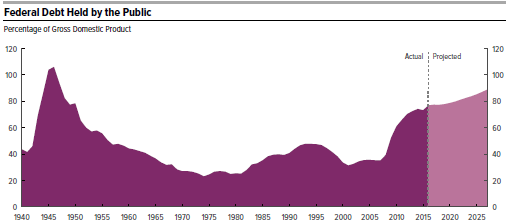
The Congressional Budget Office predicts (see chart) that, under current law, the public debt (on which we pay interest) will grow from 77% of GDP in 2017 to 89% of GDP in 2027.  Furthermore, mandatory programs (Social Security, Medicare and Medicaid) will grow from 13% of GDP this year to 15.4% in 2027 while discretionary programs (everything else except interest payments) will fall from 6.3% of GDP today to 5.3% of GDP in 2027.  Interest payments on the debt will grow from 1.4% of GDP ($270 billion) today to 2.7% of GDP ($768 billion) in 2027.

capture97
It turns out that it is possible to avoid this calamitous scenario in the following fiscally responsible way (see the attached table):

  • Note that spending (outlays) is projected to increase from $3963 billion in 2017 to $6548 in 2027, which represents a 5% annual increase in spending every year.
  • But also revenues (tax income) are projected to increase from $3404 billion in 2017 to $5140 billion in 2027.
  • If spending growth could slow down from $3963 billion in 2017 to $5140 billion in 2027 (the projected amount of revenue in that year), the budget would then be balanced in 2027!
  • It turns out that no budget cuts are required to accomplish this. In fact a calculation shows that simply limiting spending increases to 2.6% per year (rather than CBO’s projected increases of 5% per year) is sufficient to achieve this goal.

Conclusion. Above is outlined a plan to balance the budget over a ten year period without making any spending cuts! All that is needed is a modest amount of spending restraint!

Follow me on Twitter
Follow me on Facebook

Trumponomics II. Debt


As I discussed in my last post, Donald Trump’s primary mandate from the presidential election is to get the economy growing faster in order to help out his base of blue-collar workers who have suffered wage stagnation for many years and especially since the end of the Great Recession in June 2009.  The tax and regulatory reform needed to accomplish this urgent task will undoubtedly turn out to be the first plank of Trumponomics.

capture2
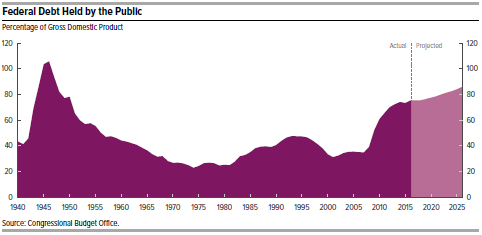
But there is another equally urgent task which must not be overlooked by the incoming Trump Administration.  Our national debt, the public part on which we pay interest, is now 75% of GDP, the highest level since the end of WWII, and projected by the nonpartisan Congressional Budget Office to keep growing rapidly in the years just ahead (see chart above).
As Barron’s has pointed out, “Saving America, Part 1”, in its current issue:

  • Today’s public debt of $14 trillion will grow to $45 trillion in just 20 years’ time on the basis of current entitlement programs like Medicare and Medicaid, without any new spending programs or tax cuts.
  • The annual interest on a $45 trillion debt load would be about $750 billion at today’s super low interest rates. If interest rates rise to more typical levels, the interest payment on this level of debt would be about $1.5 trillion a year. This represents almost half of all federal spending during the current 2016-2017 budget year.

Conclusion. Such a high level of interest payment on our debt is unthinkable. This means that either we make fundamental reforms in government entitlement programs in the next few years or else we will have a severe fiscal crisis on our hands in less than twenty years’ time. We have some stark choices to make and hopefully the incoming Trump Administration will not shy away from what needs to be done.

Follow me on Twitter
Follow me on Facebook

Why We Should Be Deeply Worried about Our National Debt


My last post is highly critical of the economist and New York Times columnist, Paul Krugman, for encouraging massive new deficit spending to stimulate our under-performing economy.
Debt and the slow growth of our economy are the two main topics of this blog which I have now been writing for almost four years.  How to speed up growth is a complicated and highly charged political issue about which reasonable and well informed people can differ.  However avoiding excessive debt is to me a moral issue whose resolution should not be that difficult, at least in a conceptual sense.
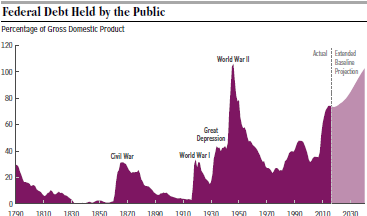
Capture2 I have often used the above chart from the Congressional Budget Office to illustrate our debt problem because it clarifies the problem so vividly.  Here are its main features:

  • Our public debt (on which we pay interest), now about $13 trillion, is 75% of GDP, the highest since right after the end of WWII. And it is projected to keep getting steadily worse under current policy.
  • Note the decline in the debt from the end of WWII until about 1980. This doesn’t mean that the debt was actually paid off but rather that it shrank as a percentage of GDP as the economy grew fairly rapidly during this time period.
  • From 1980 – 2008 the debt level fluctuated and increased somewhat but did not get badly out of control.
  • Debt shot up rapidly with the Great Recession and has been continuing to grow ever since.
  • The current GDP of our economy is about $19 trillion. At a current growth rate of 2.1%, this adds $400 billion of GDP per year. This means that a $400 billion deficit for 2016 would stabilize the public debt at 75% of GDP. But our 2016-2017 deficit is projected to be almost $600 billion (and rising). This is not good enough!

Conclusion. In order to begin to shrink the size of the public debt, it is imperative that annual spending deficits be reduced to well below $400 billion per year. This will be difficult for our political process to achieve but it is the only way to avoid a new and much worse financial crisis in the relatively near future.

Follow me on Twitter
Follow me on Facebook

Our Dire Fiscal Situation: A Summary


We are currently living in a high risk fiscal bubble. Low interest rates mean that our enormous and rapidly growing national debt is virtually “free” money.  When interest rates return to historically normal (much higher) levels, interest payments on the debt will explode putting us in a precarious fiscal situation.
As I have pointed out in the last few posts, it is the cost of entitlements and, in particular, health care entitlements, i.e. Medicare and Medicaid, which is driving our debt problem. The most effective way to control these entitlement costs is to control overall health care costs by insisting that all of us have more “skin in the game,” meaning that we must pay more of our health care costs directly from our own pockets as opposed to having them paid by third party insurance companies.
Capture20The latest report from the Congressional Budget Office, just a few days ago, shows that our debt problem is even worse than was projected just a year ago (see above).
Capture21The second chart (just above) shows the magnitude of the effort it will take to get our debt under control.  Just to stabilize the debt, i.e. to keep it from getting any worse than it is right now, will require a combination of spending cuts and/or revenue increases of 1.7% of GDP which amounts to $330 billion in 2016 dollars.
Conclusion. We have a huge national debt problem which is only going to keep getting worse until we make somewhat painful changes in federal policy.  We have to either restrain spending increases and/or increase taxes by significant amounts.  Health care entitlements are the biggest problem area and Medicare is worst of all.
Our two presumptive presidential candidates, Hillary Clinton and Donald Trump, are completely ignoring this grave problem.  And indeed their proposed policy initiatives will only make it worse!
Do we have the strength to deal with this dire problem short of another crisis?

Follow me on Twitter
Follow me on Facebook

Entitlement Spending and the National Debt


I discuss two fundamental economic and fiscal problems on this website:

  • The slow growth of our economy, only 2.1% per year since the end of the Great Recession in June 2009. This is largely responsible for stagnant wages for middle- and low-income workers, which is in turn responsible for the rise of the populist presidential candidates Bernie Sanders and Donald Trump.
  • Our massive national debt, now 74% of GDP for the so-called public part, on which we pay interest. This is the highest it has been since right after WWII.
    Capture2

Slow economic growth gets more public attention because of its direct and negative effect on so many people. However massive debt is more of an existential problem.  Right now our debt is almost “free” money because interest rates are so low.  But with debt predicted (by the Congressional Budget Office, for example) to keep climbing steadily under current policy (see the first chart) and with the inevitability of increased interest rates in the future, interest payments on the public debt are bound to rise precipitously.
Capture4The second chart just above (from the Concord Coalition) shows that interest payments on the debt will likely soon become the leading source of growth in federal spending.  But perhaps surprising is that the three non-interest sources of spending growth are the entitlement programs, Medicare, Social Security and the combined Medicaid, CHIP and ACA exchange subsidies.  All other government spending will decrease in relative terms.
Capture3Is it not readily apparent from this data that the only way to curtail a huge fiscal crisis in the not so distant future is to get entitlement spending under much better control?  The last chart, just above, (from the Trustees of SS and Medicare) shows the growth in general fund revenue required for Medicare and SS going forward.  In 2016 the discrepancy is 2.1% of GDP which amounts to $401 billion.  The discrepancy will double by 2040.  Of course, OASDI (SS) and HI (Medicare Part A) have trust funds paid into by payroll taxes.  But these trust funds are already paying out more than they take in and will be exhausted in a few years.

Conclusion. Spending on entitlement programs must be brought under much better control. How to do this will be the topic of my next post.

Follow me on Twitter
Follow me on Facebook

The Big Picture on America’s Fiscal Crisis II. How Urgent?


My last post, “The Big Picture on America’s Fiscal Crisis” explains, according to the political scientist James Piereson, why three very difficult contemporary problems:

  • Very high public debt (74% of GDP, highest since WWII)
  • Unfavorable demographics (a rapidly increasing number of retirees)
  • Slowing economic growth (for fundamental reasons)

will inexorably lead to a breakdown of the Democratic-welfare regime which has lasted from 1932 until the present. The reasoning is very simple and direct.  We already have huge debt.  Rapidly increasing entitlement spending on our rapidly increasing number of retirees will keep driving our debt higher and higher.  We won’t be able to grow our way out from under this debt because we have run out of industrial revolutions to spur new growth.
Capture1A new study co-written by Doug Elmendorf, CBO Director from 2009-2015,  makes the case that our fiscal crisis, although real, is less urgent than often believed for the following reasons:

  • Lower than expected health-care inflation
  • The persistence of low interest rates

The above chart shows, for example, that the public debt may not reach 100% of GDP until 2032 instead of the earlier CBO prediction of 2030. I believe that this Elmendorf projection should be viewed as false comfort.
Both health-care inflation and low interest rates are a direct result of very low overall inflation in the U.S. and this will not last forever.  Low interest rates mean that interest payments on the debt are also very low.  This is a very poor reason to increase current borrowing.  When interest rates do go up, whether it is sooner or later, interest payments on the debt will increase by hundreds of billions of dollars a year over a likely relatively short time period.
This is the severe crisis, or Fourth Revolution, which Mr. Piereson is predicting.  We don’t know when it will occur because we don’t know when inflation will rear its ugly head.
Wouldn’t it be much better to put our debt on a downward path, as a percentage of GDP, and avoid the otherwise very unpleasant consequences?

Follow me on Twitter: https://twitter.com/jack_heidel
Follow me on Facebook: https://www.facebook.com/jack.heidel.3

Annual Deficits are Starting to Go Back Up!


As regular readers of It Does not Add Up know well, I am highly alarmed about the large budget deficits and slow economic growth in the U.S. in recent years.  Some people respond that deficits are falling and that we have entered a new era of slow-growth secular stagnation which is unavoidable.
CaptureA new report from the Congressional Budget Office, our most reliable source for objective fiscal and economic information, now predicts that the deficit for 2016 will be $544 billion, a large increase over the $439 billion deficit for 2015.  Furthermore, CBO predicts that for future years deficits will continue to grow, exceeding $1 trillion by 2022. Here is a summary of the CBO predictions:

  • Federal outlays are projected to rise by 6% this year, to $3.9 trillion, or 21.2% of GDP. This represents a 7% rise in mandatory (entitlement) spending, a 3% increase in discretionary spending, and a 14% increase in net interest on the national debt.
  • Under entitlements, Social Security payments will increase by 3% and healthcare (Medicare, Medicaid, CHIP (children’s health) and Obamacare) payments will increase by 11%.
  • Revenues will increase by 4% in 2016, to $3.4 trillion, or 18.3% of GDP.
  • Deficits are projected to increase from 74% of GDP in 2015 to 86% of GDP by 2026.
  • Spending for mandatory programs will increase from 13.1% of GDP in 2016 to 15% of GDP in 2026.

First Conclusion: The spending increases from 2015 to 2016, outlined above, illustrate a clear and alarming trend which is evident in the full ten-year set of CBO data. Discretionary spending will rise but at a sustainable rate of about 3% a year or less.  Mandatory (entitlement) spending will rise at a much faster and unsustainable rate.  It is healthcare spending, i.e. for Medicare, Medicaid, CHIP and Obamacare, and not Social Security, which is driving the rapid increase in mandatory spending.
Second Conclusion:  Although it is government healthcare spending which is driving our rapidly worsening deficit and debt problem, this is just part of the larger problem of the rapidly increasing cost of overall (including private) healthcare spending in the U.S.  This is the basic problem we need to focus on to get both fiscal and economic policy back on the right track.

Follow me on Twitter: https://twitter.com/jack_heidel
Follow me on Facebook: https://www.facebook.com/jack.heidel.3

Setting Up a Balanced Budget Amendment to the U.S. Constitution


I have made the case in several recent posts, herehere, and here, as to why we need a Balanced Budget Amendment to the U.S. Constitution.  This is a very timely issue since 27 states (out of the 34 required) have now called for a Constitutional Convention to propose such an amendment.
Many people have pointed out the difficulty of creating such an amendment which would be both effective enough to get the job done as well as flexible enough to allow for any emergencies which might arise.
CaptureHere are some suggestions for the main features which are needed:

  • Prior to the beginning of each fiscal year, the President is required to submit a proposed budget for the U.S. Government in which total outlays do not exceed total receipts.
  • Congress need not adopt the President’s proposed budget but is likewise required to adopt a balanced budget for the coming fiscal year.
  • A two-thirds vote of each House of Congress is required to approve an excess of outlays over receipts, either for the entire budget or for supplemental spending once the fiscal year has begun. (Many proposed amendments require only three-fifths majorities for override but I think that this is insufficient.)
  • Congress may pass appropriate legislation to implement and enforce this amendment. For example, official estimates of receipts and outlays could be provided by the Congressional Budget Office.
  • The BBA amendment takes effect beginning with the fifth fiscal year following its ratification. (The idea here is to provide Congress with a sufficient time window to whittle down our current deficit spending, approximately $450 billion, to a more manageable amount, before the strict limits of the BBA take effect.)

Keep in mind that the real purpose of a BBA is not to establish exact numerical balance for the budget but to put our national debt on an overall downward course as a percentage of GDP. Occasional spending overrides during the budget year, as long as they are reasonable, will not detract from this goal.  A two-thirds majority vote for balance overrides should be sufficient to accomplish this.

Follow me on Twitter: https://twitter.com/jack_heidel
Follow me on Facebook: https://www.facebook.com/jack.heidel.3


What Lesson Does “The Big Short” Have for Us?


The newly released movie, “The Big Short” based on Michael Lewis’s book of the same name is a fascinating account of several investors who figured out that subprime mortgages would eventually turn bad and made billions of dollars by betting against them.
One of the main characters in The Big Short, the investor Michael Burry, could accurately predict when his credit default swaps would pay off.  Subprime mortgages started out with a low, fixed two-year “teaser” rate and then reset after two years to much higher floating interest rates.  Once the housing market peaked out in 2006 and started to turn down, it became virtually certain that many subprime mortgages would end up in default after the initial two year period because the holders of these mortgages would be unable to refinance in a falling market.
CaptureToday we have a very large debt bubble as illustrated in the above chart from the Congressional Budget Office.   Why is this so serious?

  • Right now our public debt (on which we pay interest) is “only” 74% of GDP but it is likely to keep getting worse in the coming years as clearly indicated by CBO. Congress has the ability to reduce deficit spending and shrink the debt but does it have the will to do so?
  • Right now our debt is almost “free” money because interest rates are so low. But this is already starting to change and we should assume that interest rates will eventually return to normal historical levels of about 5%. When this happens, interest payments on the debt will surge from about $250 billion per year at present to double or triple this amount. This will make our deficits and debt grow even faster.
  • The debt bubble is much more dangerous than the housing bubble from ten years ago because its bursting will affect the whole economy and not just one sector. It is unlikely that anyone will be able to pull a Michael Burry and predict the exact timing of the burst. But this doesn’t mean that no one will try. When China and Japan (our biggest foreign lenders) start shorting U.S. debt, it will serve to hasten the downfall of our whole financial system.

Conclusion. This is an intentionally scary scenario. Things don’t have to happen this way but it’s going to require an enormous effort to turn it around.  Are we capable of doing this?

Follow me on Twitter: https://twitter.com/jack_heidel
Follow me on Facebook: https://www.facebook.com/jack.heidel.3

Austerity’s Grim Legacy?


There is a very important debate going on in the country right now as I have discussed in my last three posts:

  • The Republican presidential candidates are proposing big tax cuts to stimulate the economy but at the cost of huge increases in annual deficits and the accumulated debt.
  • The Democratic candidates want to raise taxes on the wealthy but even raising the top tax rate from 39.6% to 50% would have only a modest effect in lowering income inequality.
  • The Tax Foundation has an excellent plan to lower tax rates for all in a revenue neutral manner by closing loopholes and limiting deductions. Their plan would give the economy a big boost and actually lower deficits by bringing in more tax revenue.

Now comes Paul Krugman in Friday’s New York Times, “Austerity’s Grim Legacy”  saying that “Some of us tried in vain to point out that deficit fetishism was both wrong-headed and destructive, that there was no good evidence that government debt was a problem for major economies, … And we were vindicated by events.  More than four and a half years have passed since Alan Simpson and Erskine Bowles warned of a fiscal crisis within two years; U.S. borrowing costs remain at historic lows.”
Capture12How can such an obviously intelligent and articulate economist miss what is so very, very clear to so many lesser mortals?  Interest rates will not stay low forever!  And when they do go up, interest payments on our rapidly expanding debt will skyrocket! The Congressional Budget Office estimates that the interest payment on our debt will increase from 1.7% of GDP today to 3.6% of GDP in 2025, or $827 billion in 2025 compared with $227 billion in 2015.  Where will the money to pay this new $600 billion expense come from?
It is absolutely crazy not to take our enormous debt seriously.  We simply must put this huge debt on a downward path as a percentage of GDP.  It can be done but it will take a concerted effort by our national leaders to do it.

                                    Follow me on Twitter: https://twitter.com/jack_heidel
                         Follow me on Facebook: https://www.facebook.com/jack.heidel.3