Are Democratic Presidents Better for the Economy than Republicans?


In his usual provocative manner, Paul Krugman reminded us yesterday that, according to a recent study by Alan Blinder and Mark Watson, ever since President Truman the economy has grown faster under Democratic presidents than under Republican presidents.  There are a lot of different explanations for this, not necessarily demonstrating better economic policies by Democratic presidents.  Nevertheless, it is a noteworthy finding which fiscally conservative, fix-the-economy types, need to be aware of.
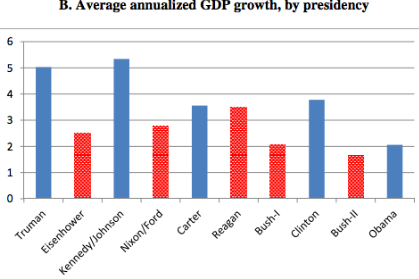
CaptureAmong other things, Republican presidential candidates must become more credible about their economic policies than they have been so far.  They have all proposed big cuts in tax rates to stimulate the economy. But their plans lose trillions of dollars in tax revenue.  At a time of huge deficits and a rapidly growing national debt this is simply unacceptable.
In today’s Omaha World Herald, the economics journalist, Robert Samuelson, reports on a new Brookings Institute study about the effect of raising the top individual tax rate from 39.6% to 50%.  Such a tax hike would raise as much as $100 billion per year.

  • However, if used to lower deficit spending, it would cover less than ¼ of current deficit spending ($439 billion in 2015, for example).
  • If used to reduce income inequality for the poorest 1/5 of Americans, it would give such households an average of $2,650, and the overall effect on income inequality would be very modest.

The point is that neither costly tax cuts to boost economic growth nor a sizable tax increase on the wealthiest Americans represents a viable program to straighten out our economic problems. What we need to grow the economy is:

  • Revenue neutral tax reform, lowering rates across the board, paid for by closing loopholes and shrinking deductions.
  • Lightening the regulatory burden at least on small and mid-size businesses in order to speed up business growth and entrepreneurship.
  • Trade expansion and immigration reform to increase productivity.

Fiscal conservatives are badly needed to implement such policies effectively but neither party can get the job done alone. It will take both parties working together to make progress.

                                Follow me on Twitter: https://twitter.com/jack_heidel
                      Follow me on Facebook: https://www.facebook.com/jack.heidel.3
The Politics of Distrust


I define myself as a fiscal conservative with a social conscience, because I want to address budget deficits and income inequality at the same time.  There is so much divisiveness in politics these days that liberals accuse me of favoring austerity while, at the same time, conservatives accuse me of being soft on welfare.
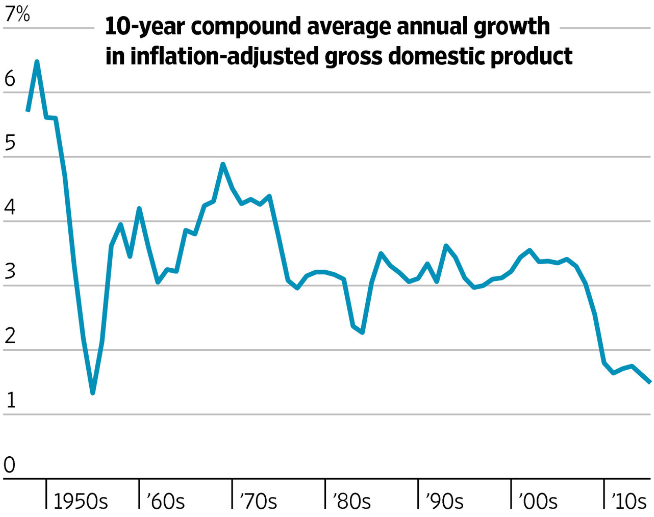
The author Jay Cost has an article, “The Politics of Distrust” on this topic in yesterday’s Wall Street Journal.  He says that the principal cause of this distrust is “the stubborn torpor of the American economy.”
Capture0According to Mr. Cost:

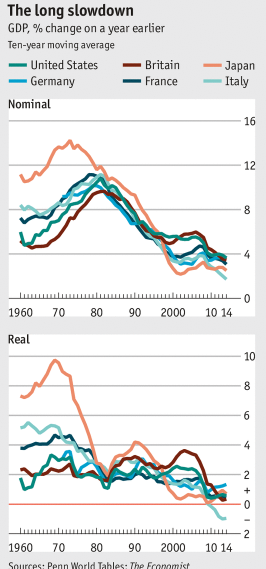
  • For roughly half a century after WWII economic growth averaged 3.6% a year.
  • Over the past 14 years, real growth has averaged only 1.7%.
  • Persistently weak economic growth has contributed to our sour civic mood in three important ways:
  1. It has prompted voters to turn against the incumbent party time and again.
  2. Underwhelming growth has heightened anxieties about economic anxiety – liberals blame the unfairness of market-based capitalism and conservatives blame the corrupting hand of government – in taxation, regulation and monetary policy.
  3. Finally, weak economic growth has damaged the credibility of the experts – the experts failed to foresee the slowdown of the early 2000s, failed to anticipate the housing bubble, failed to predict that economic growth would remain weak after it burst, and failed to implement policies to return it to our postwar norm.
  • These trends amount to a comprehensive assault on the political equilibrium of the past half century. During the postwar era public policy could evolve because broad agreement existed. Now the consensus has vanished and we are left with gridlock, indecision and drift.
  • The tonic to this stalemate is as obvious as it is elusive: economic growth that approximates the levels of the late 20th century.

Perhaps surprisingly there is a fair amount of agreement between liberals and conservatives on how to speed up economic growth. This will be the subject of my next post.

Light at the End of the Tunnel


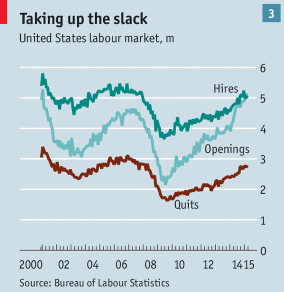
The Bureau of Labor Statistics has just reported very good news in its monthly Job Openings and Labor Turnover Survey.  For the first time since 2000, the number of job openings now exceeds the number of new hires, as shown in the chart just below.  This means that wages will start to grow faster as employers have to compete harder for new workers.
Capture1This is an early indication that our economy will likely soon resume a faster rate of growth than its average of 2.3% since the end of the Great Recession in June of 2009.  There will be many benefits.  The unemployment rate should continue to keep heading downward from its current level of 5.5%.  More unemployed and underemployed workers will be able to find satisfactory jobs.  The labor participation rate should start to head back up from its historically low current state.
The Federal Reserve is likely to begin raising short term interest rates sooner rather than later in order to keep inflation in check before it has a chance to heat up.  In other words we may be breaking out of the ambiguous state of slow-growth secular stagnation in which we have been trapped for six years.
All of this is very good news as long as Congress realizes that it is now even more urgent than ever to put our massive public debt of $13 trillion on a downward path, compared to the total economy, before interest rates begin to rise substantially and eat us alive with interest payments on this huge debt.
In this regard the Budget Plan approved by Congress just this Spring, which will lead to a balanced budget over ten years, looks very attractive indeed.  It will be a mammoth job to achieve such a milestone in fiscal restraint, but doing so will lead to a more secure and prosperous future for all Americans.

Are Economics and Social Progress Related to Each Other?


“Your (last post) is one of the most active and positive that I have read of yours. You do put your time to where your values are. Those of us who see you as too economically focused and ourselves as more humanely concerned need to act as well. Thanks for your focus and attention.”
from a reader of my blog

I am a fiscal conservative and a social moderate. The primary reason I write this blog is because I am so concerned about the fiscal recklessness of our national leaders. Our national debt is much too large and still growing too fast. We need to either cut spending or raise taxes (or do both).
But I am also a social progressive. I voted in favor of Nebraska raising its minimum wage last fall. I support gay marriage as a civil right. I support having Nebraska expand Medicaid in order to cover more low-income people (where Medicaid needs to be fixed is at the federal level).
CaptureThere is in fact a very close connection between having a sound economy and social progress. As the above chart shows, the U.S. ranks very high in both GDP per person and social progress. All of the countries which are most socially progressive also have sound economies. This is not a coincidence.
My last post talks about what society can do to help blacks improve their socio-economic status. This includes improving educational opportunity in the inner city. But improved educational opportunity needs to be closely directed toward improved economic opportunity. This means, for example, having good jobs available for new high school and community college graduates. But this, in turn, means having strong economic growth with intelligent tax and regulatory policies to encourage entrepreneurship and business expansion.
In short, a sound economy is essential for social progress.

Why Inequality Is Harmful and What to Do About It


I describe this blog as addressing our fiscal and economic problems, meaning deficits and debt on the one hand and slow economic growth on the other.  But these topics, while being of critical importance to our national welfare, are also somewhat on the dry side.  The subject of economic inequality stirs up lots more interest and response. In the Fall of 2012 The Economist declared that “a new form of radical centrist politics is needed to tackle inequality without hurting economic growth.”
CaptureSays The Economist:

  • There’s too much cronyism in the rich world. Banks which are “too big to fail” have an implicit subsidy. From doctors to lawyers, many high paying professions are full of unnecessarily restrictive practices. Social spending often helps the rich more than the poor. For example housing subsidies for the top 20% (mortgage-interest deductions) are four times the amount spent on public housing for the poorest 20%.
  • If income gaps become too wide, they can lead to less equality of opportunity, especially in education. The gap in test scores between rich and poor American children is 30 – 40% wider than it was 25 years ago.
  • If those on the top of the heap resist equalizing changes, it could lead to political pressure which serves nobody’s best interests.

Here are The Economist’s proposals for a True Progressive Agenda to attack inequality:

  • Compete.   A Rooseveltian attack on monopolies and vested interests is needed. School reform is crucial: no Wall Street financier has done as much damage to social mobility as the teacher’s unions have.
  • Target. Government spending need to be focused on the poor and the young. Governments can’t hope to spend less on the elderly but they can reduce the pace of increase.
  • Reform. Eliminate tax deductions which primarily benefit the wealthy such as for mortgage-interest; narrow the gap between tax rates on wages and capital income.

“The right is still not convinced that inequality matters.  The left’s default position is to raise income tax rates for the wealthy and to increase spending still further – unwise when sluggish economies need to attract entrepreneurs and when governments are overburdened with promises of future spending.”
Surely there is a better way!

Will Wage Stagnation Continue Indefinitely?


It is widely deplored that wages for both middle- and lower-income workers are stagnant and have not even recovered from where they were before the beginning of the Great Recession.  The latest issue of The Economist explores this problem, “When what comes down doesn’t go up.”
CaptureThe Economist sees several factors at work:

  • As the unemployment rate continues to drop, many new jobs are paying less than the old jobs that were lost.
  • In Germany “mini jobs,” paying under $440 per month, are skyrocketing. In Britain “zero hours” contracts, with no commitment to a fixed number of hours, are becoming more common.
  • In 2013 Kelly Services, which provides temporary workers, was the second largest employer in the U.S. with a staff of 750,000. 2.9 million temps account for 2% of all jobs in the U.S.

As The Economist points out, if low pay does in fact lock in, inflation will stay low even as the unemployment rate continues to fall.  The Federal Reserve will then be likely to keep interest rates low indefinitely as well.  But this means there will be far less incentive for Congress and the President to cut back on huge deficit spending because debt is almost “free money” when interest rates are low.  Long term, massive debt, is a huge threat to our security and prosperity.
Breaking out of this pernicious low wage trap will require a bold effort by Congress and the President to boost economic growth.  By far the best way to do this is with broad-based tax reform at both the individual and corporate levels.  As I have discussed in previous posts, what is needed is lower tax rates paid for by closing loopholes and deductions.  Hopefully, the new Congress is headed in this direction!

Will ‘Middle Class Economics’ Lift Us Out of ‘Secular Stagnation’?


‘Secular Stagnation’ is the expression, made popular by the economist Larry Summers,  to refer to the present time period, since the end of the Great Recession, with slow economic growth, high unemployment, stagnant middle-class wages and increasing inequality.  It is to be contrasted with ‘The Great Moderation,’ from 1982 – 2007, with a rapidly growing economy, rising wages and stable prices.
CaptureMy last post, “Does ‘Middle Class Economics’ Really Work,” discusses President Obama’s attempt to appeal to middle-class families with policies such as:

  • Tax and regulatory provisions such as tax credits for childcare, college tuition, and second earners in two parent households; also requiring paid sick leave and a higher minimum wage.
  • Expanding access to community colleges to make workers more productive.
  • Increased infrastructure spending to boost employment.

The problem with this strategy is that it is much too weak to combat the huge headwinds opposing it.  In addition to the well-known effects of globalization and technological advance, consider the demographical challenge described below:

OECD old age support ratio:  the number of workers aged 20-64 relative to those aged over 65
Capture1
As is very clear from this chart, the demographics are just going to keep getting worse and worse and will be very bad indeed by 2050.
Here is a surprising quote from Mr. Summers: “To achieve growth of even 2 percent over the next decade, active support for demand will be necessary but not sufficient.  Structural reform is essential to increase the productivity of both workers and capital, and to increase growth in the number of people able and willing to work productively.  Infrastructure reform, policies to promote family-friendly work, support for exploitation of energy resources, and business tax reform become ever more important policy imperatives.”
I would add several additional policy changes which would speed up change in this direction:

  • Reform (but not repeal!) the Affordable Care Act by eliminating all mandates. This would incentivize businesses to move part-time employees to full time. Tax credits and subsidies provide enough incentive for individuals to become insured.
  • Regulatory reform to make it easier to start a new business.
  • Raise the age limits for both Social Security and Medicare to encourage people to work longer.
  • Reform disability insurance to make it more difficult to be declared disabled.
  • Tighten up welfare requirements to require all able-bodied adult recipients without dependents to work.
  • Reform immigration with guest-worker visas for needed foreign workers.

We need to get serious about boosting our labor participation rate in order to grow the economy faster.  Happy talk about ‘middle class economics’ will simply not do the trick!

It’s Paul Krugman Who Is Being Irresponsible!


The New York Times columnist, Paul Krugman, writes provocatively on fiscal and economic issues and is well-known as a liberal icon.  Usually I ignore his diatribes.  But his column yesterday, “The Long-Run Cop-Out” goes way overboard.
CaptureI will refute several of the statements from this column.

  • “Think about it: Faced with mass unemployment and the enormous waste it entails, for years the beltway elite devoted all most all its energy not to promoting recovery, but to Bowles-Simpsonism – to devising “grand bargains” that would address the supposedly urgent problem of how we’ll pay for Social Security and Medicare a couple of decades from now.” Worrying about our enormous and rapidly increasing national debt, does not mean ignoring our sluggish economy and the high unemployment it causes. The way to increase economic growth is to enact broad based tax reform by lowering tax rates, offset by closing loopholes and limiting deductions. This will further boost the economy in the same way that lower gasoline prices is already doing.
  • “Many projections suggest that our major social insurance programs will face financial difficulties in the future (although the dramatic slowing of increases in health costs makes even that proposition uncertain).” Healthcare costs dropped to 4.1% in 2014 but this is still more than double the inflation rate of 1.7%. This isn’t nearly good enough.
  • “Why, exactly, is it crucial that we deal with the threat of future benefit cuts by locking in plans to cut future benefits?” The point is to protect benefits, not curtail them. If we act now, to increase revenue and/or slow down the growth of entitlement spending, then we won’t have to cut future benefits.
  • “So why the urge to change the subject (from austerity) to structural reform? The answer, I’d suggest, is intellectual laziness and lack of moral courage.” $6 trillion added to our debt in the last six years is profligacy, not austerity. It is immoral to burden future generations with such massive new debt.
  • “In today’s economic and political environment, long-termism is a cop-out.” Preparing for the future is just plain common sense. Should we ignore festering problems like global warming, illegal immigration and increasing poverty until they get much worse? Of course not. We should address these problems now and get our debt under control at the same time.  

A Lull in the Storm


The Congressional Budget Office has a sterling reputation for collecting accurate data and making credible predictions about basic economic and fiscal trends.  CBO analyses, which are based on current law, are generally accepted as valid by both liberals and conservatives.  Considering the degree of hyper-partisanship in most discussions of fundamental policy, it is reassuring to at least have an unimpeachable source of basic information.
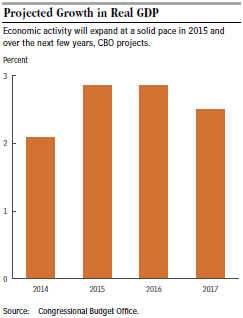
CaptureCBO has just released its regular annual report, ”The Budget and Economic Outlook: 2015-2025.” There is good news for the near term.  As shown above, GDP is projected to grow by 2.9% in the (budget) years 2015 and 2016, and dropping to 2.5% growth in 2017, which is still better than 2014. This means that our national debt will not grow from its current level of 74% of GDP for the next few years and might even decrease slightly.
Capture1Growth will then hover around 2.2% for the remainder of the 2015 – 2025 decade, which is the average GDP since the end of the Great Recession in June 2009.  Likewise, unemployment will likely not fall much below its current value of 5.6% for the next ten years.  In short, under current policy, except for the next couple of years, we are stuck in the same slow-growth rut where we have been for the past five and one-half years.
It should be obvious that we need new policies to speed up growth, put more people back to work, and raise the stagnant wages endured by many middle- and lower-income workers.  How can this be accomplished?

  • Tax reform, both individual and corporate, is the primary route to faster growth. Lower tax rates across the board, paid for by closing loopholes and shrinking deductions. This will put extra income in the pockets of the 64% of taxpayers who do not itemize deductions, which they will likely spend. It will also make it easier for potential entrepreneurs to successfully launch a new business.
  • Immigration reform, expanded foreign trade and deregulation will also create more business opportunities which will in turn grow the economy and create more jobs.

Hopefully the new Congress will be able to move forward in this direction.  A better future depends on it!


Is It Feasible to Cut Tax Preferences to Pay for Lower Tax Rates?


I have been focusing lately on America’s two biggest fiscal and economic problems:

  • How to boost the economy in order to put more people back to work
  • How to either cut spending or raise revenue in order to shrink the deficit.

A few days ago in “The Great Wage Slowdown and How to Fix It,” I laid out a fairly specific proposal to make a substantial reduction in tax preferences in order to cut tax rates across the board and especially for the 64% of taxpayers who do not itemize deductions.  These are the middle- and lower-income workers with stagnant incomes who would likely spend any tax savings they received thereby giving the economy a big boost. Let’s examine whether or not this is a realistic course of action.
CaptureThe above chart from the Congressional Budget Office document, “The Distribution of Major Tax Expenditures in the Individual Income Tax System,” shows that, for example, the upper 10% of households by income receive about 40% of the total $1 trillion in individual tax expenditures per year.  Furthermore, this same top 10% of tax payers have an income of about $140,000 or more (Congressional Research Service). My basic idea is to shrink tax preferences by $250 billion per year and to lower tax rates for middle- and lower-income non-itemizers by this same amount.  If we assume that they would spend 2/3 of this new income, it would boost the economy by $170 billion per year which is 1% of GDP.
A reasonable way to achieve this savings is to expect higher income earners to contribute a greater percentage of their tax preference savings.  For example:

  • top 1% contribute $110 billion (2/3 of their total deductions).
  • top 96th % to 99th % contribute $50 billion (1/2 of their total deductions).
  • top 91st % to 95th % contribute $30 billion (1/3 of their total deductions).
  • top 81st % to 90th % contribute $30 billion (1/4 of their total deductions).
  • top 61st % to 80th % contribute $30 billion (1/5 of their total deductions).
  • this gives a total of $250 billion in tax preference savings.

This back-of-the-envelope calculation is not intended to be definitive but rather to suggest what can be done along these lines.  Those who are more well-off need to make bigger sacrifices in getting our economy back on track.