How to Increase Growth and Decrease Inequality at the Same Time!


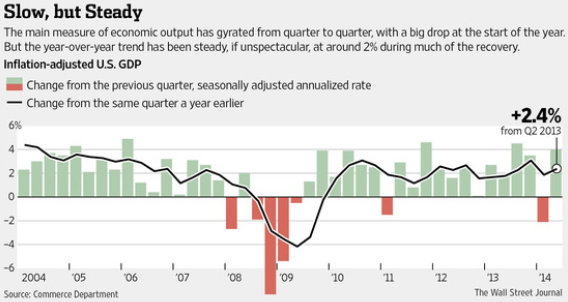
The Department of Commerce has just reported basic economic data for the second quarter of 2014.  As the chart below shows, the economy gradually lost steam from 2004 – 2008, sunk badly in 2008 and 2009, and has now grown at a slow but steady rate of about 2% during the period 2010 – 2014.
CaptureOne of my favorite journalists, the New York Times’ economics reporter Eduardo Porter, has just written again on the topic of inequality, “Income Inequality and the Ills behind It.”  He quotes the economist Tyler Cowen as saying “The right moral question is ‘are poor people rising to a higher standard of living?’  Inequality itself is the wrong thing to look at.  The real problem is slow growth.”  The economist Gregory Mankiw is quoted as saying that “Policies which address the symptom (of inequality) rather than the cause include higher taxes and a more generous safety net.  The magnitude of what we can plausibly do with these policy tools is small compared to the size of the growing income gap.”
What Mr. Cowen and Mr. Mankiw are both suggesting is that we can’t effectively attack income inequality without also increasing economic growth.  I believe that it is possible to address both problems at the same time by implementing broad-based tax reform as follows:

  • Individual income tax rates should be lowered across the board, paid for by closing loopholes and shrinking deductions, in a revenue neutral way.
  • The 64% of all taxpayers who do not itemize deductions will get a significant tax cut. Since they are largely the middle and lower-income wage earners with stagnant incomes, they will tend to spend their tax savings, thereby giving the economy a big boost.
  • At the same time the 36% of taxpayers who do itemize their deductions will, on average, see their income taxes go up. But these are, on the whole, the wealthier wage earners who can afford to pay higher taxes.
  • A plan such as this represents a shift of net after-tax income from more wealthy people to the less wealthy. It therefore reduces income inequality.

If we can cut tax rates, increase economic growth and reduce income inequality all at once, why can’t our national leaders come together and act along these lines?
Why We Need a Carbon Tax VI. Because of China!


Over the past two months I have posted several blogs about the seriousness of global warming and demonstrated that the best way to address it is with a carbon tax of about $20 per ton of CO2 released into the atmosphere.  Here is a summary of my argument:

  • The reality of global warming can hardly be questioned. For example, the extent of summer ice in the arctic ocean is shrinking rapidly.
  • Expecting the Environmental Protection Agency to be able to administer an effective program by giving each state a target for CO2 emissions reductions is cumbersome and arbitrary.
  • The current EPA program of trying to reduce carbon emissions by 30% over the next 15 years will set up an economic incentive to substitute natural gas for coal and slow down the further development of nuclear energy and renewable energy sources such as wind and solar power. This is because natural gas is plentiful and inexpensive. But the burning of natural gas still releases half as much CO2 as coal and so will continue to contribute to global warming.

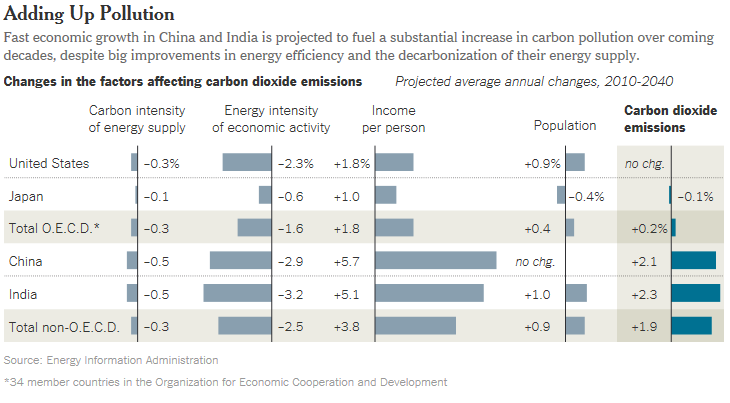
CaptureIn yesterday’s New York Times, the reporter Eduardo Porter in “China’s Hurdle to Fast Action on Carbon” calculates that even under conservative growth assumptions, China will almost double its carbon emissions between now and 2040.  And this doesn’t even consider all of the other developing nations which also will increase their use of inexpensive energy sources in order to increase their standards of living.
In other words, even if the EPA is able to force a big switch from coal to natural gas in the U.S., any such reduction in carbon emissions will be dwarfed by increases from other countries.
A carbon tax on CO2 emissions will not only give a big boost to all non-fossil fuels, it will also unleash American ingenuity to figure out how to accomplish carbon sequestration in the use of fossil fuels.  This will enable the U.S. to achieve a much greater reduction than 30% in carbon emissions over the next 15 years and beyond.  Furthermore the new technology which we develop to do this will be immediately available for use around the world.
With such a program the U.S. would actually be demonstrating how to effectively attack global warming instead of just advocating for it!

Wealth Inequality I. What Is It?


The subject of income inequality has generated much interest and concern in recent months.  Now we will also be hearing a lot about wealth inequality, based on the highly credible new work, “Capital in the Twenty-First Century” by the French economist, Thomas Piketty.  The New York Time’s Eduardo Porter, summarizes the basic message in his recent column “A Relentless Widening of Disparity in Wealth”, which is clearly displayed in the two charts below.
CaptureThe value of private capital as a percentage of national income worldwide has been growing steadily since about 1950 and Mr. Piketty predicts that this trend will continue indefinitely.  The trend is equally true, not only in the U.S., but also in other developed countries as is illustrated in the chart.  It happens because the income from wealth, i.e. return on investment, typically grows faster than wages and GDP.
As Mr. Porter says, “It means future inequality in the United States will be driven by two forces.  First of all, a growing share of national income will go to the owners of capital.  Of the remaining labor income, a growing share will also go to the top executives and highly compensated stars at the pinnacle of the earnings scale.”
This trend has now been in effect ever since 1870, with the exception of the period between World War I and World War II, when a massive amount of wealth was destroyed.  The forces of globalization and growth of technology are contributing to both types of inequality, especially in the developed world (see my post of January 23), and these forces will almost surely continue unabated.  So the wealth and income inequality gaps are just going to keep getting worse.
How much inequality can exist in a democracy?  The number of losers (the low income, the poor, and even the struggling middle class) will gradually get bigger and bigger and will become more and more frustrated and express their discontent at the ballot box.  This threatens the future of capitalism and free enterprise, the economic principles on which our way of life is founded.
Something has to be done!  Stay tuned for my next post!

Should Government Address Inequality Directly?


Wall Street Journal columnist William Galston suggests in “Where Right and Left Agree on Inequality”, that both sides of the political spectrum agree that economic inequality is increasing in America and that government needs to address this problem.  “Poverty is part of the explanation, as liberals insist.  But so are parenting and family structure, as conservatives believe.”
CaptureIt so happens that we have a broadly supported federal program which simultaneously addresses both poverty and family structure.  It is the Earned Income Tax Credit program.  It provides $3,305 a year to low-income working families with one child and up to $6,143 for families with three or more children.  The U.S. spends $61 billion a year on this program and it has proven to be very successful in encouraging low-income people to find and keep jobs.  In fact, the economist, Gregory Mankiw, recommends the EITC over a higher minimum wage as a better way to increase the earnings of the working poor.
The New York Times’ Eduardo Porter reports in “Seeking Ways to Help the Poor and Childless”, that New York City is conducting an experiment to see if a locally run program similar to the EITC  will have the same positive effect in increasing employment of childless adults.  It is understood that many of the jobs being created in today’s economy are low paying service jobs.  As Mr. Porter says, “for the American market economy to remain viable, being employed must, one way or another, provide for workers’ needs.”
Conclusion:  as important as it is for Congress and the President to adopt measures to increase economic growth (e.g. tax reform, fiscal stability, expanded foreign trade, immigration reform), in order to create more and better paying jobs, government also has a responsibility to provide direct help to the needy who are trying to help themselves.  The EITC program is an excellent way to do this!

Many Skilled Jobs Are Going Begging in the U.S.

A few days ago the Omaha World Herald ran a story, ”Manufacturers Want More Young People to Consider a Job on the Factory Floor”, pointing out that there are almost 100,000 manufacturing jobs in Nebraska paying an average salary of $55,000 per year, many of which are unfilled because of a lack of qualified applicants.  Says Dwayne Probyn, Executive Director of the Nebraska Advanced Manufacturing Coalition, “Science, technology, engineering and math, that’s what we need.”
This is in fact a nationwide problem.  A few weeks ago the New York Times had an article, “Stubborn Skills Gap In America’s Work Force” reporting on a recent study by the Organization for Economic Cooperation and Development assessing literacy, math skills and problem solving using information technology, for people aged 16 – 65, in the 22 advanced nations of the O.E.C.D..  Eduardo Porter reports that while the U.S. is about average in literacy skills, it lags way behind in both math and problem solving skills.
One question addressed by Mr. Porter is the much larger wage premium for highly skilled U.S. workers over unskilled workers, than in most other O.E.C.D. countries.  Another question is “how can the U.S. remain such an innovative, comparatively agile economy if the supply of skilled workers is so poor?”  The suggested answer is troubling.  “The American economy rewards skill very well but the supply hasn’t responded.”
This situation is first of all an indictment of K-12 education in the U.S. which has a high school graduation rate of only 80% and also focuses too much on college preparation rather than career education.  These two problems are likely interrelated and at least partially explain the skills gap.
Another factor is immigration.  Right now the U.S. is still attracting more talented foreigners than other countries.  But it is risky to our economy to depend on foreign talent which can stay home as well as choosing to go elsewhere.  Immigration reform will help with this problem but improved K-12 education will help even more.

Will Higher Inflation Help the Economy?

The New York Times’ Eduardo Porter has a column in yesterday’s paper “Making the Case for a Rise in Inflation”, arguing that a 4% inflation rate, for example, would be a better target rate for the Federal Reserve than its present 2% target rate.   The idea is that higher inflation would lessen the value of a dollar, thereby eating away at our $12 trillion in public debt (on which we pay interest).  A lower value of the dollar would also boost the economy by making exports less expensive.  Higher inflation would likewise encourage consumers to spend more because the value of the dollar is decreasing more rapidly.
Mr. Porter does point out that there would be opposition to any policy of purposely letting inflation go up.  The best known Fed Chair in recent years, Paul Volcker, says that “All experience amply demonstrates that inflation, when fairly and deliberately started, is hard to control and reverse”.
The biggest problem, though, is the risky procedure of trying to boost the economy with monetary policy (quantitative easing, QE1, QE2 and QE3) rather than using fiscal policy (tax reform and deregulation).  The creation of an enormous amount of new money in a slow recovery creates huge upward pressure on inflation.  The economy is slowly improving on its own accord.  Very soon (in the next few years) the Fed will have to perform the difficult function of withdrawing money from the system fast enough to avoid inflation and, at the same time, slow enough, to keep interest rates from skyrocketing.  So the question is, will the Fed be able to simultaneously keep both inflation and interest rates under some kind of control?
For sure we don’t want to make its job more difficult by pushing inflation any higher than necessary at the present time!