Can the U.S. Economy Do Better? V. Entitlement Reform


My last several posts, e.g. here, have discussed the question as to whether or not the U.S. economy can grow faster. Even though there are many headwinds to faster growth, there are still various measures to take which will help significantly. Beyond specific policy directions, such as aiding small business and cleaning up and simplifying our tax code, another very important step is to get our fiscal problems, i.e. massive debt, under much better control.
Capture7As made clear in the above chart, there is really only one way to do this.  It is entitlement reform.  In the last 50 years, from 1965 – 2015, mandatory, i.e. entitlement, spending has grown from 26% of the federal budget to 62% and this percentage will just keep growing until something is done to stop it. Along this line, an excellent new report from the American Enterprise Institute, “Increasing the Effectiveness and Sustainability of the Nation’s Entitlement Programs” lays out some basic principles for entitlement reform. They are:

  • Personal Responsibility for Retirement Savings. The idea is to move toward turning Social Security into a universal flat benefit for all U.S. residents age 65 and older. Anyone could supplement this basic income with additional private savings.
  • Market Discipline in Health Care. The idea here is to keep the ACA exchanges with subsidies for low-income households. Employer provided care would have no mandates and a rational and equal tax credit for all. Health Savings Accounts would be liberalized to encourage widespread participation. Both Medicare and Medicaid would provide premium support for basic care. The point is to bolster the consumer’s role in the marketplace in order to slow down the rising cost of healthcare.
  • Promotion of Work for Safety-Net Programs. The federal government spends about $400 billion annually to fight poverty (not counting healthcare programs) with much overlap of federal and state programs. Reform efforts should emphasize work as the key to improved economic prospects as well as greater state control over resources to allow for better coordination of efforts. Two major reform concepts, block grants to states as well as wage subsidies, should be implemented.


We have to get our fiscal house in order, so entitlement reform is not optional. Delay, moreover, could be catastrophic.  If we wait until another crisis hits, then it will no longer be possible to design reforms with gradual adjustments. Now is the time to act!

Follow me on Twitter
Follow me on Facebook

Can the U.S. Economy Do Better? IV. Let’s Try Tax Reform!

Image


After seven straight years of anemic, sub-par growth of 2.1% annual growth, one of the most important questions in public policy today is whether or not the U.S. economy can do better. I have devoted my last three posts, here, here, and here, to this question, presenting both positive and negative points of view.
Capture7There are very definitely strong headwinds slowing down growth but there are also specific strategies that are very likely to help speed up growth. One of these is tax reform.  The nonpartisan Tax Foundation (TF) has just issued an excellent report, “Options for Reforming America’s Tax Code” with many good ideas. Here are just three of the many different examples presented.  But they show the powerful effects that would be generated by significant tax reform.

  • Replace the Corporate Income Tax with a Value Added Tax (VAT) of 5%. This would be a huge change but it would also have a hugely positive impact. TF estimates that doing this would boost the economy by 5.5% in the long run as well as boosting tax revenue by a whopping $315 billion per year on average. Furthermore, all income groups from low to high would see equal gains in income.
  • Eliminate All Itemized Deductions Except for Charitable Contributions and Mortgage Interest and Lower the Top Individual Income Tax Rate to 27%. This change would grow the economy 1.1% in the long run and also create 496,000 new jobs. It would also increase tax revenues by $26 billion per year on average. It has the defect of raising incomes more for the affluent than for low- and middle-income groups. But this defect could easily be remedied by, for example, limiting the size of the mortgage interest deduction.
  • Cap the Total Value of Itemized Deductions at $25,000. This popular proposal would not help grow the economy but would bring in almost $200 billion a year in new tax revenue.

What is the better strategy? To be pessimistic and accept the point of view that faster growth is just too difficult or to adopt specific policies which are likely to help?

Follow me on Twitter 
Follow me on Facebook


Can the U.S. Economy Do Better? III. Yes, and Here’s How


Almost everyone agrees that faster economic growth would be beneficial. It would provide more new jobs as well as bigger raises for the already employed.  It would also bring in more tax revenue which would help greatly to shrink our large annual spending deficits.
My last two posts, here and here, present first an optimistic and then a very pessimistic view about the chances of speeding up growth.  In particular, the banker Satyajit Das, thinks that even the fairly anemic 2.1% average growth of the past few years will be impossible to maintain in the years ahead.
My next few posts will focus on exploring several specific ways in which growth could be speeded up.  First of all, I refer to a report from Babson College, “The State of Small Business 2016” which is the basis of a recent article in USA Today by Warren Buffett and others, “To grow the economy, grow small business.”
Capture1Key points are:

  • Capital. Securing financing remains a major barrier to growth. Small business owners overwhelmingly rely on banks for funding but banks face more stringent regulatory requirements. The median funding request for small businesses is $100,000 but businesses typically secure jus $40,500.
  • Regulation. The typical small business owner spends 200 hours per year on regulatory compliance. Streamlining approval processes would help immensely.
  • Skills. 70% of small businesses find it difficult to hire qualified employees. Furthermore there are currently 5.8 million job openings in the U.S. This reflects a mismatch between company needs and applicants’ skills. School districts and community colleges could help alleviate this problem.
  • Technology. Accessing better technology is perceived as costly and requires skills that many businesses lack. Cybersecurity and protecting intellectual property are two significant areas of exposure for small business, which 40% are ill-prepared to address.

Small businesses create over 60% of net new private-sector jobs. Helping them expand is one of the best ways to support economic growth.

Follow me on Twitter
Follow me on Facebook

Can the U.S. Economy Do Better? II. It Won’t Be Easy


In my last post, “Can the U.S. Economy Do Better?” I laid out the view of the Hoover Institution economist John Cochrane that a few basic changes such as deep tax reform, a thorough overhaul of social programs, more educational competition and regulatory simplification would go a long way towards perking up the economy.
Capture6The banker and financial analyst, Satyajit Das, presents a contrary point of view in, “The Age of Stagnation: Why Perpetual Growth is Unattainable.”  According to Mr. Das:

  • The Global Financial Crisis (GFC) was not part of the normal boom and bust cycle, but rather the collapse of the postwar economic expansion under the weight of four main factors: high debt levels, large global imbalances, excessive financialization and an unsound build-up of future entitlements.
  • The economy risks becoming trapped in a QE-forever cycle. A weak economy leads to expansionary fiscal measures and Quantitative Easing (QE). If the economy responds then interest rates will go up and lead to a debt crisis. If the economy does not respond, then there is pressure for additional stimuli.
  • The economist Robert Gordon predicts that the future U.S. growth rate, adjusted for six big headwinds (demographics, declining educational attainment, rising inequality, effects of globalization, environmental costs, and debt overhang) may only be .2%, well below the 2.1% growth rate of the past few years.
  • The GFC may signal the zenith of globalization. The U.S. could function successfully as a closed economy, with foreign trade making up only 15% of GDP. The European Union and China could also turn inward. The rise of autarky and nationalism is a dangerous cocktail.
  • Financialization drives inequality. QE and low interest rates encourages high-income households to increase investments and therefore boosts the stock market. The increasing cost of healthcare, higher education and childcare is a big burden on low-income households.
  • Financial repression is increasingly accompanied by political repression which engenders lack of trust which in turn drives political disengagement and social disorder.

Ouch, ouch, ouch! This is a very negative assessment of the U.S. economic and social scene today.  But I report the views of Mr. Das because they are reality based and need to be dealt with.

Follow me on Twitter
Follow me on Facebook

Can the U.S. Economy Do Better?


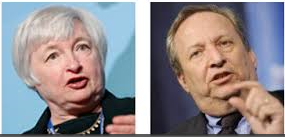
In my last post I discussed the differing views of the U.S. economy held by Federal Reserve Chair Janet Yellen and her rival for the post, Larry Summers:

  • Janet Yellen thinks that the U.S. economy is steadily recovering from the Great Recession and that there is no hurry to raise interest rates back to normal levels.
  • Larry Summers thinks that the U.S. economy is suffering from secular stagnation and that there is a great need for more fiscal stimulus by the federal government.

There is another point-of-view, perhaps best expressed by the Hoover Institution’s John Cochrane in a recent Wall Street Journal Op Ed.  Let me try to summarize Mr. Cochrane’s argument:

Capture1

  • From 1950 – 2000 the U.S. economy grew at an average rate of 3.5% per year. Since 2000 it has grown at only half this rate, 1.76% annually. By 2008 the average American was more than three times better off than in 1952. Real average GDP per person grew from $16,000 to $49,000 during this period.
  • The U.S. economy is now overrun by an out-of-control and increasingly politicized regulatory state. America is now middle-aged and overweight. The solution is to eat better and exercise.
  • Consider the above chart, the World Bank’s “Distance to Frontier” ease-of-doing-business measure for 2014. The U.S. is near the top but there is plenty of room for improvement.
  • Here is what a growth agenda would involve: deep tax reform, cleaning out the insane complexity and cronyism; a thorough overhaul of social programs, getting rid of all the perverse incentives; better schools that come from increased choice and competition; a dramatic legal and regulatory simplification, restoring a transparent rule of law.
  • Growth-oriented policies will be resisted. Growth comes from productivity which comes from new disruptive technologies and businesses.

Can our political system deliver the changes that are needed? The rise of Donald Trump and Bernie Sanders show that the people want big changes and are willing to disrupt the status quo to achieve them.  This means change is possible but it won’t come easily.

Follow me on Twitter
Follow me on Facebook

Janet Yellen vs Larry Summers


There is an informative article in the May 12, 2016 issue of Bloomberg Businessweek, “How to Pull the World Economy out of Its Rut.”  Recall that Janet Yellen succeeded Ben Bernanke as Chair of the Federal Reserve in January 2014. The other candidate for the post was Larry Summers.
Capture6They have rather different views about the role of a central bank:

  • Janet Yellen insists that economic conditions are returning to normal, even if slowly. She is neutral about the slow growth, secular stagnation hypothesis and using fiscal stimulus to overcome it.
  • Larry Summers argues that world growth is stuck in a rut because there is a chronic shortage of demand for goods and services. Growing inequality puts a bigger share of the world’s income in the hands of rich people who spend less. The new economy is asset-lite (Uber and Airbnb prosper by exploiting existing assets) and so needs less investment. Software doesn’t require the construction of new factories. He thinks that central bankers should spend more time and effort trying to influence fiscal policy. For example, more government spending on infrastructure, global warming and improving education. Also changing the tax code to put more money in the hands of lower- and middle-income families who would spend it.

I think that they are both partly right and partly wrong.

  • Janet Yellen is correct in believing that the Fed should stick to monetary policy. But she is too cautious in raising interest rates back to more normal levels. There will be some (stock market) pain in accomplishing this but it needs to be pushed faster regardless.
  • Larry Summers is correct in calling for action on the fiscal front. But his suggestions for how to do this are mostly off base because they will lead to massive new debt which must be avoided.

So what is the proper course to get out of our economic rut? It is what I’ve been saying over and over again but I’ll repeat it for good measure in my next post!  Stay tuned!

Follow me on Twitter
Follow me on Facebook

A Guaranteed Income for All: Good Idea or Bad Idea?


The social scientist and American Enterprise Institute scholar, Charles Murray, has an interesting article in yesterday’s Wall Street Journal, “A Guaranteed Income for Every American,” Mr. Murray proposes a Universal Basic Income (UBI) with the following features:
Capture6

  • Every American citizen age 21 and older would get a $13,000 annual grant deposited electronically into a bank account in monthly installments. $3000 would be applied towards health insurance.
  • UBI is financed by eliminating all other welfare programs: Social Security, Medicare, Medicaid, food stamps, housing subsidies, aid for dependent children, etc. as well as agricultural subsidies and corporate welfare.
  • People can make up to $30,000 a year without losing any part of the grant. Above $30,000 in earned income, the grant decreases to $6500 when the income reaches $60,000. The $6500 retained by all compensates for losing Social Security and Medicare.
  • The overall cost of UBI will be $200 billion per year less than the current system. By 2020 UBI would be nearly $1 trillion per year cheaper.

On the other hand, there are at least two possible drawbacks to the Murray plan, as discussed recently by Eduardo Porter in the New York Times:

  • It would probably discourage work. Right now 80% of Americans in their prime working years, 25 – 54, are employed. Work is not just what people do for a living, it organizes people’s lives. Making work more optional would impair this basic social structure.
  • A UBI divorces assistance from need. For example, a housing voucher could lead a family to move to a better neighborhood. A basic monthly income would probably not.
  • More generally, a single parent with several children would be strapped to get by for $10,000 per year without any additional welfare assistance. We can’t let the kids starve.

Conclusion: UBI appears to be an attractive way to simplify our vast welfare system and would save a significant amount of money (always important). But the poor would not be well served.  There are better ways to reform our public assistance programs.

Follow me on Twitter
Follow me on Facebook

The Challenges of American Health Care II. Specific Problems to Overcome


My last post, “The Challenges of American Health Care,” describes the huge demographic and cost pressures facing American healthcare  and lays out a comprehensive reform plan by the Hoover Institution’s Scott Atlas to address them.  Today I will give more details about these pressures on both private care as well as care subsidized by the Affordable Care Act.
Capture6For example:

  • The cost of providing health care to an average American family surpassed $25,000 for the first time in 2016, $1,155 higher than last year, and triple the cost in 2001.
  • A significant cost driver is the rapid growth in what health plans and insured people are paying for prescription drugs, now comprising $4,270 annually, or 17% of the total.
  • 80% of healthcare costs come from just 20% of the population.
  • The insurance company United Healthcare announced that it is withdrawing from most ACA exchanges because it lost $475 million on plans sold in 2015 and expects to lose another $650 million in 2016.
  • Overall $2.5 billion was lost by insurance companies on the exchanges in 2014. The government’s “risk corridors” program is insufficiently funded to reimburse these losses to the insurance companies involved.
  • The fundamental problem is politicization of the marketplace. Insurers were pressured to set premiums low initially to ensure that the rollout was not a flop. Now premiums are increasing rapidly to cover the initial losses. Households with income over 250% of poverty already find the plans offered on the ACA exchanges unattractive.

Conclusion: The overall rapid increases in the cost of healthcare, public and private, is unsustainable for individuals, families, employers and government. Something has to give.  We need a total reform of healthcare spending in the U.S.  Many good suggestions have been made for how to do this.  Now is the time to act!

Follow me on Twitter
Follow me on Facebook


The Challenges of American Health Care


America is facing great challenges in healthcare. Our national health expenditure is $3.1 trillion per year, 17.4% of GDP, and is projected to reach 19.6% of GDP by 2024.   Some 34% of Americans are obese (BMI>30), far more than in any other country. Their medical expenses will soar in the years ahead.  Medicaid now covers over 70 million low-income people at a cost of $500 billion per year.  Medicare spends $615 billion per year on the 42 million Americans over age 65.
CaptureThe Hoover Institution’s Scott Atlas has just published “Restoring Quality Health Care: a six-point plan for comprehensive reform at lower cost.”  He claims that his plan will save $2.75 trillion over a decade for private healthcare and an additional $1.5 trillion per decade for federal healthcare programs such as Medicare, Medicaid and the Affordable Care Act.
The elements of his plan are to:

  • Expand Affordable Private Insurance by allowing all insurers to offer high deductible, limited-mandate catastrophic coverage (LMCC) to all citizens, which would be owned by individuals and portable.
  • Establish and Liberalize Universal Health Savings Accounts (HSA) for all citizens, individually owned and portable.
  • Instill Appropriate Incentives with Rational Tax Treatment of Health Spending equal for all, whether individual, self-employed or employer-based, requiring LMCCs for all.
  • Modernize Medicare for the 21st Century by establishing a private insurance option with defined-benefit premium support based on regional benchmarks featuring cash rebates to individual HSAs if premium is less than benchmark, otherwise additional cost paid by enrollee.
  • Overhaul Medicaid and Eliminate the Two-Tiered System for Poor Americans by permitting all insurers to offer LMCC plans to entire state population as well as setting up government seeded HSAs for all Medicaid enrollees.
  • Strategically Enhance the Supply of Medical Care While Ensuring Innovation by stimulating private retail clinics and loosening practice restraints on nurse practitioners and physician assistants.


A plan along these lines would go a long way towards both improving the quality and lowering the costs of American healthcare.

Follow me on Twitter
Follow me on Facebook

Black Lives Matter II. The Ferguson Effect


A recent post, “Black Lives Matter,” discusses the perhaps surprising fact, that the black-white life expectancy gap has been decreasing in recent years.  One aspect of this trend is that the death rate by homicide for blacks has been falling faster than it has been for whites. This may be about to change.
As recently reported by Heather MacDonald in the Wall Street Journal, “The Nationwide Crime Wave Is Building,” since Michael Brown was shot and killed by a policeman in Ferguson MO in August 2014, cops are disengaging from discretionary enforcement activity especially in big cities.
Capture4This “Ferguson Effect” is likely responsible for rising violence in urban areas.  For example:

  • Homicides increased 9% in the largest 63 cities in the first quarter of 2016.
  • These increases are on top of last year’s 17% rise in homicides in the 56 biggest U.S. cities, with heavily black cities showing murder spikes above 60%.
  • A study of gun violence in Baltimore showed an inverse correlation with proactive drug arrests. When Baltimore cops virtually stopped making drug arrests last year after the death of Freddie Gray while in police custody, shootings soared.
  • In Chicago, where pedestrian stops have fallen nearly 90%, homicides this year are up 60% compared with the same period last year.

As Ms. MacDonald notes, “If a powerful segment of society sends the message that proactive policing is bigoted, the cops will eventually do less of it. Ultimately, denial of the Ferguson effect is driven by a refusal to acknowledge the connection between proactive policing and public safety.”
Conclusion: If “Black Lives Matter” is going to be more than a slogan, it has to be tied in with sensible policies to reduce violent crime.  Demonizing law enforcement is exactly the wrong way to make things better.

Follow me on Twitter
Follow me on Facebook