How Not to Help Black Americans


“It is important and right that all privileges of the law be ours, but it is vastly more important that we be prepared for the exercise of these privileges.”                                                                  Booker T. Washington, 1856 – 1915

How do we lift up the black underclass, the school dropouts, gang members, and drug dealers who become criminals and spend their lives as a drag on society?  The Wall Street Journal’s (black) editorial writer, Jason Riley, addresses this question in today’s paper, “How Not to Help Black Americans”.  As he says “Upward mobility depends on work and family.  Government policies which undermine the work ethic – open-ended welfare benefits, for example – help keep poor people poor.  Why study hard in school if you will be held to a lower academic standard?  Why change antisocial behavior when people are willing to reward it or make excuses for it?”
A few days ago, Robert Balfanz, the Director of the Everyone Graduates Center at John Hopkins University in Baltimore, wrote in the New York Times, “Stop Holding Us Back”, that even though 80% of Americans now graduate from high school, 33% of the nation’s African-American and Latino young men will not graduate.  Half of these non-graduates go to a total of just 660 high schools out of a total of 12,600 high schools in the country.  He suggests the following:

  • Refocus such high-poverty high schools in order to identify by the middle of ninth grade the students most likely to drop out.
  • Set up early warning systems so that adults can step in at the first sign that a student is in trouble.
  • Employ additional adults to support students who need daily nagging to succeed, especially during the key transitional years in sixth and ninth grade.

Capture Such a plan has been instituted in the Chicago Public Schools as described in “Preventable Failure”.  As the above chart shows, it has led to dramatic improvement in the on-track rate of at-risk ninth graders in CPS.
These two school programs, in Baltimore and Chicago, represent what we should be doing to help all minorities, especially blacks, succeed in life.  Resources provided for such programs will do much more to eliminate poverty than expanding conventional welfare.

A Scarred U.S. Economy


Today’s New York Times has an article “U.S. Economic Recovery Looks Distant as Growth Stalls”, summarizing the predominant view of economic experts that annual growth of the U.S. economy in the future is now expected to be only 2.1%, about two-thirds of the historical rate of 3%.
CaptureThis is, of course, disappointing since it means continued stagnation of household incomes as well as high unemployment.  Much of the projected decline in GDP growth is attributed to structural factors such as:

  • The number of Americans receiving disability benefits has increased significantly in recent years. Few of these people will ever return to work.
  • Fewer immigrants are arriving. There are now two million fewer people over the age of 16 than had been projected in 2007.
  • The birth rate has declined each year from 2007.
  • Government spending on public investment has fallen by 8% since the recession started. Corporate investment has been lackluster.
  • Fewer businesses are being created and existing businesses are spending less on research and development.
  • Rising income inequality results in “secular stagnation” whereby there is insufficient consumer spending to stimulate economic growth.

There are lots of head winds slowing down the economy.  As the NYT article says, “for more than a century the pace of growth was reliably resilient, bouncing back after recessions like a car returning to its cruising speed after a roadblock.”  Treasury Secretary Jacob Lew says that the government now expects annual growth to be permanently slower.
Should we resign ourselves to this pessimistic attitude or should we consider whether or not there is any practical and feasible alternative?
There is, in fact, an easy way to speed up growth.  Broad-based tax reform would do it.  By this I mean lowering tax rates across the board paid for by closing loopholes and shrinking the deductions which primarily benefit the wealthy.  This would place more income in the hands of the two-thirds of taxpayers who do not itemize deductions.  These are typically middle and lower income folks with stagnant incomes.  They would spend their tax savings, thereby giving the economy a big boost.
This would also amount to redistribution from the rich to the poor, making us a more equal society in the process.  It’s a win-win for our economy and for social harmony.  What’s holding us back?

Why We Need a Carbon Tax III. Natural Gas Is Not a Real Solution


Most people agree that global warming is for real and that it is caused by a buildup of greenhouse gases in the atmosphere, mostly from carbon dioxide.  We need to respond to this existential threat and the U.S. should lead the way.  The Environmental Protection Agency’s new regulations call for a 30% reduction in carbon emissions, from 2005 levels, by 2030.  Since fracking has led to a natural gas boom in the U.S. and the burning of natural gas only emits half as much carbon as the burning of coal, it is very likely that the new EPA rules will lead to a major replacement of coal by natural gas in U.S. energy production.
CaptureBut there is a downside to this approach as pointed out in yesterday’s New York Times, “The Potential Downside of Natural Gas,” as follows:

  • Natural gas is starting to replace nuclear power which has no carbon footprint. Last year five reactors announced that they would close because of the low cost of natural gas. This will increase CO2 in the atmosphere.
  • Fracking for oil produces natural gas as a side product which may not be easily marketable. This excess natural gas is either burned off or escapes unburned releasing methane which causes even more damage than CO2.
  • The low cost of natural gas is also slowing down the development of renewable energy sources such as wind and solar power.

A far more efficient system of reducing carbon dioxide in the atmosphere would be to tax its emission from any fuel source.  The most commonly mentioned amount is $20 per ton which would raise the price of gasoline by about 10 cents per gallon.   This way the use of all forms of fuel, including coal, oil and gas, would be taxed equally based on how much carbon they emit.  This would create a huge economic incentive for developing carbon capture in fuel combustion, which is the ultimate solution to eliminating CO2 emissions.
In other words, we have a huge problem on our hands which needs an effective solution.  Half measures will not get the job done and will just cause lots of confusion and political controversy in the meantime.  It’s time for some real leadership!

What Is the Best Way to Boost the Economy and Create More Jobs?


The publication of two new books is causing a reevaluation of the financial rescue and its aftermath, e.g. “The Case Against the Bernanke-Obama Financial Rescue”.  The two books are “Stress Test” by Timothy Geithner, former Treasury Secretary, and “House of Debt” by the economists Atif Mian and Amir Sufi.
CaptureMr. Mian and Mr. Sufi maintain that the government’s response to the financial crisis should have focused less on saving the banking system and more on the problem of excessive household debt.  They discovered in their research that, during the housing bubble, less affluent people were spending as much as 25 – 30 cents for every dollar of increase in housing equity.  When the bubble burst, and housing prices started to fall, these borrowers cut way back on spending which caused many businesses to lay off employees.  The authors propose setting up a government program to help borrowers decrease what they owe in underwater mortgages.
Five years after the end of the Great Recession it would still be very helpful to speed up our lagging economy.  Here are three different possible ways to do this:

  • The Keynesians say the best way to stimulate the economy is with more government (deficit) spending. For example, spending several hundred billion dollars a year on infra-structure would create hundreds of thousands, if not millions, of new construction jobs. I think this is a good idea, but only if it’s paid for with a new tax (e.g. a carbon tax or a wealth tax).
  • The Mian/Sufi plan, as described above, would alleviate mortgage debt problems for millions of middle class homeowners who are still under water, encouraging them to spend more money which would in turn boost the economy. The problem is that the M/S plan creates a moral hazard for mortgage holders unless it’s paid for by mortgage insurance which would raise costs for borrowers.
  • Broad-based tax reform, with lower tax rates for everyone, paid for by closing loopholes and limiting tax deductions for the wealthy, would automatically put more income in the hands of the two-thirds of tax payers who do not itemize deductions. These middle class wage earners would tend to spend this extra money thereby boosting the economy.

The point is that there very definitely are ways to boost the economy, some better than others, and it should be a top priority of Congress and the President to get this done.

A Rescue That Worked But Left a Troubled Economy


The occasion of the publication of Timothy Geithner’s book “Stress Test,” giving his version of the financial crisis, has led to a number of newspaper articles looking back at the Great Recession and its aftermath.  The New York Times’ economics reporter David Leonhardt has such an analysis “A Rescue That Worked, But Left a Troubled Economy” in today’s NYT.
Capture“The Great Depression created much of modern American government and reversed decades of rising inequality.  Today, by contrast, incomes are rising at the top again, while still stagnant for most Americans.  Wall Street is flourishing again.”
“The financial crisis offered an opportunity to change this dynamic.  But the (Dodd-Frank) law seems unlikely to transform Wall Street, and the debate over finance’s huge role in today’s economy will now fall to others.  Should the banks be broken up?  Should the government tax wealth?  Should the banks face higher taxes?”
In my opinion, the real problem is not our financial system but the strong headwinds which are slowing down the economy.


  • Globalization of markets which creates huge pressure for low operating costs.
  • Labor saving technology which also puts downward pressure on wages.
  • Women and immigrants having entered the labor market in huge numbers, and therefore greatly increasing the labor supply.

The loss of wealth in the Great Recession also means that even people with good jobs have less money to spend.  What we sorely need is faster economic growth to create more jobs and higher paying jobs.  How do we accomplish this?

  • The best way to boost the economy is with broad-based tax reform to achieve the lowest possible tax rates to put more money in the hands of the working people who are the most likely to spend it. Such lower rates can be offset by closing the myriad tax loopholes and at least shrinking, if not completely eliminating, tax deductions which primarily benefit the wealthy.
  • Lowering corporate tax rates, again offset by eliminating deductions, providing a huge incentive for American multinational companies to bring their profits back home for reinvestment or redistribution.

With millions of unemployed and underemployed workers, reviving our economy with a faster rate of growth should be one of the very top priorities of Congress and the President.  Survey after survey show that this is what voters want.  Why isn’t it happening?

Do Programs for the Poor Become Poor Programs?


Most Americans agree that achieving better educational outcomes is one of the key ingredients to providing better opportunities for moving up the economic ladder.  As one way to accomplish this, more and more attention is being given to early childhood education.  The preeminent early childhood program in the U.S. is Head Start, which was begun in the 1960s as part of LBJ’s war on poverty.  But a 2012 federal evaluation of Head Start showed that children who have participated in Head Start have been no more successful in elementary school than those who haven’t.
In today’s New York Times, UC Berkeley Professor David Kirp addresses this problem, “The Benefits of Mixing Rich and Poor”.  Mr. Kirp reminds us that only low-income children are eligible to participate in Head Start.  He then goes on to describe several pre-K programs around the country which serve kids from both low-income and middle class families together.  These programs achieve much better success for low-income kids without sacrificing the interests of the well-off kids.
CaptureA similar phenomenon has been observed in the Learning Community of Omaha Nebraska.  The LC is a six year old experiment created by the State to close the achievement gap between children from low income and middle class families.  The Open Enrollment facet of the LC enables low income kids to receive free transportation to transfer to other schools within the 11 individual school districts which comprise the LC.  The above chart shows that resident FRL (free and reduced price lunch) students in low poverty schools perform substantially better than resident FRL students in high poverty schools.  In other words, low-income students benefit academically from associating with middle class students.
The question is how to design efficient public policy around this widely noted and common sense observation.  It would be too expensive, in today’s tight budget climate, to provide universal pre-K education for all three and four year olds in the U.S.  But the Rosemount Center, in Washington D.C., one of the pre-K programs described by Mr. Kirp., admits children from middle class families on a paying basis.
This could become an affordable and effective national model for providing pre-K education for rich and poor together!

Saving the System


I seldom use the New York Times sociological columnist, David Brooks, as a source for my blog posts because I am focused primarily on economic and fiscal issues.  But his column today, “Saving The System,” is highly pertinent to my message.
Capture1“All around, the fabric of peace and order is fraying.  The leaders of Russia and Ukraine escalate their apocalyptic rhetoric.  The Sunni-Shiite split worsens as Syria and Iraq slide into chaos.  China pushes its weight around in the Pacific. … The U.S. faces a death by a thousand cuts dilemma.  No individual problem is worth devoting giant resources to.  But, collectively, all the little problems can undermine the modern system.”
In addition to all of these pesky worldwide problems, our free enterprise economic system is under siege.  Wages have been largely stagnant since the early 1970s and income inequality is growing as the top 1%, and perhaps the top 10 or 15% as well, do much better than everyone else.  And just lately we have also learned from the French economist, Thomas Piketty, that wealth inequality has been growing steadily ever since about 1950 and is likely to get substantially worse in the future.
In other words, western civilization is under threat in more ways than one.  What are we going to do about it?  At the risk of oversimplifying, I believe that the single best thing we can do is to undertake fundamental tax reform to make our economy stronger.  Cut everyone’s tax rates and pay for it by closing loopholes and deductions which primarily benefit the wealthy.

  • Lower tax rates will put more money in the hands of the two thirds of Americans who don’t itemize their tax deductions. These are largely the same people with stagnant wages and so they will spend this extra income they receive.
  • The resulting increase in demand will put millions of people back to work and thereby increase tax revenues which will help balance the budget. This shift of income from the wealthy to the less wealthy will reduce income inequality.
  • Although harder to implement politically, a low (between 1% and 2%) wealth tax on financial assets above a threshold of $10 million per individual, would be a highly visible way to address wealth inequality. The substantial sum of revenue raised by this method could be used to fund national priorities as well as paying down the deficit.

I don’t want to leave the impression that I consider this program to be a panacea for strengthening our country.  But it would help and we need to make some big changes to maintain our status as world leader.

Is America Falling Behind?


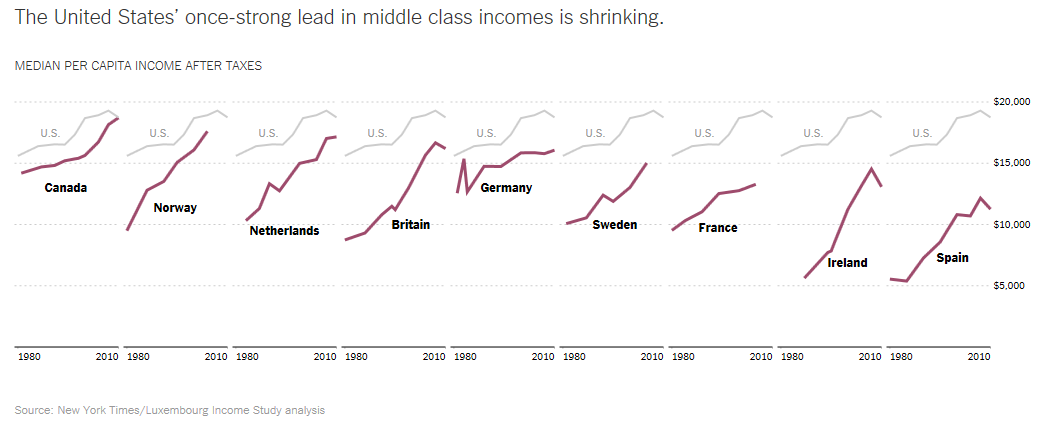
Yesterday’s New York Times has a very interesting article, “U.S. Middle Class No Longer World’s Richest”, demonstrating that from 1980 -2010 the median wage in many other developed nations has grown faster than in the U.S.  The chart below does show that the U.S. median wage is still growing but just not as fast as elsewhere.
CaptureThe authors suggest three reasons to explain what is happening:

  • Educational attainment in the U.S. is growing more slowly than in the rest of the industrialized world.
  • A larger portion of business profits in the U.S. is going to top executives meaning less for middle and low income workers.
  • There is a higher degree of income redistribution (through taxation) in Canada and Western Europe than in the U.S.

The data presented in this article is more elaborate but nevertheless consistent with what other studies are showing.  We are still on top but we need to make some major changes in order to stay there.  For example:

  • Most states have adopted the national Common Core curriculum for K – 12 schools. In today’s highly competitive global environment, this will enable a more rigorous evaluation of educational attainment between the states and should, therefore, improve overall academic achievement.
  • The best way to raise salaries for middle and low-income workers is to boost economic output overall. Fundamental tax reform, with lower tax rates for everyone, offset by closing loopholes and lowering deductions for the wealthy, will put more money in the hands of the people most likely to spend it. This will increase demand and make the economy grow faster.
  • As a highly visible way of addressing economic inequality in the U.S., institute a relatively small, i.e. 1% or 2%, wealth tax on the assets of individuals with a net worth exceeding $10 million. This would raise up to $200 billion per year which could be used for an extensive infrastructure renewal program, creating lots of jobs and further boosting the economy, with a lot left over to devote to shrinking our massive federal deficits.

A program like this encourages everyone to work hard and reach their highest potential, including accumulating as much wealth as they are able to.  But the people at the very top, i.e. the superrich, will be required to give back a little bit more in order to benefit the entire country.

The Resurrection of Karl Marx


The French economist Thomas Piketty is creating a huge stir with the publication in English of his new book “Capital in the 21st Century.”  Mr. Piketty develops a very simple idea, with reams and reams of data.  Namely that income from wealth, i.e. investment income, typically grows faster than income from wages and GDP.  This means that the value of private capital is growing steadily as a percentage of national income.  This trend has been occurring ever since 1950, at the end of WWII, and is likely to continue indefinitely absent new mega shocks to the global economy such as another world war.
CaptureIn other words, wealth inequality is rapidly increasing just as is income inequality.  Today’s New York Times has an interesting article “Taking on Adam Smith (and Karl Marx)”  discussing Mr. Piketty’s background and how it has influenced his research.  “No revolutionary, Mr. Piketty says that inequality by itself is acceptable to the extent it spurs individual initiative and the generation of wealth.  But extreme economic inequality, he contends, will have a deep and deleterious impact on democratic values,” says the reporter.
Now that income inequality and wealth inequality are clearly well documented, the question is how our democratic society will respond through the political process.  First of all, we need to agree to take the problem seriously.  Equality of opportunity and economic mobility still exist but it is getting harder and harder to move up the income ladder. What our country badly needs right now is an economic program that will get our economy growing faster in order to create more jobs as well as bringing in more tax revenue to pay for government.
One way to accomplish this is with

  • Broad-based tax reform to lower rates in order to put more money in the hands of people who will spend it on basic necessities as well as business expansion. Lower rates can be paid for by closing loopholes and deductions which primarily affect the wealthy.
  • A low percentage (1% or 2%) tax on wealth (i.e. financial assets) with a fairly high personal exemption of perhaps $10 million in order to only include the most wealthy. This would raise about $200 billion per year which could be used to fund a wide scale infrastructure renovation program which would provide employment to millions of people.

Such a wealth tax would be a highly visible means of addressing economic inequality in a way which would greatly benefit to the economy at the same time.

Global Warming Is For Real II. How Do We Move Forward?


The Intergovernmental Panel on Climate Change has just issued a new report, reported in yesterday’s New York Times, “Climate Efforts Falling Short, U.N. Panel Says”. The IPCC is saying that an intensive effort is needed in the next 15 years to prevent the global average temperature from rising more than 3.6 degrees Fahrenheit (2 degrees Celsius) above the preindustrial level. Since the U.S. and China are the biggest emitters of carbon, it is critical for the U.S. to show leadership on this issue.
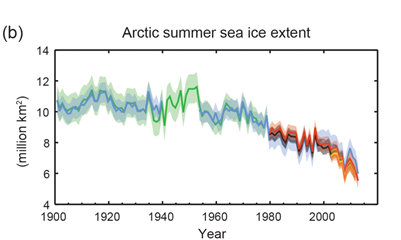
CaptureOne dramatic piece of evidence that global warming is real is the rapidly shrinking size of the artic polar ice cap measured at the end of each summer. In a previous post last December 8, I took note that at least 29 U.S. companies “are incorporating a price on carbon into their long range plans.” I also noted a report from the Congressional Budget Office which estimates that a tax on energy companies of $20 to emit a ton of CO2 would raise $120 billion a year and raise the cost of gasoline by 10 to 15 cents per gallon.
The scene is clearly set. There is a serious threat to life on earth. We have a good estimate of what it will take to meet the threat and a specific time window for responding. We also know the approximate cost of a sensible plan for doing so. Can our democratic political system be moved to action?
A large energy tax like this will take a bite out of the economy. An attractive way of building support would be to make it part of broad based tax reform designed to stimulate the economy with lower individual and corporate rates offset by closing loopholes and eliminating deductions. In fact a carefully assembled package might be able to reduce carbon emissions, stimulate the economy (with lower tax rates) and raise revenue to pay down the deficit, all at the same time!
Is this too much to hope for?