An Emerging Democratic Agenda


I am just as personally embarrassed by President Donald Trump as most other people I know. He is rude towards other world leaders and especially our own allies.  His destructive behavior endangers even his own policy initiatives.  He was elected by blue-collar workers who feel left behind in today’s global economy.  But how can he possibly lead others in implementing policies to help even his most avid supporters?


What is the Democratic Party doing about this?  First of all, they are trying to stop acting so elitist toward the working class.  But more fundamentally a new progressive social agenda apparently is emerging, here and here.  It has many attractive features but there is one big thing missing, namely fiscal responsibility:

  • A “public apprenticeship” jobs program. The idea here is to maintain the employment rate for prime-age workers without a bachelor’s degree at the 2000 level of 79%. This would require the creation of 4.4 million jobs, ideally at a living wage of $15 per hour plus Social Security and Medicare payroll taxes, and therefore at a wage of $36,000 per year. This would cost $158 billion per year.
  • A universal child allowance of $250 per month. This would cost $190 billion per year, although half could be offset by consolidating less-efficient existing programs. This would cut child poverty by 40%.
  • An expansion of the earned income tax credit. A family of four making $40,000 per year would get a tax credit of $6000 instead of the current credit of $2000. This would cost $1 trillion over ten years. The idea here is extra motivation to hold a job.


Conclusion. Who is opposed to creating millions of new living wage jobs to put the unemployed and underemployed back to work? Such a program would give our economy a huge boost.  Who is opposed to cutting child poverty in half (or doing even better)?  But how in the world would we make room for such new programs in the federal budget?  With $500 billion annual deficit spending already, we need to curtail federal spending, not increase it.


Follow me on Twitter 
Follow me on Facebook 

Responsible Tax Reform II. The Trump Plan


Responsible tax reform will be highly beneficial for the U.S. economy because:

  • Economic growth will be speeded up by lowering tax rates on businesses, thereby encouraging more investment.
  • National debt will shrink because faster growth will produce more tax revenue. But this only works if the revised tax plan is revenue neutral to begin with.

The Trump tax plan, described here and here, has the following features:

  • three tax brackets, reduced from seven. Simplification like this is a good idea.
  • double the standard deduction. This puts more money in the pockets of the average tax payer who does not itemize deductions and is therefore a good idea.
  • repeal of the alternative minimum tax. This only affects wealthy people and should be retained, if necessary, to make sure that overall reform does not increase the deficit.
  • lower capital gains tax. This will encourage more investment but should not be included unless the overall plan is revenue neutral.
  • repeal of inheritance tax. This tax feature should be retained until our annual budget deficits are eliminated, i.e. until we achieve balanced budgets on an annual basis.
  • preserving deductions for mortgage interest and charitable contributions. The mortgage interest deduction should be greatly reduced from its current level of $1 million per residence. Wealthy taxpayers don’t need that much help. Raising the standard deduction will already help middle income taxpayers.
  • cutting the corporate tax rate. This is an excellent idea as long as its revenue loss is made up elsewhere. It will encourage multinational corporations to bring their overseas profits back home for reinvestment in the U.S.

Conclusion. The Trump tax plan has some good features as well as some poor ones. Reducing tax rates is a good idea.  But adding to annual deficits is a very bad idea.  With some effort it is possible to reduce tax rates in a revenue neutral way.

Follow me on Twitter
Follow me on Facebook

Keeping Global Warming in Perspective


The evidence for man-made global warming is now overwhelming. For example:

  • The extent of artic summer sea ice is steadily shrinking.
  • The world’s oceans are getting warmer.
  • Spring in the U.S. is coming sooner each year on average.

The three biggest carbon emitters in the world are China, the U.S. and India in that order. But what is also true, and not sufficiently well appreciated, is that carbon emissions in the U.S. are dropping while they are still increasing in China and India:

  • In the 2015 Paris climate agreement, China pledged that it would start reducing carbon emissions by 2030 but, in the meantime, is still continuing to open coal burning power plants.
  • In the U.S. carbon emissions have been steadily decreasing since 2000 (see chart).
  • In India the economy is growing at 7% per year and 240 million people still lack electric power. This means that carbon emissions from coal burning are likely to double in the years ahead.

Coal use in the U.S. will continue to drop with or without enforcement of the Obama era Clean Power Plan because natural gas is now so plentiful and so much less expensive than coal. The best way for the U.S. to continue showing leadership in combatting global warming is for it to adopt a revenue-neutral carbon tax.  This would let the market sort out which type of energy is the cleanest and most efficient in meeting our country’s growing energy needs.  In fact a carbon tax might even be beneficial for the coal industry by creating a strong incentive to develop carbon capture and storage technology.
Conclusion. Most Americans now agree that global warming is real and that this presents a huge threat to human civilization.  It is likely that a revenue-neutral carbon tax will be adopted by our country in the near future.

Follow me on Twitter
Follow me on Facebook

Trump’s Bark Is Worse than His Bite


The anti-Trump fervor seems to be slowly dying down as his appointees take hold of their agencies and begin to promulgate new policies. I have expected this to happen because of the excellent quality of many of the people he has appointed.
Here are a few recent developments:

  • Interior Secretary Ryan Zinke has said that “the border is complicated as far as building a physical wall” and there are all sorts of problems to be resolved before it can be done.
  • Reality is setting in with regard to Russia policy “given Russia’s continued provocations in terms of weapon’s deployments, overtures to Iran, cyber intrusions and intervention in Ukraine.”
  • The Brookings Institution has just issued a new report showing that school choice options are increasing in the country’s largest school districts. This indicates that Education Secretary Betsy DeVos is in the mainstream by supporting more choice.
  • Coal jobs Trump vows to save no longer exist.  In other words, cancelation of the Obama Clean Power Plan will have little effect on the huge drop in coal use because coal has become so much more expensive than natural gas.
  • Of course, the Trump 2018 Budget Proposal will be heavily modified by Congress but it does contain some good ideas. Agriculture, Foreign Aid and Community Development Block Grants are all ripe for big cuts.
  • The biggest unknown with respect to administrative action concerns trade policy. The question here is what concessions he can get from China and Mexico without starting a disastrous trade war.

What is mainly lacking at this point is any significant action by Congress on the Trump agenda. What will happen with healthcare reform, tax reform and deficit reduction, for example?

Conclusion. Trump is doing fine so far but it is on relatively straightforward issues under his control. Hopefully he will be able to make progress on the bigger issues as well which require working with Congress.

Follow me on Twitter
Follow me on Facebook


What, if Anything, Will Restrain Donald Trump?


The Atlantic magazine has just released a remarkable essay written by the political commentator, David Frum, entitled, “How to Build an Autocracy.”  Says Mr. Frum, “Donald Trump will not set out to build an authoritarian state.  His immediate priority seems likely to be to use the presidency to enrich himself.  But as he does so, he will need to protect himself from legal risk.  Being Trump, he will also inevitably wish to inflict payback on his critics.  Construction of an apparatus of impunity and revenge will begin haphazardly and opportunistically.  But it will accelerate.  It will have to.”

capture99
Let’s assume that Mr. Frum is correct that Trump’s top priority is to enrich himself.  What will stop him from doing this?  A recent column in the New York Times points out that:

  •  54% of registered voters in congressional districts represented by Republicans view Mr. Trump favorably compared with only 42% who view him unfavorably.
    In these same districts, 87% of registered Republicans view Mr. Trump favorably.
  • In other words, the Republican dominated Congress is unlikely to strongly oppose his sleazy and self-enriching behavior.

But there are other constraints on what he does in office:

  • As I said in a recent post in order for Mr. Trump to be reelected in 2020, he will need to substantially speed up economic growth in order to increase the wages of his key blue-collar supporters. He clearly wants to accomplish this.
  • On the other hand, the conservative Republican base, including its representatives in the House such as the Freedom Caucus, will simply not support huge increases in deficit spending for anything (except an emergency) including infrastructure, the military or unfunded tax cuts.
  • In fact, Rep Mick Mulvaney (R, SC), a deficit hawk, has been nominated to become the Trump Administration’s Budget Director. In March the debt ceiling will have to be raised. I expect the many fiscal conservatives in Congress to insist on significant fiscal restraint (e.g. a ten year plan to balance the budget) as a tradeoff for raising the debt ceiling.

Conclusion. Just because Republicans are tolerant of Mr. Trump’s personal behavior does not mean he can successfully ignore the strong Republican desire for fiscal restraint.

Follow me on Twitter
Follow me on Facebook


Fixing Obamacare: Keep it Simple and Low Cost


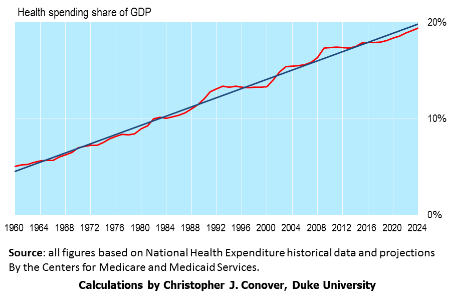
Straightening out healthcare insurance is a high priority for the new Trump Administration and Congress as it should be. The U.S. spends 18% of GDP on healthcare, public and private, twice as much as any other developed country and this percentage is likely to keep on increasing without major changes.

capture
Republican thought is converging, see here and here, on a plan with these broad features:

  • Repeal of both the individual and employer mandates so that health insurance can be individually tailored and purchased at a much lower cost than under the ACA.
  • A Universal (and refundable) tax credit sufficient to pay for catastrophic insurance coverage.
  • Health Savings Accounts to pay for routine healthcare expenses up to the deductible for catastrophic insurance. Such HSAs could be funded, at least initially, with (refundable) tax credits.
  • High risk pools and coverage for pre-existing conditions. It is estimated that 500,000 people with pre-existing conditions would need protection if the ACA is repealed. This would cost about $16 billion annually, much less than the full cost of the ACA.

Conclusion. Such a plan will insure coverage for all Americans who want it. The high deductibility feature, coupled with HSAs, will strongly encourage healthcare consumers to shop around for the best price on routine care.  Such price consciousness by consumers is the only way (short of a single payer system with severe rationing) to get our national healthcare costs under control.
A modification of such a plan, proposed by Senator Bill Cassidy (R, LA) and Senator Susan Collins (R, ME) would give each state the choice of either keeping the ACA or replacing it with a version of the above plan.  This is a poor idea because the ACA has no cost control and this is what is sorely needed.  In other words, the above plan should be made universal, identical for all states.  Let the states provide and pay for supplemental coverage if they wish.

Follow me on Twitter
Follow me on Facebook


On Evaluating President Trump: Put Substance over Style


In Sunday’s New York Times, the Ethics and Public Policy Center’s Peter Wehner wrote: “Donald Trump is a transgressive personality.  He thrives on creating disorder, in violating rules, in provoking outrage.  He is a shock jock.  . . . For Mr. Trump, nothing is sacred.  The truth is malleable, instrumental, subjective.  It is all about him.  It is always about him.”

capture97
I understand that he is a narcissist but I am paying as much attention to what he does as to what he says.  For example:

  • Economic Policy. A major focus of his campaign was to get the economy growing faster. His appointments so far will help in this regard. Mnuchin at Treasury is for tax reform and financial deregulation. Price at HHS is for healthcare deregulation. Pruitt at EPA is for loosening environmental rules. He may try to negotiate modifications to NAFTA but he is too smart to start a trade war which would be devastating to the overall economy. His best hope for being re-elected in 2020 is to create more jobs and better paying jobs for his fervent blue-collar supporters.
  • Education Policy. K-12 public education for minorities in many big inner cities is a disaster. Betsy DeVos is an education reform activist in Michigan. Shaking up the education establishment is a good idea.
  • Fiscal Policy. Our public debt is much too large and must be reduced, sooner rather than later, before we have a new fiscal crisis. This will be very difficult to do because it means modifying entitlements such as Social Security and Medicare which Mr. Trump has said he won’t do. The Republican House is adamant about shrinking the debt and it is hard to imagine Mr. Trump standing in the way. It will be fascinating to see how he finesses this critical issue.

Conclusion. Far from being a detriment to performing his presidential duties, Mr. Trump’s rhetorical skills could come in very handy in moving our nation forward.

Follow me on Twitter
Follow me on Facebook

Trump as the Anti-Obama


Donald Trump assumes office with perhaps the lowest favorability ratings of any modern president. According to the New York Times,

  • Mr. Trump’s approval rating is only 40% among all adults and just 46% among likely voters.
  • But a recent CNN poll reports that 48% of adults think he’ll do a good job as president and 61% think he’ll bring back well-paying jobs to economically depressed areas.capture97

Contrast this with Barack Obama’s latest poll ratings:

  • According to Gallup Mr. Obama leaves office with an approval rating of 57%.
  • But Rasmussen reports that only 35% of likely voters think the country is heading in the right direction (with 55% saying that we’re headed in the wrong direction).

I interpret this to mean that the country is largely turned off by Mr. Trump’s crude speech and sleazy behavior, while still liking his economic program.  On the other hand, voters like Mr. Obama personally while disapproving of many of his policies and accomplishments.

All of this leaves Mr. Trump in an amazingly good political position:

  • With unemployment currently at a relatively low 4.7% and the economy fully recovered from the Great Recession, even modest reform in tax policy coupled with energy, healthcare and financial deregulation could provide a significant boost to long stalled economic growth.
  • He is criticized for having no clear cut political philosophy but this means he is free to do whatever makes good sense regardless of ideology. This will be a huge advantage in working with both parties to get things done.
  • He has nowhere to go but up in the polls. Such an increase in personal popularity will create the semblance of forward momentum.

Conclusion. The prospects are indeed propitious for Donald Trump to become a transformational president.

Follow me on Twitter
Follow me on Facebook


Trump’s Economic Challenge


As I like to remind my readers from time to time, I am a non-ideological fiscal conservative. I simply want to solve our two most fundamental fiscal and economic problems:

  • Slow economic growth, averaging just 2.1% since the end of the Great Recession in June 2009,
  • Massive debt, now at 76% of GDP (for the public part on which we pay interest), the highest since the end of WWII,

by whatever means it takes.
Donald Trump won the presidential election contest because he convinced blue-collar white voters that he would do something about their declining economic prospects.  But can he actually deliver for them?
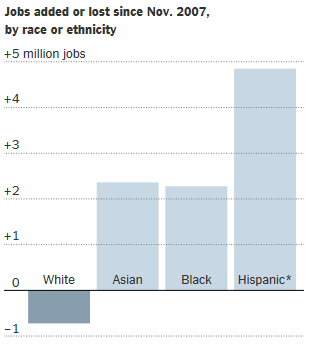
capture87Yesterday’s New York Times has an excellent analysis of this problem by the economic journalist, Eduardo Porter, “Where were Trump’s votes?  Where the jobs weren’t.”  Mr. Porter points out that, in fact, Hispanic, Black and Asian workers have all done much better than white workers since November 2007 (see above chart).
capture88He also points out that all three of these minority groups live primarily in metropolitan areas where jobs have been growing much faster than in nonmetropolitan areas (see above chart).
He further points out that while the number of manufacturing jobs has been flat since 1978, the number of service jobs has been increasing rapidly and that most of these new service jobs are in the cities where minorities are clustered (see below).
capture89The question then is what Mr. Trump (or anyone else!) can do to help his largely rural blue-collar constituency?  Mr. Porter recognizes that faster economic growth will have to come from investments in technology and human capital.  But he thinks that this will happen mostly in the cities and thus help minorities proportionally more than whites. Conclusion. Helping blue-collar whites is Mr. Trump’s fundamental economic problem.  Faster overall economic growth will help to some extent.  Trade restrictions will not help.  Immigration restrictions might help but could also hurt the overall economy if employers can’t hire enough workers. Better education and vocational training will help in the long run but not immediately.  This is a very tough problem to solve!

Follow me on Twitter
Follow me on Facebook

The Economy Is Improving But Not Enough


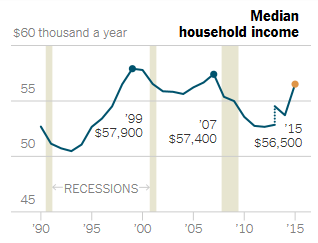
It has been widely reported that medium household incomes were up 5.2% to $56,500 in 2015.  Furthermore the lower income quintiles have gained the most.  This is very good news.
capture54But this new peak is below the previous peak of $57,400 in 2007, before the Great Recession started, which in turn is below the absolute peak of $57,900 in 1999. Now look at economic growth more broadly.
capture55The second chart shows the annual rate of real (i.e. inflation adjusted) GDP growth, by expansion period, all the way back to 1949.  What is most striking is that growth has been steadily decreasing over this entire time period and is now down to an average rate of just 2% during the current recovery. There is really only one way to reverse this steep decline.  It is to return to proven fundamentals as well explained by the economist, John Cochrane.  In summary:

  • There is only one source of growth. Nothing other than productivity matters in the long run. And, unfortunately, the business investment which leads to gains in productivity is way down.
  • The vast expansion in regulation is the most obvious change in public policy accompanying America’s growth slowdown.
  • The basic structure of growth-oriented tax reform is lower marginal rates paid for by removing exemptions and loopholes. A high corporate tax rate hurts workers more than anyone else.
  • Solving our immigration problem would turn 11 million illegal immigrants into productive citizens. Guest worker and e-Verify enforcement are fixable problems.
  • International trade with strict reciprocity between trading partners will benefit almost everyone. Manufacturing workers who lose their jobs to foreign competition need robust retraining programs for the many manufacturing jobs which still exist.

Conclusion. Faster economic growth is imminently doable. Just follow tried and true economic fundamentals!

Follow me on Twitter
Follow me on Facebook