Too Much Income Inequality is Harmful to Society


It is well understood that income inequality is increasing in the U.S. and that there are lots of reasons for it.  Globalization provides low cost goods from around the world and thus puts pressure on low-wage workers in our own country.  Rapid technological advancement puts a high premium on educational attainment and skill acquisition and thus helps individuals who are highly motivated to succeed.  The Great Recession and our slow recovery from it have held back the growth of employment and wages increases for middle- and lower-income workers.
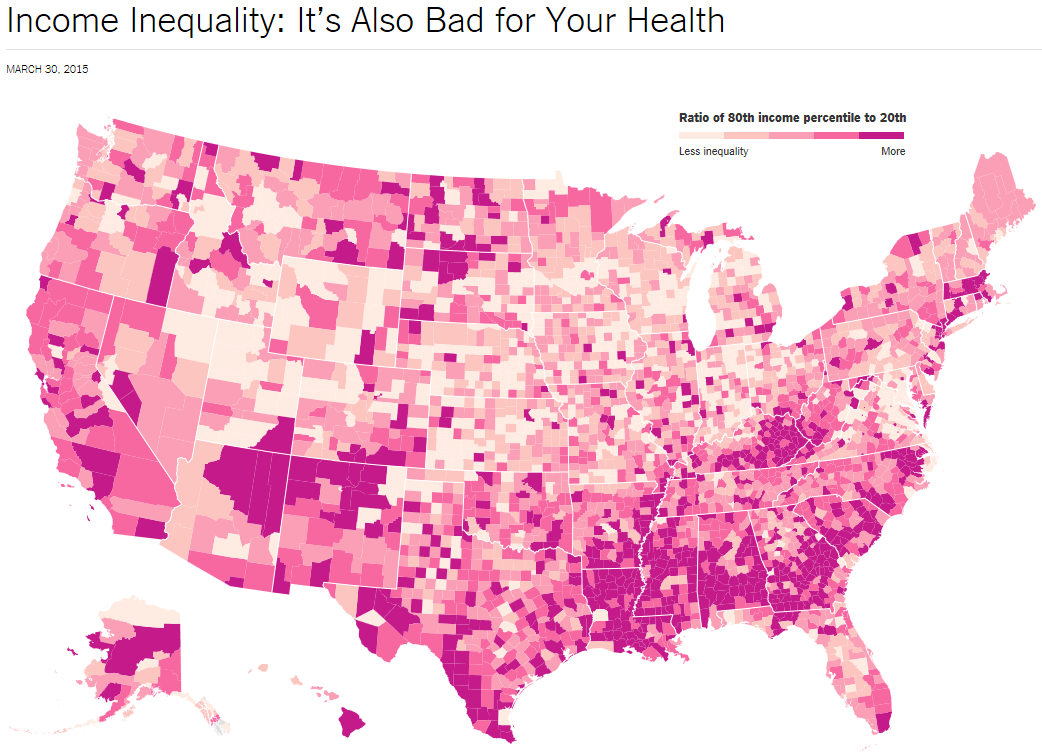
CaptureIncreasing income inequality is a pernicious social condition and has lots of unpleasant consequences.  A new study of U.S. counties has shown that there is a strong correlation between more inequality in a particular geographical area and shorter average live spans.  It is quite reasonable to expect that higher-income people will be more health conscious than lower- income people. Excessive inequality is bad for lots of reasons.
The question is what we can do about it.  Here are two good ways to address it:

  • Faster economic growth would help a lot. The American Enterprise Institute’s Michael Strain has recently proposed a fairly modest plan for increasing employment by cutting tax deductions for the wealthy, increasing the Earned Income Tax Credit for the poor and at the same time decreasing deficit spending. I have made a more substantial proposal along the same lines.
  • Boost educational performance across the board. College-ready middle class kids will take care of themselves so the emphasis should be on the 70% of young adults who will not go to a four year college. There are lots of good jobs available for the highly skilled and so we need more career education in high school. We also need more early childhood education to prepare kids from low-income families to get off to a good start in elementary school.

Increasing economic growth and expanding educational opportunities for the non-college bound will require little, if any, new federal spending.  Such policies as above are simply common sense ways to reduce income inequality and achieve a more inclusive society.

Status Quo on the Budget Is Not Good Enough!


As I like to remind readers, I am a non-ideological fiscal conservative.  I am not hard core anything.  I just want to find practical, workable solutions for difficult and complicated problems.  There is basically only one exception to my generally moderate outlook.  I detest huge amounts of deficit spending except for unusual circumstances.  Most of the time we should be willing to either raise taxes and/or cut spending to do what needs to be done and to live within our means.
This is why the current efforts by the Budget Committees of both the House and the Senate to devise a plan to balance the budget, i.e. eliminate deficit spending, over a ten year period is so exciting to me.
An analysis in today’s New York Times suggests that Congress should be content to just extend the so-called Ryan-Murray Budget from 2014-2015.  “Ryan-Murray didn’t decisively move the needle one way or the other, which is why it was able to attract bipartisan support.  Rather it preserved the status quo.  In a world of divided government and polarized politics, keeping the government running without a lot of brinkmanship and high drama may be the best we can hope for.”
CaptureAs I pointed out in my last post, current policy will raise government spending by 5.1% annually over the next ten years.  The President wants to increase spending by an additional $1 trillion over this time period.  The Republican budgets, which lead to balance in ten years, still allow spending to increase by 3.3% annually.  The difference between the two plans is illustrated in the above chart from last Sunday’s Omaha World Herald.
Congress is finally in a position this year to start digging us out of the deep fiscal hole we have fallen into.  Let’s hope that too much “bipartisan” status quo thinking doesn’t get in the way of progress!

How the Obama and Republican Budgets Compare


The Budget Committees for both the House of Representatives and the Senate have now passed plans to achieve balanced budgets within a ten year period.  My last two posts have discussed the compelling need to get deficit spending under control and an overall rationale for how to approach this difficult task. Today I will take a look at the major differences between the Obama budget and the House and Senate budgets.  The two congressional budgets are quite similar and will surely be reconciled into a single budget.
CaptureHere are the major differences:

  • Revenue. The President wants to raise taxes by $3 trillion over 10 years to pay for more spending while the Republicans wants revenue-neutral tax reform in order to increase economic growth.
  • Spending. Under current policy the government will spend $48.6 trillion over the next ten years which represents a 5.1% annual rate of spending increase over the present. The President wants to spend an additional $1 trillion over this time period on new initiatives. The Republicans propose spending about $5.4 trillion less, or $43.2 trillion, which still works out to a 3.3% annual rate of increase over the present.
  • Deficits. Under current policy the deficit would start to increase, as a percentage of GDP, in 2018. The President proposes to stabilize the deficit at 2.5% of GDP. The Republicans would balance the budget within ten years by shrinking the deficit down to zero.
  • Public Debt. Under current policy the public debt (on which interest is paid) will increase to 79% of GDP by 2025. The President’s budget would stabilize the debt at the current level of 73% of GDP. The Republican’s balanced budget would shrink the debt to 57% of GDP by 2025.


There are stark differences between the President’s proposed budget and the Republican alternative.  Which is the better route to progress and prosperity?  Is it to raise taxes, increase government spending and only stabilize the debt or is it to streamline taxes, slow down the growth of spending and shrink the debt?  This is a fundamental question of government policy which will not be quickly resolved.  But at least the question is being raised in a dramatic way!

When Liberals Blew It


“It is important and right that all privileges of the law be ours, but it is vastly more important that we be prepared for the exercise of these privileges.”
                                                                       Booker T. Washington, 1856 – 1915

My last two posts have discussed the theme of a new book by Dennis Prager, “Still the Best Hope: why the world needs American values to triumph.” Mr. Prager’s thesis is that there are three competing ideologies for the allegiance of humankind, namely Islamism, Leftism and Americanism and, furthermore, that these three ideologies are incompatible.  Any one of them succeeds at the expense of the other two.
As I said on March 8, Mr. Prager’s broad framework helps me place my own ideological views into perspective.  Here is one example of this. As everyone knows, 2015 is the 50th anniversary of the March from Selma to Montgomery.  But it is also the 50th anniversary of Daniel Patrick Moynihan’s report “The Negro Family: The Case for National Action.”  Nicholas Kristof’s Op-Ed in today’s New York Times, “When Liberals Blew It” reminds us how prescient Moynihan was about a breakdown in family structure and how reviled he was by liberals when he issued his report.  Mr. Kristof points out that:

  • In 2013, 71% of black children were born to an unwed mother (compared to 53% of Hispanic children and 36% of white children), far more than in 1965.
  • Growing up with just one biological parent reduces the chance that a child will graduate from high school by 40%.
  • A father’s absence from the home increases antisocial behavior especially for boys.

CaptureA column by the black author, Jason Riley, in yesterday’s Wall Street Journal, “Drawing the Wrong Lessons from Selma about America today,” points out that the main problem for blacks today is not racial discrimination but rather:

  • A lack of preparation for many jobs which are now available.
  • A black subculture which rejects attitudes and behaviors conducive to upward mobility.
  • That too few blacks are taking advantage of the opportunities now available to them.

In other words, more and more spending on welfare and public services is not what blacks need for further advancement.  Rather it is to stop thinking of themselves as victims and to develop a greater sense of personal responsibility.  This is the American way to get ahead!

Does ‘Middle Class Economics’ Really Work?


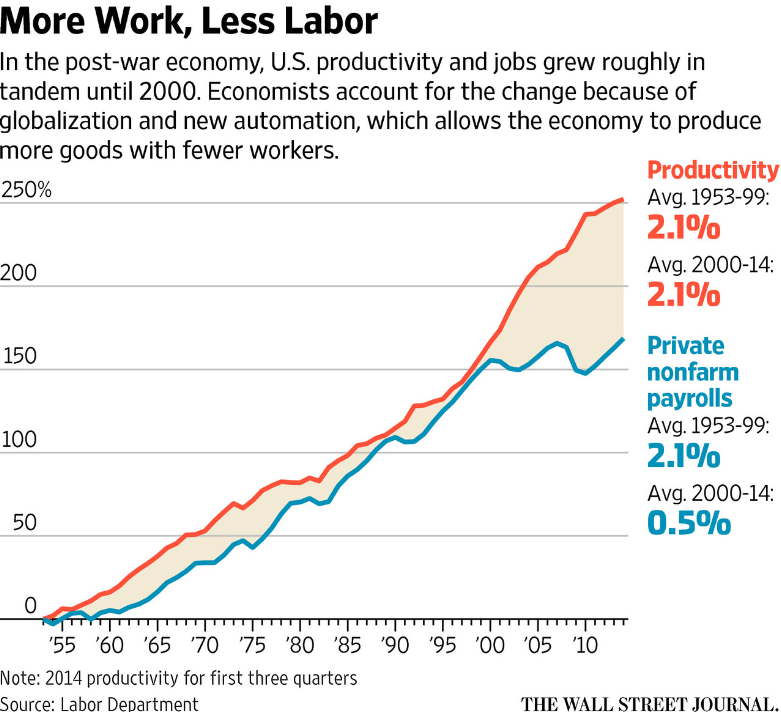
An article in yesterday’s Wall Street Journal, “What Clever Robots Mean for Jobs,”  illustrates the stark fact that “automation is commandeering much middle-class work such as clerk and bookkeeper, while creating jobs at the high- and low-end of the market.  This is one reason the labor market has polarized and wages have stagnated over the past 15 years.”
CaptureThe above chart shows the divergence between productivity growth and payrolls beginning in the year 2000.  It is a vivid portrayal of the “hollowing out” of the middle class which is causing so much grief.
Now let’s turn to a column in today’s New York Times, “What Is Middle-Class Economics,” by the journalist, Josh Barro.  The term, of course, refers to the policies by which President Obama hopes to appeal to the millions of middle-class families with stagnant incomes. According to Mr. Barro, the President’s policy proposals have three facets:

  • Tax and regulatory provisions such as tax credits for childcare, college tuition and a second earner in households where both parents work. Employers would be required to provide paid sick leave and the minimum wage would be raised.
  • Make workers more productive by expanding access to community college.
  • Increase overall economic growth with increased infrastructure spending and new trade agreements.

The problem, as Mr. Barro points out, is that such policies would have only a small effect on the taxes of a middle-income family, amounting to a cut of no more than $150 per year on average.  This is much less than the average family will save from falling gasoline prices.
On the other hand, it is generally understood that stagnant middle-class wages will not rise very much until the labor market becomes tighter as a result of falling unemployment.  Mr. Barro suggests that the government can help this process along in two ways:

  • By the Federal Reserve holding down interest rates, or at least letting them increase only very slowly.
  • With policies to make it easier to work less. The Affordable Care Act does this by decoupling health insurance from full time work. The surge in disability insurance recipients takes people out of the labor market. The rapid retirement of baby-boomers does the same thing.

Unfortunately there are many negative effects from both the Federal Reserve’s easy money policy as well as a shrinking labor participation rate.  I will return to this issue soon!

Is the Democratic Party Giving Up On Growth?


Prospects for future economic growth are decidedly grim.  The Congressional Budget Office has just reported that after a brief improvement for a couple of years, annual GDP growth will likely hover around 2.2% for the remainder of the ten year window 2015 – 2025.  This means, in turn, that the unemployment rate will also not likely fall much below its current level of 5.7% for the same ten year period.
CaptureA new report from the McKinsey Global Institute makes the even gloomier prediction that average U.S. GDP growth rate for the next 50 years will be only 1.9% per year, given current trends and policies.  A summary of this report is provided by the Brookings Institution social economist, William Galston.
On the other hand, according to New York Times columnist, Nate Cohn, the Democratic Party may be adopting a new policy direction, “The Parent Agenda, The Democrats’ New Focus.”  By this new focus he means:

  • Paid family leave
  • Universal preschool
  • An expanded earned-income tax credit and child tax credit
  • Free community college
  • Free four year college in time

Mr. Cohn points out that both President Obama as well as Hillary Clinton have endorsed such ideas.  Initiatives such as these are unlikely to go far in the current Republican Congress but they may still sound very attractive to the many hard-pressed middle class families with stagnant incomes.
The problem is that to emphasize a “family” political agenda like this is in effect to accept the conventional wisdom that faster economic growth is unattainable.  This is a defeatist attitude which is very harmful to the 20 million Americans who are either unemployed or under-employed. Here, briefly, is what could be done to boost economic growth in the short term:

  • Implement broad-based tax reform with lower tax rates for all, paid for by closing loopholes and limiting deductions.
  • Reduce regulatory burdens on business by, for example, streamlining (not repealing!) the Affordable Care Act and the Dodd-Frank Financial Reform Act.
  • Expand legal immigration with additional high-skill visas as well as an adequate guest worker program.
  • Expand international trade with new trade agreements.

These are all political footballs, of course, but also policies with much potential to speed up economic growth.  Either we take initiatives such as these or we consign our country to a future of relative economic stagnation with slow wage growth, high unemployment and increasing income inequality.

The President’s Budget: Stabilization of the Debt Is Not Enough!


President Obama has proposed a $3.99 trillion budget for next year, a $340 billion increase from the current 2015 budget year.  As shown in the charts below, it projects deficits of about 2.6% over the next ten years equal to its (optimistic in comparison to the CBO) growth projections for GDP.  This means that the debt would stabilize at about 73% of GDP.  And, of course, achieving his predicted stabilization of debt will require big tax increases over this ten year period.
CaptureHere are the major weaknesses in the budget:

  • Sequestration. The President declares that “I’m not going to accept a budget that locks in sequestration going forward.” Everyone deplores the mindlessness of sequestration but the only responsible alternative is to make targeted cuts throughout the budget. The President makes no attempt to do this. And he wants to add spending for various new education and research initiatives, as well as an expanded Earned Income Tax Credit for low-income workers.
  • Infrastructure. Spending over the next six years would increase by $238 billion to be raised from a 14% repatriation tax on the $2 trillion in foreign earnings held overseas by American multinational corporations. The problem is that any repatriation tax should be tied in with overall corporate and business tax reform, exchanging lower tax rates in return for closing loopholes and deductions, in order to make U.S. business taxes competitive with those of other countries. Fundamental tax reform is the key to getting our economy growing faster.
  • Entitlements. The President’s budget does not even mention the biggest threat to long-term fiscal sustainability, namely the rapidly increasing spending for Social Security, Medicare and Medicaid. It will be very difficult to make progress on this critical issue without presidential leadership.
  • Stabilization of the Debt. The President’s budget, with quite optimistic revenue and growth projections, stabilizes the debt over ten years. But this is not nearly good enough. To be satisfied with a public debt of 73% of GDP indefinitely into the future is simply too risky. What’s going to happen when we have another financial crisis, as we surely will? How are we going to cope with our growing rivalry with China with very little budget flexibility? And one can imagine any number of other possible emergencies which might occur. Putting the debt on a clear downward trajectory is the only prudent thing to do!

Solving the Student Debt Problem?


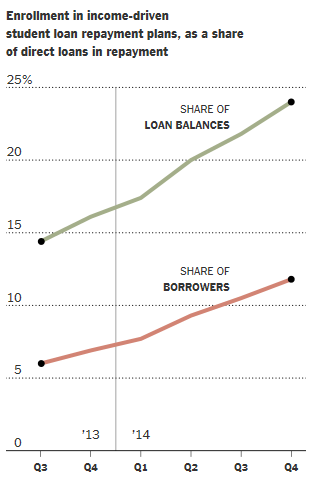
Today’s New York Times has an excellent article by Kevin Carey on the current status of federal student loans, “A Quiet Revolution is Helping Lift the Burden of Student Debt.” Our current system, called Income-Based Repayment, allows former students to repay their college loans, on a monthly basis, at a rate of 10% of net income, after deducting basic living expenses.  It forgives all loan balances after 20 years, reduced to only 10 years for people who work for government or non-profits.  As shown in the chart below, participation in the IBR program is increasing rapidly.
CaptureMr. Carey shows by example, that the IBR program is quite generous to low paid workers.  Take a teacher who borrows the national average of $29,000 for a bachelor’s degree and another $13,000 for a master’s degree and then takes a teaching job starting at $35,000 and paying $50,000 ten years later.  The teacher’s monthly payments will start at $117 and rise to about $200 in the tenth year.  The teacher will pay back a total of $18,360 and be forgiven the remainder of $48,840 of principal and interest after 10 years.
It makes sense to subsidize college education for teachers and others who work in low wage occupations.  The problem, of course, is that it is very expensive to do so.  The federal government is now committing over $100 billion each year to student loans.  There is over $1 trillion in outstanding federal student loan debt.
Many people have pointed out that our very generous student loan program is subsidizing the rapidly increasing cost of American higher education.  Here are two specific ways to address this problem:

  • Put limits on the amount of money an individual can borrow for college expenses. One such suggestion, from the political scientist, Peter Salins, would set the maximum value of a loan at 50% of the full prevailing average cost of educating undergraduates at U.S. public colleges.
  • Require all colleges to cover 20% of a defaulting student’s loan out of their own pockets. Sheila Bair makes this suggestion for for-profit colleges only but it should apply to all colleges, public and private as well as for-profit.

There are lots of low-cost and high quality educational institutions around the country, including the University of Nebraska at Omaha where I work!  Both students (and their families), as well as the colleges they attend, need to have higher stakes in limiting the explosive costs of higher education.

The Future of American Higher Education


President Obama’s proposal, to make community college free of cost for all Americans, is generating a lot of controversy.  Major complaints are that:

  • The projected cost of $6 billion per year is too high and the program is highly duplicative with other scholarship programs such as Pell grants.
  • Education is primarily a state and local responsibility, not federal.
  • The graduation rate at community colleges is only 21%, much lower than at other types of educational institutions.
  • There is a whole new marketplace of non-degree credentials such as competency-based programs and micro-certifications which often provide greater variety, quality and monetary value than community college programs.

These criticisms are largely valid and should largely be incorporated into the guidelines of the President’s proposal as they are drawn up and submitted to Congress.
CaptureBut they miss the larger point.  Today, about 30% of young people in the U.S. graduate from a four year college.  Tuition and fees at public college averages $9,000 per year while the comparable cost at private colleges is $31,000.  Loan debt for college graduates averages $27,000 per year, and is much higher for many.  And, according to the above chart from the New York Times, educational attainment in the U.S. lags behind the rest of the developed world.
Today’s increasingly high-tech and interconnected world puts a huge premium on educational attainment and America’s system of higher education is not meeting the challenge.  It is too expensive and not educating enough people, especially minorities and those with low-incomes.
The best way to address this problem in a cost-efficient manner, which is a necessity in today’s fiscal climate, is to expand opportunities at our 1100 community colleges. Community colleges are not only incredibly low cost operations, they accept all students and start them out at whatever academic level is necessary.  They provide the ideal venue to lift up large numbers of average and previously-failed students and turn them into productive members of society.  Boosting community college enrollments will, in turn, give our economy a big boost.
This is the real reason why President Obama’s free tuition plan should be taken seriously.  It will shine a strong light on an educational sector whose potential is greatly under-appreciated by many Americans.

The American People Are Amazingly Upbeat!


I think of myself as a political moderate, conservative on fiscal matters and somewhat liberal on social issues.  My blog posts are usually based on a recent newspaper article or think tank study presenting one side or the other of an important issue in an intelligent way.  In other words, I seldom bother to refute what I consider to be dumb ideas.  I assume that they will eventually die of their own dead weight.  My favorite approach is to respond to an attractive article with which I may have a somewhat different point of view.
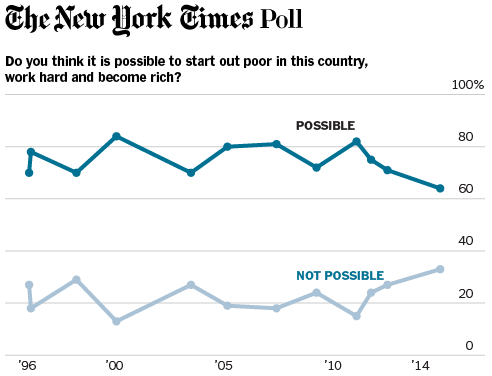
CaptureToday’s New York Times has such an article, “Many Feel American Dream is Out of Reach, Poll Shows,” pointing out that 64% of a NYT Poll respondents think that it is possible to start out poor and become rich (see above chart), which opinion has dropped from 72% in 2009.  The Poll also reports that:

  • 81% of Americans have confidence in their own local banks whereas only 41% have confidence in Wall Street bankers and brokers.
  • 52% think the economic system in the U.S. is basically fair, since all Americans have a chance to succeed, whereas 45% think it is unfair.
  • 54% of Americans think that over-regulation of the economy, which interferes with economic growth, is a bigger problem than under-regulation, which may create an unequal distribution of wealth.

For almost two-thirds of Americans to be upbeat about the American Dream, after six or seven years of recession and slow recovery is to me a very positive sign.  After a severe financial crisis, it is not at all surprising that “main street” bankers have a much higher favorability rating than “Wall Street” bankers.
Several months ago I reported on a survey taken by the progressive Global Strategy Group showing that 80% of voters consider economic growth more important than income inequality.
Both today’s NYT Poll and the previous GSG Survey are saying loud and clear that Americans put a high premium on economic growth and this is where our national leaders should be concentrating their time and energy.  The new Republican majority in Congress has an almost historic opportunity to get this right.  Let’s hope they don’t blow it!