How to Get Our Economy Back On Track


My last several posts have expressed dissatisfaction with both presidential candidates and the hope that whoever wins in November (very likely Hillary Clinton) will work with the Republican House of Representatives to implement its “A Better Way” plan for national renewal.
In particular, faster economic growth would produce more jobs and better paying jobs and hence is highly desirable.  As many people, including myself,  have pointed out, it is low productivity growth caused by low business investment, which is largely responsible for slow economic growth.
The economist John Taylor has an excellent analysis of this problem.  He points out that the rate of economic growth equals the growth of labor productivity plus the growth of employment.

capture73
He then shows that:

  • Productivity growth slowed from the mid-1960s until the early 1980s, then increased until the mid-2000s, and has slowed way down in the past ten years.
  • The labor force participation rate has dropped dramatically since the Great Recession but only a small part of this drop off was caused by demographic trends (i.e. more retirees).
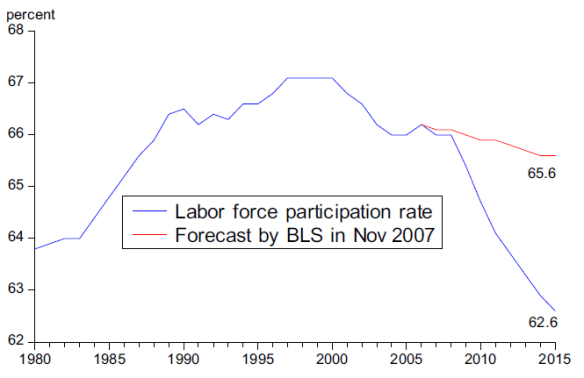
    capture72Such relatively long cycles of productivity growth and decline (longer than normal business cycles) suggests that government policy is having a major effect on economic performance. According to Mr. Taylor, what is needed is:

  • Tax reform to lower tax rates to improve incentives for work and investment.
  • Regulatory reform to prevent regulations which fail cost-benefit tests.
  • Free trade agreements to open markets.
  • Entitlement reforms to prevent a debt explosion.
  • Monetary reform to restore predictability in financial markets.

Conclusion. Mr. Taylor makes a very strong case that faster economic growth is not only possible but even achievable in the short run if our national leaders would just make some common sense policy changes.

Follow me on Twitter
Follow me on Facebook


How to Get Our Country Back On Track


In my last two posts, here and here, I have said that I like some of Donald Trump’s policy ideas but he is too personally repugnant for me to support and vote for.  Hillary Clinton is morally less objectionable than Mr. Trump but her economic policy proposals are unlikely to have much success.
capture66The best hope for our country is to keep the Republicans in control of the House of Representatives.  They have put together an excellent plan, “A Better Way,” for reviving the American economy and boosting the American spirit.  Its main principles are:

  • Poverty. Every capable person is expected to work or prepare for work. Poverty fighting programs will be directed to get people back on their feet. The poor will have more opportunities to succeed at every stage.
  • National Security. It is a top priority to defeat radical Islamic extremism. We must restore American influence, advance free enterprise and expand the community of free nations.
  • The Economy. We need to take a smarter approach that cuts down on needless regulations while making the rules we do need more efficient, especially for our small businesses.
  • The Constitution. Agencies and bureaucracies should be subject to more scrutiny from Congress. Give Congress more say – and the final word – over what is being spent and why it is being spent.
  • Health Care. Individuals should have more control and more choices in order to improve quality and lower costs. No one should have to worry about having coverage taken away regardless of age, income or medical conditions.
  • Tax Reform. The tax code should be simpler, fairer and flatter while remaining progressive. It should be constructed to create jobs, raise wages and expand opportunity for all Americans.

Conclusion. These principles are widely supported by almost all Republicans in Congress and are more important than specific differences on immigration, trade, or entitlement policy.  Their serious consideration depends upon returning a Republican controlled House in 2017.

Follow me on Twitter 
Follow me on Facebook

Donald Trump Should Withdraw from the Presidential Race


Like many other fiscal conservatives I have been overlooking Donald Trump’s moral failings in hopes of electing a president who would be able to disrupt our current economic stagnation and move the U.S. towards faster growth which is the only way to achieve broad-based prosperity.
capture72But at some point we all have to say that enough is enough and the appearance last week of the video with lewd remarks about women is the tipping point for me.  Even though I can no longer support or vote for Mr. Trump, I would like to summarize where I agree (and disagree!) with him on various issues. In decreasing order of importance:

  • Massive Debt. Mr. Trump at least talks about our almost $20 trillion national debt (and large annual deficits) even though he has made no proposals to deal with this problem. Mrs. Clinton has shown even less interest in this issue.
  • Tax Reform. Mr. Trump wants to lower tax rates for both individuals and corporations in order to stimulate economic growth. This is a very good idea as long as the tax rate cuts are made revenue neutral by closing loopholes and shrinking deductions. The Republican House has an excellent plan, “A Better Way” to accomplish just this. Hillary Clinton talks far more about economic inequality than about growth.
  • Regulatory Reform. Mr. Trump specifically mentions both the ACA and Dodd/Frank as being harmful to economic growth whereas Mrs. Clinton defends them.
  • Trans-Pacific Partnership trade deal. Mr. Trump opposes both TPP and NAFTA. Fair trade deals create more jobs than they destroy. Furthermore they produce lower priced products for everyone which boosts the economy. Wage insurance and better retraining programs will help those who lose their jobs due to foreign competition.
  • Immigration Reform. We need to solve our illegal immigration problem and Mr. Trump would probably be able to accomplish this, one way or another.

Conclusion. At this point it is pretty clear that Mrs. Clinton will be our next president. If the Republicans retain control of the House of Representatives, and she is willing to work with them, there is at least a chance to make progress on the growth issue.

Follow me on Twitter
Follow me on Facebook

Can U.S. Economic Growth Be Speeded Up?


It is widely recognized and deplored, see here and here, that economic growth in the U.S. has been very slow, averaging only 2% per year, since the end of the Great Recession in June 2009.
The Federal Reserve has taken unprecedented steps to limit the severity of the recession by holding down both short term and long term interest rates.  But these efforts are only partially working and are, unfortunately, having a number of negative effects as well.
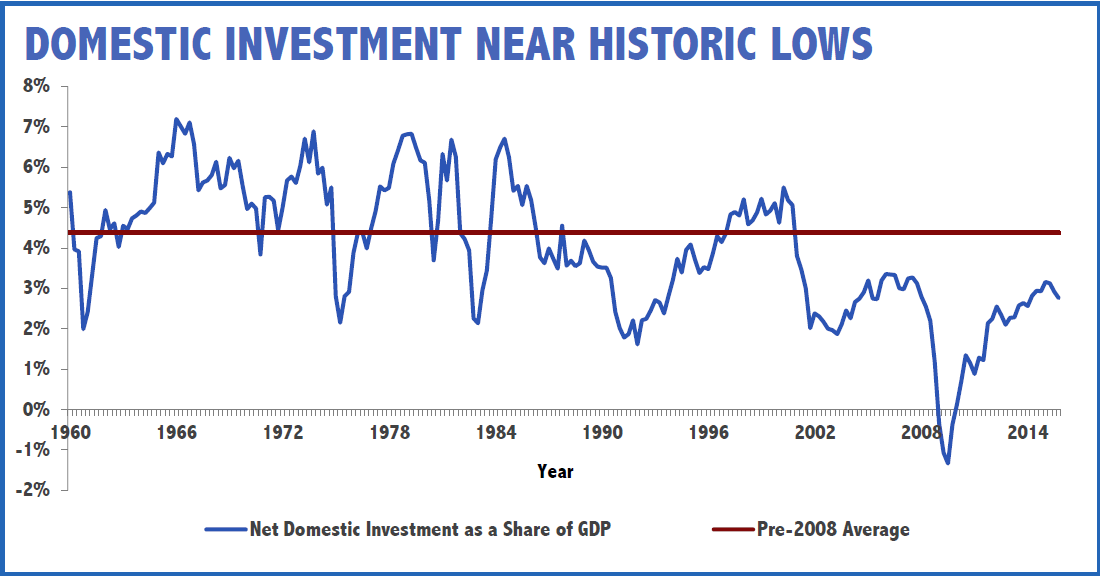
It also has been made quite clear that the problem is supply side and not demand side.  This is because, on the one hand, wages are beginning to rise more quickly and consumers are spending more money but, on the other hand, business investment is shrinking which is leading to slow productivity growth.
Capture38The American Enterprise Institute’s James Pethoukoukis has just provided new data  on the current weakness of business investment as illustrated in the above chart. Furthermore he quotes the economist, Robert Gordon, who has clearly described the many headwinds holding back the U.S. economy to the effect that:

“The American tax code exerts a downward pressure on capital formation and therefore on economic growth. It is now 30 years since the passage of comprehensive federal tax reform in the U.S.  In the intervening years, nearly every developed country has reformed its tax codes to make them more competitive than that of America.  Meanwhile the U.S. has allowed its tax code to atrophy.”

Conclusion. Yes, economic growth can be speeded up. But monetary policy won’t do the trick.  Congress must intervene with the right changes to fiscal policy, i.e. lowering tax rates for both individuals and corporations, paid for by closing loopholes and shrinking deductions.

Follow me on Twitter
Follow me on Facebook

The Economic Damage Caused by Very Low Interest Rates


As is well known, the Federal Reserve’s main tool in responding to the Financial Crisis in 2007 – 2009 has been quantitative easing (to lower long term interest rates) and direct reduction of the Federal Funds Rate (to lower short term interest rates). These measures definitely limited the severity of the Great Recession resulting from the Financial Crisis.  But the recession ended in June 2009, more than seven years ago.
Capture37In the meantime the continuation of such low interest rates is having many detrimental effects such as:

  • Pension funds, both public and private, have become greatly underfunded,  creating crises especially for state and local governments with defined contribution plans.
  • Retirement plans for millions of seniors have been upset by erosion of savings.
  • Inequality has increased as affluent stock owners benefit from the rapid increase of asset prices as investors reach for yield.
  • An immense misallocation of capital towards bond issuers at the expense of small business is taking place.
  • Federal debt is soaring as low interest rates make it much easier for Congress to ignore large budget deficits.
  • The next recession, when it inevitably arrives, will leave the Fed in a bind. The only tools remaining are a new round of quantitative easing (additional bond purchases) and even lower (i.e. negative) interest rates.
  • The Fed’s dual mandate of low unemployment (currently 4.9%) and price stability (low inflation) is being met but is accompanied by anemic GDP growth averaging only 2% since the end of the Great Recession. Such slow economic growth is largely responsible for the populist revolt in the 2016 presidential race.

Conclusion. Monetary policy can only accomplish so much. It is critical for the Fed to wind down its $4.5 trillion balance sheet as its bond holdings mature and to keep raising short term interest rates.  This will force Congress to step up to the plate with the changes in fiscal policy which are needed to stimulate economic growth.

Follow me on Twitter
Follow me on Facebook

“A Better Way” for Donald Trump to Make His Case


In my last post, “Donald Trump’s Best Chance to Win in November,” I said that the best way for Mr. Trump to broaden his appeal beyond working-class whites and to have any chance of winning the presidential election is for him to endorse the reform plan, “A Better Way,”  recently developed by the Republican House of Representatives.
Capture9Here is a brief and positive summary of the Trump platform so far:


  • His tax plan is highly pro-growth and will not cost nearly as much as the previously advertised $10 trillion over a decade.
  • He supports legal immigration and simply wants to solve the illegal immigration problem, one way or another.
  • He is not opposed to foreign trade per se but wants to negotiate, from a position of strength, with countries that manipulate their currencies, steal intellectual property or compel companies to disclose trade secrets as a condition of entering their markets.

His policy proposals so described are completely compatible with the House’s “A Better Way” reform plan whose planks are:


  • Poverty. Reward work. Tailor benefits to people’s needs. Improve skills and schools. Demand results.
  • National Security. Defeat the terrorists. Protect the homeland. Defend freedom.
  • The economy. Regulate smarter. End bailouts and cronyism. Put students and workers first.
  • The constitution. Make government more accountable and more representative. Restore constitutional checks on spending.
  • Health Care. More choices and lower costs. Real protections and peace of mind. Cutting edge cures and treatments. A stronger Medicare.
  • Tax reform. Simplicity and fairness. Jobs and growth.


These guiding principles are being fleshed out into complete policy documents. They do indeed represent a better way forward for our national government.  Donald Trump could do far worse than to endorse this comprehensive reform plan developed by the House Republicans.  It would show that he is serious about “Making America Great Again.”

Follow me on Twitter
Follow me on Facebook

 

What Should Brexit Mean for the U.S.?


My two main sources of information for this blog are the New York Times and the Wall Street Journal. In particular I am always eager to read Eduardo Porter’s weekly column, Economic Scene, in the NYT.  He frames the issues very well, even though I often disagree with him on the details.
Capture17Yesterday’s column, “In Brexit and Trump, a Populist Farewell to Laissez-Faire Capitalism,” points out the similarities in the white working class support for both Brexit and for Donald Trump.  It then goes on to advocate for what the economist Larry Summers refers to vaguely as “responsible nationalism.”
I couldn’t agree more with Mr. Porter and Mr. Summers that we need policies to boost the fortunes of blue collar workers, and here are some good ways to do it:

  • Tax reform to put more disposable income in the pockets of middle- and lower-income workers, to support job creators, and to provide a big incentive for American multinational companies to bring their earnings back home for reinvestment.
  • Immigration Reform. The key here is a rigorous Guest Worker Visa program to provide immigrant employees for businesses who are unable to hire enough qualified domestic workers. At the same time, a strict eVerify enforcement system would also be established to catch illegal immigrants and deport them.
  • Free and Fair Trade. Free trade among nations has lifted hundreds of millions of people out of poverty worldwide, as well as benefitting all Americans with lower prices. What we have failed to do is to adequately help displaced workers retrain for the millions of high skilled jobs available in the U.S. which go unfilled for lack of qualified applicants.

Conclusion. Our country faces severe problems. If we don’t get deficit spending under greater control, we risk a new and more severe financial crisis.  If we can’t create more and better paying jobs for the modestly educated, we will be faced with Trump-like demagogic candidates for president every four years. It will be a huge challenge for us to extricate ourselves from this mess in a peaceful manner.

Follow me on Twitter
Follow me on Facebook
Tax Reform for Faster Economic Growth


Several of my recent posts have been devoted to the topic of faster economic growth, see, for example, here. One way to do this is by making it easier to start and grow a small business.  Another way is with broad-based tax reform.
Capture11House Republicans have just released the outline of a plan for fundamental tax reform, “A Better Way: A Pro-Growth Tax Code for All Americans.”  It has the following main features:

  • The current seven tax brackets for individuals are condensed to just three: 12%, 25% and 33%.
  • The standard deduction of $12,600 (for joint returns) is raised to $24,000 and the $4,050 personal exemption is eliminated. This feature means that fewer filers will need to itemize deductions.
  • In fact, all itemized deductions for individuals are eliminated except for mortgage interest and charitable contributions.
  • To encourage business creation and expansion, the pass through tax rate for small business will be 25%. Full and immediate expensing for investments in new equipment and technology will be allowed.
  • The corporate tax rate will drop from 35% to 20%, paid for by eliminating dozens of tax carve-outs and deductions, including net interest expensing. A territorial system will be established whereby multinational firms will no longer be taxed both abroad and at home for the same dollar of income. This will encourage the multinationals to keep production facilities in the U.S. and to bring home foreign profits for reinvestment here.

The purpose of this plan, according to Kevin Brady, Chair of the House Ways and Means Committee, is “to rev up the economy, cut taxes on business, simplify the code and let American families file on a postcard.” The authors of the report claim that this tax proposal is revenue neutral, i.e. will not lower tax revenue, on a dynamic scoring basis, taking resulting economic growth into account.  If this assertion holds up under nonpartisan analysis, then this is an excellent proposal which deserves broad support.

Follow me on Twitter
Follow me on Facebook


The U.S. Middle Class Is Growing, Not Shrinking


One of the topics I discuss on this blog is income inequality (here, here, and here).  An interesting article in yesterday’s Wall Street Journal, “Upper Middle Class Sees Big Gains, Research Finds,” is highly pertinent to the inequality issue.
Capture1As can be seen in the above chart, the percentage of people in the middle class or above has greatly expanded between 1979 and 2014.  Furthermore, the basic research on this issue,by Stephen Rose at the Urban Institute, shows very clearly (in the chart below) what is happening: the higher is a family income, the faster it is increasing.
Capture3The best policy response to this phenomenon should be clear.  Rather than trying to decrease inequality with higher taxes on the wealthy, we should be trying to boost the less wealthy into higher income classes. The way to accomplish this is to:

  • Grow the economy faster with broad-based tax reform (lower tax rates paid for by shrinking deductions), immigration (guest worker) reform, (fair) trade expansion, and regulation reform (to help more small businesses get started). This will create more jobs and better paying jobs.
  • Improve education with early childhood education (to get minorities off to a better start in school), boosting high school graduation rates above the current 80% average (with better career and vocational education) and making college more affordable by putting more resources into community colleges and scholarships for low-income students.
  • Combat social inequality. The fraction of children with a single parent is the best predictor of upward economic mobility. The lower-income class marriage rate has dropped from 84% in 1960 to 48% in 2010. Policy should therefore focus on removing the marriage penalty in all government programs.

The basic forces of globalization and growing technology use are driving this societal change. The best way to respond is to enable more people to benefit from these basic trends.

Follow me on Twitter
Follow me on Facebook

Can the U.S. Economy Do Better? IV. Let’s Try Tax Reform!

Image


After seven straight years of anemic, sub-par growth of 2.1% annual growth, one of the most important questions in public policy today is whether or not the U.S. economy can do better. I have devoted my last three posts, here, here, and here, to this question, presenting both positive and negative points of view.
Capture7There are very definitely strong headwinds slowing down growth but there are also specific strategies that are very likely to help speed up growth. One of these is tax reform.  The nonpartisan Tax Foundation (TF) has just issued an excellent report, “Options for Reforming America’s Tax Code” with many good ideas. Here are just three of the many different examples presented.  But they show the powerful effects that would be generated by significant tax reform.

  • Replace the Corporate Income Tax with a Value Added Tax (VAT) of 5%. This would be a huge change but it would also have a hugely positive impact. TF estimates that doing this would boost the economy by 5.5% in the long run as well as boosting tax revenue by a whopping $315 billion per year on average. Furthermore, all income groups from low to high would see equal gains in income.
  • Eliminate All Itemized Deductions Except for Charitable Contributions and Mortgage Interest and Lower the Top Individual Income Tax Rate to 27%. This change would grow the economy 1.1% in the long run and also create 496,000 new jobs. It would also increase tax revenues by $26 billion per year on average. It has the defect of raising incomes more for the affluent than for low- and middle-income groups. But this defect could easily be remedied by, for example, limiting the size of the mortgage interest deduction.
  • Cap the Total Value of Itemized Deductions at $25,000. This popular proposal would not help grow the economy but would bring in almost $200 billion a year in new tax revenue.

What is the better strategy? To be pessimistic and accept the point of view that faster growth is just too difficult or to adopt specific policies which are likely to help?

Follow me on Twitter 
Follow me on Facebook