Inequality and Growth


In my opinion the two most serious problems facing the U.S. at the present time are 1) stagnant growth and 2) massive debt. As discussed by William Galston in yesterday’s Wall Street Journal, the U.S. presidential campaign is now beginning to address the first of these issues.  For example:

  • Bernie Sanders rejects “growth for the sake of growth” and says that “our economic goals have to be redistributing a significant amount back from the top 1%.”
  • Hillary Clinton says that we have to build a “growth and fairness” economy. “We can’t create enough jobs and new businesses without more growth, and we can’t build strong families and support our consumer economy without more fairness.”
  • Jeb Bush argues that there is nothing wrong with household incomes that 4% growth wouldn’t solve.

The readers of this blog will have little difficulty figuring out where I stand on this continuum of economic values. My view is illustrated by the chart just below from the World Bank which shows that countries with the fastest growing economies also have the least amount of inequality.
CaptureLet’s be more specific. Mrs. Clinton would achieve more fairness by:

  • Raising the minimum wage.
  • Guaranteeing child care and other family friendly policies.
  • Encouraging profit sharing.
  • Encouraging more innovation by increasing public investment in infrastructure, broadband, energy and scientific research.

These are attractive goals but how do we achieve them? The best way to raise wages is to get the economy growing so much faster that it creates a labor shortage. Then businesses will be competing for labor and wages will go up. This is exactly what is happening in Omaha NE where I live and the unemployment rate is down to 2.9% (2.6% in Nebraska as a whole).
Furthermore, in a tight labor market, businesses will automatically try harder to keep good employees by providing extra benefits such as childcare and profit sharing.
Public investment in infrastructure, etc. will be more easily affordable with the higher tax revenue generated by a faster growing economy.
Conclusion: faster growth is the best way to create a more fair and equal society!

The Root of Greece’s Problem (and Ours)


Will it be the Euro or Drachma for Greece?  It’s down to the wire as Greece and the European Union negotiate the necessary conditions for Greece to remain in the Eurozone.  I have devoted several recent posts to the Greek fiscal crisis, pointing out the parallels between the Greek situation and our own.
Greece needs a bailout because its public debt is nearly 180% of GDP.  Our own public debt is “only” 74% of GDP at the present time but is predicted by the CBO to reach 175% of GDP by 2040, just 25 years from now.  Furthermore, Greece is currently receiving very favorable lending conditions from the European Central Bank, much better than are likely to apply in the U.S. in the long term.  This means we’re likely to have another deep crisis on our hands much sooner than 25 years from now.
CaptureConsider the data in the above charts from today’s Wall Street Journal.  It shows that Greece is spending 14.4% of GDP on pensions, more than any other major European country.  Furthermore, the efficiency of its VAT revenue collection is the poorest in the EU.  In other words, Greece has a very high rate of entitlement spending and has a poor tax collection system to support it.
Capture1In a general sense the U.S. is in a similar situation.  Today we spend about 13% of GDP on mandatory, i.e. entitlement, programs, compared to a total tax revenue level of 18% of GDP.  Just entitlement spending alone is projected to rise to 18% of GDP by 2050, unless changes are made.
Just as Greece needs to tighten up on pension spending, improve revenue collection and get its economy growing faster, the U.S. needs to tighten up on entitlement spending and speed up its stagnant economic growth as well.
We’re not yet as bad off as Greece is today.  But we’re headed in that direction with no one to bail us out when we get there!

Can the U.S. Economy Grow Faster?


The U.S. economy has grown at the rate of only 2.2% since the end of the Great Recession in June 2009.  This is much slower than the average rate of growth of 3% for the past fifty years.
CaptureThe economists Glenn Hubbard and Kevin Warsh, writing in the Wall Street Journal, “How the U.S. Can Return to 4% Growth,” point out that:

  • After the severe recession of 1973-1975, the economy grew at a 3.6% annual real rate during the 23 quarters that followed.
  • After the deep recession of 1981-1982, real GDP growth averaged 4.8% in the next 23 quarters.
  • Recent research has shown that steep recoveries typically follow financial crises.

The economist John Taylor, also writing in the WSJ, “A Recovery Waiting to Be Liberated,” explains that the growth of the economy, i.e. growth of GDP, equals employment growth plus productivity growth.  He then points out that:

  • Population is growing about 1% per year. However the labor-force participation rate has fallen every year of the recovery, from 66% in 2008 to 62.9% in 2014. Even turning this around slightly would increase employment growth above the 1% figure coming from population growth alone.
  • Although productivity growth has hovered around 1% for the past five years, this is less than half of the 2.5% average over the past 20 years.

Given the strong headwinds of globalization and ever new technology affecting the U.S. economy, we especially need new policies such as:

  • Fundamental tax reform directed at increasing the incentives for work and driving investment in productive assets.
  • Regulatory reform that balances economic benefits and costs (e.g. lightening the burdens of Obamacare and Dodd-Frank).
  • Trade agreements to break down barriers to open global markets.
  • Education policies to prepare all young people for productive careers.

In other words, rather than accepting our current situation as “the new normal” or as unalterable “secular stagnation,” we need to “give growth a chance”!

Why Obamacare Should Be Fixed and not Repealed


The Supreme Court will soon render an opinion in King v. Burwell challenging the implementation of the Affordable Care Act.  If the Court agrees with the plaintiffs, then anyone receiving health insurance through one of the federal exchanges operating in 33 states is not eligible to receive a subsidy.  Several Committees in the House of Representatives are proposing to take such an opportunity to make improvements to the ACA.
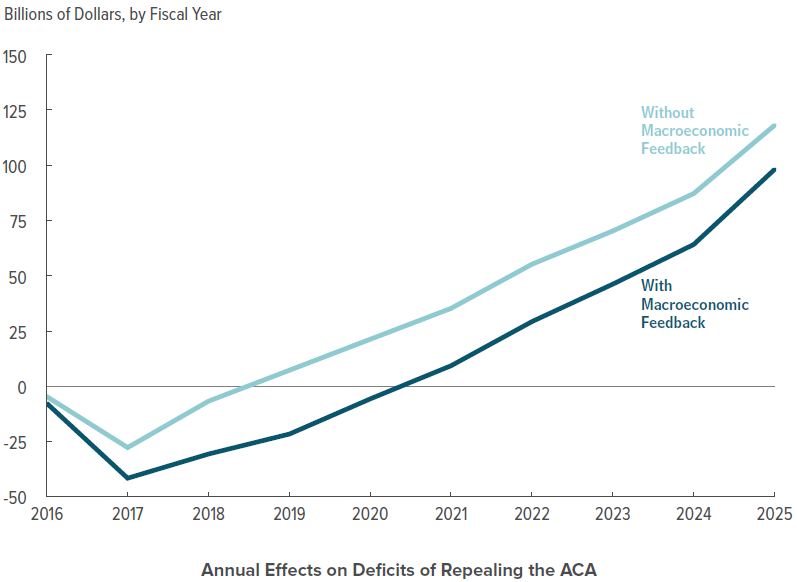
CaptureIn addition, the Congressional Budget Office has just released a report on the “Budgetary and Economic Effects of Repealing the Affordable Care Act,” indicating that repeal of the ACA would add $137 to the deficit over 10 years.  This is because the loss of ACA imposed new tax revenues and spending cuts to Medicare would exceed the amount of money spent to expand insurance coverage.
The economist John Goodman has an excellent new book, “A Better Choice: Healthcare Solutions for America,” describing several basic changes which would greatly improve the ACA.  In summary they are:

  • Replace all of the ACA mandates and tax subsidies with a universal (and refundable) tax credit which is the same for everyone. This is the fairest way to subsidize healthcare for all and it also removes the huge market distortion provided by employer provided health insurance which is tax exempt. The tax credit would be about $2500 per individual and $8000 for a family of four, the approximate cost of catastrophic health insurance and also the average cost of Medicaid.
  • Replace all of the different types of medical savings accounts with a Roth Health Savings Account (after-tax deposits and tax-free withdrawals).
  • Allow Medicaid to compete with private insurance, with everyone having the right to buy in or get out.
  • Keep the ACA exchanges which would be required to provide change-of-health status insurance for the protection of the chronically ill.

Changes such as these would dramatically lower the cost of American healthcare by making all of us directly responsible for the cost of our own healthcare.  They would also virtually eliminate the perverse market effects of the ACA which encourage companies to cut back on numbers and working hours of employees.  This in turn would speed up the growth of our stagnant economy!

What’s Wrong With U.S. Manufacturing Policy


The Brookings Institution’s Martin Baily has an informative article, “what’s wrong with U.S. manufacturing policy,” in a recent issue of the Wall Street Journal.
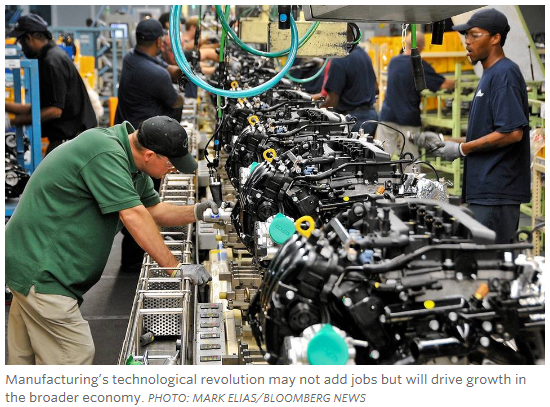
Capture1Says Mr. Baily, “Of the 5.7 million manufacturing jobs that disappeared in the 2000s, only 870,000 have returned so far, according to the Bureau of Labor Statistics, and the claim that millions more are coming back is nothing more than a myth. … If the U.S. is serious about promoting a recovery in manufacturing, it will stop measuring success by the number of people employed in the sector and start supporting the technological advancements that are making factories more productive, competitive and innovative.”
CaptureAccording to Mr. Baily the technological shift taking place is powered by three developments:

  • The internet of things in which machines are able to communicate with each other.
  • Advanced manufacturing including 3-D printing, new materials and more accurate digital logistics.
  • Distributed innovation in which crowdsourcing is used to find solutions to technical challenges more quickly.

Such advances must be supported even if it means putting robots in place of workers.  It follows that:

  • there will still be good jobs in manufacturing for those with big data, programming and other specialized skills
  • a shortage of qualified workers means we want highly qualified immigrants to stay in the U.S. instead of returning to their home countries
  • propping up uncompetitive jobs with tax breaks and subsidies won’t work for long and just interferes with introducing a lower corporate tax rate to drive new investment
  • new trade agreements strengthen U.S. manufacturing by reducing foreign barriers to U.S. goods
  • Displaced workers Should be supported with retraining programs especially through community colleges
  • Government can further help with infrastructure improvements and expedited permitting processes.

Conclusion:  U.S. manufacturing will continue to thrive in a rapidly changing environment as long as it is properly supported with intelligent government policies.

Economics Is a National Security Issue


“Speak softly and carry a big stick”                          President Theodore Roosevelt, 1900

There are many foreign policy issues facing the U.S. at the present time:

  • Russia is stirring up unrest in Eastern Europe by threatening the independence of Moldova and the Ukraine as well as several NATO countries.
  • The Middle East is in turmoil stirred up by ISIS and the effort to prevent Iran from acquiring nuclear weapons.
  • China is working hard to assert dominance in East Asia.

The world is more stable when there is a single dominant power such as the U.S..  If the U.S. retreats from this role, it is inevitable that regional powers such as Russia, China and Iran will assert themselves to take up the slack.  We don’t need to act as the world’s policeman every time a problem flares up around the world.  But democracies are  better actors on the world stage than are autocracies.  Therefore the whole world benefits when the U.S. projects power and interest.
CaptureA column in today’s Wall Street Journal by Michele Flournoy and Richard Fontaine makes a very important point, namely that “Economic Growth Is a National Security Issue.” In other words, the stronger is our economy, the more influence and respect we will enjoy in our relations with other countries.  Especially they recommend emphasizing:

  • Trade and Investment. It looks like Congress will give the President trade-promotion authority for negotiating a Trans-Pacific Partnership free-trade agreement. Indian, African and European trade agreements could then follow.
  • Energy. The ban on the export of crude oil and natural gas should be lifted.
  • International Institutions. A Chinese-led Asian Infrastructure Investment Bank will be much less of a threat to the U.S. one a TPP trade agreement goes into effect.

Ms. Flournoy and Mr. Fontaine are focused here on international economic growth.  But all economic growth, domestic as well as international, will make the U.S. stronger and therefore better able to project power.
Conclusion: we need to focus more strongly on economic growth in all of its guises!


Why Is U.S. Productivity Growth Declining?


The economist Alan Blinder has just reported, “The Mystery of Declining Productivity Growth” that U.S. productivity growth has fallen dramatically in the last few years.  “The healthy 2.6% a year from 1995-2010 has since been an anemic 0.4%.  What’s scary is that we don’t know why.”
CaptureThe economists Edward Prescott and Lee Ohanian believe the productivity slowdown is caused by a corresponding slowdown in new startups (as illustrated by the above chart).  They point out, for example, that:

  • The creation rate of new businesses in 2011 was 30% lower than the average rate of the 1980s.
  • New startups are critical for growth since many of today’s heavyweights will decline as new businesses take their place. For example, only half of the Fortune 500 firms in 1995 remained on that list in 2010.
  • Startups in high technology have also declined since 2000 even though there is no slowdown in the development of new technology.

Consistent with the recommendations of James Bessen in a recent post of mine, “Learning by Doing,” Messrs. Prescott and Ohanian recommend policy changes such as:

  • Better training, plus immigration reform, to produce more skilled workers.
  • Streamlining regulations that raise cost, especially for small businesses.
  • Tax reform to reduce marginal tax rates.
  • Reforming Dodd-Frank to make it easier for small businesses to obtain loans from main street banks.

In today’s New York Times, the economist Tyler Cowen wonders whether our economy is in the midst of a “Great Reset.”  “Perhaps the most crucial issue is whether economies will return to normal conditions of steady growth, or whether we are witnessing a fundamental transformation” to a less productive economy.
Here’s another way to put it: shall we attempt to adopt better pro-growth policies or shall we just give in to the status quo and accept that we can’t do any better?  Are we optimists or are we pessimists?

Baltimore Is About Economics, Not Racism


The death of another black man at the hands of the police, this time Freddie Gray of Baltimore, has again set off a national debate about poverty, inequality and racial injustice.
CaptureThe Washington Post journalist Marc Thiessen wrote about this several days ago in, “The Baltimore Democrats Built,” saying that:

  • Although 63% of Baltimore residents are black, so are 40% of police officers.
  • City officials injected $130 million into the Sandtown-Winchester community (where the riots took place) in a failed effort to transform it.
  • The poverty rate in Baltimore is 24% compared with 14.5% nationally.
  • The unemployment rate for black men in Baltimore between the ages of 20 – 24 is 37%.
  • Among the nation’s 100 largest counties, the one where children face the worst odds of escaping poverty is the city of Baltimore.
  • In 2014, Baltimore public schools ranked third in the country in per-pupil spending, yet 55% of Baltimore fourth graders scored below basic in reading.
  • In the Sandtown-Winchester community, nearly half of all high school students missed at least 20 days of school in 2011.
  • This community’s murder rate is double the average for Baltimore, which in turn had the fifth highest murder rate last year among major U.S. cities.

In other words, Baltimore’s problems cannot be blamed on racial prejudice or on a lack of resources to combat poverty and low educational performance.  Clearly needed are better schools and more employment opportunities.  Better state and local leadership would help in this respect. But what is most needed is faster economic growth for the whole country.  There are many things which could be done to accomplish this.  It’s a shame that our current political system is too fractured to allow this to happen.

One Thing Congress and the President Are Doing Right


This blog is mostly devoted to a discussion of the big fiscal and economic problems facing our country.  A growing and fiscally prudent economy will do the most good for the greatest number of Americans.  I have also argued that “A Strong Country Requires a Strong Economy” in the sense that our adversaries take us more seriously because we have the world’s dominant economy.
In addition, I strongly believe that U.S. power plays a critical role in maintaining stability around the world.  More bluntly, the world is better off because the good guys are also the strong guys.  It is often said that we can’t police the whole world but whether we want to or not we have this role.
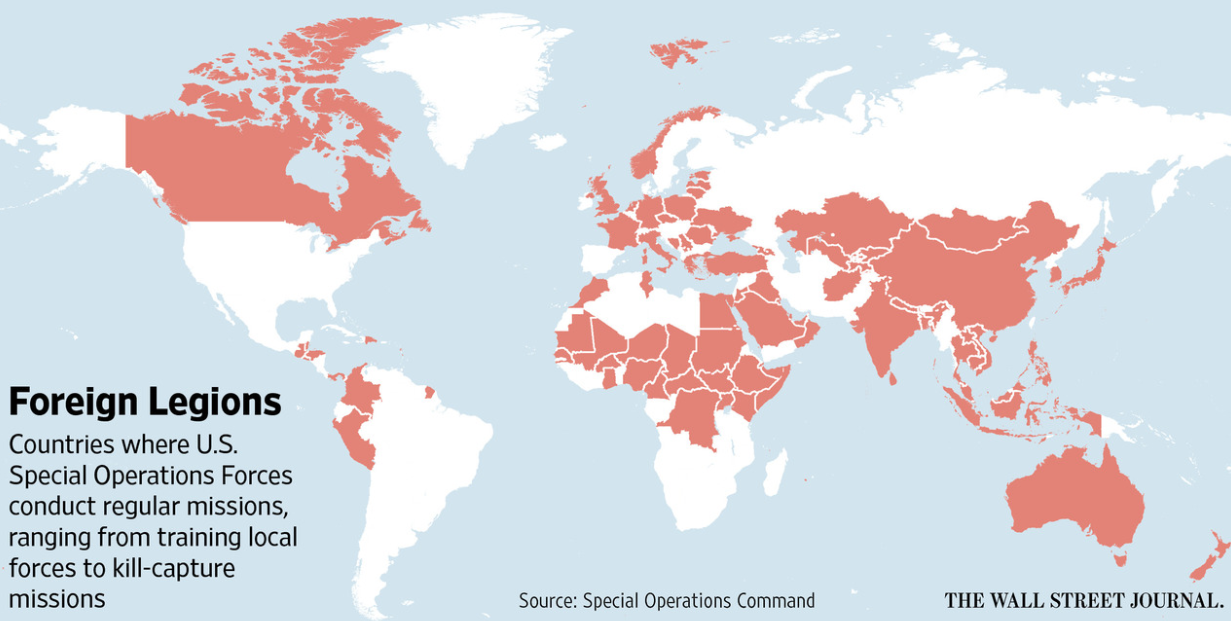
CaptureIn this regard, the Wall Street Journal has just published an informative article, “New Way the U.S. Projects Power around the Globe: Commandos.” The U.S. Special Forces currently has 70,000 people in uniform and an annual budget of $10 billion.  Last year they operated in 81 different countries on six continents.  For example:

  • Navy SEALs and Army Green Berets are stationed in the Baltics, training troops from Lithuania, Estonia and Latvia for the type of proxy warfare Russia is conducting in eastern Ukraine.
  • U.S. forces are helping Filipino forces stymie al Qaeda aligned Abu Sayyaf Group.
  • The U.S. has trained Columbian troops to fight rebels and drug traffickers.
  • A Navy Seal raid killed Osama bin Laden in his Pakistani hideout.
  • U.S. special operators work with Ugandan troops to hunt the leader of the Lord’s Resistance Army.
  • 1,300 troops from 18 western nations are training commandos from 10 African countries to fight extremist organizations such as Islamic Maghreb and Boko Haram.

The world is a messy, chaotic place.  Our own wellbeing depends on maintaining at least a minimal degree of stability.  We have accepted this responsibility and are meeting it head on.  This represents America at its best.

The Republican Budgets Focus on Entitlement Savings


Last week, both the House and the Senate passed ten year budget plans which would bring the federal budget into balance by 2025.  I have devoted several recent blog posts to discussing these budget proposals and how they address our very serious debt and deficit problems.
CaptureThere are several important points to make:

  • Under both of these Republican plans, overall spending will continue to increase by an average of 3.3% per year, from $3.8 trillion in 2016 to just over $5 trillion in 2015. The President’s budget would increase spending to $6.17 trillion by 2025 and would achieve no balance between spending and revenue.
  • Most of the savings in the Republican budgets, as indicated in the above chart, come from the mandatory (entitlement) programs of Social Security, Medicare and Medicaid. Medicare would be transformed into a subsidy program along the lines of the exchanges set up under the Affordable Care Act. Medicaid would be turned into a block grant program administered by the states. Social Security would be studied by a bipartisan commission to recommend operating efficiencies.
  • Other social welfare programs would be affected to a much smaller extent. For example, the Supplemental Nutrition Assistance Program (SNAP), or Food Stamps, has seen a growth of recipients of 69% between 2008 and 2013 while the poverty rate increased by just 16.5% during the same period. The Republican budgets would block grant Food Stamps to the states in order to achieve operating efficiencies.
  • It is true that both the House and Senate budgets would increase military spending by about 10%. But so would the President’s budget and we live in a very dangerous world. Military defense is one of the most very basic functions of our federal government.

Our country is in dire fiscal condition with large annual deficits projected indefinitely into the future, contributing to an exploding national debt.  It is heartening that our political system is responding to this threat to our future security and prosperity.  Let’s hope that House and Senate majorities continue to keep a sharp focus on the urgent task of fiscal restraint.