The High Cost of Less Austerity


All eyes are focused on the drama playing out in Greece.  The Greeks have just voted not to accept Europe’s latest offer to keep the credit flowing, amounting to a 5% of Greek GDP income transfer from their European neighbors, in return for additional economic reforms to put the country on a path to self-sufficiency.
Capture1The New York Times declares, “For Europe’s Sake, Keep Greece in the Eurozone,”  that the European Union should “offer some path forward for the Greek economy, starting by writing down its huge and unpayable debts.”  More than likely EU leaders will work out a new agreement with Greece to enable it to remain in the EU and the Eurozone.  Greece is lucky to be in such a position.
In a recent post, “Could the U.S. End up Like Greece? II. How Long Will It Take?”, I pointed out that the U.S. is likely to have a public debt of 175% of GDP by 2040, the same level as the Greek debt today.  Furthermore interest rates are likely to be higher than their unusually low level today which means that we will be making proportionally higher interest payments at that time.  In other words, we are likely relatively soon, within 25 years, to have a painfully high level of debt.
Who is going to bail us out when our own debt becomes “unpayable”?  Obviously, no one!  Right now the austerity and pain caused by the Greek debt is confined to the 11 million people in Greece.
Which is better?  For us to bite the bullet now and get our fiscal house in order by, for example, moving towards annual balanced budgets Or to wait until our debt becomes unbearable and there is no one to bail us out?
We are so big that if this ever happens and drastic measures have to be taken, much of the world will be drawn into the suffering along with us.  It won’t be a pretty sight!

The Land of the Free and the Home of the Brave


As we celebrate the 239th anniversary of the signing of the Declaration of Independence in 1776, Americans have much to be thankful for.  It is often said that the United States is the strongest, wealthiest and freest country the world has ever known.  Although this may be somewhat of an exaggeration (see below), it is still indicative of how fortunate we are compared to the rest of the world.
CaptureAs we celebrate our good fortune, we need to be acutely aware that our continued success as a great nation is not automatically assured.  In fact we face a number of troubling and persistent problems which are not likely to disappear unless we take strong action to address them.  For example we have:

  • A stagnant economy with only 2.2% annual growth since the end of the Great Recession. And the Congressional Budget Office predicts no speed up over at least the next ten years, based on current policy. Such slow growth condemns 20 million unemployed and underemployed citizens to unfulfilling lives, as well as lackluster pay raises for many more tens of millions.
  • Massive debt. Our public debt (on which we pay interest) is now at 74% of GDP, highest since the end of WWII, and predicted by the CBO to grow rapidly under current policies. When interest rates return to the normal 5% level, interest payments on the debt will skyrocket, making it much more difficult to fund all of the federal programs we depend on for our quality of life.
  • Increasing Income Inequality is real even if overhyped in the media. America is still a land of great opportunity but basic fairness demands that all citizens be able to share in our national abundance.
  • Threats from abroad. ISIS now controls much of Iraq, Syria and northern Africa and must be defeated. NATO needs our very strong support, all the more so with the Eurozone and European Common Market under increasing pressure from within.


As the strongest nation in the world we have much responsibility for continued world peace and prosperity.  We can’t fulfill this role adequately unless our own internal fiscal and economic policies are in fundamentally sound shape.
Let’s be thankful for what we have and bear down hard to insure that we keep it!

Could the U.S. End Up Like Greece? II. How Long Will It Take?


My last blog post, “Could the U.S. End Up Like Greece?” compares Greece’s present fiscal situation (public debt at 180% of GDP) with our own current fiscal situation (public debt at 74% of GDP and rising fast).  The Congressional Budget Office predicts that, under current policy, the U.S. debt will not reach 180% until about 2055, forty years from now.  One could (wrongly!) conclude from this that we are okay for the time being.
CaptureHowever, this is not true!  The Peter G. Peterson Foundation has taken a closer look at the most recent CBO report.  Under a less optimistic, but more realistic, Alternative Fiscal Scenario, the U.S. debt will reach 175% in 2040.  The Alternative Fiscal Scenario assumes, for example, that:

  • About 50 expiring tax breaks will continue to be extended year by year, as they were in 2014 and have been repeatedly in the past. These “tax extenders” increase the deficit by over $40 billion per year.
  • Discretionary spending will soon rise back up to its historical share of GDP. In other words, the sequester, which is currently holding down the growth of discretionary spending, may be overridden or at least relaxed.

Greece, with its debt at 180% of GDP, is only being required by the European Central Bank to pay 1.7% interest on this debt indefinitely into the future.  Thanks to the low interest rate policy of the Federal Reserve, 1.7% is also the current rate of interest being paid on the U.S. debt.  But this historically low interest rate is unlikely to continue much longer without setting off a much higher rate of inflation.
In other words, we’ll likely be in the same situation as Greece is currently, in much less than 25 years.  Furthermore, Germany and the other EU countries have been keeping Greece afloat for years and may continue to do so.
Who is going to bail us out when we get to where Greece is now?  China?  Unlikely.  We’ll be on our own and it won’t be pretty!

Could the U.S. End Up Like Greece?


The whole world is watching while Greece decides between two unpleasant alternatives.  Will it further tighten its belt in order to stay in the Eurozone?  Or will it default on its massive debt, reintroduce the drachma and go through a severe recession likely accompanied by hyperinflation?   Greece has put itself into this precarious position by accumulating a debt of 180% of GDP.  It’s current situation would be much worse if it were not getting by with the low interest rate of 1.7% from the European Central Bank.
CaptureCompare Greece (see chart above) with the U.S. debt situation.  Our current public debt (on which we pay interest) is 74% of GDP.  This is the highest it has been since the end of WWII.  And, thanks to Federal Reserve policy, we are now paying an historically low interest rate of 1.7% on this debt.
The problem is that (under current policy) our debt will keep growing larger and larger until, by 2080, it would reach the enormous level of 270 % of GDP.  Our very low interest rate level of 1.7% will almost surely rise in the near future to a more normal level of 5%.  As interest rates do begin to rise, and long before the debt reaches 270%, interest payments on the debt will have increased to a much higher level, crowding out other spending.
Notice that, according to the above chart, our debt will reach the Greek level of 180% around the year 2055.  But with higher interest rates, it would be exceedingly reckless to assume that we won’t arrive at Greece’s currently perilous state much sooner than that.
Understanding that we have a very serious long term debt problem, it is imperative to begin to address it now, because the longer we wait:

  • the older our population gets
  • the higher the debt will rise
  • the less time we’ll have to phase in changes
  • the slower our economy will grow, and
  • the fewer tools we will have to fix it

The answer to the question in the title is: Yes, we could easily end up like Greece if we are foolish enough to postpone action on our own debt problem for much longer.

Life in America: Opportunity or Inequality?


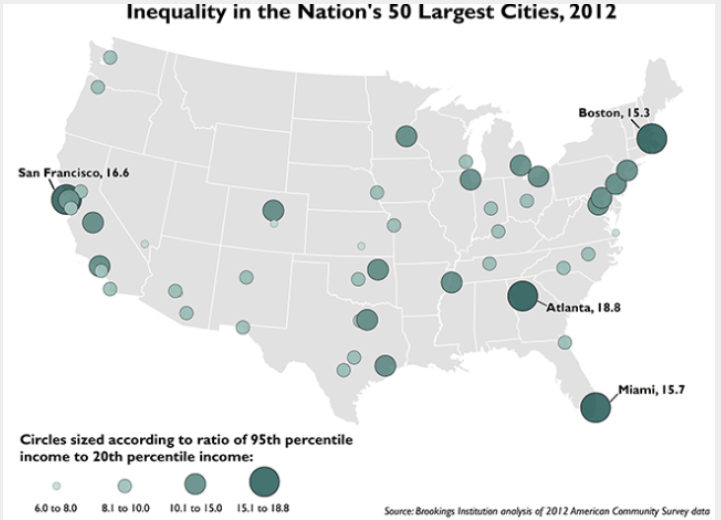
How bad is income inequality in the U.S. and what should be done about it?  This is a question of great current interest with many different points of view.  The chart just below from the Congressional Budget Office shows the extent of income inequality and also shows that it has gotten somewhat worse between 1979 and 2007, just before the onset of the Great Recession.  And we know that our stagnant economy has made it worse yet between 2007 and the present.
CaptureBut now look at the chart (below) from the U.S. Census Bureau of the distribution of household income in the U.S. in 2012.  The chart shows the median income of about $51,000 and then has a very long tail to the right.  This means that there are large numbers of households making large incomes of all different sizes.  It makes no particular sense to distinguish the top 1% (who make $380,000 or more) from the bottom 99%.
Capture1The point is that there is huge opportunity in the U.S. to do very well financially whether or not one makes it into the top 1%.
In an earlier post, “Growth vs Equitable Growth,” I reported on the agenda of the Washington Center for Equitable Growth, a progressive think tank.  In order to achieve “equitable growth” they advocate:

  • Improving educational outcomes at all levels, pre-K – 12+.
  • Running a “high pressure” economy in order to tighten the labor market.
  • Expand the Earned Income Tax Credit especially for workers without children.

I couldn’t agree more.  This is an excellent plan to create more prosperity for more people.  It’s much more plausible in the U.S. to make poor people richer than to make rich people poorer.

Can the U.S. Economy Grow Faster?


The U.S. economy has grown at the rate of only 2.2% since the end of the Great Recession in June 2009.  This is much slower than the average rate of growth of 3% for the past fifty years.
CaptureThe economists Glenn Hubbard and Kevin Warsh, writing in the Wall Street Journal, “How the U.S. Can Return to 4% Growth,” point out that:

  • After the severe recession of 1973-1975, the economy grew at a 3.6% annual real rate during the 23 quarters that followed.
  • After the deep recession of 1981-1982, real GDP growth averaged 4.8% in the next 23 quarters.
  • Recent research has shown that steep recoveries typically follow financial crises.

The economist John Taylor, also writing in the WSJ, “A Recovery Waiting to Be Liberated,” explains that the growth of the economy, i.e. growth of GDP, equals employment growth plus productivity growth.  He then points out that:

  • Population is growing about 1% per year. However the labor-force participation rate has fallen every year of the recovery, from 66% in 2008 to 62.9% in 2014. Even turning this around slightly would increase employment growth above the 1% figure coming from population growth alone.
  • Although productivity growth has hovered around 1% for the past five years, this is less than half of the 2.5% average over the past 20 years.

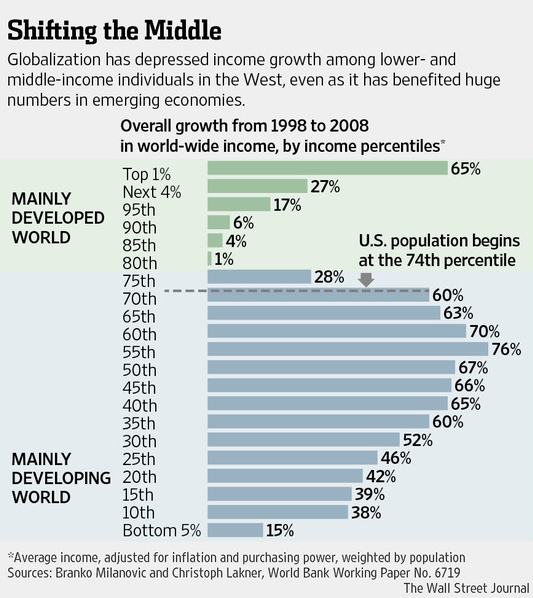
Given the strong headwinds of globalization and ever new technology affecting the U.S. economy, we especially need new policies such as:

  • Fundamental tax reform directed at increasing the incentives for work and driving investment in productive assets.
  • Regulatory reform that balances economic benefits and costs (e.g. lightening the burdens of Obamacare and Dodd-Frank).
  • Trade agreements to break down barriers to open global markets.
  • Education policies to prepare all young people for productive careers.

In other words, rather than accepting our current situation as “the new normal” or as unalterable “secular stagnation,” we need to “give growth a chance”!

Letting Young People Drift and the Liberal Disconnect


The New York Times had an excellent lead editorial on Sunday, “The Cost of Letting Young People Drift,” describing how 5.5 million young Americans, ages 16 – 24, are neither working nor in school.  “At a time when the economy is requiring workers to have higher levels of skills, one in seven of America’s young adults can’t even get started.”
CaptureThe NYT editorial is based on new research, “Zeroing In on Place and Race: youth disconnection in America’s cities” performed by Measure of America.  The report points out that the problem has gotten much worse since the Great Recession in 2008, as shown in the chart below.
Capture1It also breaks down the youth disconnection rate by state.  For example, Nebraska (7.6%), North Dakota (7.9%) and Iowa (8.8%) have the lowest percentages, while Mississippi (18.5%), West Virginia (19.6%) and Louisiana (19.8%) have the highest percentages (as shown below).
Capture2Capture3But also look at the latest “Unemployment Rates for States” published by the Bureau of Labor Statistics.  There is a very close connection between a state’s unemployment rate and its youth disconnection rate, as shown below. In other words, one of the best ways to keep young people connected is to give them a better chance of finding a job.
Capture4Capture6But it requires faster economic growth to provide more jobs.  Just yesterday the NYT had an editorial, “Obstacles to Economic Growth,” lamenting our very slow rate of economic growth of about 2.2% for the past six years.  According to the NYT, “What’s needed most is public and private investment in the economy sufficient to support strong growth and rising productivity.”  The editorial then goes on to berate Congress for being more interested in budget cuts than in new spending programs to stimulate the economy.  According to the NYT, “the pathway to prosperity is clear for leaders who will dare to take it.”
The NYT thus recognizes the need for more private investment to stimulate the economy but has no apparent interest in policy measures to encourage it.  How can a news organization as sophisticated as the NYT be so passionate about wanting to improve society and so clueless about the best way to do it?

Why Obamacare Should Be Fixed and not Repealed


The Supreme Court will soon render an opinion in King v. Burwell challenging the implementation of the Affordable Care Act.  If the Court agrees with the plaintiffs, then anyone receiving health insurance through one of the federal exchanges operating in 33 states is not eligible to receive a subsidy.  Several Committees in the House of Representatives are proposing to take such an opportunity to make improvements to the ACA.
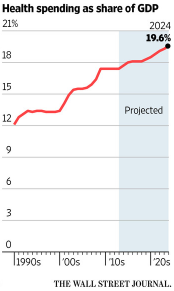
CaptureIn addition, the Congressional Budget Office has just released a report on the “Budgetary and Economic Effects of Repealing the Affordable Care Act,” indicating that repeal of the ACA would add $137 to the deficit over 10 years.  This is because the loss of ACA imposed new tax revenues and spending cuts to Medicare would exceed the amount of money spent to expand insurance coverage.
The economist John Goodman has an excellent new book, “A Better Choice: Healthcare Solutions for America,” describing several basic changes which would greatly improve the ACA.  In summary they are:

  • Replace all of the ACA mandates and tax subsidies with a universal (and refundable) tax credit which is the same for everyone. This is the fairest way to subsidize healthcare for all and it also removes the huge market distortion provided by employer provided health insurance which is tax exempt. The tax credit would be about $2500 per individual and $8000 for a family of four, the approximate cost of catastrophic health insurance and also the average cost of Medicaid.
  • Replace all of the different types of medical savings accounts with a Roth Health Savings Account (after-tax deposits and tax-free withdrawals).
  • Allow Medicaid to compete with private insurance, with everyone having the right to buy in or get out.
  • Keep the ACA exchanges which would be required to provide change-of-health status insurance for the protection of the chronically ill.

Changes such as these would dramatically lower the cost of American healthcare by making all of us directly responsible for the cost of our own healthcare.  They would also virtually eliminate the perverse market effects of the ACA which encourage companies to cut back on numbers and working hours of employees.  This in turn would speed up the growth of our stagnant economy!

The Fiscal Time Bomb Is Still Ticking!


The Congressional Budget Office is by far the most objective source of detailed information about the federal budget, playing a valuable role in the super-charged political atmosphere of Washington D.C.  It has just released a new annual report, “The 2015 Long-Term Budget Outlook,” projecting our fiscal health for the 25 year window, 2015-2040, based on current policy. It is a scary scenario indeed.
CaptureAs shown in the above chart, our public debt (on which we pay interest) has increased from 38% of GDP at the beginning of the Great Recession in 2008 to 74% today.  Although it will remain steady at this high level for about five years, it will then resume a steady increase, reaching a level of about 100% of GDP by 2040.
As many observers, including myself, have pointed out, when interest rates eventually return to their normal historical level of around 5%, interest payments on this huge, and rapidly increasing, debt will double or triple from their current low level, causing a very painful budget shortfall.
Simple prudence suggests that the only responsible course of action is to put our debt on a downward path, as a percentage of GDP, in order to minimize this looming problem to the greatest possible extent.
Capture1CBO gives some useful guidelines for what is required to do this:

  • Just to keep the debt at its current value of 74% of GDP by 2040 would require an annual 6% increase in revenue or a 5½% decrease in spending. This would amount, for example, to a $210 billion spending cut for 2016.
  • To reduce the debt to 38% of GDP by 2040, its average over the past 50 years, would require an annual 14% increase in revenues or a 13% decrease in spending. The spending cut for 2016 would be $480 billion.

These examples show the enormity of the fiscal mess we have gotten ourselves into.  Under current policy it will require a big effort just to stay even with where we are right now, without showing any debt reduction over the next 25 years!
Our only hope is to change current policy.  But how?

An Off-Ramp from Obama Care


The Supreme Court will soon render an opinion in King v. Burwell, challenging the implementation of the Affordable Care Act which stipulates that subsidies can only be paid “through an Exchange established by the State.”  If the plaintiffs are upheld, it will mean that anyone receiving health insurance through one of the federal exchanges operating in 33 states is not eligible to receive a subsidy.  It will be necessary for Congress to intervene to fix a problem like this.
CaptureThree committee chairs in the House of Representatives, John Kline, Paul Ryan and Fred Upton, are proposing to take such an opportunity to improve the Affordable Care Act along the following lines:

  • First of all, making health insurance more affordable by ending both the individual and employer mandates, and giving choices back to the states, individuals and families.
  • Secondly, supporting Americans in purchasing the coverage of their choosing. For example, people could save money by buying insurance across state lines.
  • Finally, many existing features of the ACA would be retained. Children could stay on their parents policies until age 26. Lifetime limits on benefits would be prohibited. People with existing conditions would be protected. Renewability would be guaranteed. Insurance would be decoupled from employment by offering equal (perhaps, age adjusted) tax credits for all.

There remains the practical problem of providing immediate assistance to the approximately 5 million people currently receiving subsidies through the federal exchanges, while larger scale changes are being worked out by Congress.  The American Enterprise Institute has proposed a simple way for Congress to do this as follows:

  • Enact a short-term extension of subsidies for current enrollees.
  • States with federal exchanges could immediately set up a state exchange if they wished.
  • People with preexisting conditions and/or continuous coverage would be protected.

Both quality control and cost control are badly needed to make the ACA sustainable for the long run.  Given the right decision in King v. Burwell, these two plans outline a possible way to accomplish this.