Why We Need a Carbon Tax V. We’re Playing with Matches!


“Risk is like fire: If controlled it will help you; if uncontrolled it will rise up and destroy you.”                                                                            Theodore Roosevelt,   1858 – 1919

Just a few days ago I featured an Op Ed column in the New York Times “The Coming Climate Crash” by Henry Paulson, the former Secretary of the Treasury.  He discusses global warming as an economic issue.  The increasing number of severe storms, deeper droughts, longer fire seasons and rising sea levels it will cause will wreak tremendous economic damage on our country and the whole world as well.
CaptureA new report, “Risky Business” produced by the Risky Business Project, elaborates much further on this theme.  “The American economy is already beginning to feel the effects of climate change.  These impacts will likely grow materially over the next 5 to 25 years and affect the future performance of today’s business and investment decisions in the following areas: coastal property and infrastructure (damaged by storm surges and higher sea levels); agriculture (disrupted by higher temperatures); energy (costs will go up to provide more cooling).”
In addition to the large scale economic effects referred to above, global warming will affect each of us in a very direct way.  For example, in Omaha NE where I live, in just a few short years the current average of about 10 days per summer with a temperature over 95 degrees F, will increase to about 25 such summer days.
All of these effects are assuming that we continue on our present course of rapidly increasing CO2 build up in the atmosphere.  We do have a choice in this matter.  We can cut back but it will take a big effort to accomplish this.  The whole world needs to cut back and it is up to the U.S. to lead the way.
Republicans need to step forward on global warming.  It is highly irresponsible to say that any anti-carbon measures we take will just hurt our economy and ignore all of the harmful effects of proceeding on our present course.  It is also irresponsible to say that we can’t act unless everyone else does too.  If we are exceptional, and I agree that we are, then it is up to us to set an example for the whole world.
We need fiscal conservatives in office to address our very serious deficit and debt problems.  But fiscal conservative have to win the trust of a wider group of voters to show that they are deserving of broader support.

The President Plays Small Ball


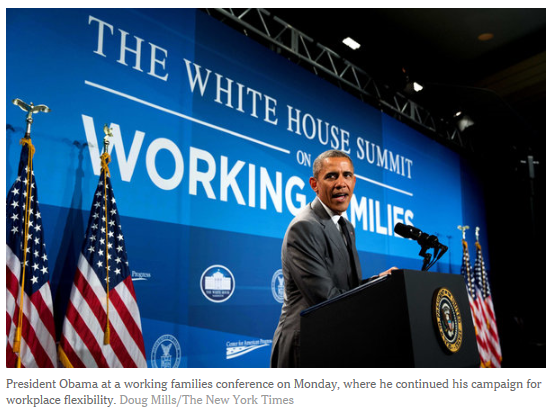
As reported in today’s New York Times, ”Personal Tack by Obama in an Effort to Aid Parents”, the President held an all-day conference yesterday for working families, saying that

  • “Family leave, child care, workplace flexibility, a decent wage – these are not frills – they are basic needs.”
  • “There is only one developed country in the world that does not offer paid maternity leave. And that is us. And that is not the list you want to be on by your lonesome.”
  • “We need you to tell Congress, don’t talk about how you support families: actually support families.”

Capture

The economic journalist, Robert Samuelson, pointed out in the Washington Post a few days ago, ”The Jobs Mystery”, that even though our unemployment rate has now dropped to 6.3%, there are still 9.8 million officially unemployed people, plus an additional 7 million who would like a job but are not looking.  There are also 7.3 million part-time workers who would like longer hours.  This gives a really quite shocking total of 24.1 million unemployed or underemployed workers.
Granted we had a bad recession which was not the President’s fault, but it ended in June 2009, a full five years ago.  In the meantime his administration has done much to retard economic growth (passing ObamaCare and the Dodd-Frank Act) and little, besides huge deficit spending, to boost it.  He and the Democratic Party should be held responsible for this neglect and they probably will be.
One thing which would do a lot to boost economic growth is apparently contrary to liberal ideology and therefore off the discussion table.  I am referring to fundamental, broad-based tax reform whereby individual tax rates would be lowered across the board, but in a revenue neutral manner, by closing or greatly shrinking the loopholes and deductions which primarily benefit the wealthy.  The two-thirds of Americans who do not itemize their tax deductions would get a big boost in take home pay.  Since they are primarily middle and lower income workers whose wages have been stagnant since the recession began, they will tend to spend this extra income, thereby giving the economy a big boost.
If the President were to sincerely ask the House Republican leadership to work with the Democratic Party to boost economic growth, something along this line could be acted upon.  This is the way to really aid families.  Why doesn’t he do it?

Why We Need a Carbon Tax IV. The Economic Risks of Climate Change


I have now posted more than 200 entries on my blog.  I have discussed a wide variety of fiscal and economic issues in the last year and one-half.  But there are really, in my opinion, just a fairly small number of basic themes in my posts, such as:

  • Eliminating deficit spending so that we can shrink our national debt over time to a substantially lower level than the current 73% of GDP.
  • Boosting our economy in order to put more people back to work as well as bringing in more tax revenue.
  • Maintaining an activist foreign policy including a sufficiently strong military force to protect our free and democratic way of life.
  • Maintaining high citizen morale by addressing other critical domestic issues such as economic mobility and increasing income inequality.
  • Addressing natural threats to our way of life such as global warming.

Capture Today’s New York Times has an excellent article on global warming “The Coming Climate Crash” from a surprising source, former Secretary of the Treasury, Henry Paulson.  He was in office when the credit bubble burst in 2008 and is therefore an expert on crisis management.  His argument is that global warming presents a strong economic threat as well as an environmental threat.  It therefore should be addressed by an effective economic policy, such as a carbon tax.  He points out that:

  • Global warming is a far more intractable problem than a credit bubble, not at all amenable to a relatively quick fix by government action.
  • A threat from nature like global warming is not an ideological issue because it affects all of us in the same way, conservatives and liberals alike.
  • A future with more severe storms, deeper droughts, longer fire seasons and rising sea levels creates huge economic risks which we ignore at our great peril.
  • A carbon tax doesn’t outlaw the use of fossil fuels but rather creates a huge economic incentive for developing carbon sequestration when fossil fuels are burned.

Government regulation of fossil fuels by the Environmental Protection Agency represents a timid and arbitrary half measure that won’t have nearly the impact of a sound economic incentive like a carbon tax.  Let’s get serious and do things the right way!

Crony Capitalism and Economic Growth


“If there is one thing that populists on the left and right can agree upon, it is disdain for crony capitalism.  It is a distaste for the cesspool of Washington influence in which big-business lobbyists canoodle with lawmakers to get their way.  It is anger at corporate welfare enriching America’s biggest companies at the expense of the little guy.”  So says the economics journalist Neil Irwin in today’s New York Times, “Why we’re All Crony Capitalists, Like It or Not”.
Specifically he is talking about the current debate in Congress over whether or not the Export-Import Bank of the United States should be continued.  It mostly helps big corporations like Boeing and General Electric finance sales to other countries.  But there’s a trade off.  If it shuts down, then American corporations will be at a disadvantage compared with international competitors who get help from their own governments.
CaptureIn fact, crony capitalism has a much wider scope than this.  Each year deductions and loopholes in the U.S. tax code, referred to euphemistically as tax expenditures, total $1.2 trillion in lost tax revenue.  As the above chart from the Congressional Budget Office shows,  50% of these tax reductions are enjoyed by the highest earning 20% of all U.S. households, with 30% of the benefits going to just the top 5%.
Many experts say that our stagnant economy is caused by a lack of consumer demand, in turn caused by the huge loss of wealth during the Great Recession.  If lower and middle income people had more money, they would surely spend it and our economy would grow faster.  This line of reasoning suggests a way forward!
We should enact fundamental, broad-based tax reform, whereby individual tax rates are lowered across the board, in a revenue neutral way, paid for by greatly shrinking the deductions and loopholes enjoyed by the top 5% of wage earners.  The two-thirds of taxpayers who do not itemize their deductions will receive a correspondingly significant increase in income which they are most likely to spend.
A plan like this would not only boost the economy but also boost public morale by lessening inequality.  A win, win plan!

How Not to Help Black Americans


“It is important and right that all privileges of the law be ours, but it is vastly more important that we be prepared for the exercise of these privileges.”                                                                  Booker T. Washington, 1856 – 1915

How do we lift up the black underclass, the school dropouts, gang members, and drug dealers who become criminals and spend their lives as a drag on society?  The Wall Street Journal’s (black) editorial writer, Jason Riley, addresses this question in today’s paper, “How Not to Help Black Americans”.  As he says “Upward mobility depends on work and family.  Government policies which undermine the work ethic – open-ended welfare benefits, for example – help keep poor people poor.  Why study hard in school if you will be held to a lower academic standard?  Why change antisocial behavior when people are willing to reward it or make excuses for it?”
A few days ago, Robert Balfanz, the Director of the Everyone Graduates Center at John Hopkins University in Baltimore, wrote in the New York Times, “Stop Holding Us Back”, that even though 80% of Americans now graduate from high school, 33% of the nation’s African-American and Latino young men will not graduate.  Half of these non-graduates go to a total of just 660 high schools out of a total of 12,600 high schools in the country.  He suggests the following:

  • Refocus such high-poverty high schools in order to identify by the middle of ninth grade the students most likely to drop out.
  • Set up early warning systems so that adults can step in at the first sign that a student is in trouble.
  • Employ additional adults to support students who need daily nagging to succeed, especially during the key transitional years in sixth and ninth grade.

Capture Such a plan has been instituted in the Chicago Public Schools as described in “Preventable Failure”.  As the above chart shows, it has led to dramatic improvement in the on-track rate of at-risk ninth graders in CPS.
These two school programs, in Baltimore and Chicago, represent what we should be doing to help all minorities, especially blacks, succeed in life.  Resources provided for such programs will do much more to eliminate poverty than expanding conventional welfare.

Escaping the Student Debt Trap


Student debt in the U.S. now tops $1.2 trillion with 37 million borrows, 5.4 million of whom have already defaulted.  President Obama has proposed to expand a program which allows students to repay debt based on what they earn, eventually forgiving the balance.  Massachusetts Senator Warren has proposed taxing millionaires to pay for student loan refinancing.  Small scale free market proposals abound.  What is badly needed is a sensible broad-based public program approved by Congress.
CaptureThe Brookings Institution has recently proposed just such a model for student loan repayment “Loans for Educational Opportunity: Making Borrowing Work for Today’s Students”.  It is based on four observations:

  • Moderate debt for the typical student borrower. 69% of students have borrowed $10,000 or less.
  • The high payoff of a college education. Over a lifetime the holder of a bachelor’s degree earns several hundred thousand dollars more than a high school graduate. Even those who attend college but do not graduate will experience an income gain of about $100,000.  Postsecondary education should be encouraged as widely as possible.
  • The highest rates of default are on typical loan balances. The average loan balance in default is $14,000 while the average loan balance in good standing is $22,000.
  • The highest rates of default are among young borrowers. For borrowers under age 21, 28% have defaulted, for borrowers between ages 30 and 44, 18% have defaulted and it is 12% for borrowers aged 45 and older.

The Brookings’ authors propose that student loan payments be deducted from pay by the employer, in the same way as for income taxes and Social Security.  The payment rate would be only 3% of the first $10,000 in annual earnings and would rise with higher earnings topping out at 10%.  Loan payments will stop when the loan is repaid or after 25 years, whichever comes first.  Various measures can be adopted to protect against deadbeats.  See the Brookings report for details.
The fairest system would be for all students, past and present, to be put into a program like this.  Nobody would be expected to pay during periods of unemployment. Interest rates could be adjusted from year to year to make the program self-supporting. Something along these lines is badly needed!

A Scarred U.S. Economy


Today’s New York Times has an article “U.S. Economic Recovery Looks Distant as Growth Stalls”, summarizing the predominant view of economic experts that annual growth of the U.S. economy in the future is now expected to be only 2.1%, about two-thirds of the historical rate of 3%.
CaptureThis is, of course, disappointing since it means continued stagnation of household incomes as well as high unemployment.  Much of the projected decline in GDP growth is attributed to structural factors such as:

  • The number of Americans receiving disability benefits has increased significantly in recent years. Few of these people will ever return to work.
  • Fewer immigrants are arriving. There are now two million fewer people over the age of 16 than had been projected in 2007.
  • The birth rate has declined each year from 2007.
  • Government spending on public investment has fallen by 8% since the recession started. Corporate investment has been lackluster.
  • Fewer businesses are being created and existing businesses are spending less on research and development.
  • Rising income inequality results in “secular stagnation” whereby there is insufficient consumer spending to stimulate economic growth.

There are lots of head winds slowing down the economy.  As the NYT article says, “for more than a century the pace of growth was reliably resilient, bouncing back after recessions like a car returning to its cruising speed after a roadblock.”  Treasury Secretary Jacob Lew says that the government now expects annual growth to be permanently slower.
Should we resign ourselves to this pessimistic attitude or should we consider whether or not there is any practical and feasible alternative?
There is, in fact, an easy way to speed up growth.  Broad-based tax reform would do it.  By this I mean lowering tax rates across the board paid for by closing loopholes and shrinking the deductions which primarily benefit the wealthy.  This would place more income in the hands of the two-thirds of taxpayers who do not itemize deductions.  These are typically middle and lower income folks with stagnant incomes.  They would spend their tax savings, thereby giving the economy a big boost.
This would also amount to redistribution from the rich to the poor, making us a more equal society in the process.  It’s a win-win for our economy and for social harmony.  What’s holding us back?

Raising America’s Pay II. How Can We Do It?


My last post “Raising America’s Pay” addresses a new report from the Economic Policy Institute, “Raising America’s Pay: Why It’s Our Central Economic Policy Challenge”.  Its starting point is the now generally accepted view that wages for the typical American worker have been flat ever since the early 1970s even though labor productivity has continued to rise steadily.
The EPI authors recognize that globalization and the growth of technology have contributed to wage stagnation even though they blame malign policy decisions as well.  I do agree with them that the resulting increase in economic inequality is detrimental to America.  I also agree with them that the way to address inequality is for wages to go up. The best way to accomplish this is to lower unemployment by increasing economic growth.  This will happen when large numbers of consumers start spending more money, thereby increasing demand.  Does this sound like a vicious circle?  It need not be!
CaptureThe above chart from the Wall Street Journal shows that the net worth of U.S. households has now more than recovered from the Great Recession.  The problem is that most of this new wealth has gone to the people with the highest incomes who are more likely to save it.  What we need to do is “redistribute” (gasp!) some of this vast sum of new wealth back to middle and lower income people who would be much more likely to spend it.
There is a straightforward way to do this.  Broad based tax reform!  Lower everyone’s tax rates paid for by closing loopholes and shrinking deductions which primarily benefit the wealthy.  This will be a pure gain in income for the two thirds of Americans, about 80 million, who pay income taxes but do not itemize deductions, most of whom are in the lower and middle income brackets.  These people are likely to spend most of their new income, thus giving the economy the big boost that it needs!
Our leaders in Washington should be able to figure this out!

Raising America’s Pay


The Economic Policy Institute has just issued a provocative new report, “Raising America’s Pay: Why It’s Our Central Economic Policy Challenge”.  It is based on the now widely accepted view, as summarized in the chart below, that wages for the typical (i.e. median, not average) American worker have been stagnant since the early 1970’s, even though productivity has continued to increase at its historical rate.
CaptureFirst of all, the authors make reasonable arguments that:

  • The slumping of hourly wage growth for the vast majority explains the overall trends in income inequality.
  • Wage stagnation stalls progress in reducing poverty.
  • Wages are the root of economic security for the vast majority. This includes the fact that Social Security benefits depend upon wage earnings before retirement.

Then they ask: “Why has wage growth faltered for the vast majority, and what can be done?”  Here is where the report becomes controversial!

  • The authors do agree that globalization of markets and technological change have contributed to the wage growth slowdown but argue that this overlooks the impact of labor market and tax policy and business practices as follows:
  • Falling top tax rates have increased the income share of the top 1 percent.
  • The Federal Reserve has prioritized low rates of inflation over low rates of unemployment in recent decades and high unemployment suppresses wage growth.
  • The erosion of the inflation adjusted minimum wage and the share of the workforce represented by a union explain much of the entire rise of wage inequality over this time period.

The authors are completely correct that stagnant wages for American workers is a critical, even “central,” problem facing the economy at the present time.  The question, of course, is how to address this problem most effectively.  In my opinion, the authors have completely neglected to take into account how a faster rate of economic growth would contribute to a solution of the problem and how this could be accomplished.  I will address this question in my next post in a couple of days.
They conclude by saying that this report is only the first in a multiyear research and public education initiative of the EPI.  We have a lot to look forward to!

Why We Need a Carbon Tax III. Natural Gas Is Not a Real Solution


Most people agree that global warming is for real and that it is caused by a buildup of greenhouse gases in the atmosphere, mostly from carbon dioxide.  We need to respond to this existential threat and the U.S. should lead the way.  The Environmental Protection Agency’s new regulations call for a 30% reduction in carbon emissions, from 2005 levels, by 2030.  Since fracking has led to a natural gas boom in the U.S. and the burning of natural gas only emits half as much carbon as the burning of coal, it is very likely that the new EPA rules will lead to a major replacement of coal by natural gas in U.S. energy production.
CaptureBut there is a downside to this approach as pointed out in yesterday’s New York Times, “The Potential Downside of Natural Gas,” as follows:

  • Natural gas is starting to replace nuclear power which has no carbon footprint. Last year five reactors announced that they would close because of the low cost of natural gas. This will increase CO2 in the atmosphere.
  • Fracking for oil produces natural gas as a side product which may not be easily marketable. This excess natural gas is either burned off or escapes unburned releasing methane which causes even more damage than CO2.
  • The low cost of natural gas is also slowing down the development of renewable energy sources such as wind and solar power.

A far more efficient system of reducing carbon dioxide in the atmosphere would be to tax its emission from any fuel source.  The most commonly mentioned amount is $20 per ton which would raise the price of gasoline by about 10 cents per gallon.   This way the use of all forms of fuel, including coal, oil and gas, would be taxed equally based on how much carbon they emit.  This would create a huge economic incentive for developing carbon capture in fuel combustion, which is the ultimate solution to eliminating CO2 emissions.
In other words, we have a huge problem on our hands which needs an effective solution.  Half measures will not get the job done and will just cause lots of confusion and political controversy in the meantime.  It’s time for some real leadership!