The Federal Reserve Cannot Revive the Economy by Itself


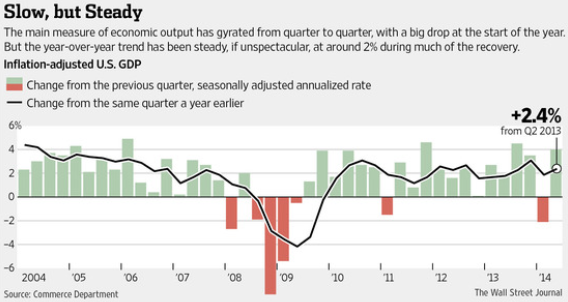
The Great Recession caused by the financial crisis ended in June 2009.  In the intervening five years the U.S. economy has grown at the anemic annual rate of 2.2%.  In an attempt to speed up growth the Fed has injected $4 trillion into the economy and kept short term interest rates near zero during this time period.  Fed Chair Janet Yellen recently gave her semiannual report to Congress and, according to the American Enterprise Institute’s John Makin, “Fed Chair Yellen puts on a brave face.”  She said that “If economy performance is disappointing, then the future path of interest rates likely would be more accommodative than currently anticipated.”
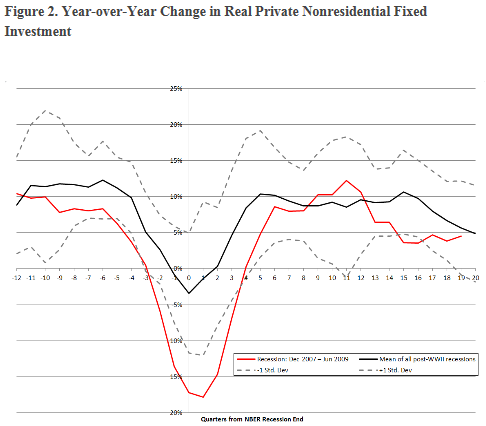
CaptureCapture1Mr. Makin adds that “Eventually the realization will dawn that the only way to get the economy moving again is to work on the supply side.  Specifically, that means undertaking measures to boost investment and produce a rising capital stock which will boost labor productivity, hiring, and GDP growth without inflation.” He suggests that three measures to boost capital spending are:

  • Enactment of accelerated depreciation provisions and investment tax credits.
  • A sharp reduction in the corporate tax rate from 35 to 15 percent to induce corporations to repatriate the $1.59 trillion in accumulated profits being held abroad.
  • A concerted White House-led effort to set a clear, less burdensome path for healthcare and other regulatory measures as a means to reduce investment dampening uncertainty.

I would add a fourth measure:

  • An across the board lowering of individual tax rates (offset by closing loopholes and deductions which primarily benefit the wealthy) in order to boost personal consumption which has been highly depressed due to stagnant wage growth and high unemployment.

In other words there are clear and straightforward measures which our national leaders can take to speed up the economy.  ‘If there is a will, there’s a way’ and incumbents should be held responsible for inaction come the elections in November!

The Truth behind the Latest Job Figures


Mortimer Zuckerman, writing a few days ago in the Wall Street Journal, “The Full-Time Scandal of Part-Time America,” points out that the latest employment figure of 288,000 net jobs created in June is highly misleading.  “Full-time jobs last month plunged by 523,000, according to the Bureau of Labor Statistics.  What has increased are part-time jobs.  They soared by about 800,000 to more than 28 million.” Mr. Zuckerman goes on to say, “Since 2007 the U.S. population has grown by 17.2 million, according to the Census Bureau, but we have 374,000 fewer jobs since a November 2007 peak and are 10 million jobs shy of where we should be.”
CaptureInterestingly, the New York Times discusses the same problem from a different point of view, ”A Push to Give Steadier Shifts To Part-Timers”.   The NYT does recognize that there are now about 7.5 million part-time workers who would prefer full time employment but are unable to find it.  But the emphasis is on giving them more advance notice for changes in work schedules.
The only way that we’ll get what we really need, more jobs, more good jobs and more fulltime jobs, is by faster economic growth beyond the anemic 2.2 average growth rate since the recession ended five years ago.  Here are several ways to accomplish this:

  • The most obvious and immediate thing we should do is to lower the corporate tax rate from its currently highest in the world level of 35%. This will stop the hemorrhaging of U.S. companies moving overseas and encourage multinational corporations to bring their profits home and reinvest them in the U.S.
  • Broad-based individual tax reform, with lower tax rates for all, offset by closing loopholes and shrinking deductions which primarily benefit the wealthy. This will put more money in the hands of the two thirds of Americans who do not itemize their tax deductions. Since these are the middle and lower income wage earners with stagnant incomes, they will spend their extra income thereby giving the economy a big boost.
  • The employer mandate in Obamacare is responsible for some of the shift from fulltime to part-time employment, and should be repealed (it has already been suspended for two years by the Obama Administration).

These are just common sense reforms which should be doable by Congress without a huge ideological fight.  We badly need leadership capable enough to do this!

How to Control Federal Spending III. Reform Medicaid!


One of the many controversies involving the Affordable Care Act concerns the expansion of Medicaid to cover low income people up to 138% of the federal poverty level.  As Robert Samuelson reported in the Washington Post a few days ago, “The Real Medicaid Problem,” 24 states have refused to expand Medicaid coverage even though the federal government will pay 100% of all additional costs until 2017.
CaptureAs Mr. Samuelson points out, the underlying issue is a matter of cost:

  • The basic Medicaid program is funded with a fixed percentage of each state’s costs paid by the federal government. This means that the more a state spends, the more is contributed by the federal government. From 1989 to 2013, the share of state budgets devoted to Medicaid has risen from 9% to 19%. This upward trend is clearly unsustainable.
  • In Medicaid, children and adults up to age 65 represent three-fourths of beneficiaries, but only one-third of costs. The quarter of beneficiaries who are aged or disabled are responsible for two-thirds of costs.
  • More than 60% of nursing home residents are on Medicaid.
  • There is no assurance that the federal share of the expanded coverage will continue at the announced rate of 90% after 2017 because the federal government is in much worse financial shape than are most states.

An interesting Op Ed appeared recently in the Wall Street Journal, “The Smarter Way to Provide Health Care for the Poor,” written by Mike Pence, the Governor of Indiana.  In 2008 Indiana set up the Healthy Indiana Plan to better serve low income Indianans.  It now provides Health-Savings Accounts to 40,000 low income citizens, with very good results.  Indiana is applying for a waiver to the ACA to use Medicaid expansion funds to provide HIP to all low income families up to 138% of the poverty level ($33,000 for a family of four).
Clearly, individual states, when offered the opportunity, are quite capable of coming up with innovative solutions for difficult problems.
A good way to resolve the problem of state resistance to Medicaid expansion is to fundamentally change Medicaid into a block grant program whereby the federal government contributes a specific amount of money to each state each year.  Then the states design their own programs to meet their own needs.  Block grant funding for Medicaid is a common sense approach to address one aspect of our huge fiscal problem in an intelligent way!


Now Is the Time to Solve Our Illegal Immigration Problem!


The sight of thousands of children from Central America sitting in camps at the U.S. border should knock some sense into those members of Congress who are dragging their feet on comprehensive immigration reform.  Overall, illegal border crossings are at their lowest level in many years (see chart below).  Now is the time to get things straightened out before the illegal traffic starts building up again.
CaptureWhen the New York Times, “The Border Crisis,” and the Wall Street Journal, “A Better Border Solution,” agree on an issue, I tend to agree with them.  Both newspapers say that the current crisis is the result of illegal immigrants in the U.S. trying to rescue their children from deplorable conditions back home.  If they had legal status they would go home themselves and bring their children back to the U.S. but they can’t risk doing this without a visa.
As I pointed out in a recent blog, “Immigration Reform Will Benefit Nebraska,” it shouldn’t be that hard to achieve a comprehensive solution as follows:

  • All businesses would compile a list of their current employees who are illegal. Everyone on this list, without a criminal record, would receive a guest worker visa as of a certain date. Visas would be transferable from one employer to another.
  • Companies would be authorized to hire additional foreign workers in their home countries who would then receive a guest worker visa to enter the U.S.
  • Once the system was set up and operational, all businesses would be required to periodically demonstrate the legal status of all workers.
  • Guest workers would be eligible to apply for citizenship after a relatively lengthy period of time.

America needs immigrant labor to do the hard low skilled physical work such as in agriculture, meatpacking, and construction, which most Americans don’t want to do.  An adequate guest worker system would virtually eliminate illegal immigration, thereby solving a huge current law enforcement problem.  It would also give the U.S. economy a big boost by providing all businesses with an adequate source of labor.
We have got to get beyond our hang-up about amnesty to solve this incredibly serious problem!

How to Control Federal Spending II. A General Approach


“Life’s tragedy is that we get old too soon and wise too late”

Benjamin Franklin, 1706 – 1790

CaptureThe above chart from the  Congressional Budget Office’s latest budget forecast “Updated Budget Projections: 2014 to 2024” shows very clearly how the public debt (on which we pay interest) has climbed dramatically in the last six years, as a percentage of GDP, and is projected to keep on growing indefinitely.  As the economy improves and interest rates return to normal levels, interest payments on the debt will skyrocket and become a permanent drag on future growth.
In a recent post “How to Control Federal Spending: The Highway Trust Fund” I pointed out that thanks to the Budget Sequester Act from 2011, it is unlikely that the $35 billion Highway Trust Fund, supported by an 18.2 cent per gallon federal gasoline tax, will be supplemented by general government revenue, paid for by increasing the deficit. In other words, discretionary spending is under control at the present time due to the ten year sequester limits.
But this makes up less than 1/3 of the federal budget, the rest being “mandatory” entitlement spending, for such programs as Social Security, Medicare and Medicaid.  This is where the huge projected future growth in overall federal spending comes from and therefore where we need to focus on budget control.  The huge challenge is that the number of Americans who are retired, now about 50 million, is growing rapidly.  Furthermore, older citizens vote in greater proportion than any other age group and don’t want their benefits to be cut. Elected representatives need help to resist the pressure from senior citizens for greater benefits.  Here are two possible ways to provide this help:

  • A Balanced Budget Amendment to the U.S. Constitution. It would have to be flexible enough to allow overrides for emergencies by a supermajority vote, but otherwise it would force Congress to either cut spending or else raise taxes to bring in more revenue. The tradeoff between these two alternatives would create the discipline to make the hard choices required.
  • Term Limits for national office. I would choose 12 year limits for both the Senate and the House of Representatives but other choices are possible. Knowing that one’s time in office is limited will help provide the strength to make the difficult decisions to either cut spending or raise tax revenue. New members of Congress are more independent thinking than the careerists whose main goal is to get reelected.

Either of these two possible changes in the rules would help turn things around.  We need to do something before we have another financial crisis much worse than the last one!

Freedom and Equality


The Wall Street Journal published its first issue on July 8, 1889 and today it is appropriately celebrating its 125th anniversary.  The lead editorial refers to its consistent editorial policy over the years as well as admitting several mistakes along the way. “These columns emphasize liberty, but on occasion those who prize equality can provide a necessary corrective.  The best example is the civil rights movement … Yet those who promote freedom typically do better by equality than the progressives who elevate equality do by freedom.”
CaptureToday’s WSJ Op Ed page is devoted to “Ideas for Renewing American Prosperity” provided by many different luminaries (who were asked to propose one change in American policy, society or culture to revive prosperity and self-confidence), such as:

  • George Shultz, Return to Constitutional Government, meaning that “the president governs through people who are confirmed by the Senate and can be called upon to testify by the House or the Senate at any time. They are accountable people,” as opposed to unaccountable White House aids.
  • Heather MacDonald, Encourage Two-Parent Families. “Children raised by single mothers fail in school and commit crime at much higher rates than children raised by both parents. Single-parent households are far more likely to be poor and dependent on government assistance. But far more consequential is the cultural pathology of regarding fathers as an optional appendage for child rearing.”
  • George Gilder, Listen to Peter Drucker on Regulations. “At least half the bureaus and agencies in government regulate what no longer needs regulation.” We need “a new principle of effective administration under which every act, every agency, and every program of government is conceived as temporary and as expiring automatically after a fixed number of years.”
  • Sheila Bair, Find a Better Way to Tax the Rich. “By eliminating corporate income taxes, we would ease pressure on U.S. wages, bring back jobs and repatriate an estimated $2 trillion in profits stashed elsewhere. … It would be smarter to tax corporate profits once, at the shareholder level, and apply the same, higher rates to capital gains and dividends that apply to us working stiffs.”

These sentiments are really just non-ideological common sense.  They might seem to be overly idealistic but are, nevertheless, quite doable if enough of our national leaders would just make them a priority.  This is why we so badly need independent-minded non-partisans in national office!

How to Control Federal Spending: The Highway Trust Fund


The federal Highway Trust Fund is almost out of money.  It takes in $35 billion per year from the 18.4 cents per gallon federal gas tax, which has not been raised since 1993.  Sometime this summer the government will have to cut back on payments to state highway departments unless Congress acts.
CaptureAs the above chart from the Economist  shows, the U.S. spends much less of GDP on roads than many other developed nations.  Something clearly needs to be done because we need many improvements in infrastructure.  But there are better ways and poorer ways to solve this problem.  Here are two good ways as described by Thomas Donlan in a recent issue of Barron’s:

  • A bill to raise the gas tax by 12 cents per gallon over two years has been introduced in the Senate by Bob Corker (R, Tenn.) and Chris Murphy (D, Conn.). Each penny added to the federal gas tax rate will raise $1.3 billion and this would solve the problem.
  • Repeal the federal gas tax and turn federal highway construction entirely over to the states. Each state could then increase its own gas tax and/or pay for construction with tolls on bridges and roads.

Here are two examples of poor ways to replenish the Highway Trust Fund:

  • Continue adding to the Fund with borrowed money. $54 billion has been borrowed since 2008 for this purpose. Presumably the Sequester will make it much harder to continue such deficit financing.
  • Rep John Delaney (D, Mary.) has proposed a tax break for repatriated foreign profits by multinational American companies if part of the money brought back was spent on infrastructure bonds. This would interfere with the urgent need to reform corporate taxes with significantly lower rates offset by lowering deductions, in order to make our corporate tax internationally competitive.

Conclusion: There is a good chance that the Budget Sequester established by Congress in 2011 to control discretionary spending, as well as the widely recognized urgent need for corporate tax reform, will lead to a “good” rather than “bad” solution to the shortfall in the Highway Trust Fund. This is just one specific example of the challenge to sensible budgeting by Congress.
A much broader approach is needed to really shrink the deficit.  Stay tuned!

Why We Need a Carbon Tax VI. Because of China!


Over the past two months I have posted several blogs about the seriousness of global warming and demonstrated that the best way to address it is with a carbon tax of about $20 per ton of CO2 released into the atmosphere.  Here is a summary of my argument:

  • The reality of global warming can hardly be questioned. For example, the extent of summer ice in the arctic ocean is shrinking rapidly.
  • Expecting the Environmental Protection Agency to be able to administer an effective program by giving each state a target for CO2 emissions reductions is cumbersome and arbitrary.
  • The current EPA program of trying to reduce carbon emissions by 30% over the next 15 years will set up an economic incentive to substitute natural gas for coal and slow down the further development of nuclear energy and renewable energy sources such as wind and solar power. This is because natural gas is plentiful and inexpensive. But the burning of natural gas still releases half as much CO2 as coal and so will continue to contribute to global warming.

CaptureIn yesterday’s New York Times, the reporter Eduardo Porter in “China’s Hurdle to Fast Action on Carbon” calculates that even under conservative growth assumptions, China will almost double its carbon emissions between now and 2040.  And this doesn’t even consider all of the other developing nations which also will increase their use of inexpensive energy sources in order to increase their standards of living.
In other words, even if the EPA is able to force a big switch from coal to natural gas in the U.S., any such reduction in carbon emissions will be dwarfed by increases from other countries.
A carbon tax on CO2 emissions will not only give a big boost to all non-fossil fuels, it will also unleash American ingenuity to figure out how to accomplish carbon sequestration in the use of fossil fuels.  This will enable the U.S. to achieve a much greater reduction than 30% in carbon emissions over the next 15 years and beyond.  Furthermore the new technology which we develop to do this will be immediately available for use around the world.
With such a program the U.S. would actually be demonstrating how to effectively attack global warming instead of just advocating for it!

A Recovery Stymied by Government?


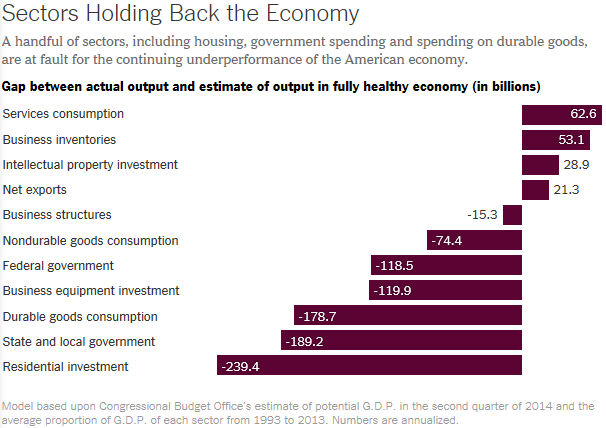
Why has the recovery from the Great Recession of 2007 – 2009 been so slow?  Many mainstream economists blame structural problems in the economy such as more global competition for business and technological progress which replaces people by machines.  Other economists blame greatly increased government regulation since 2009 such as the Affordable Care Act in healthcare, The Dodd-Frank Act for finance and many new regulations from the Environmental Protection Agency.
CaptureThe economist Casey Mulligan, writing in yesterday’s Wall Street Journal, “A Recovery Stymied by Redistribution”, makes a case that government programs designed to alleviate the effects of the recession have made it deeper and more prolonged.  Such actions include:

  • Long-term unemployment insurance
  • Looser restrictions on food stamps which do not require recipients to seek work
  • Mortgage assistance programs which set mortgage payments at “affordable” levels
  • New rules for consumer bankruptcy with special emphasis on current earnings

Mr. Mulligan’s point is that all of these new programs, like taxes, reduce incentives to work and earn.
But, by definition, structural effects are endemic and can’t be overturned.  Also, some government reaction to the financial crisis, in order to prevent recurrence, was inevitable.  And it is natural for the government to be responsive to the human misery caused by the recession.  All of these points of view help us understand what has happened but don’t provide much guidance for boosting economic growth going forward.
The Great Recession was fundamentally caused by the bursting of the housing bubble which destroyed trillions of dollars of wealth for tens of millions of Americans.  The recovery won’t speed up until many more millions of consumers feel comfortable in spending more money. We need to put more money in their pockets.
A very good way to accomplish this, as I have been saying over and over again, is through fundamental tax reform.  The idea would be to lower individual income tax rates for everyone, and pay for this by closing the loopholes and deductions which primarily benefit the wealthy.  This will put big bucks in the hands of the two-thirds of Americans who do not itemize their deductions. Since these are the middle and lower income wage earners whose wages have been stagnant for many years, they will spend this new income in their pockets thereby giving the economy a big boost.
Let’s do it!

Does Economic Growth Depend on Healthcare Expansion?


Even though economic growth is much too slow, it has been steadily increasing since the end of the Great Recession at a rate of about 2.2% per year.  But our economy actually shrunk at a 2.9% rate in the first quarter of 2014.  Healthcare spending decreased by 6.9% in the first quarter and therefore contributed to this overall drop in GNP.
CaptureThe New York Times’ economic reporter, Neil Irwin, discusses the connection, ”Our Economic Growth Is a Mystery.  Obamacare is the Reason.” in yesterday’s paper.  Since healthcare makes up one-sixth of the economy, and the implementation of Obamacare is expanding the healthcare sector, it is not surprising that the economy stumbles if Obamacare stumbles.
But he continues “The United States also has the most expensive healthcare system in the world, without producing better health outcomes.  If the nation succeeds in reducing health care costs while also getting coverage for more people, it would be a huge win for the country’s long term competitiveness.  Overtime the dollars that aren’t being spent on overpriced or unneeded health services can go to other stuff which makes life better: houses, college education, restaurant meals and the like.”
Conclusion:  we need to try all the harder to figure out how to grow the economy faster.  The best single thing we can do about this is to implement fundamental tax reform whereby individual tax rates are cut across the board, paid for by closing many of the loopholes and deductions which primarily benefit the rich.  The two thirds of taxpayers who do not itemize deductions will automatically receive a tax reduction in this way.  Since they are middle and lower income wage earners, with largely stagnant incomes, they will tend to spend their tax savings, thereby boosting the economy.
The loopholes enjoyed by the wealthy are example of crony capitalism which both liberals and conservatives complain about.  Closing these loopholes and other deductions is a very good way to lessen income inequality.  Our leaders should be able to work together in this direction!