Does Free Trade Increase Inequality?


Several days ago, David Bonior, a former Congressman from Michigan, wrote in the New York Times about “Obama’s Free-Trade Conundrum”. “The President cannot both open markets and close the wage gap.”  There is an “academic consensus that trade flows contribute to between 10 and 40 percent of inequality increases.”  This happens because “there is downward pressure on middle-class wages as manufacturing workers are forced to compete with imports made by poorly paid workers from abroad.”
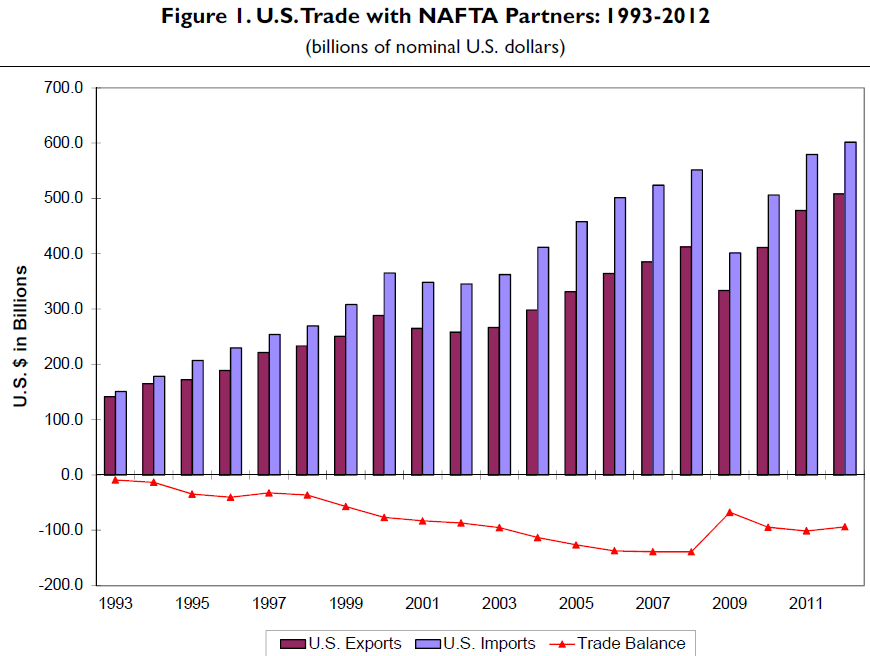
CaptureBut there is another point of view, provided, for example, by the report “NAFTA at 20: Overview and Trade Effects”, prepared by the Congressional Research Service about a year ago.  “U.S. trade with its NAFTA partners has more than tripled since the agreement took effect (in 1993).  (Canada and Mexico) accounted for 32% of U.S. exports in 2012.  40% of the content of U.S. imports from Mexico and 25% of U.S. exports from Canada are of U.S. origin.  In comparison, U.S. imports from China are said to have only 4% U.S. content.”  In other words, NAFTA at least has been a huge success.
Being able to trade with others is the foundation of private enterprise.  Foreign trade is simply an extension of domestic trade.  To limit trading opportunities with other countries would be a huge barrier to economic growth and therefore to future prosperity as well.
But at the same time we do want a more equal society as well as well as a more prosperous one.  The key to resolving this “conundrum”, as Mr. Bonior puts it, is to address “opportunity inequality” as well as “income inequality.”
It is estimated that each billion dollars in U.S. exports provides employment for about 5000 workers.  Nebraska, for example, exported $12.6 billion worth of goods and services in 2012 which translates into 63,000 jobs.
More jobs and better jobs are what create economic opportunity.  One way to create more jobs and better jobs is to promote foreign trade by removing as many trade barriers as possible.  Hopefully Congress and the President can work together to get this done!

Invested in America


The Business Roundtable, an association of chief executive officers of leading U.S. companies, has just issued a new report, “Invested in America: A Growth Agenda for the U.S. Economy”, describing four actions which policymakers can take to rejuvenate the U.S. economy.
CaptureThey are:

  • Restore Fiscal Stability: constrain federal spending in a manner that reduces long-term spending growth, making both Medicare and Social Security more progressive and less expensive.
  • Enact Comprehensive Tax Reform: adopt a competitive, pro-growth tax framework that levels the playing field for U.S. companies competing in global markets.  Several studies estimate that cutting the U.S. corporate tax rate by 10 % (e.g. from 35% to 25%) would boost GDP by 1% or more.
  • Expand U.S. Trade and Investment Opportunities: pass updated Trade Promotion Authority legislation and use TPA to complete many new trade agreements which are already pending.
  • Repair America’s Broken Immigration System: increase the number of visas for higher skilled workers and provide legal status for the millions of undocumented immigrants currently living in the U.S.

These are the same “big four” policy changes which many progressive business leaders as well as evenhanded think tank experts often recommend.  They are really just common sense ideas which reasonable people should be able to come together on.
Isn’t it obvious that we’ll soon be in big trouble if we don’t get our enormous budget deficits under control?  And that controlling entitlement spending is key to getting this done?
Isn’t it just as obviously commonsensical that even U.S. based multinational corporations will try to avoid locating business operations in countries like the United States with very high corporate tax rates?
Isn’t it likewise obvious that foreign trade is just an extension of domestic trade and that the world is better off with as much trade as possible?
Finally, the secret of a vibrant, growing economy is to encourage as much initiative and innovation as possible.  Who take more initiative than the immigrants who figure out how to get here in the first place?
We don’t have to accept a sluggish economy, high unemployment and massive debt!  But we do need to take intelligent action to extricate ourselves from the predicament we are in!

What Is the State of the U.S. Economy?


On the eve of the President’s State of the Union address, the New York Times gives an answer to this question in today’s paper, “Obama’s Puzzle: Economy Rarely Better, Approval Rarely Worse”.  The charts below do show the basic trends all moving in the right direction.  But is this good enough?
CaptureThe unemployment rate is moving steadily downward but it is still a high 6.7% almost five years after the recession ended in June 2009.  And this is with a labor participation rate of only 58.6%, which is historically very low.
The budget deficit is dropping but is still unsustainably high.  In the five years, 2009 – 2013, deficits have totaled $6 trillion dollars.  As soon as interest rates return to their historical average of 5%, interest on this $6 trillion in new debt alone will total $300 billion per year, forever!  Furthermore, the Congressional Budget Office, the most credible source of budget information, predicts that the deficit is likely to resume an inexorable climb within a few years as baby boomers retire in ever greater numbers, rapidly driving up entitlement costs.
Economic growth was stronger than expected in the last quarter of 2013 and this is a good sign.  But it has averaged only about 2% since the recession ended which is very low by historical standards, in a post recessionary period.
The point is, do we really need to settle for such mediocre performance: a stagnant economy, high unemployment and massively accumulating debt?  Should we just declare that in a highly competitive global economy with an ever higher premium on information and technology, that we just can’t do any better than we already are?  Isn’t there some way to make our economy grow faster in order to provide more and higher paying jobs?
I think that the answer to this last question is an emphatic yes!  In fact, this is what my blog is all about.  Just read some of the other recent posts and let me know if you disagree with what I am saying!

A Global Perspective on Income Inequality II. Where Are the Jobs?


My last post on January 23 shows vividly what the challenges are in restoring the American middle class to the prosperity which existed up until the Great Recession hit in late 2007.  The problem, of course, is the gale strength force of globalization which is lifting up low wage workers all over the developing world and creating huge competition for the many low-skilled workers in the United States.
In today’s New York Times, the former Obama Administration car czar, Steven Rattner, writes about “The Myth of Industrial Rebound” in the United States, explaining why manufacturing jobs are coming back much more slowly than other jobs.  “Manufacturing would benefit from the same reforms that would help the broader economy: restructuring of our loophole-ridden corporate tax code, new policies to bring in skilled immigrants, added spending on infrastructure and, yes, more trade agreements to encourage foreign direct investment.”
CaptureThe above chart shows the huge decline in manufacturing jobs relative to other parts of the economy such as the education and health sector as well as the professional and business sector.  Of course, these more rapidly growing service sectors are the ones benefitting from the information technology revolution.  In manufacturing, on the other hand, the low skill jobs are going overseas while the high skill jobs, using technology such as robots, are much fewer in number.
Conclusion: in order to increase manufacturing jobs in the U.S., we better government policies, as outlined above by Mr. Rattner.  But we also need to recognize that there aren’t going to be as many high skilled manufacturing jobs in the future.  We are going to need much better K-12 and post-secondary educational outcomes to prepare the middle class for the high skilled service jobs which will predominate in the future.

A Global Perspective on Income Inequality


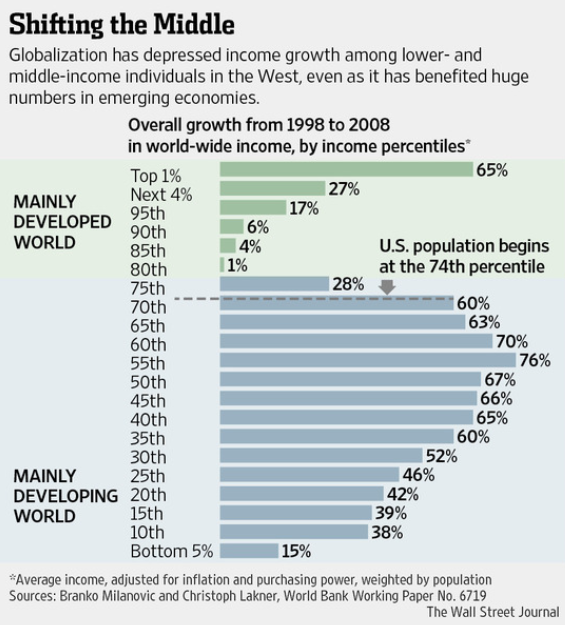
In connection with the annual World Economic Forum in Davos Switzerland, the World Bank has published a breakdown of income growth around the world, as reported yesterday by the Wall Street Journal in the article “Two-Track Future Imperils Global Growth”.  The key finding, as shown in the chart below, is that it is precisely the middle class in the developed nations which saw the slowest income growth in the years from 1998-2008.
CaptureIt is clear from this chart what is going on around the world.  The top 1% makes its money from capital investments and historically the return on capital exceeds economic growth.  The next 9% are both the skilled workers and the educated professionals who are benefitting from the growth of  knowledge industry.  The medium skilled middle class in the developed world, from the 75th percentile through the 90th percentiles, are the ones who are seeing the smallest income gains.  Their jobs are being eliminated by the force of globalization which is shifting lower skilled work to lower paid workers in the developing world.
The article points out, consistent with the above chart, that the income, including benefits, of the poorest 50% in the U.S. grew 23% in this same time period.  So it really is the middle class which is hurting the most in the U.S.  There are three basic ways of addressing this problem:

  • The federal government can help by taking much stronger measures to boost the economy thereby creating more jobs as well as higher paying jobs.  Tax reform, trade expansion, immigration reform and fiscal stability are what is needed to get this job done.
  • The states can help by improving our K-12 education system to make sure that everyone acquires the basic academic skills, such as reading and math, which they will need to achieve their highest potential in life.
  • All concerned and aware individuals (such as ourselves!) must constantly beat the drums to encourage young people to stay in school and take learning seriously.

America is “exceptional” because it is the strongest, freest, and wealthiest country the world has ever known.  But our future success is by no means guaranteed.  We have to constantly work for it and earn it!

Harnessing Market Forces versus Offsetting Market Forces


The economist Matthew Slaughter writes in today’s Wall Street Journal that ’High Trade’ Jobs Pay Higher Wages. He points out that the 22.9 million Americans who work for U.S. headquartered multinational companies made an average of $73,338 in 2011 compared with the overall average wage of about $55,000 that year.  “Workers in multinational firms earn more, as global engagement fosters innovation and productivity growth.”
“There is a growing concern about stagnant or falling incomes, yet most of the measures proposed to deal with the issue – raising the minimum wage and reinstating unemployment benefits – purport to help workers by offsetting market forces.  Less attention is given to harnessing market forces.”
CaptureThis can be done by “liberalizing U.S. trade, investment, immigration and tax policies.”  In other words, we need more trade agreements like NAFTA, which has been so successful in increasing trade in North America.  We need more high skilled workers, both domestic and foreign.  We need lower corporate tax rates to encourage multinational corporations to bring their trillions of dollars in overseas profits back home.
We should always strive for a more equal society with less income inequality.  But the best single way to do this is to create more opportunity by growing the economy, i.e. by harnessing market forces.

How To Address Inequality: A Summary


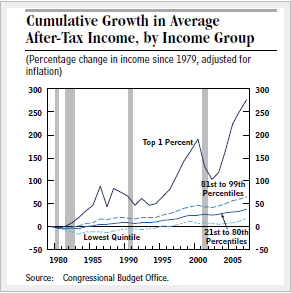
I have had many recent posts addressing the problem of income inequality in the United States and what can and should be done about it.  Below is a chart, from the Congressional Budget office, which also appeared in my December 24, 2013 post.  It shows that all income groups have made gains since 1980 but that higher income groups have gained the most.
CaptureThis means that income inequality is increasing.  The question is what to do about it.  My own attitude is to try to provide more economic opportunity for low income people.  How do we do this in the most effective way?

  • First and foremost by stimulating the private economy to grow faster and therefore to create more and higher paying jobs.  This can be done with broad based tax reform (lowering tax rates offset by closing loopholes), fiscal stability achieved by eliminating deficit spending, expanded foreign trade for a more efficient global economy, and finally, immigration reform to give legal status to undocumented workers and allow more high skilled foreigners to immigrate to the U.S.  Such measures as these require action by Congress and the President.
  • Secondly, by improving human capital, meaning fixing underperforming schools, improving rundown neighborhoods, combatting inner city crime more effectively, providing at least part-time jobs to young people and combatting teenage pregnancy. Problems such as these are best addressed at the state and local level.
  • Finally, providing more motivation for the unemployed and underemployed to find jobs and hold onto them.  A very effective way to do this is with the federal Earned Income Tax Credit.  It supplements the salary of working adults with children.  New York City is conducting an experiment to see if a similar program will also motivate childless adults to try harder to find work and stay employed.

Conclusion:  the best way to address inequality is to give people the best possible opportunity to obtain full time employment.  This means 1) creating more jobs, 2) providing better qualified workers for all jobs and 3) motivating the unemployed more strongly to find jobs and hold on to them.
Government at all levels can help people find jobs, in one way or another, and therefore become more productive citizens.  This will lead to a happier, healthier, and therefore a stronger society.  All of us will benefit from this happening!

Should Government Address Inequality Directly?


Wall Street Journal columnist William Galston suggests in “Where Right and Left Agree on Inequality”, that both sides of the political spectrum agree that economic inequality is increasing in America and that government needs to address this problem.  “Poverty is part of the explanation, as liberals insist.  But so are parenting and family structure, as conservatives believe.”
CaptureIt so happens that we have a broadly supported federal program which simultaneously addresses both poverty and family structure.  It is the Earned Income Tax Credit program.  It provides $3,305 a year to low-income working families with one child and up to $6,143 for families with three or more children.  The U.S. spends $61 billion a year on this program and it has proven to be very successful in encouraging low-income people to find and keep jobs.  In fact, the economist, Gregory Mankiw, recommends the EITC over a higher minimum wage as a better way to increase the earnings of the working poor.
The New York Times’ Eduardo Porter reports in “Seeking Ways to Help the Poor and Childless”, that New York City is conducting an experiment to see if a locally run program similar to the EITC  will have the same positive effect in increasing employment of childless adults.  It is understood that many of the jobs being created in today’s economy are low paying service jobs.  As Mr. Porter says, “for the American market economy to remain viable, being employed must, one way or another, provide for workers’ needs.”
Conclusion:  as important as it is for Congress and the President to adopt measures to increase economic growth (e.g. tax reform, fiscal stability, expanded foreign trade, immigration reform), in order to create more and better paying jobs, government also has a responsibility to provide direct help to the needy who are trying to help themselves.  The EITC program is an excellent way to do this!

Who Are the Enemies of the Poor?


In his usual provocative fashion, New York Times columnist Paul Krugman says that Republicans are “Enemies of the Poor” because “they’re deeply committed to the view that efforts to aid the poor are actually perpetuating poverty, by reducing incentives to work.”
CaptureBut the Heritage Foundation’s Robert Rector has recently pointed out in the Wall Street Journal, “How the War on Poverty Was Lost”, that “the typical American living below the poverty line in 2013 lives in a house or apartment that is in good repair, equipped with air conditioning and cable TV.  He has a car, multiple color TVs and a DVD player.  The overwhelming majority of poor Americans are not undernourished and did not suffer from hunger for even one day of the previous year.”  In fact we are now spending $600 billion a year of our $3.4 trillion federal budget and another $230 billion by the states to fight poverty.  The poverty rate was 19% in 1964 and is 16% today (when government benefits are included).
Mr. Rector reminds us that “LBJ’s original aim (in initiating his antipoverty program) was to give poor Americans ‘opportunities, not doles’.  It would attack not just the symptoms of poverty but, more important, remove the causes.  By that standard, the war on poverty has been a catastrophe.  The root ‘causes’ of poverty have not shrunk but expanded as family structure disintegrated and labor force participation among men dropped.”
So what should our poverty agenda look like going forward?  We are already providing the basic necessities of life.  Our future efforts should therefore be focused on improving the quality of life for the poor.  This means more effective education and job training.  It means more effort to keep families together by reducing marriage penalties.  But most of all it means providing more opportunities for employment and job advancement.  This requires faster economic growth.  There are many ways to accomplish this.  Back to square one!
The true enemies of the poor are those who refuse to accept the progress which has been made in the War on Poverty and the need to change our approach in order to make further progress.

How Do We Increase Economic Mobility?


As the Wall Street Journal reported several days ago, “Economic Mobility Is the New Flashpoint”.  “Both parties agree the opportunity gap is widening, but the proposed solutions are starkly different.”  The Democrats want to increase the minimum wage, extend unemployment benefits, and expand access to college.  The Republicans suggest a whole potpourri of approaches such as reforming welfare (including food stamps), extending school choice, cutting taxes, and relaxing regulations on new businesses.
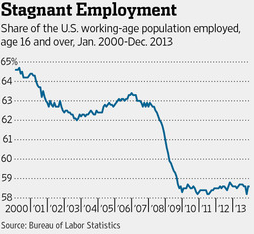
A look at the latest jobs report from the Labor Department should provide the focus which Congress needs to figure out how to increase economic opportunity.  Although the unemployment rate dropped substantially to 6.7% from 7.0% at the beginning of December, only 74,000 new jobs were created in December.  The explanation is that 347,000 left the labor force last month.  The labor force participation rate, the share of the U.S. working-age population employed, age 16 and over, has dropped from 64.5% in 2000, to just under 63% at the beginning of 2008 to near a post-recession low of 58.6% last month (see chart below).
CaptureIn other words, Congress should be totally focused on speeding up economic growth in order to create more jobs.  Since new businesses create the most new jobs, we should indeed relax as many regulations as possible which impede entrepreneurship.  We should lower the corporate tax rate from its very high current value of 35% to get American multinational companies to bring their trillions of overseas profits back home for reinvestment in the U.S.  Moving to a national consumption tax (see the Graetz Plan discussion in my January 7 post), could mean dropping the corporate tax rate to as low as 15%.
Isn’t is obvious that the best thing we can do to give low income people an opportunity to rise up the economic ladder is to just give them a job in the first place?  If they’re ambitious they’ll take any opportunity they can get and run with it!