Election Day 2016: The Fourth Anniversary of this Blog


I have now been writing this blog for four years, beginning right after the presidential election of 2012. I was a candidate in the May 2012 Republican Primary for the 2nd Congressional District of Nebraska.  I campaigned on the platform to “eliminate the deficit.”  I lost to the incumbent Lee Terry who was in turn replaced in office by the Democrat Brad Ashford in 2014.

capture79
The overriding theme of my blog is “how to restore fiscal responsibility to our national government.”   I discuss two fundamental and related issues:

  • Massive Debt now 75% of GDP, the highest level since right after WWII, and predicted by the Congressional Budget Office to keep rising steadily under current policies.
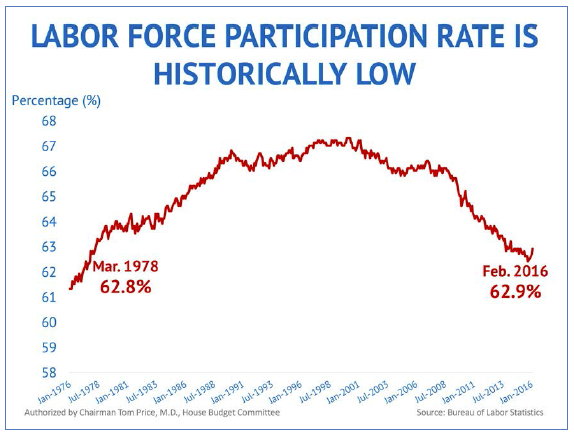
  • Slow Economic Growth averaging just barely 2% per year since the end of the Great Recession in June 2009. Although the unemployment rate is down to a respectable 4.9%, the labor participation rate is also lower than usual. Faster growth would mean more jobs and better paying jobs. It would also mean more tax revenue to shrink our annual deficits.

How should these problems be addressed?  In briefest outline:

  • Balanced Budget Amendment to the Constitution. This is a drastic measure but I see no other way to get the job done. The pressure on Congress is always to create new programs and spend more money, not less. A BBA could be designed in a flexible manner to allow emergency overrides. It could also be phased in by, for example, having an effective date three years after ratification. It so happens that 28 states (out of 34 needed) have now called for a Constitutional Convention to propose such an amendment. (http://bba4usa.org/)
  • Tax Reform, lowering rates for individuals and corporations, paid for by shrinking deductions, would do wonders for encouraging business investment and entrepreneurship, as well as encouraging American multinational companies to bring their foreign earnings back home for reinvestment.

Conclusion. Much more can be done but this would be a very good start.
Follow me on Twitter
Follow me on Facebook

Why Medicaid Needs to Be Reformed


One of the very most serious problems facing our nation is our massive federal debt, now over $13 trillion (the public debt on which we pay interest), or 75% of GDP, the highest since right after WWII, and predicted by the CBO to keep getting worse unless major policy changes are made.
The main contributors to this rising debt are the big three entitlement programs of Social Security, Medicare and Medicaid. All three need substantial reforms in order to rein in spending.
Today I will discuss Medicaid, based on an excellent analysis performed by the Manhattan Institute’s Oren Cass, “Over-Medicaid-Ed: how Medicaid distorts and dilutes America’s Safety net.”
capture41Consider these pertinent points:

  • Badly designed incentives for Medicaid expansion. Each state sets the size of its Medicaid program and receives matching federal dollars, from $1 to $4, for every dollar spent. States thus have a strong incentive to overinvest in Medicaid, expanding their programs far beyond the point where a marginal dollar of their own spending produces a dollar of value.
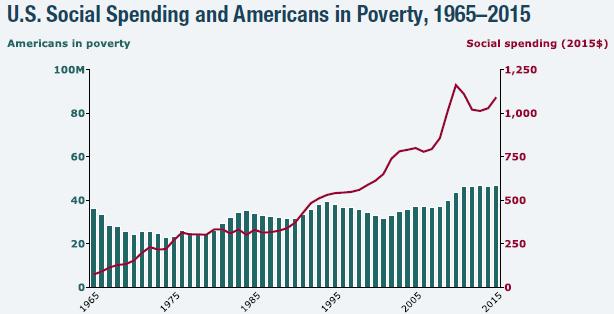
  • Health care dominates safety-net spending. During 1975 – 2015, government social spending per person in poverty more than doubled (in constant 2015 dollars) from $11,600 to $23,400. Rising health care expenditures accounted for more than 90% of that increase.

    capture42

  • Medicaid spending in 2012 was 39% higher than if it had remained a constant share of state budgets since 2000. State spending on education and welfare was 9% and 54% lower, respectively.
  • This allocation is an ineffective poverty-fighting strategy. While the majority of government social spending goes to health care, low-income households not enrolled in Medicaid allocate less than 10% of their spending to health care. Studies consistently show little or no positive impact on health outcomes from Medicaid enrollment.
  • How to strengthen America’s safety net. The federal government should consolidate all antipoverty funding streams, including Medicaid, and allow states to design programs and allocate funding to such programs as states see fit.

Conclusion. The above program outlines a way to both improve the effectiveness of social welfare spending and curtail its costs to both states and the federal government. Let’s do it!

Follow me on Twitter
Follow me on Facebook


Why We Should Be Deeply Worried about Our National Debt


My last post is highly critical of the economist and New York Times columnist, Paul Krugman, for encouraging massive new deficit spending to stimulate our under-performing economy.
Debt and the slow growth of our economy are the two main topics of this blog which I have now been writing for almost four years.  How to speed up growth is a complicated and highly charged political issue about which reasonable and well informed people can differ.  However avoiding excessive debt is to me a moral issue whose resolution should not be that difficult, at least in a conceptual sense.
Capture2 I have often used the above chart from the Congressional Budget Office to illustrate our debt problem because it clarifies the problem so vividly.  Here are its main features:

  • Our public debt (on which we pay interest), now about $13 trillion, is 75% of GDP, the highest since right after the end of WWII. And it is projected to keep getting steadily worse under current policy.
  • Note the decline in the debt from the end of WWII until about 1980. This doesn’t mean that the debt was actually paid off but rather that it shrank as a percentage of GDP as the economy grew fairly rapidly during this time period.
  • From 1980 – 2008 the debt level fluctuated and increased somewhat but did not get badly out of control.
  • Debt shot up rapidly with the Great Recession and has been continuing to grow ever since.
  • The current GDP of our economy is about $19 trillion. At a current growth rate of 2.1%, this adds $400 billion of GDP per year. This means that a $400 billion deficit for 2016 would stabilize the public debt at 75% of GDP. But our 2016-2017 deficit is projected to be almost $600 billion (and rising). This is not good enough!

Conclusion. In order to begin to shrink the size of the public debt, it is imperative that annual spending deficits be reduced to well below $400 billion per year. This will be difficult for our political process to achieve but it is the only way to avoid a new and much worse financial crisis in the relatively near future.

Follow me on Twitter
Follow me on Facebook

Our Dire Fiscal Situation: A Summary


We are currently living in a high risk fiscal bubble. Low interest rates mean that our enormous and rapidly growing national debt is virtually “free” money.  When interest rates return to historically normal (much higher) levels, interest payments on the debt will explode putting us in a precarious fiscal situation.
As I have pointed out in the last few posts, it is the cost of entitlements and, in particular, health care entitlements, i.e. Medicare and Medicaid, which is driving our debt problem. The most effective way to control these entitlement costs is to control overall health care costs by insisting that all of us have more “skin in the game,” meaning that we must pay more of our health care costs directly from our own pockets as opposed to having them paid by third party insurance companies.
Capture20The latest report from the Congressional Budget Office, just a few days ago, shows that our debt problem is even worse than was projected just a year ago (see above).
Capture21The second chart (just above) shows the magnitude of the effort it will take to get our debt under control.  Just to stabilize the debt, i.e. to keep it from getting any worse than it is right now, will require a combination of spending cuts and/or revenue increases of 1.7% of GDP which amounts to $330 billion in 2016 dollars.
Conclusion. We have a huge national debt problem which is only going to keep getting worse until we make somewhat painful changes in federal policy.  We have to either restrain spending increases and/or increase taxes by significant amounts.  Health care entitlements are the biggest problem area and Medicare is worst of all.
Our two presumptive presidential candidates, Hillary Clinton and Donald Trump, are completely ignoring this grave problem.  And indeed their proposed policy initiatives will only make it worse!
Do we have the strength to deal with this dire problem short of another crisis?

Follow me on Twitter
Follow me on Facebook

How Will America Solve Its Biggest Problems?


As I repeat over and over again, our two biggest national problems, in my opinion, are slow economic growth (only 2.1% annual increases in GDP for the past seven years) and massive public debt (now 74% of GDP, the highest it has been since right after WWII).
Capture11Are these problems being addressed by our political system?

  • Our 2016 presidential race is clearly touching on them to some extent. The “Sandernistas” think that the Obama economic policies are not progressive enough and need to be doubled down on. Middle-income “Trumpsters” are revolting against the stagnant and falling wage growth of the past fifteen years.
  • The political scientist James Piereson thinks that the Democratic-welfare regime, in place since 1932, has now run its course and will necessarily be superseded by America’s Fourth Revolution which is imminent.
  • The social scientist Yuval Levin thinks that our “Fractured Republic” can heal itself peacefully if the left is willing to accept a less centralized, more federalist, governmental approach to solving economic and fiscal problems and the right is willing to accept that modern America is highly diverse and individualistic and where a significant degree of cultural fracturing, family breakdown and estrangement from tradition are inevitable.

My own opinion is that our huge and rapidly growing public debt (on which we pay interest) is unsustainable and will lead to another crisis much worse than the Great Recession of 2008-2009 unless it is curtailed. Without an adequate response in the meantime, the new crisis will occur when interest rates inevitably rise significantly and therefore lead to huge increases in interest payments on our larger and larger accumulated debt.
To avoid such a calamity we need to do a much better job of controlling federal spending.  It would also help to speed up economic growth in order to increase tax revenue.  Furthermore, faster growth would create more jobs and better paying jobs.  This would take much of the steam out of the appeal of populist candidates such as Bernie Sanders and Donald Trump.
I can’t foresee exactly how we will be forced to change course but it’s going to happen fairly soon.

Follow me on Twitter
Follow me on Facebook

Another Way to View the Presidential Candidates

As regular readers of this blog well know, I constantly advocate for two major changes in government policy:

  • Speeding up economic growth, which has averaged an anemic 2.1% per year since the end of the Great Recession in June 2009. This will create the new and higher paying jobs that country so badly needs.
  • Shrinking annual deficits, ideally down to zero, so that our huge public debt (on which we pay interest) will begin to decrease as a percentage of GDP over time.

My last post compared the President’s proposed budget for 2017 with a proposal from the House Budget Committee. Basically the President’s budget increases both taxes and spending while the House budget keeps revenues at a steady 18.2% and leads to a balanced budget after ten years.
Capture2The non-partisan Committee for a Responsible Federal Budget has just produced an interesting report, ”How Much More Would Government Spend Under the Next President?” It compares the spending plans of the remaining five presidential candidates from both parties.  It finds that:

  • Only John Kasich would actually decrease spending over the next decade from 22.1% of GDP (under current law) to 21.5%.
  • The other four candidates would all increase spending: Hillary Clinton (to 22.5%), Donald Trump (to 22.7%), Ted Cruz (to 23.4) and Bernie Sanders (to 29.5%).

Mr. Kasich’s spending restraint would amount to a 2% decrease over current law while Ms. Clinton, for example, would increase spending by 2%.
As I showed a year ago,  reining in spending by 2% per year over current law is a major achievement and will lead to a balanced budget in ten years. In other words, Mr. Kasich’s spending plans are in sync with the latest House Budget Committee proposal.  Perhaps this should not be surprising since Mr. Kasich served as Chair of this House Committee in the 1990s!
Easy question: Which presidential candidate and which chamber of Congress are acting in the most fiscally responsible manner?

Follow me on Twitter: https://twitter.com/jack_heidel
Follow me on Facebook: https://www.facebook.com/jack.heidel.3

The House Budget vs the President’s Budget: Another Reason for a Balanced Budget Amendment


In January I had several posts advocating in favor of a Balanced Budget Amendment to the U.S. Constitution.  Briefly, the argument runs as follows:

  • Our public debt (on which we pay interest) is now at 74% of GDP, the highest it has been since the end of WWII.
  • Democrats want to raise taxes and increase spending; Republicans want to cut taxes and decrease spending. The only way to satisfy both parties simultaneously is to run huge annual deficits which is exactly what has happened ever since the end of the Great Recession in 2009.

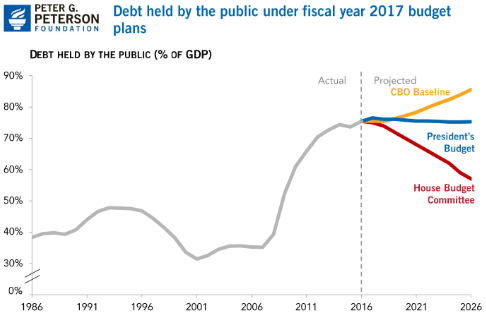
Current planning for the next budget year beginning October 1, 2016 has now begun. Both the House Budget Committee and the President have budget proposals for next year. As reported by the Peterson Foundation, these two budgets differ substantially:
Capture0

  • The President’s budget would hold the public debt at about 75% of GDP over the next ten years by both raising taxes and increasing spending on a variety of programs.
  • The House Budget Committee plan keeps revenues steady at 18.2% of GDP over the next ten years and achieves a balanced budget after ten years. By 2026 the debt held by the public would fall to 57% of GDP from its current 74% level.

Here are two significantly different ten year budget plans. What is likely to happen is a complete standoff without any bipartisan agreement.  This means that no appropriations bills for individual government agencies will be enacted by October 1.  Finally, as usual, an omnibus spending bill will be put together by Congressional leaders and forced through at the last minute to avoid a government shutdown.
A BBA would make both sides compromise and come up with an overall plan.  It would likely contain both spending restraint and new sources of revenue.  Then the various Congressional committees would hammer out the spending details for individual agencies and department.  It would be a far more sensible and transparent process than the way things are done now.
Congress and the President have to be forced to act in such a reasonable manner.  A Balance Budget Amendment is perhaps the only way to make this happen.

Follow me on Twitter: https://twitter.com/jack_heidel
Follow me on Facebook: https://www.facebook.com/jack.heidel.3

Solving America’s Most Basic Problems


My last two posts, here and here, argue that America’s two most critical problems are:

  • Speeding up economic growth in order to create more jobs and better paying jobs, especially for middle- and lower-income workers whose wages have been stagnant for the past 15 years.
  • Getting our large and rapidly growing national debt under control by shrinking annual deficit spending. This will put our debt on a downward path as a percentage of GDP.

Many Facebook comments on these posts inquire about how these goals will be accomplished. If tax reform is the best way to increase economic growth, how can this be done in a way that is fair to the non-wealthy. If spending cuts are necessary to balance the budget, what cuts should be made?  Here is a summary of my views on these questions:

  • Growing the economy with tax reform. The best way to spur investment and business expansion is with the lowest possible tax rates on owners and investors. Broad-based tax reform, with lower tax rates for all, paid for (i.e. in a revenue neutral way) by closing loopholes and shrinking deductions, will accomplish this. The 64% of taxpayers who do not itemize deductions will increase their income with tax rate cuts. Lower tax rates for the affluent will be offset by shrinking deductions and closing loopholes.
  • The corporate tax rate should also be cut to internationally competitive levels, again paid for by drastically shrinking, if not totally eliminating, all deductions. This way all corporations (including GE!) would pay the same tax rate. And American companies would have much less incentive to move overseas.
    Capture0
  • Reducing our national debt. We have got to drastically shrink our annual deficits (now running about $500 billion per year) in order to put our national debt on a downward course, as a percentage of GDP. The House Budget Committee has recently passed a plan to balance the budget within ten years. Not everyone will agree with the details, but at least it’s a starting point. An alternative approach is to adopt a Balanced Budget Amendment to the U.S. Constitution. This would require Congress to make tradeoffs annually between either restraining spending or raising taxes.  A BBA will force them to do what they should be doing anyway!

Follow me on Twitter: https://twitter.com/jack_heidel
Follow me on Facebook: https://www.facebook.com/jack.heidel.3

Why I Lean Republican II. Priorities for the Next President


In my last post, “Why I Lean Republican,” I endorse the ten year budget plan just released by the House Budget Committee which will lead to a balanced budget within ten years.  It represents an excellent starting point towards addressing one of our country’s most serious problems, our huge and rapidly growing national debt.
Capture1
Jim Vanderholm responded to this post by giving his own top priorities for the next President. They are:

  • Job Formation. All sorts of other problems would be addressed in the process. Record high numbers of unemployed and underemployed. Record numbers of people on 85 different welfare programs at a cost of over $1 trillion per year.
  • Highly targeted education/training of the workforce to fill the newly created jobs with American citizens.
  • Reducing annual deficits. Growing the economy by putting more people back to work will bring in more tax revenue. Along with slowing the growth of spending this will lead to lower annual deficits. Once the deficit is reduced by half or more of its current value (about $500 billion), then the debt as a percentage of GDP will begin to shrink.
  • Reduced focus on divisive social issues. The basic structural problems referred to above will not be solved by more gun control, higher carbon tax, shuttering the coal industry, free pre-school and college education, or discontinuing tax-payer funding to Planned Parenthood.

In other words, we need a new President who will focus on basic economic and fiscal issues and not be distracted by divisive social issues. In fact, an ideal division of labor would be for the House Budget Committee to take the lead in getting spending under control while the new President attempts to implement policies to get the economy growing faster. This would lead to real progress on both fronts!

Follow me on Twitter: https://twitter.com/jack_heidel
Follow me on Facebook: https://www.facebook.com/jack.heidel.3

The Quality of American Health Care


One of the most common themes on this website is the high cost of American healthcare. What I am saying is that our annual deficits are way too high and that our accumulated debt is increasing too fast.  Furthermore, the only way to get the cost of healthcare entitlements, Medicare and Medicaid, under control, is to get the overall cost of private healthcare under control as well.  And, of course, I support specific policies to do just this.
CaptureIt so happens that I have just had a major interaction with the American healthcare system in Omaha NE where I live.  I go jogging first thing in the morning, five days a week, all year around.  I have done this all my life and have never had a problem – until last Monday morning when I slipped on some ice, fell down and fractured my wrist.  What I did then was:

  • Call off my 8:00 A.M. Calculus class
  • My wife, Sharon, took me to a Minor Medical facility at 8:00 A.M. just as it opened.
  • The facility x-rayed my wrist and determined that I had broken several bones.
  • They then located an orthopedic surgeon who could see me the same day at 2:50 P.M.
  • The surgeon scheduled me for surgery the very next morning.
  • The surgery was successful and I am now recovering.
  • In other words, 30 hours after my accident occurred, I had had an intense inter-action with American medicine and came through with flying colors.
  • To say the least, I am very impressed with the quality of the facilities and healthcare professionals with whom I interacted.

It may cost an arm and a leg for this superb medical treatment but then I have excellent health insurance which I have seldom had to make use of.
Conclusion: Although we must make significant changes in healthcare delivery in the U.S., to make the system more cost efficient, we should try hard to do this without affecting the high degree of quality inherent in the system.

Follow me on Twitter: https://twitter.com/jack_heidel
Follow me on Facebook: https://www.facebook.com/jack.heidel.3