The Presidential Candidates Are Clueless on the Economy


My last several posts, here and here, have discussed the economic plans of both Hillary Clinton and Donald Trump.  In short,

  • Ms. Clinton wants “equitable” growth meaning huge new public spending on such things as infrastructure, free public college tuition universal pre-K education as well as increasing the minimum wage to $15 per hour nationally and mandating paid family leave. More public spending and new mandates will provide only minimal economic growth.
  • Mr. Trump wants to restrict the labor force with immigration controls and raise the price of imports with new tariffs. He would also cut tax rates across the board (good idea) but in such a way that would increase the national debt by $10 trillion over the next ten years (very bad idea).

They both need to take our actual current economic situation into account as follows:

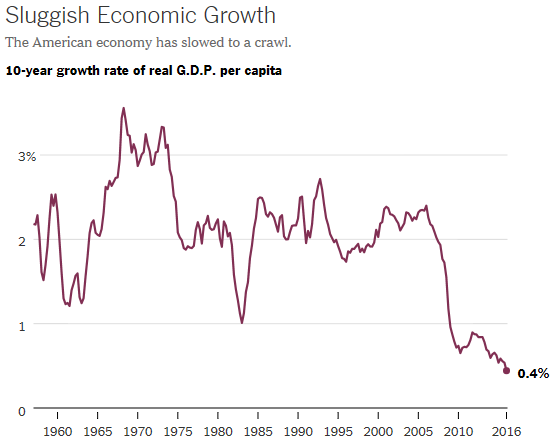
  • The U.S. is in its weakest recovery since post WWII. The average growth rate of 2.2% for 2012 – 2015 has now stalled in the past year to just barely 1%.

    Capture25

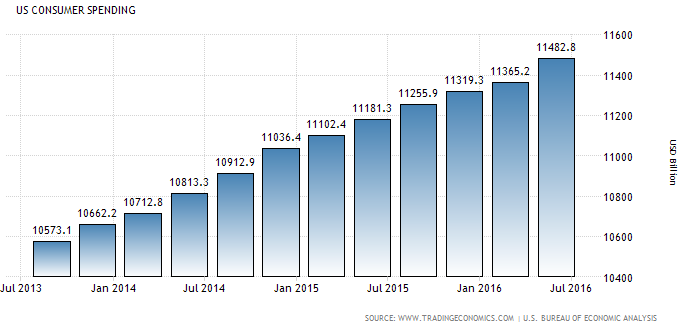
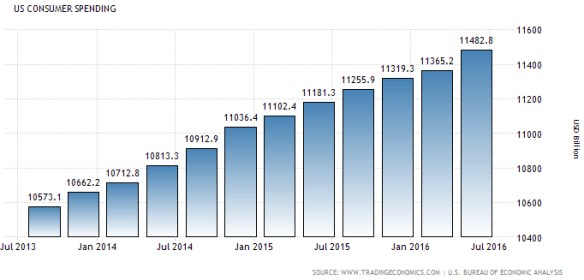
  • Consumer spending has been increasing steadily and rose 4.2% in the second quarter of 2016. In other words, consumer demand is at a high level.
    Capture26

  • The problem is that business investment, i.e. supply, has decreased.
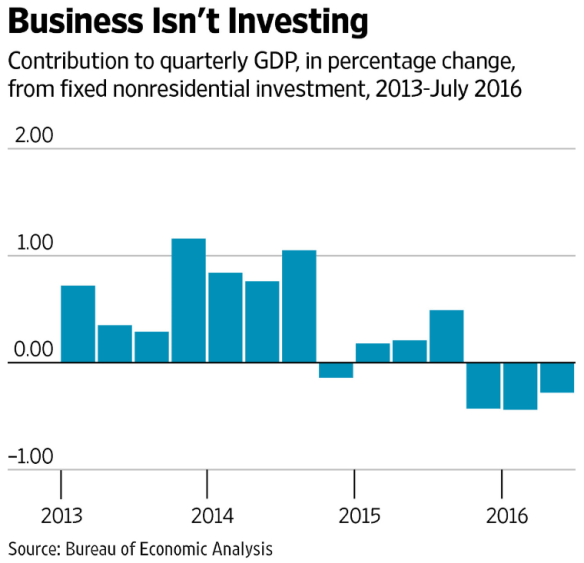
    Capture24

The House Republicans have “a better way.” Their tax reform plan, among many other good features, would

  • Lower the top corporate tax rate from 35% to 20% and establish a territorial system, to encourage multinational corporations to produce in the U.S. as well as bringing their foreign earnings back home for reinvestment.
  • Provide a tax-free return on new investment by allowing, for the first time ever, for full and immediate write-offs.

Conclusion. The House Republicans have a sensible plan for getting our country back on a much faster economic growth track. Regardless of who is elected president, the House is likely to stay under Republican control.  I am waiting to see if either of the presidential candidates will figure this out and adjust their campaign messages accordingly.

Follow me on Twitter
Follow me on Facebook


“A Better Way” for Donald Trump to Make His Case


In my last post, “Donald Trump’s Best Chance to Win in November,” I said that the best way for Mr. Trump to broaden his appeal beyond working-class whites and to have any chance of winning the presidential election is for him to endorse the reform plan, “A Better Way,”  recently developed by the Republican House of Representatives.
Capture9Here is a brief and positive summary of the Trump platform so far:


  • His tax plan is highly pro-growth and will not cost nearly as much as the previously advertised $10 trillion over a decade.
  • He supports legal immigration and simply wants to solve the illegal immigration problem, one way or another.
  • He is not opposed to foreign trade per se but wants to negotiate, from a position of strength, with countries that manipulate their currencies, steal intellectual property or compel companies to disclose trade secrets as a condition of entering their markets.

His policy proposals so described are completely compatible with the House’s “A Better Way” reform plan whose planks are:


  • Poverty. Reward work. Tailor benefits to people’s needs. Improve skills and schools. Demand results.
  • National Security. Defeat the terrorists. Protect the homeland. Defend freedom.
  • The economy. Regulate smarter. End bailouts and cronyism. Put students and workers first.
  • The constitution. Make government more accountable and more representative. Restore constitutional checks on spending.
  • Health Care. More choices and lower costs. Real protections and peace of mind. Cutting edge cures and treatments. A stronger Medicare.
  • Tax reform. Simplicity and fairness. Jobs and growth.


These guiding principles are being fleshed out into complete policy documents. They do indeed represent a better way forward for our national government.  Donald Trump could do far worse than to endorse this comprehensive reform plan developed by the House Republicans.  It would show that he is serious about “Making America Great Again.”

Follow me on Twitter
Follow me on Facebook


Our Dire Fiscal Situation: A Summary


We are currently living in a high risk fiscal bubble. Low interest rates mean that our enormous and rapidly growing national debt is virtually “free” money.  When interest rates return to historically normal (much higher) levels, interest payments on the debt will explode putting us in a precarious fiscal situation.
As I have pointed out in the last few posts, it is the cost of entitlements and, in particular, health care entitlements, i.e. Medicare and Medicaid, which is driving our debt problem. The most effective way to control these entitlement costs is to control overall health care costs by insisting that all of us have more “skin in the game,” meaning that we must pay more of our health care costs directly from our own pockets as opposed to having them paid by third party insurance companies.
Capture20The latest report from the Congressional Budget Office, just a few days ago, shows that our debt problem is even worse than was projected just a year ago (see above).
Capture21The second chart (just above) shows the magnitude of the effort it will take to get our debt under control.  Just to stabilize the debt, i.e. to keep it from getting any worse than it is right now, will require a combination of spending cuts and/or revenue increases of 1.7% of GDP which amounts to $330 billion in 2016 dollars.
Conclusion. We have a huge national debt problem which is only going to keep getting worse until we make somewhat painful changes in federal policy.  We have to either restrain spending increases and/or increase taxes by significant amounts.  Health care entitlements are the biggest problem area and Medicare is worst of all.
Our two presumptive presidential candidates, Hillary Clinton and Donald Trump, are completely ignoring this grave problem.  And indeed their proposed policy initiatives will only make it worse!
Do we have the strength to deal with this dire problem short of another crisis?

Follow me on Twitter
Follow me on Facebook

Reforming U.S. Health Care to Control Costs


My last two posts, here and here, have made the case that:

  • Our national debt is now 74% of GDP (for the public part on which we pay interest), the highest since WWII, and steadily getting worse. This will create a huge problem in the not so distant future, as soon as interest rates return to normal (higher) levels.
  • Entitlement spending is the main driver of our increasing debt. The best way to control Medicare and Medicaid spending is to control the cost of health care spending in general.
  • The overall cost of health care, public and private, in the U.S. is now 17.4% of GDP, much higher than for any other developed country, and is steadily increasing.
  • The main reason our health care costs are rising so rapidly is that Americans do not have enough “skin in the game.” Health insurance pays for close to 90% of our health care costs so that we pay for very little directly out of our own pockets. This means we have little incentive to pay close attention to these costs.

Christus Health in Dallas and Privia Medical Group in Washington, DC  are causing disruption by shifting health care delivery from hospitals to outpatient settings.  They are putting in place a number of lower-cost and more consumer friendly options which reward collaboration, performance and a focus on cost and quality on the part of both management and front-line providers.
Capture18As I have pointed out in previous posts, here and here, several policy changes would help speed up this process of needed change:

  • The tax exemption for employer provided health insurance should be limited to the cost of high deductible catastrophic insurance with an equal (refundable) tax credit for those without employer coverage. Health Savings Accounts would be encouraged for routine health care expenses.
  • Affordable Care Act exchanges would continue to operate as at present but without any mandates.
  • Medicare would provide a fixed level of assistance with which seniors would purchase a private health plan of their own choosing, rather than being open ended as at present.
    Medicaid. The federal government would give states fixed, per-person payments. Low-income individuals could combine Medicaid and the (refundable) tax credit to enroll in private insurance.

Conclusion. The whole idea is to make everyone, rich and poor, young and old alike, responsible for their own health care expenses.  Only with such a consumer-oriented, free-market system will we be able to preserve the high quality of American health care and rein in excessive costs at the same time.

Follow me on Twitter
Follow me on Facebook

The High Cost of U.S. Health Care


As I indicated in my last post, ”Entitlement Spending and the National Debt,” our national debt is much too high and steadily getting worse.  Furthermore, it is entitlement spending, especially Medicare, which is the fundamental driver of our increasing debt.  If we don’t solve this problem relatively soon, we will have another financial crisis on our hands, much worse than the last one in 2008.  When interest rates go up, as they will sooner or later, then interest payments on our accumulated debt will rise precipitously and threaten to bankrupt the nation.
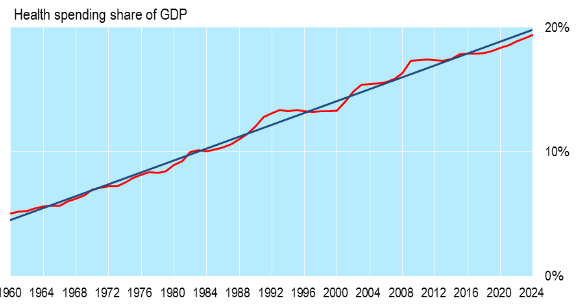
CaptureThe only effective way to control Medicare costs, however, is to control the overall cost of healthcare in the U.S., i.e. for private healthcare.  The above chart shows the nature of this problem.  Right now we are spending 17.4% of GDP on healthcare, public and private, and this is predicted to reach 19.6% of GDP by 2024.  This is almost twice as much as for any other developed country.
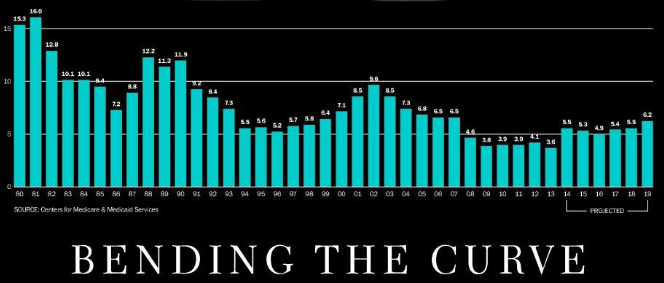
Capture6The Omaha World Herald had an article on Sunday, “Bending the Curve,” purporting to show that cost increases for total national healthcare spending are dropping (see just above).  The problem is that these supposedly low price increases in recent years are still twice the rate of inflation which is now averaging under 2% per year.  This means that even 4% – 5% price increases per year are much too high and need to be curtailed even further.
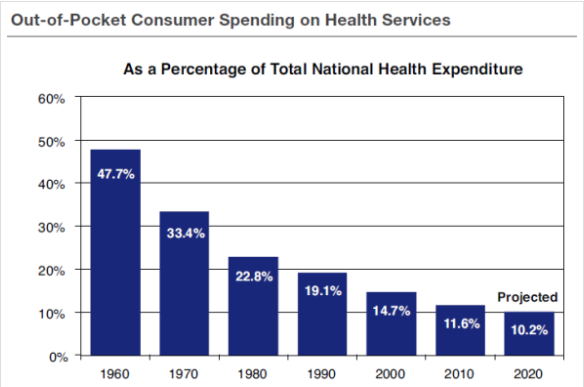
Capture10The fundamental reason why U.S. healthcare is so expensive is that Americans do not have enough “skin in the game.”  The above chart shows that our direct out-of-pocket costs for healthcare have been steadily dropping for the last fifty years as the role of health insurance has expanded.  This means that we simply don’t have enough personal incentive to hold down healthcare spending on our own.
Conclusion: We have to control entitlement spending, especially for Medicare, to get our national debt under control.  But this can only be done by limiting the steep spending increases in overall healthcare, public and private.  How will we be able to do this?  Be patient, we’re getting there!

Follow me on Twitter
Follow me on Facebook
Entitlement Spending and the National Debt


I discuss two fundamental economic and fiscal problems on this website:

  • The slow growth of our economy, only 2.1% per year since the end of the Great Recession in June 2009. This is largely responsible for stagnant wages for middle- and low-income workers, which is in turn responsible for the rise of the populist presidential candidates Bernie Sanders and Donald Trump.
  • Our massive national debt, now 74% of GDP for the so-called public part, on which we pay interest. This is the highest it has been since right after WWII.
    Capture2

Slow economic growth gets more public attention because of its direct and negative effect on so many people. However massive debt is more of an existential problem.  Right now our debt is almost “free” money because interest rates are so low.  But with debt predicted (by the Congressional Budget Office, for example) to keep climbing steadily under current policy (see the first chart) and with the inevitability of increased interest rates in the future, interest payments on the public debt are bound to rise precipitously.
Capture4The second chart just above (from the Concord Coalition) shows that interest payments on the debt will likely soon become the leading source of growth in federal spending.  But perhaps surprising is that the three non-interest sources of spending growth are the entitlement programs, Medicare, Social Security and the combined Medicaid, CHIP and ACA exchange subsidies.  All other government spending will decrease in relative terms.
Capture3Is it not readily apparent from this data that the only way to curtail a huge fiscal crisis in the not so distant future is to get entitlement spending under much better control?  The last chart, just above, (from the Trustees of SS and Medicare) shows the growth in general fund revenue required for Medicare and SS going forward.  In 2016 the discrepancy is 2.1% of GDP which amounts to $401 billion.  The discrepancy will double by 2040.  Of course, OASDI (SS) and HI (Medicare Part A) have trust funds paid into by payroll taxes.  But these trust funds are already paying out more than they take in and will be exhausted in a few years.

Conclusion. Spending on entitlement programs must be brought under much better control. How to do this will be the topic of my next post.

Follow me on Twitter
Follow me on Facebook
How Progress Has Led to Discord


We were reminded by Robert Samuelson in yesterday’s Washington Post that America has made amazing progress in the last half century.
Consider that in 1960:

  • Men and Women held rigid gender roles.
  • African-Americans were restricted by legal segregation in the South and informal segregation almost everywhere else.
  • Homosexuality was virtually under the radar.
  • There was little environmental regulation.
  • Immigration was not an issue.
  • Defense made up 52% of government spending.

    Capture17

Think about all the (mostly) positive changes which have taken place in the meantime:

  • Women have taken paying jobs by the millions.
  • Racial segregation has been outlawed.
  • Gay rights have been established.
  • Environmental regulation has exploded.
  • Immigration, both legal and illegal, has increased.
  • Social spending has soared.
  • Defense is down to 16% of the federal budget in 2015.

Consider how our national politics is now stalemated:

  • The political system favors extremes.
  • Minorities live largely in big cities where they produce Democratic super-majorities.
  • Rural areas produce Republican super-majorities.
  • Incumbents are insulated from general election challenges which might pull them towards the center but are perpetually vulnerable to primary challenges from extremists who pull them towards the fringes.
  • Ideological purity trumps pragmatism. In the internet and cable-news era, politicians are constantly reassuring their constituents that they haven’t sold out.
  • The center sags and paralysis prevails.

Meanwhile serious national problems are getting much worse and not being addressed. Our public debt (on which we pay interest) is 74% of GDP, the highest since WWII.  The U.S. economy is growing only slowly at the rate of 2.1% per year ever since the end of the Great Recession seven years ago.  Neither presidential candidate has a credible plan to deal with these two most aggravating problems.
As a country we are in a huge mess.  How do we break out of it?  I wish I knew!

Follow me on Twitter
Follow me on Facebook


Can the U.S. Economy Do Better VI. Does the President Matter?


My last five posts have discussed several different aspects of the question, “Can the U.S. Economy Do Better?”  Our economy has been doing especially poorly since the end of the Great Recession seven years ago (see the chart below).  Many people claim that the President doesn’t really have all that much control over the economy.
Capture6 Here is what the2016 presidential candidates are saying on economic policy so far:

  • Hillary Clinton. She wants national paid family leave, a national minimum wage increase and more government spending on infrastructure projects. She would raise taxes by about $100 billion per year to pay for these initiatives. She is opposed to the Trans Pacific Partnership to expand trade with 11 other Pacific Rim countries.
  • Donald Trump. His top priorities are trade and immigration policy. Would he be able to successfully address China’s currency manipulation without starting a trade war? How would he be able to round up and deport millions of illegal immigrants without destroying millions of jobs and thereby crippling many businesses? His plan to slash tax rates would boost the economy but also add trillions of dollars to the debt.

As I have discussed over and over again on this blog, see, for example, here and here,  there are several fundamental policy changes needed to make our economy grow faster and create more and better paying jobs.  We need to:

  • Make it easier to start a small business by simplifying regulations at all levels.
  • Lower tax rates and simplify the tax code, paid for by shrinking deductions and closing loopholes.
  • Respond to globalization and new technology by helping its victims rather than blocking progress.

Our two presidential candidates are appealing to the fears of the voters rather than to their hopes and aspirations. Neither of them is espousing policies which will help the economy really grow in a healthy way.

Follow me on Twitter
Follow me on Facebook

Can the U.S. Economy Do Better? V. Entitlement Reform


My last several posts, e.g. here, have discussed the question as to whether or not the U.S. economy can grow faster. Even though there are many headwinds to faster growth, there are still various measures to take which will help significantly. Beyond specific policy directions, such as aiding small business and cleaning up and simplifying our tax code, another very important step is to get our fiscal problems, i.e. massive debt, under much better control.
Capture7As made clear in the above chart, there is really only one way to do this.  It is entitlement reform.  In the last 50 years, from 1965 – 2015, mandatory, i.e. entitlement, spending has grown from 26% of the federal budget to 62% and this percentage will just keep growing until something is done to stop it. Along this line, an excellent new report from the American Enterprise Institute, “Increasing the Effectiveness and Sustainability of the Nation’s Entitlement Programs” lays out some basic principles for entitlement reform. They are:

  • Personal Responsibility for Retirement Savings. The idea is to move toward turning Social Security into a universal flat benefit for all U.S. residents age 65 and older. Anyone could supplement this basic income with additional private savings.
  • Market Discipline in Health Care. The idea here is to keep the ACA exchanges with subsidies for low-income households. Employer provided care would have no mandates and a rational and equal tax credit for all. Health Savings Accounts would be liberalized to encourage widespread participation. Both Medicare and Medicaid would provide premium support for basic care. The point is to bolster the consumer’s role in the marketplace in order to slow down the rising cost of healthcare.
  • Promotion of Work for Safety-Net Programs. The federal government spends about $400 billion annually to fight poverty (not counting healthcare programs) with much overlap of federal and state programs. Reform efforts should emphasize work as the key to improved economic prospects as well as greater state control over resources to allow for better coordination of efforts. Two major reform concepts, block grants to states as well as wage subsidies, should be implemented.


We have to get our fiscal house in order, so entitlement reform is not optional. Delay, moreover, could be catastrophic.  If we wait until another crisis hits, then it will no longer be possible to design reforms with gradual adjustments. Now is the time to act!

Follow me on Twitter
Follow me on Facebook

How Will America Solve Its Biggest Problems?


As I repeat over and over again, our two biggest national problems, in my opinion, are slow economic growth (only 2.1% annual increases in GDP for the past seven years) and massive public debt (now 74% of GDP, the highest it has been since right after WWII).
Capture11Are these problems being addressed by our political system?

  • Our 2016 presidential race is clearly touching on them to some extent. The “Sandernistas” think that the Obama economic policies are not progressive enough and need to be doubled down on. Middle-income “Trumpsters” are revolting against the stagnant and falling wage growth of the past fifteen years.
  • The political scientist James Piereson thinks that the Democratic-welfare regime, in place since 1932, has now run its course and will necessarily be superseded by America’s Fourth Revolution which is imminent.
  • The social scientist Yuval Levin thinks that our “Fractured Republic” can heal itself peacefully if the left is willing to accept a less centralized, more federalist, governmental approach to solving economic and fiscal problems and the right is willing to accept that modern America is highly diverse and individualistic and where a significant degree of cultural fracturing, family breakdown and estrangement from tradition are inevitable.

My own opinion is that our huge and rapidly growing public debt (on which we pay interest) is unsustainable and will lead to another crisis much worse than the Great Recession of 2008-2009 unless it is curtailed. Without an adequate response in the meantime, the new crisis will occur when interest rates inevitably rise significantly and therefore lead to huge increases in interest payments on our larger and larger accumulated debt.
To avoid such a calamity we need to do a much better job of controlling federal spending.  It would also help to speed up economic growth in order to increase tax revenue.  Furthermore, faster growth would create more jobs and better paying jobs.  This would take much of the steam out of the appeal of populist candidates such as Bernie Sanders and Donald Trump.
I can’t foresee exactly how we will be forced to change course but it’s going to happen fairly soon.

Follow me on Twitter
Follow me on Facebook