The Fading American Dream and Donald Trump


It is now generally accepted that Donald Trump was elected President because of his strong support amongst white blue-collar workers, especially in the battle ground states of Wisconsin, Michigan and Pennsylvania. Mr. Trump was able to persuade these voters that he would be able to raise their stagnant incomes and even bring back the millions of manufacturing jobs which have been lost to automation and globalization.


Now the two economists, Anne Case and Angus Deaton, have shown that mortality rates for white, U.S. non-Hispanics, aged 45 – 54, with a high school degree or less, have doubled since 1990.
Here is the general situation:

  • Overall, U.S. life expectancy at birth has increased from 63 years in 1940 to 79 years in 2010.
  • Life expectancy is still increasing for the college educated as well for U.S. Blacks and U.S. Hispanics. It is also still rising in many other developed countries.
  • The main cause for the rising death rates of the vulnerable group is “deaths of despair” – suicides, drug overdoses and the consequences of heavy drinking.
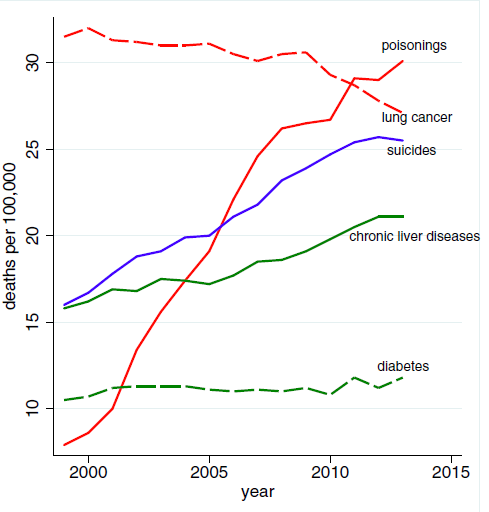
The authors point out that:

  • It is precisely working class whites whose economic prospects have deteriorated the most in recent years, especially since the financial crisis.
  • The U.S. has moved largely to defined-contribution pension plans with stock market risk in recent years whereas in Europe defined-benefit pensions are still the norm.
  • The current mortality crisis bears a resemblance to the AIDS epidemic which took the lives of 650,000 Americans from 1981 – 2015. However, public awareness of the AIDS crisis was far greater than for the current mortality epidemic.

Conclusion. The basic American dream of home ownership, modest financial and job security and a bright outlook for one’s children has faded for a large class of middle-aged workers. The crisis is manifested in an increase in mortality rates for this vulnerable class.  Donald Trump’s election mandate is to fix this problem but it is a tall order indeed.

Follow me on Twitter
Follow me on Facebook

Trump’s Bark Is Worse than His Bite


The anti-Trump fervor seems to be slowly dying down as his appointees take hold of their agencies and begin to promulgate new policies. I have expected this to happen because of the excellent quality of many of the people he has appointed.
Here are a few recent developments:

  • Interior Secretary Ryan Zinke has said that “the border is complicated as far as building a physical wall” and there are all sorts of problems to be resolved before it can be done.
  • Reality is setting in with regard to Russia policy “given Russia’s continued provocations in terms of weapon’s deployments, overtures to Iran, cyber intrusions and intervention in Ukraine.”
  • The Brookings Institution has just issued a new report showing that school choice options are increasing in the country’s largest school districts. This indicates that Education Secretary Betsy DeVos is in the mainstream by supporting more choice.
  • Coal jobs Trump vows to save no longer exist.  In other words, cancelation of the Obama Clean Power Plan will have little effect on the huge drop in coal use because coal has become so much more expensive than natural gas.
  • Of course, the Trump 2018 Budget Proposal will be heavily modified by Congress but it does contain some good ideas. Agriculture, Foreign Aid and Community Development Block Grants are all ripe for big cuts.
  • The biggest unknown with respect to administrative action concerns trade policy. The question here is what concessions he can get from China and Mexico without starting a disastrous trade war.

What is mainly lacking at this point is any significant action by Congress on the Trump agenda. What will happen with healthcare reform, tax reform and deficit reduction, for example?

Conclusion. Trump is doing fine so far but it is on relatively straightforward issues under his control. Hopefully he will be able to make progress on the bigger issues as well which require working with Congress.

Follow me on Twitter
Follow me on Facebook


America’s Biggest Problem is Almost under the Radar


I’ve had several posts recently elaborating on the theme of Tyler Cowen’s new book, “The Complacent Class,” that too many Americans have become complacent about the comfortable life which they now enjoy.


Let’s take a different approach today and consider some of the problems which large numbers of Americans really are concerned about:

  • The election of Donald Trump as President. Granted, he just barely squeaked through in the Electoral College with 46% of the popular vote. He makes outlandish statements which have little, if any, basis in fact. But he has appointed many capable cabinet secretaries and other assistants and he listens to them. He adjusts his policies when struck down by the courts. In my opinion he has suffered no major mistakes so far.
  • Increasing income inequality in American society. This is a problem but, as Nicholas Eberstadt has pointed out, the real problem is income insecurity for millions of blue-collar workers. The best solution here is faster economic growth which the Trump Administration and the Republican Congress hope to achieve through tax reform and deregulation.
  • Global Warming. More and more Americans understand the increasing severity of this problem. There is a fair chance that a revenue neutral carbon tax will be implemented in the near future. This would be a big boost toward controlling carbon emissions in the U.S. and would provide more clout in establishing worldwide emission standards as well.
  • A chaotic world. Terrorism will not go away but at least ISIS will soon be defeated as an independent state. Other worldwide threats such as China, Russia and Iran can be managed with a strong U.S. military force undergirded by a strong U.S. economy.

Conclusion. The above problems are considered by large numbers of people to be serious and are therefore being addressed in one way or another. But our biggest problem of all, massive debtis off the radar for much of the political class, including President Trump. It needs to be taken far more seriously than it is before we have another, and much more severe, financial crisis.

Follow me on Twitter
Follow me on Facebook

The Dangers of Complacency


My last post, “What Ails America? I. Complacency,” lays out the thesis of the economist Tyler Cowen that American society has become much too complacent, i.e. self-satisfied, in recent years.  In particular:

  • Fewer Americans are moving.
  • Segregation (by income, education, social class and race) is increasing.
  • Americans have stopped creating. New business creation is down and monopolies are getting stronger.
  • Matching (i.e. assortative mating) is on the upswing.
  • Calm and safety above all is the predominant attitude.

These societal trends are normal and even desirable in many respects. But they can lead to stagnation.  Eventually needed social change will boil over in uncontrollable ways and America will undergo a “Great Reset.”


This will likely involve major events such as:

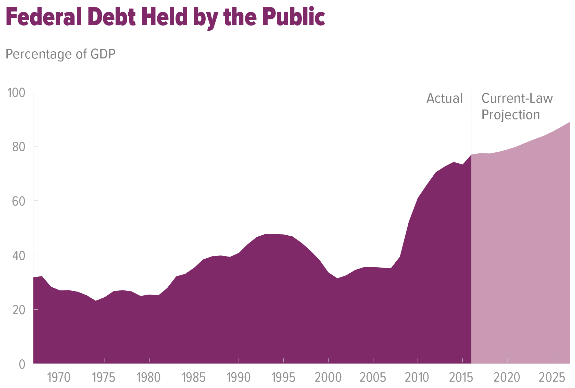
  • A major fiscal and budgetary crisis. Currently our public debt (on which we pay interest) is 77% of GDP, the highest since just after WWII. It will keep rising steadily without a major change in public policy. When interest rates return to more normal higher levels, interest payments on our debt will be a huge drain, without letup, on our tax revenue.
  • The inability of government to adjust to the next global emergency which comes along. When the financial crisis came along in 2008, debt was at the much smaller level of 38% of GDP. This allowed for temporary fiscal stimulus and larger deficits to ride out the resulting recession. With our currently high debt level, we’ll have far less flexibility when the next recession comes along.
  • A rebellion of many less-skilled men. The median male wage (adjusted for inflation) was higher in 1969 than it is today. In fact, the take-home pay for typical American workers has been falling since the end of the Great Recession in June 2009. To a large extent this explains the rise of Donald Trump.
  • A resurgence of crime. A new crime wave will probably be internet related. There are now tens of millions of identity thefts, phishing attacks and successful but fraudulent pleas for cash every year. Internet crime is calmer than traditional crime and less visible. But the next crime wave could badly damage internet commerce.


Conclusion.  Mr. Cowen paints a depressing picture for the future of American society.  Of course, it is possible to turn some or all of these negative developments around.  But will a complacent American populace have the political will to do it?

Follow me on Twitter
Follow me on Facebook

Donald Trump’s Popularity is Steadily Increasing


Like many things about Donald Trump, his approval ratings are contradictory and misleading. The Wall Street Journal reports that:

  • Only 44% of Americans currently approve of President Trump’s job performance (while 48% disapprove) which is historically low for a new President.capture107
  • On the other hand, the percentage of Americans who have positive feelings about him has been steadily increasing ever since he declared his candidacy in June of 2015, and has now reached a high of 43% (see chart). Since his State of the Union speech was generally well received, this rating is likely to go even higher.

Here is my own perspective. As I have said many times on this blog, I believe our country’s two biggest and most urgent problems are:

  • Slow economic growth, averaging just 2% per year since the end of the Great Recession in June 2009. This means fewer jobs, smaller raises for workers and less tax revenue to spend on important national initiatives.
  • Massive Debt, now standing at 77% of GDP (for the $14 trillion public debt on which we pay interest), the highest since right after WWII. The Congressional Budget Office predicts that this debt level will keep on steadily getting worse, without big changes in current policy. It is therefore a huge threat to our national security and prosperity.

I have great confidence that the Trump administration and Congressional allies will put a high priority on faster growth and are likely to be able to achieve it. I can’t yet tell if Trump understands the seriousness of our massive debt.  But the Tea Party and Freedom Caucus members in the House of Representatives do very strongly understand this problem and will insist on addressing it.  I believe that they will be able to persuade the President to support them in doing this.

Conclusion. At this point I am a supporter of President Trump because I think that our national government is moving in the right direction.

Follow me on Twitter
Follow me on Facebook

Is 3% Economic Growth Possible?


Donald Trump was elected President because of strong support from blue-collar workers in the battleground states such as Wisconsin, Michigan, Pennsylvania and Ohio. The American Enterprise Institute scholar, Nicholas Eberstadt, has explained clearly why this happened.  It is largely a result of a slowdown in economic growth in recent years which has hit blue-collar workers especially hard.

capture104
Can this recent slow growth trend be reversed?  The economist, Edward Lazear, has a positive answer to this question in today’s Wall Street Journal.  According to Mr. Lazear:

  • 3% growth is the long term norm. The annual growth rate in the 30 years preceding the 2007 recession was 3.1%. It has averaged just 2% annually since the end of the recession in June 2009.
  • GDP growth is the sum of two components: growth in productivity and in labor hours. Historically productivity has grown at a rate of about 2% per year and labor at about 1%.
  • Nonfarm labor productivity rose by a total of 7% between 2009 and 2016 which amounts to only 1% per year. It rose 18% between 2001 and 2008 or 2.3% per year.
  • Both President Trump and the House Republicans advocate business expensing (immediate tax write-offs for new investment) as an important part of tax reform. It has been estimated that just this one change in policy will induce an increase in GDP of from 5% to 9% over ten years. This would raise GDP from the current 2% annual growth to between 2.5% and 2.9% annually.
  • The Social Security Administration predicts no increase in the U.S. population age 20 to age 64 between 2020 and 2030.
  • But note that the labor participation rate fell during the recession by 2% among Americans between ages 25 and 54, the prime working age. Two drivers of this loss of workers are: 1) a large increase of the disability rolls and 2) the fact that the ACA will likely reduce the number of hours worked by about 2% between 2017 and 2024.
  • Eliminating burdensome business regulations will also help significantly.

Conclusion. There is clearly much that can be done to speed up both labor productivity and the number of hours worked by Americans. President Trump and the Republican Congress have a good shot at increasing economic growth to 3% annually.

Follow me on Twitter
Follow me on Facebook


The Origins of Trumpism II. A National Crisis for Working Men


The American Enterprise Institute’s Nicholas Eberstadt has performed a valuable national service with two recent publications: “Men without Work” and “Our Miserable 21st Century”  These works lay out in great detail what has gone wrong in our country in the past 16 years:

  • Overall household wealth has doubled as a result of a surging stock market fed by the Federal Reserve policy of quantitative easing.
  • The recovery from the crash of 2008 has been singularly slow and weak compared to the 1947 – 2007 trend line.
  • The work rate for Americans aged 20 and older has declined by 4% from 66% to 62%.
  • Half of all prime working age male labor-force dropouts take opioid medication on a daily basis paid for by Medicaid. 57% of this population class is collecting disability benefits.
  • 17 million male ex-prisoners and convicted felons are now in our midst and largely unable to find the employment which would lead to productive lives.

Here is Mr. Eberstadt’s initial prescription for addressing this very serious social problem:

  • Revitalize American business and its job-generating capacities. According to the Brooking Institution’s Ian Hathaway and Robert Litan, “business deaths now exceed business births for the first time in the thirty-plus-year history of our data.”capture63
  • Reducing the immense and perverse disincentives against male work embedded in our social welfare programs. For example, U.S. disability programs are subject to widespread abuse and gaming. Social welfare programs should emphasize a “work first” principle emphasizing training and education, job placement, and tax credits, etc.
  • Drawing men with a criminal record back into productive work life. Note that the huge increase in America’s ex-prisoner and ex-felon population in recent years coincides with a dramatic drop in rates for both violent crime and property crime. This suggests that former criminals do not pose a continuing danger to society.

Conclusion. For the future prosperity and social cohesion of our country addressing this problem should be a very high priority. Let’s hope that President Trump gets the message.

Follow me on Twitter
Follow me on Facebook


The Origins of Trumpism


Everyone is trying to figure out what Donald Trump is all about and I am no exception. My last two posts, here and here, compare his positives and negatives and what he is doing well so far and also not so well.
The American Enterprise Institute’s political economist, Nicholas Eberstadt, has an article in the current issue of Commentary, “Our Miserable 21st Century,” describing very cogently the economic and social conditions which have led to the election of Donald Trump as President of the United States. Says Mr. Eberstadt:

  • The year 2000 marks a grim historical milestone for our nation. The warning lights have been flashing for 15 years and now these signals are impossible to ignore.
  • First of all, the estimated net worth of American households has more than doubled between 2000 and 2016, from $44 trillion to $88 trillion (see below).capture103
  • At the same time the recovery from the crash of 2008 has been singularly slow and weak. By late 2016 per capita output was just 4% higher than in late 2007. In effect the American economy has suffered something close to a lost decade (see below).capture104
  • Then there is the employment situation. Between 2000 and 2016 the work rate for Americans aged 20 and older declined by 4% from 66% to 62%. To put this in different words: if our nation’s work rate today were back up to its start-of-the-century highs, 10 million more Americans would currently have paying jobs (see below).capture105
  • Half of all prime working-age male labor-force dropouts (totaling 7 million men) take opioid medication on a daily basis, typically paid for by Medicaid. In fact, 53% of prime-age males not in the labor force are enrolled in Medicaid.
  • Of the entire un-working prime-age male Anglo population in 2013, 57% were collecting disability benefits.
  • Currently 17 million men in America have a felony conviction somewhere in there past. This amounts to one of every eight adult males in the country. It is difficult for felons to find work and therefore to become productive members of society.

Concludes Mr. Eberstadt, “The abstraction of inequality doesn’t matter a lot to ordinary Americans. The reality of economic insecurity does.  The Great American Escalator is broken – and it badly needs to be fixed.  With the election of 2016, Americans within the bubble (of affluence) finally learned that the 21st century has gotten off to a very bad start in America.  Welcome to the reality.  We have a lot of work to do together to turn this around.”

Follow me on Twitter
Follow me on Facebook


A Tale of Two Trumps II. Which Is the Real One?


From a reader of my blog:

One thing you should think about (very seriously) is whether Trump is set to become an autocrat and whether the institutions in the US are able to prevent this. There is the constitution, laws and norms (by which all Presidents or all Presidents for the vast majority) have conformed to. Trump is a master at recognizing the norms and blowing them off. The truth matters and when Trump says the press is the enemy of the people, you need to think about this. Very scary. Maybe, perhaps likely, our democracy is very fragile and not able to contain him. When I think of economic progress, my first thought is how long it took the Germans to overcome Hitler’s rule, 50-60 years. You seem to be willing to cut him a break, thinking our institutions will contain him. I think the German intelligentsia in the 30’s felt the same way about Hitler.

capture103

 My last post, “A Tale of Two Trumps,” compared what Trump is doing well with what he is doing poorly and how he has modified some of his extreme rhetoric. Of course the truth matters but the truth is highly subjective.  To say that the press is “an enemy of the people” is asinine but Trump has made a lot of outrageous statements and will surely continue to do so.  I simply ignore them.  He backs down when it matters.
I think it is farfetched (for the time being) to compare Trump to Hitler.  Hitler arose in a Germany devastated by WWI, with terrible economic conditions including extreme hyper-inflation.  The U.S. is still the world’s overwhelmingly dominant superpower and enjoys the highest level of prosperity in the world.
Trump was elected because this prosperity is enjoyed most prominently by the elite professional class.  He has convinced blue-collar workers that he will be able to improve their lot.  If he succeeds his grossness won’t matter.  In the meantime the courts will continue to slap him down when he steps out of line.

Follow me on Twitter
Follow me on Facebook


A Tale of Two Trumps


I have mixed feelings about Donald Trump. I didn’t vote for him because of his crude and sleazy behavior.  But I like some of the things he is doing.  Barron’s frames the issue well in its cover story this week, ”A Tale of Two Trumps,” by John Kimelman.

capture103
On the positive side he has:

  • Been a successful real estate developer and serial entrepreneur who favors lower taxes and fewer regulations for many industries, especially energy, financial services and healthcare.
  • Made many good appointments such as Mnuchin for Treasury, Tillerson for State, Pruit for EPA, Price for HHS, Cohn for Chief Economic Advisor, Ross for Commerce, etc.

But on the negative side he has:

  • Issued a badly executed travel ban on immigrants from seven Mideast nations which has now been withdrawn.
  • Belittled the leaders of Mexico and Australia.
  • Torn up the Trans Pacific Partnership negotiated by President Obama
  • Threatened to withdraw from NAFTA which supports hundreds of thousands of jobs in the U.S.

On the other hand he has dialed back some of his extreme rhetoric by

  • Meeting with President Obama after the election.
  • Deferred to Defense Secretary Matson on the undesirability of waterboarding.
  • Accepted the “One China” policy in a telephone conversation with Chinese Premier Xi Jinping.

What remains to be seen is whether or not he can:

  • Make better trade deals with Mexico and China without starting a trade war which would badly hurt our economy.
  • Enact tax rate cuts and a $1 trillion infrastructure program without making deficits worse than they already are.
  • Work with his deficit hawk Budget Director Mulvaney to establish a plan to eventually achieve a balanced budget.

Conclusion. I personally remain optimistic that his good instincts will lead to faster economic growth and that his disruptive instincts will be sufficiently restrained by Congress and the courts so that they will not do major harm.

Follow me on Twitter
Follow me on Facebook