Predicting the Future


The postwar liberal consensus, beginning with President Roosevelt’s New Deal and extending through President Johnson’s Great Society, has broken down. The Reagan Revolution did not undo it and politics in the new 21st century have now become highly contentious with neither the Democrats nor the Republicans able to push their agendas very far.
Capture1The Manhattan Institute’s James Piereson has written a book, “Shattered Consensus: The Rise and Decline of America’s Postwar Political Order,” describing how we have arrived at our current impasse. Most interestingly, he predicts that “the Democratic blue model is unlikely to succeed at restoring growth and dynamism to the American economy” and that a new system will necessarily look more like the red model than the blue model, i.e. more sympathetic to business and private sector growth than to public employee groups and beneficiaries of public spending.
There will likely be at least three central elements to the new synthesis that must eventually replace the postwar order. They are:

  • A focus on growth, and the fiscal and regulatory policies required to promote it, as an alternative to the emphasis on redistribution, public spending and regulation.
  • An emphasis on federalism both to encourage experimentation and innovation in the American system and to remove issues from the national agenda which contribute to division, stalemate and endless controversy.
  • A campaign to depoliticize the public sector by eliminating or strictly regulating public employee unions.

Mr. Piereson promotes these three new principles of political organization on their intrinsic merits. For me there is the added attraction that each one would also improve our perilous fiscal condition by significantly reducing budget deficits. Growing the economy faster will increase tax revenue. Strengthening federalism means transferring spending programs from the national government (which is highly wasteful) to state governments which are far more efficient because they have to balance their budgets. Public employee unions are especially costly to state governments because of their strong negotiating power.
In short, the cost of government simply must be brought under much tighter control and Mr. Piereson has proposed three organizing principles which would accomplish this.


Inequality and Growth


In my opinion the two most serious problems facing the U.S. at the present time are 1) stagnant growth and 2) massive debt. As discussed by William Galston in yesterday’s Wall Street Journal, the U.S. presidential campaign is now beginning to address the first of these issues.  For example:

  • Bernie Sanders rejects “growth for the sake of growth” and says that “our economic goals have to be redistributing a significant amount back from the top 1%.”
  • Hillary Clinton says that we have to build a “growth and fairness” economy. “We can’t create enough jobs and new businesses without more growth, and we can’t build strong families and support our consumer economy without more fairness.”
  • Jeb Bush argues that there is nothing wrong with household incomes that 4% growth wouldn’t solve.

The readers of this blog will have little difficulty figuring out where I stand on this continuum of economic values. My view is illustrated by the chart just below from the World Bank which shows that countries with the fastest growing economies also have the least amount of inequality.
CaptureLet’s be more specific. Mrs. Clinton would achieve more fairness by:

  • Raising the minimum wage.
  • Guaranteeing child care and other family friendly policies.
  • Encouraging profit sharing.
  • Encouraging more innovation by increasing public investment in infrastructure, broadband, energy and scientific research.

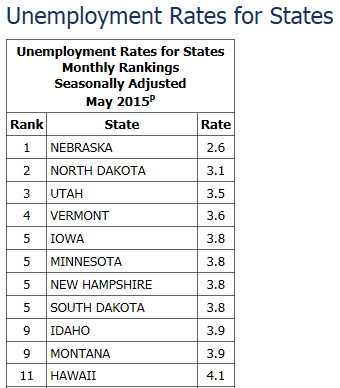
These are attractive goals but how do we achieve them? The best way to raise wages is to get the economy growing so much faster that it creates a labor shortage. Then businesses will be competing for labor and wages will go up. This is exactly what is happening in Omaha NE where I live and the unemployment rate is down to 2.9% (2.6% in Nebraska as a whole).
Furthermore, in a tight labor market, businesses will automatically try harder to keep good employees by providing extra benefits such as childcare and profit sharing.
Public investment in infrastructure, etc. will be more easily affordable with the higher tax revenue generated by a faster growing economy.
Conclusion: faster growth is the best way to create a more fair and equal society!

“The Dung of the Devil”


My last post, “The Moral Case for Free Enterprise,” was motivated in part by a recent speech of Pope Francis comparing the excesses of global capitalism to the “dung of the devil.”
Capture2The scholar Mark Perry of the American Enterprise Institute has just published an interesting chart (just below) demonstrating an 80% reduction in world poverty in the 36 year period from 1970 to 2006.  He quotes AEI President Arthur Brooks that “if you love the poor, if you are a good Samaritan, you must stand for the free enterprise system, and you must defend it, not just for ourselves but for people around the world.  It is the best anti-poverty measure ever invented.”
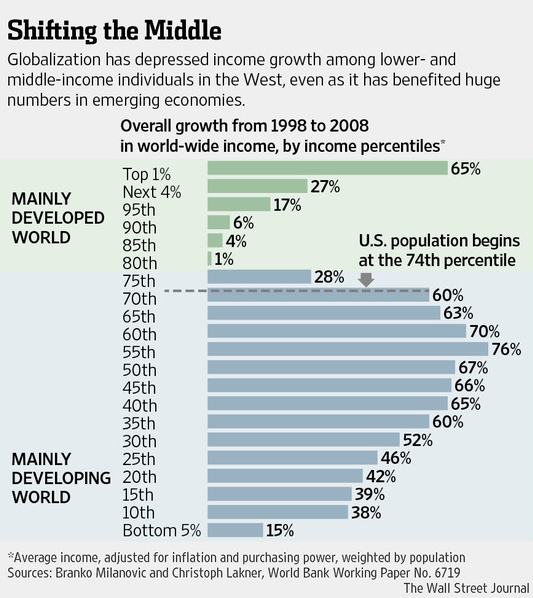
CaptureIn a previous post, a year and a half ago, “A Global Perspective on Income Inequality,”  I referred to another chart (just below) to demonstrate the massive growth of income in the developing world.  To a large extent this is the result of economic globalization shifting low-skill employment from the developed world to the developing world where the cost of labor is less expensive. As Arthur Brooks says, “It was globalization, free trade, the boom in international entrepreneurship.  In short, it was the free enterprise system, American style, which is our gift to the world.
Capture1So, yes, the world as a whole is now much better off but American workers have paid a price for the global shift in low-skill work.  The answer is not to impede globalization but rather to:

  • Speed up the growth of our own economy in order to raise wages and provide more jobs for the unemployed and underemployed.
  • Improve K-12 educational effectiveness and expand career educational opportunities to better prepare present and future workers for the many new high-skill jobs being created all the time.

The world is changing rapidly but there are effective ways for the U.S. to adapt if only we have the good sense to move forward!

The Moral Case for Free Enterprise


Capitalism is under attack around the world as Greek socialists complain about their hard- hearted EU creditors, American liberals such as Bernie Sanders and Elizabeth Warren push the Democratic Party to the left, and Pope Francis compares the excesses of global capitalism to the “dung of the devil.”
CaptureOne of my favorite economic commentators is Arthur Brooks, President of the American Enterprise Institute.  One of his books is “The Road to Freedom: How to Win the Fight for Free Enterprise,” which examines the most important economic issues facing the United States from a moral point of view.  For example:

  • Getting the U.S. Economy Growing Again. Weak economic growth means the end of opportunity in America. Furthermore, weak growth disproportionately hurts those who most need new economic opportunities: the poor. One strategy says that the key to restarting economic growth is the state: more stimulus, more taxes, more borrowing. A second strategy says the source of economic growth is free enterprise: tax reform, less government regulation, policies that make it easier for entrepreneurs to succeed, and a smarter immigration policy.
  • Putting America Back to Work. Jobs are not just a source of money for Americans; they are a ticket to earned success. High unemployment is unfair because it robs people of their potential fulfillment. It is especially harmful to the poor and the young. The key to job creation is to get the economy growing faster.
  • Getting the United States Out of Debt. Unless the U.S. reduces deficits, it will have just three choices: steal from future generations, inflate the currency to lower the value of the debt or refuse to pay those to whom it owes the money. All of these options are immoral because they are unfair: they harm others who have done no harm to America. Three points here: 1) we have out-of-control entitlement spending, 2) debt crises are more successfully dealt with through spending reductions than with tax increases and 3) there are no quick fixes.

Considering basic economic and fiscal issues from a moral perspective adds an important new dimension to the discussion.  We might disagree on the details of how to proceed but it is imperative to take effective action of some kind!

The Root of Greece’s Problem (and Ours)


Will it be the Euro or Drachma for Greece?  It’s down to the wire as Greece and the European Union negotiate the necessary conditions for Greece to remain in the Eurozone.  I have devoted several recent posts to the Greek fiscal crisis, pointing out the parallels between the Greek situation and our own.
Greece needs a bailout because its public debt is nearly 180% of GDP.  Our own public debt is “only” 74% of GDP at the present time but is predicted by the CBO to reach 175% of GDP by 2040, just 25 years from now.  Furthermore, Greece is currently receiving very favorable lending conditions from the European Central Bank, much better than are likely to apply in the U.S. in the long term.  This means we’re likely to have another deep crisis on our hands much sooner than 25 years from now.
CaptureConsider the data in the above charts from today’s Wall Street Journal.  It shows that Greece is spending 14.4% of GDP on pensions, more than any other major European country.  Furthermore, the efficiency of its VAT revenue collection is the poorest in the EU.  In other words, Greece has a very high rate of entitlement spending and has a poor tax collection system to support it.
Capture1In a general sense the U.S. is in a similar situation.  Today we spend about 13% of GDP on mandatory, i.e. entitlement, programs, compared to a total tax revenue level of 18% of GDP.  Just entitlement spending alone is projected to rise to 18% of GDP by 2050, unless changes are made.
Just as Greece needs to tighten up on pension spending, improve revenue collection and get its economy growing faster, the U.S. needs to tighten up on entitlement spending and speed up its stagnant economic growth as well.
We’re not yet as bad off as Greece is today.  But we’re headed in that direction with no one to bail us out when we get there!

The Land of the Free and the Home of the Brave


As we celebrate the 239th anniversary of the signing of the Declaration of Independence in 1776, Americans have much to be thankful for.  It is often said that the United States is the strongest, wealthiest and freest country the world has ever known.  Although this may be somewhat of an exaggeration (see below), it is still indicative of how fortunate we are compared to the rest of the world.
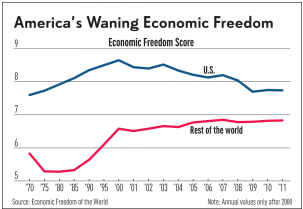
CaptureAs we celebrate our good fortune, we need to be acutely aware that our continued success as a great nation is not automatically assured.  In fact we face a number of troubling and persistent problems which are not likely to disappear unless we take strong action to address them.  For example we have:

  • A stagnant economy with only 2.2% annual growth since the end of the Great Recession. And the Congressional Budget Office predicts no speed up over at least the next ten years, based on current policy. Such slow growth condemns 20 million unemployed and underemployed citizens to unfulfilling lives, as well as lackluster pay raises for many more tens of millions.
  • Massive debt. Our public debt (on which we pay interest) is now at 74% of GDP, highest since the end of WWII, and predicted by the CBO to grow rapidly under current policies. When interest rates return to the normal 5% level, interest payments on the debt will skyrocket, making it much more difficult to fund all of the federal programs we depend on for our quality of life.
  • Increasing Income Inequality is real even if overhyped in the media. America is still a land of great opportunity but basic fairness demands that all citizens be able to share in our national abundance.
  • Threats from abroad. ISIS now controls much of Iraq, Syria and northern Africa and must be defeated. NATO needs our very strong support, all the more so with the Eurozone and European Common Market under increasing pressure from within.


As the strongest nation in the world we have much responsibility for continued world peace and prosperity.  We can’t fulfill this role adequately unless our own internal fiscal and economic policies are in fundamentally sound shape.
Let’s be thankful for what we have and bear down hard to insure that we keep it!

Life in America: Opportunity or Inequality?


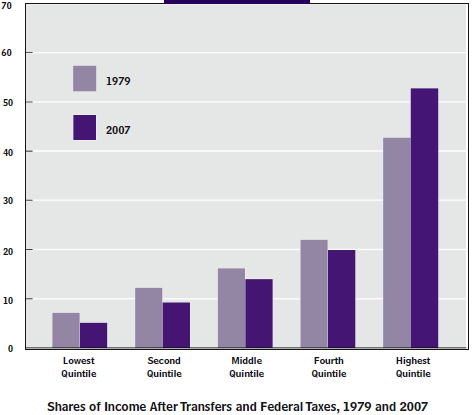
How bad is income inequality in the U.S. and what should be done about it?  This is a question of great current interest with many different points of view.  The chart just below from the Congressional Budget Office shows the extent of income inequality and also shows that it has gotten somewhat worse between 1979 and 2007, just before the onset of the Great Recession.  And we know that our stagnant economy has made it worse yet between 2007 and the present.
CaptureBut now look at the chart (below) from the U.S. Census Bureau of the distribution of household income in the U.S. in 2012.  The chart shows the median income of about $51,000 and then has a very long tail to the right.  This means that there are large numbers of households making large incomes of all different sizes.  It makes no particular sense to distinguish the top 1% (who make $380,000 or more) from the bottom 99%.
Capture1The point is that there is huge opportunity in the U.S. to do very well financially whether or not one makes it into the top 1%.
In an earlier post, “Growth vs Equitable Growth,” I reported on the agenda of the Washington Center for Equitable Growth, a progressive think tank.  In order to achieve “equitable growth” they advocate:

  • Improving educational outcomes at all levels, pre-K – 12+.
  • Running a “high pressure” economy in order to tighten the labor market.
  • Expand the Earned Income Tax Credit especially for workers without children.

I couldn’t agree more.  This is an excellent plan to create more prosperity for more people.  It’s much more plausible in the U.S. to make poor people richer than to make rich people poorer.

Can the U.S. Economy Grow Faster?


The U.S. economy has grown at the rate of only 2.2% since the end of the Great Recession in June 2009.  This is much slower than the average rate of growth of 3% for the past fifty years.
CaptureThe economists Glenn Hubbard and Kevin Warsh, writing in the Wall Street Journal, “How the U.S. Can Return to 4% Growth,” point out that:

  • After the severe recession of 1973-1975, the economy grew at a 3.6% annual real rate during the 23 quarters that followed.
  • After the deep recession of 1981-1982, real GDP growth averaged 4.8% in the next 23 quarters.
  • Recent research has shown that steep recoveries typically follow financial crises.

The economist John Taylor, also writing in the WSJ, “A Recovery Waiting to Be Liberated,” explains that the growth of the economy, i.e. growth of GDP, equals employment growth plus productivity growth.  He then points out that:

  • Population is growing about 1% per year. However the labor-force participation rate has fallen every year of the recovery, from 66% in 2008 to 62.9% in 2014. Even turning this around slightly would increase employment growth above the 1% figure coming from population growth alone.
  • Although productivity growth has hovered around 1% for the past five years, this is less than half of the 2.5% average over the past 20 years.

Given the strong headwinds of globalization and ever new technology affecting the U.S. economy, we especially need new policies such as:

  • Fundamental tax reform directed at increasing the incentives for work and driving investment in productive assets.
  • Regulatory reform that balances economic benefits and costs (e.g. lightening the burdens of Obamacare and Dodd-Frank).
  • Trade agreements to break down barriers to open global markets.
  • Education policies to prepare all young people for productive careers.

In other words, rather than accepting our current situation as “the new normal” or as unalterable “secular stagnation,” we need to “give growth a chance”!

Letting Young People Drift and the Liberal Disconnect


The New York Times had an excellent lead editorial on Sunday, “The Cost of Letting Young People Drift,” describing how 5.5 million young Americans, ages 16 – 24, are neither working nor in school.  “At a time when the economy is requiring workers to have higher levels of skills, one in seven of America’s young adults can’t even get started.”
CaptureThe NYT editorial is based on new research, “Zeroing In on Place and Race: youth disconnection in America’s cities” performed by Measure of America.  The report points out that the problem has gotten much worse since the Great Recession in 2008, as shown in the chart below.
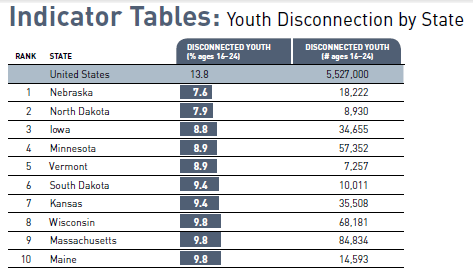
Capture1It also breaks down the youth disconnection rate by state.  For example, Nebraska (7.6%), North Dakota (7.9%) and Iowa (8.8%) have the lowest percentages, while Mississippi (18.5%), West Virginia (19.6%) and Louisiana (19.8%) have the highest percentages (as shown below).
Capture2Capture3But also look at the latest “Unemployment Rates for States” published by the Bureau of Labor Statistics.  There is a very close connection between a state’s unemployment rate and its youth disconnection rate, as shown below. In other words, one of the best ways to keep young people connected is to give them a better chance of finding a job.
Capture4Capture6But it requires faster economic growth to provide more jobs.  Just yesterday the NYT had an editorial, “Obstacles to Economic Growth,” lamenting our very slow rate of economic growth of about 2.2% for the past six years.  According to the NYT, “What’s needed most is public and private investment in the economy sufficient to support strong growth and rising productivity.”  The editorial then goes on to berate Congress for being more interested in budget cuts than in new spending programs to stimulate the economy.  According to the NYT, “the pathway to prosperity is clear for leaders who will dare to take it.”
The NYT thus recognizes the need for more private investment to stimulate the economy but has no apparent interest in policy measures to encourage it.  How can a news organization as sophisticated as the NYT be so passionate about wanting to improve society and so clueless about the best way to do it?

Why Obamacare Should Be Fixed and not Repealed


The Supreme Court will soon render an opinion in King v. Burwell challenging the implementation of the Affordable Care Act.  If the Court agrees with the plaintiffs, then anyone receiving health insurance through one of the federal exchanges operating in 33 states is not eligible to receive a subsidy.  Several Committees in the House of Representatives are proposing to take such an opportunity to make improvements to the ACA.
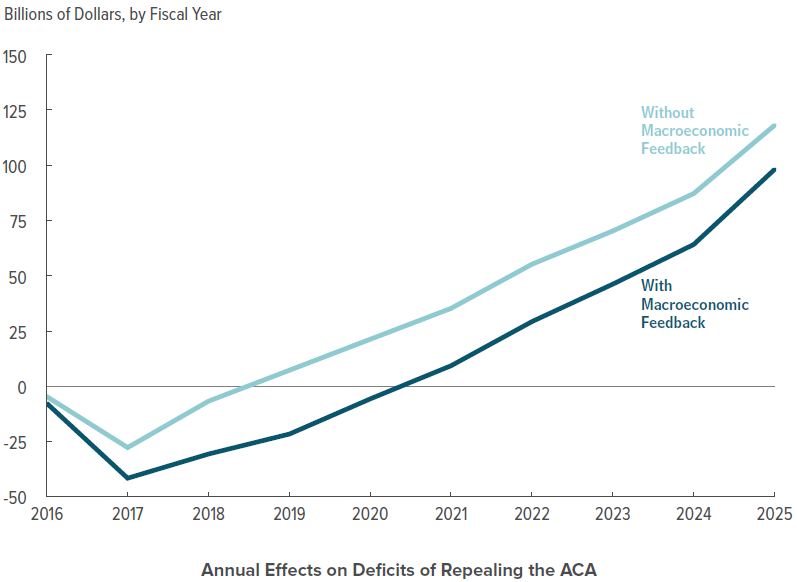
CaptureIn addition, the Congressional Budget Office has just released a report on the “Budgetary and Economic Effects of Repealing the Affordable Care Act,” indicating that repeal of the ACA would add $137 to the deficit over 10 years.  This is because the loss of ACA imposed new tax revenues and spending cuts to Medicare would exceed the amount of money spent to expand insurance coverage.
The economist John Goodman has an excellent new book, “A Better Choice: Healthcare Solutions for America,” describing several basic changes which would greatly improve the ACA.  In summary they are:

  • Replace all of the ACA mandates and tax subsidies with a universal (and refundable) tax credit which is the same for everyone. This is the fairest way to subsidize healthcare for all and it also removes the huge market distortion provided by employer provided health insurance which is tax exempt. The tax credit would be about $2500 per individual and $8000 for a family of four, the approximate cost of catastrophic health insurance and also the average cost of Medicaid.
  • Replace all of the different types of medical savings accounts with a Roth Health Savings Account (after-tax deposits and tax-free withdrawals).
  • Allow Medicaid to compete with private insurance, with everyone having the right to buy in or get out.
  • Keep the ACA exchanges which would be required to provide change-of-health status insurance for the protection of the chronically ill.

Changes such as these would dramatically lower the cost of American healthcare by making all of us directly responsible for the cost of our own healthcare.  They would also virtually eliminate the perverse market effects of the ACA which encourage companies to cut back on numbers and working hours of employees.  This in turn would speed up the growth of our stagnant economy!