Paul Krugman’s Great Crime: Stealing from Our Nation’s Future


New York Times columnist Paul Krugman is perhaps the most ardent Keynesian economist in the U.S. today. Let’s agree that Mr. Krugman is a very intelligent and articulate fellow.  He is a Nobel Prize winner and undoubtedly has made important contributions to economics. But he has the absolutely nutty idea that extreme deficit spending not only doesn’t hurt our economy but can actually be beneficial.  His column, “Time To Borrow”  in yesterday’s NYT is a perfect example of this dangerous idea.
Capture31Here is the essence of his thinking:

  • Our national debt of $19 trillion is just a big scary number. Actually just our public debt alone of $13 trillion (on which we pay interest) is 75% of GDP, the highest since the end of WWII, and is projected (by the CBO) to steadily become much worse.  
  • Federal interest payments are only 1.3% of GDP, low by historical standards. Just lock in repayment with 30-year inflation protected bonds, yielding .64% interest. Okay, suppose we can lock in very low interest payments on our current debt and therefore just borrow away oblivious to total debt for the next 30 years. In 2046 I expect to be gone but my children and grandchildren will still be around. Why should they be stuck with paying off or refinancing our own extravagant debt at likely much higher interest rates?
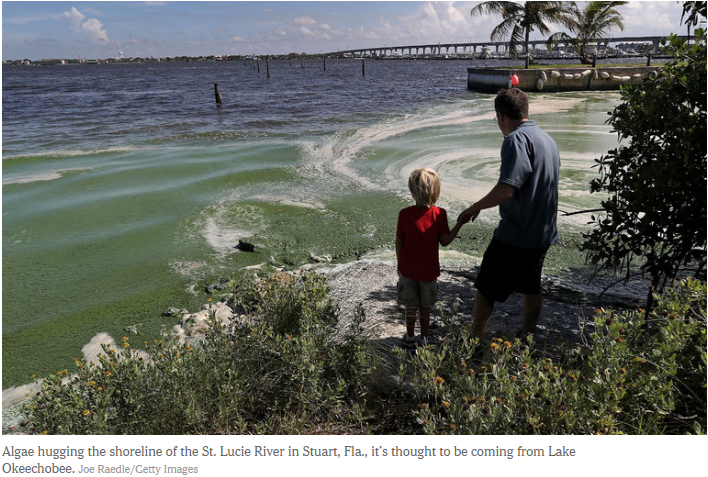
  • There are pressing infrastructure problems all over the country which need fixing now. For example, in Florida, green slime infests beaches because of failure to upgrade an 80 year old dike. The answer is to let Florida voters decide if they want to issue bonds for this project and pay them off with state tax revenue. Nebraska, for example, has decided to raise its state gas tax by 6 cents/gallon in order to pay for infrastructure upgrades.


Conclusion. The U.S. is currently in a huge fiscal bind with massive debt and continuing large annual deficits. It is extremely reckless to continue even current deficit spending, let alone increasing it, for anything less than a true national emergency.  Infrastructure repair, for example, is an important but routine need which should be paid for out of current tax revenue.

Follow me on Twitter
Follow me on Facebook

How Progress Has Led to Discord


We were reminded by Robert Samuelson in yesterday’s Washington Post that America has made amazing progress in the last half century.
Consider that in 1960:

  • Men and Women held rigid gender roles.
  • African-Americans were restricted by legal segregation in the South and informal segregation almost everywhere else.
  • Homosexuality was virtually under the radar.
  • There was little environmental regulation.
  • Immigration was not an issue.
  • Defense made up 52% of government spending.

    Capture17

Think about all the (mostly) positive changes which have taken place in the meantime:

  • Women have taken paying jobs by the millions.
  • Racial segregation has been outlawed.
  • Gay rights have been established.
  • Environmental regulation has exploded.
  • Immigration, both legal and illegal, has increased.
  • Social spending has soared.
  • Defense is down to 16% of the federal budget in 2015.

Consider how our national politics is now stalemated:

  • The political system favors extremes.
  • Minorities live largely in big cities where they produce Democratic super-majorities.
  • Rural areas produce Republican super-majorities.
  • Incumbents are insulated from general election challenges which might pull them towards the center but are perpetually vulnerable to primary challenges from extremists who pull them towards the fringes.
  • Ideological purity trumps pragmatism. In the internet and cable-news era, politicians are constantly reassuring their constituents that they haven’t sold out.
  • The center sags and paralysis prevails.

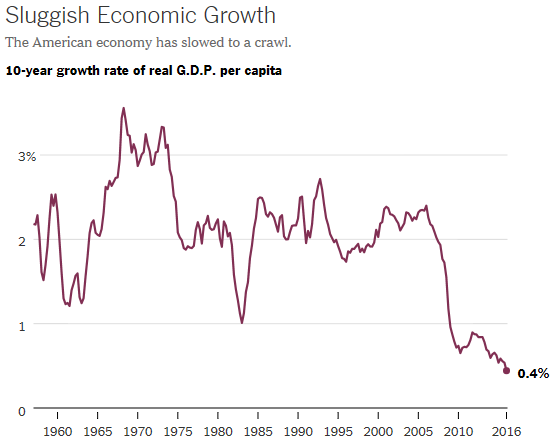
Meanwhile serious national problems are getting much worse and not being addressed. Our public debt (on which we pay interest) is 74% of GDP, the highest since WWII.  The U.S. economy is growing only slowly at the rate of 2.1% per year ever since the end of the Great Recession seven years ago.  Neither presidential candidate has a credible plan to deal with these two most aggravating problems.
As a country we are in a huge mess.  How do we break out of it?  I wish I knew!

Follow me on Twitter
Follow me on Facebook


“A Republic if You Can Keep It”


Such was the response of Benjamin Franklin to an inquiry from a citizen outside of Independence Hall in Philadelphia in 1787.  Today our national government is highly dysfunctional and Congress has an especially low approval rating of 11%. U.S. Senator Mike Lee (R, Utah) believes that Congress is rightly to blame for the dysfunction.
Capture8Says Mr. Lee in an article, “The Incredibly Shrinking Congress,” in the July 11, 2016 issue of the National Review:

  • The powers vested in Congress in Article I of the Constitution are orders of magnitude stronger than the powers given to the President (Article II) or the Supreme Court (Article III). This is because legislators are closer and more accountable to the people. Here is what Congress is doing wrong:
  • Too much power is delegated to the executive branch by allowing federal agencies to write the vast majority of the laws in the form of rules, regulations and legal interpretations.
  • Congress surrenders too much authority over federal spending to the President by letting the budget process come down to a single yes or no vote up against a crisis deadline.
  • Congress delegates too much of its constitutional oversight powers to the judicial branch. The answer is to make agency rules subject to Congressional veto.
  • Unfortunately too many members have a vested interest in a weak Congress because it relieves them of the hard job of legislating conscientiously. Only a strong Congress can fix a weak Congress. For example, Congress could:
  • Require legislative approval of major new rules and reauthorizations of existing ones.
  • Modernize its budget process to make sure that all agency budgets get proper individual consideration.
  • Rein in executive discretion by, for example, directing federal judges to conduct traditional judicial reviews in challenges against the administrative state, instead of simply deferring to the agencies own interpretations.

As Mr. Lee concludes, “Putting Congress back in charge of federal policy, would put American people back in charge of Washington, regardless of who sits in the oval office.” In today’s divisive and destructive political environment, this is a very good idea indeed.

Follow me on Twitter
Follow me on Facebook

Can the U.S. Economy Do Better VI. Does the President Matter?


My last five posts have discussed several different aspects of the question, “Can the U.S. Economy Do Better?”  Our economy has been doing especially poorly since the end of the Great Recession seven years ago (see the chart below).  Many people claim that the President doesn’t really have all that much control over the economy.
Capture6 Here is what the2016 presidential candidates are saying on economic policy so far:

  • Hillary Clinton. She wants national paid family leave, a national minimum wage increase and more government spending on infrastructure projects. She would raise taxes by about $100 billion per year to pay for these initiatives. She is opposed to the Trans Pacific Partnership to expand trade with 11 other Pacific Rim countries.
  • Donald Trump. His top priorities are trade and immigration policy. Would he be able to successfully address China’s currency manipulation without starting a trade war? How would he be able to round up and deport millions of illegal immigrants without destroying millions of jobs and thereby crippling many businesses? His plan to slash tax rates would boost the economy but also add trillions of dollars to the debt.

As I have discussed over and over again on this blog, see, for example, here and here,  there are several fundamental policy changes needed to make our economy grow faster and create more and better paying jobs.  We need to:

  • Make it easier to start a small business by simplifying regulations at all levels.
  • Lower tax rates and simplify the tax code, paid for by shrinking deductions and closing loopholes.
  • Respond to globalization and new technology by helping its victims rather than blocking progress.

Our two presidential candidates are appealing to the fears of the voters rather than to their hopes and aspirations. Neither of them is espousing policies which will help the economy really grow in a healthy way.

Follow me on Twitter
Follow me on Facebook

Can the U.S. Economy Do Better? V. Entitlement Reform


My last several posts, e.g. here, have discussed the question as to whether or not the U.S. economy can grow faster. Even though there are many headwinds to faster growth, there are still various measures to take which will help significantly. Beyond specific policy directions, such as aiding small business and cleaning up and simplifying our tax code, another very important step is to get our fiscal problems, i.e. massive debt, under much better control.
Capture7As made clear in the above chart, there is really only one way to do this.  It is entitlement reform.  In the last 50 years, from 1965 – 2015, mandatory, i.e. entitlement, spending has grown from 26% of the federal budget to 62% and this percentage will just keep growing until something is done to stop it. Along this line, an excellent new report from the American Enterprise Institute, “Increasing the Effectiveness and Sustainability of the Nation’s Entitlement Programs” lays out some basic principles for entitlement reform. They are:

  • Personal Responsibility for Retirement Savings. The idea is to move toward turning Social Security into a universal flat benefit for all U.S. residents age 65 and older. Anyone could supplement this basic income with additional private savings.
  • Market Discipline in Health Care. The idea here is to keep the ACA exchanges with subsidies for low-income households. Employer provided care would have no mandates and a rational and equal tax credit for all. Health Savings Accounts would be liberalized to encourage widespread participation. Both Medicare and Medicaid would provide premium support for basic care. The point is to bolster the consumer’s role in the marketplace in order to slow down the rising cost of healthcare.
  • Promotion of Work for Safety-Net Programs. The federal government spends about $400 billion annually to fight poverty (not counting healthcare programs) with much overlap of federal and state programs. Reform efforts should emphasize work as the key to improved economic prospects as well as greater state control over resources to allow for better coordination of efforts. Two major reform concepts, block grants to states as well as wage subsidies, should be implemented.


We have to get our fiscal house in order, so entitlement reform is not optional. Delay, moreover, could be catastrophic.  If we wait until another crisis hits, then it will no longer be possible to design reforms with gradual adjustments. Now is the time to act!

Follow me on Twitter
Follow me on Facebook

How Will America Solve Its Biggest Problems?


As I repeat over and over again, our two biggest national problems, in my opinion, are slow economic growth (only 2.1% annual increases in GDP for the past seven years) and massive public debt (now 74% of GDP, the highest it has been since right after WWII).
Capture11Are these problems being addressed by our political system?

  • Our 2016 presidential race is clearly touching on them to some extent. The “Sandernistas” think that the Obama economic policies are not progressive enough and need to be doubled down on. Middle-income “Trumpsters” are revolting against the stagnant and falling wage growth of the past fifteen years.
  • The political scientist James Piereson thinks that the Democratic-welfare regime, in place since 1932, has now run its course and will necessarily be superseded by America’s Fourth Revolution which is imminent.
  • The social scientist Yuval Levin thinks that our “Fractured Republic” can heal itself peacefully if the left is willing to accept a less centralized, more federalist, governmental approach to solving economic and fiscal problems and the right is willing to accept that modern America is highly diverse and individualistic and where a significant degree of cultural fracturing, family breakdown and estrangement from tradition are inevitable.

My own opinion is that our huge and rapidly growing public debt (on which we pay interest) is unsustainable and will lead to another crisis much worse than the Great Recession of 2008-2009 unless it is curtailed. Without an adequate response in the meantime, the new crisis will occur when interest rates inevitably rise significantly and therefore lead to huge increases in interest payments on our larger and larger accumulated debt.
To avoid such a calamity we need to do a much better job of controlling federal spending.  It would also help to speed up economic growth in order to increase tax revenue.  Furthermore, faster growth would create more jobs and better paying jobs.  This would take much of the steam out of the appeal of populist candidates such as Bernie Sanders and Donald Trump.
I can’t foresee exactly how we will be forced to change course but it’s going to happen fairly soon.

Follow me on Twitter
Follow me on Facebook

Five Ways to Destroy the U.S. Economy


For seven years following the end of the Great Recession in June 2009 our economy has been plodding along at an average growth rate of 2.1% per year, much more slowly than after a typical recession. Instead of talking about how to fix the mess we are in, most of the presidential candidates are proposing measures which will make things even worse.
Capture0The economists Glenn Hubbard and Tim Kane, writing in the Weekly Standard, take a novel approach.  Rather than suggesting ways of speeding up economic growth, which may no longer be of interest to voters in primary elections, they list their “Top Five Ways to Destroy the U.S. Economy” which are to:

  • Restrict Trade. Free exchange is the cornerstone of a growing economy. Raising tariffs will restrict imports, cause inflation and harm American consumers. Killing the Trans Pacific Partnership, stopping the Keystone Pipeline, and curtailing legal immigration would just be a start.
  • Make Work Illegal. Raising the minimum wage to $15 per hour will do lasting harm to underprivileged teenagers who are denied a first job. In the U.S. today over 30% of jobs require a government license compared to only 5% in the 1950s. This creeping need for permission keeps untold millions out of the labor force.
  • Tax People More Unequally. Why should the tax code be riddled with exemptions, deductions and credits which primarily benefit the wealthy? Why do we insist on taxing corporations at 35% when all other advanced economies are competing to lower their corporate taxes? This simply drives jobs overseas.
  • Stop Innovation. Why does Washington continue to favor big banks and bail out old established industries? A generation ago 1 in 6 companies were startups: today 1 in 12 are.
  • Increase the Debt. Debt has more than doubled in the past decade, yet interest payments in 2015 were the same as in 2006, because rates are artificially low. How long can this last? A sure path to a slow growth future is this kind of fiscal profligacy. Just call it investment and hope that most people will ignore the problem.

As Mr. Hubbard and Mr. Kane conclude, “The good news about this policy agenda is that it requires no sacrifices. If Washington just stays on course we will reap the whirlwind.”

Follow me on Twitter: https://twitter.com/jack_heidel
Follow me on Facebook: https://www.facebook.com/jack.heidel.3

The Fundamental Driver of Our Debt Problem: the Cost of Healthcare


How to grow the economy faster. How to get our rapidly growing national debt under control.  These are the two main problems facing our country which I address over and over again on this blog.  Finding satisfactory solutions to these two problems will determine our future strength and prosperity as a nation.  Today’s discussion is about the major cause of our debt and deficit problem.
CaptureI recently came across the above chart showing the steady rise of overall American healthcare spending (public and private).  In 1960 it was less than 6% of GDP.  Now it is approximately 18%, a tripling, compared to the overall size of the economy, in just 55 years. Of course it is the cost of public healthcare programs such as Medicare, Medicaid and the Affordable Care Act which directly contribute to our growing deficits and to the accumulated debt.
However we will never be able to limit the cost increases of these public programs until we get the fundamental drivers of private healthcare costs under control. As pointed out (in the chart below) by several scholars from the American Enterprise Institute, the basic reason for the high cost of private American health care is that “we don’t have enough skin in the game” as shown by the chart just below.  We are paying less and less of total healthcare costs out of our own pockets because more costs are paid directly by third party insurers.  This means we have less incentive to control our own healthcare costs.
Capture2The AEI has suggested several reform measures to improve this situation such as:

  • Placing an upper limit on the tax exemption for employer-paid insurance premiums.
  • Expanding the use of Health Savings Accounts to be used in conjunction with high deductible plans.

We have a stark choice in front of us. Either we move in this direction in the near future or we will face another, much worse, financial crisis.  In the latter case we will end up with an inferior healthcare system, much less responsive to our wants and desires.

Follow me on Twitter: https://twitter.com/jack_heidel
Follow me on Facebook: https://www.facebook.com/jack.heidel.3

Growing Employment, Shrinking Productivity: What Does It Mean?


I know that I occasionally repeat myself, but I can’t help it! In my opinion there are two major problems facing our country:

  • Slow economic growth which has averaged only an anemic 2.1% since the end of the Great Recession seven years ago.
  • Exploding national debt, now the highest it has been since the end of WWII. Unless we can quickly shrink our annual deficits down to zero, and therefore stop adding to the debt, interest payments on the debt will eventually rise to horrendous levels.


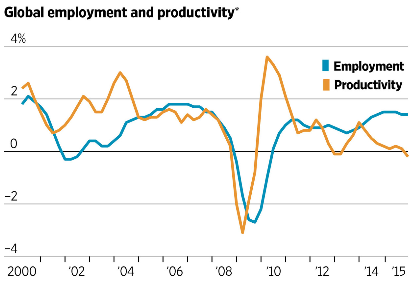
Two recent newspaper articles address the slow growth problem. Greg Ip, writing in the Wall Street Journal, points out that (worldwide) employment growth is up while productivity growth is down (see chart below).
Capture0Neil Irwin, writing in the New York Times, explains this dichotomy by pointing out that most job growth in the last decade has been in (low productivity) services rather than (high productivity) manufacturing. In other words, the U.S. economy is now producing lots of new temporary and contract jobs which do not add very much to the overall economic growth which produces higher wages and overall prosperity.
The economist John Cochrane has clearly described  why productivity growth, and therefore overall economic growth, has stagnated in recent years.  Here is a short summary:

  • Over-regulation. The Dodd-Frank Act and Affordable Care Act, for example, are hampering growth by strangling the financial and healthcare sectors of the economy.
  • Inefficient Taxation. Growth oriented taxation would have the lowest possible marginal rates paid for by shrinking deductions. Taxing consumption rather than income and savings would be even better.
  • Illegal Immigration. Solving our immigration problem would turn millions of illegals into productive citizens. An adequate Guest Worker program and e-Verify enforcement would solve this problem without the need for amnesty.

Conclusion: There are solutions to the severe economic problems facing our country. Does our political system have the flexibility to adopt these workable policies?

Follow me on Twitter: https://twitter.com/jack_heidel
Follow me on Facebook: https://www.facebook.com/jack.heidel.3


Another Way to View the Presidential Candidates

As regular readers of this blog well know, I constantly advocate for two major changes in government policy:

  • Speeding up economic growth, which has averaged an anemic 2.1% per year since the end of the Great Recession in June 2009. This will create the new and higher paying jobs that country so badly needs.
  • Shrinking annual deficits, ideally down to zero, so that our huge public debt (on which we pay interest) will begin to decrease as a percentage of GDP over time.

My last post compared the President’s proposed budget for 2017 with a proposal from the House Budget Committee. Basically the President’s budget increases both taxes and spending while the House budget keeps revenues at a steady 18.2% and leads to a balanced budget after ten years.
Capture2The non-partisan Committee for a Responsible Federal Budget has just produced an interesting report, ”How Much More Would Government Spend Under the Next President?” It compares the spending plans of the remaining five presidential candidates from both parties.  It finds that:

  • Only John Kasich would actually decrease spending over the next decade from 22.1% of GDP (under current law) to 21.5%.
  • The other four candidates would all increase spending: Hillary Clinton (to 22.5%), Donald Trump (to 22.7%), Ted Cruz (to 23.4) and Bernie Sanders (to 29.5%).

Mr. Kasich’s spending restraint would amount to a 2% decrease over current law while Ms. Clinton, for example, would increase spending by 2%.
As I showed a year ago,  reining in spending by 2% per year over current law is a major achievement and will lead to a balanced budget in ten years. In other words, Mr. Kasich’s spending plans are in sync with the latest House Budget Committee proposal.  Perhaps this should not be surprising since Mr. Kasich served as Chair of this House Committee in the 1990s!
Easy question: Which presidential candidate and which chamber of Congress are acting in the most fiscally responsible manner?

Follow me on Twitter: https://twitter.com/jack_heidel
Follow me on Facebook: https://www.facebook.com/jack.heidel.3