Trump’s Cabinet Choices Bode Well for the Economy


President-elect Donald Trump made faster economic growth one of his major campaign themes and the direction of Trumponomics is already beginning to take shape.  His major cabinet choices so far auger well for the fundamental changes which are needed to speed up economic growth:
capture64

  • Steven Mnuchin for Treasury. Mr. Mnuchin says that “the number one problem with Dodd-Frank is that it is way too complicated and cuts back lending.” Making loans is “the engine of growth to small- and medium-sized businesses.”  He also believes that 3% – 4% GDP growth is possible with tax and regulatory reform.
  • Tom Price for Health and Human Services. Mr. Price has some excellent ideas for getting American healthcare straightened out, in order to make it more consumer-oriented as well as less costly for individuals, businesses and the government (i.e. the taxpayers).
  • Scott Pruitt for the Environmental Protection Agency. Mr. Pruitt is a lawyer who has fought EPA overreach as the Attorney General of Oklahoma. Mr. Pruitt will end up improving the environment because “he will make sure that the rules issued by the EPA are rooted in law and thus won’t be overturned in court.”
  • Betsy DeVos for Education. Ms. DeVos, a school reformer from Michigan, is a strong supporter of vouchers and charter schools. K-12 school reform is absolutely essential to better prepare low-income and minority students for the high tech and global economy which awaits them after graduation.
  • General James Mattis for Defense and Senator Jeff Sessions for Attorney General are also excellent choices for strengthening America’s national security and moral fabric.

Conclusion. I have been advocating fundamental changes in fiscal and economic policy for years now and, thanks to the election of Donald Trump, things are moving rapidly in this direction. It is a good time to be optimistic about the future of our country.

Follow me on Twitter
Follow me on Facebook

Trumponomics Is Taking Shape


As the readers of this blog well know, I am very concerned about the fiscal and economic direction our country has been taking in recent years. I voted for Hillary Clinton in the 2016 presidential election because of Donald Trump’s crude and sleazy behavior.  However we need basic change in the U.S. and Mr. Trump is clearly a change agent.
As the new Trump administration begins to take shape, here is what I see happening:

  • Treasury Secretary designee, Steven Mnuchin, says that tax cuts for both upper-income and middle class taxpayers will be offset by “less deductions that pay for it.”  Revenue neutral tax rate cuts will increase both consumer and investment spending, without increasing our debt, and will give the economy a huge boost.
  • Health and Human Services Secretary designee, Rep Tom Price, is an expert on health-care and wants to replace the Affordable Care Act with a new healthcare program which provides more consumer choice at a much lower cost.

    capture83

  • The Great Rebuilding Infrastructure investment is needed but it should be accomplished with a lower corporate tax rate and repatriated profits of multinational corporations to avoid increasing the deficit.
  • Holdback on excessive fiscal stimulus.  With the unemployment rate down to 4.6%, a dollar which has already appreciated 40% since 2011, and tax cuts on the way, inflation and higher interest rates are in the offing. Let’s not overdo it.

    capture84

  • Living on borrowed time.  As shown in the above chart, interest rates are very, very low and are likely to rise significantly in the near future. When this happens, our massive public debt (on which we pay interest) of 76% of GDP will become very expensive to service. Ouch!


Conclusion.  One can see a Trump agenda emerging which has the potential to be very successful if it is coupled with overall spending restraint.

Follow me on Twitter
Follow me on Facebook

Getting American Health Care Straightened Out II. Medicare


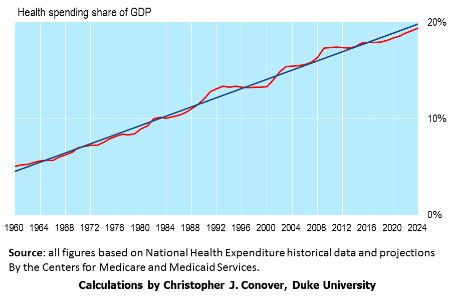
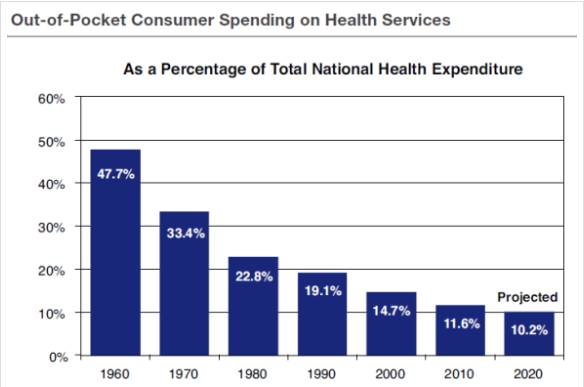
One of the major problems facing the United States today is the high cost of healthcare. We spend almost 18% of GDP on healthcare, both public and private, almost twice as much as any other developed country.  A big reason for the high cost is the low out-of-pocket consumer spending on health services in the U.S. 
My last post discusses a general plan, involving catastrophic health insurance and health savings accounts, for getting the overall cost of healthcare under control.

capture82Once we have a handle on the overall problem, we then need to focus on the cost of the Medicare entitlement program for retirees.  The problem here is easy to understand.  In just 15 years enrollment in Medicare will increase to over 80 million beneficiaries from 57 million today.  Likewise there are 3.1 workers per beneficiary today and there will be only 2.4 in 2030 (see above chart).

capture4
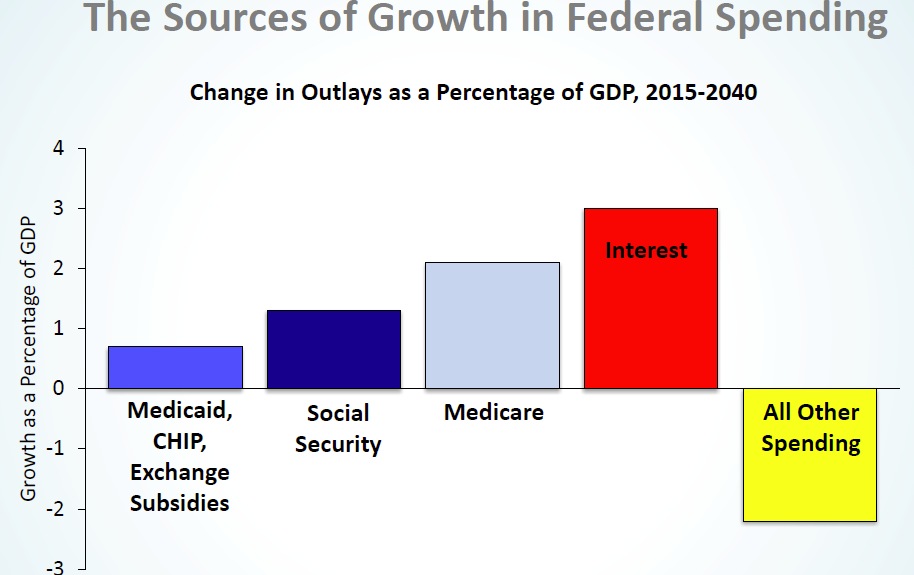
The second chart demonstrates that Medicare will be the major component of increases in federal spending in the coming years (with the other entitlements of Social Security and Medicaid following right behind).
So the question is: how do we control Medicare spending within the context of overall health-care reform?  Here is a proposal from James Capretta of the American Enterprise Institute:

  • Medicare recipients would receive fixed payments toward the coverage option of their choice, based on their age, income and health status. The traditional Medicare program would be one of the choices. Enrollees choosing less costly coverage options would see a reduction in their premiums.
  • Premium payments would be comparable to subsidies and tax credits received from the reformed Affordable Care Act.
  • Privately run managed care plans provide benefits at far less cost than traditional Medicare. Beneficiaries would share in the savings.

Conclusion. It needs to be emphasized as strongly as possible that the point of Medicare reform is to lower costs to both individuals and the government, sa that Medicare can be preserved indefinitely into the future.

Follow me on Twitter
Follow me on Facebook

Getting American Health Care Straightened Out


Donald Trump was elected to be our next president because of the huge desire for change amongst the American electorate. Many things need changing, but among the most important is our healthcare system.  The problem is that we are spending 18% of our GDP on healthcare, twice as much as any other developed country.  The Affordable Care Act has increased access to healthcare but does very little to hold down costs.  This is one reason why it is so unpopular and needs to be substantially modified.
capture10President-elect Trump has nominated Representative Tom Price (R, Ga) to head up Health and Human Services in his cabinet.  Rep. Price is an expert on healthcare and is a leading advocate for replacing the ACA with something more workable.  He will soon be in position to lead the charge for healthcare reform.
The two American Enterprise Institute scholars, James Capretta and Scott Gottlieb,  have some good ideas for what needs to be done.

  • Provide a path to catastrophic health insurance for all Americans. The idea is that all Americans who do not get health insurance through employers, or Medicare or Medicaid, should be eligible for a refundable tax credit sufficient to pay for a basic level of catastrophic (i.e. with a high deductible) insurance coverage.
  • Accommodating people with pre-existing health conditions. Everyone who maintains continuous (catastrophic, as above) coverage would be allowed to move from employer coverage to the individual market without facing exclusions or higher premiums based on health status.
  • Allow broad access to health-savings accounts. There would be a one-time federal tax credit to encourage all Americans to open an HSA to pay routine medical bills. Families typically spend up to 22% less on healthcare after switching to an HSA.
  • Deregulate the market for medical services. Providers need freedom from regulation to provide packages of services better tailored to people’s needs. Such provider flexibility will further reduce costs through additional marketplace competition.

Conclusion. The major reason why our healthcare is so expensive is because we, as individuals, don’t have enough “skin in the game,” in the sense of paying for routine medical expenses directly out of our own pockets. The reforms outlines above would correct this very problem.

Follow me on Twitter
Follow me on Facebook

Fiscal Policy after the Election


As the presidential election tightens and the likely margin of victory for either candidate continues to shrink, it becomes ever more apparent that we need a bipartisan approach to solving our most basic problems.  My last post discusses the need for fundamental tax reform to get our economy growing faster to create more and better paying jobs.  Today I remind my readers of the need for better fiscal policies as well to address our massive and steadily deteriorating debt problem.
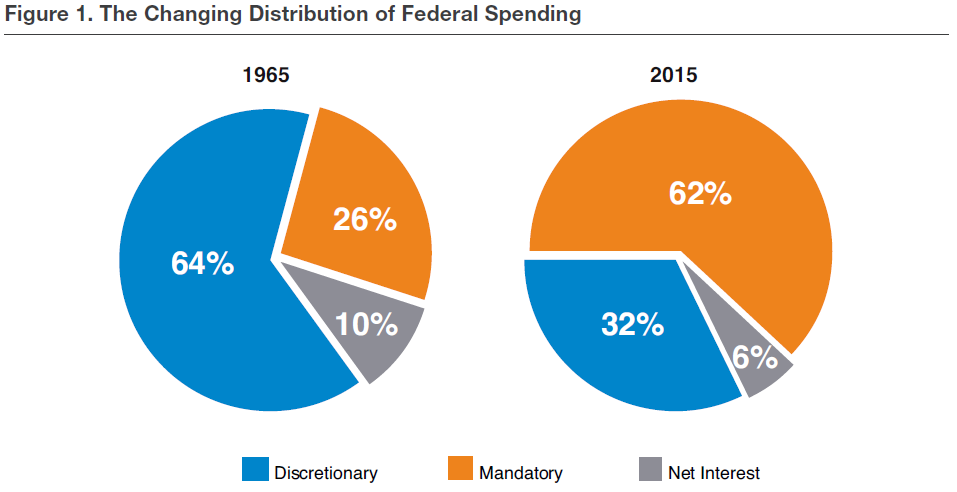
As the American Enterprise Institute,  among many other think tanks, makes abundantly clear, we are spending more and more of our federal budget on entitlements  as opposed to all of the many other federal responsibilities which are lumped together as discretionary spending.  In other words, the only way to fix our deficit and debt problems is to achieve better control over entitlement spending.

capture78
AEI has some excellent ideas on how to do this:

  • Social Security should move towards providing a universal flat benefit, set at the federal poverty level, for all U.S. residents aged 65 and older. Social Security would then become a guarantee against poverty in old age rather than a scheme for partially replacing pre-retirement earnings for middle and higher earning households.
  • Health Care. The Affordable Care Act should be replaced with a less regulated system (i.e. no mandates). The federal tax preference on employer plans could be limited to the cost of catastrophic (high deductible) insurance plus a contribution to health savings accounts. Households without employer coverage would receive a comparable tax credit.
  • Medicare would be converted into a premium support system with a fixed level of support comparable to that provided by employers.
  • Medicaid would be converted into a block grant program for the states based on the fixed, per capita costs for enrolled populations.
  • Other Safety-Net Programs should emphasize work as the key to improved economic prospects plus greater state control over resources in order to encourage innovation.

Conclusion. It should be emphasized as strongly as possible that the purpose of entitlement reform is to preserve and strengthen entitlements, not to weaken or destroy them.  Without such action we are headed for a much worse financial crisis than the one we had in 2008-2009 which will put all government social programs at risk.

Follow me on Twitter
Follow me on Facebook


Why Medicaid Needs to Be Reformed


One of the very most serious problems facing our nation is our massive federal debt, now over $13 trillion (the public debt on which we pay interest), or 75% of GDP, the highest since right after WWII, and predicted by the CBO to keep getting worse unless major policy changes are made.
The main contributors to this rising debt are the big three entitlement programs of Social Security, Medicare and Medicaid. All three need substantial reforms in order to rein in spending.
Today I will discuss Medicaid, based on an excellent analysis performed by the Manhattan Institute’s Oren Cass, “Over-Medicaid-Ed: how Medicaid distorts and dilutes America’s Safety net.”
capture41Consider these pertinent points:

  • Badly designed incentives for Medicaid expansion. Each state sets the size of its Medicaid program and receives matching federal dollars, from $1 to $4, for every dollar spent. States thus have a strong incentive to overinvest in Medicaid, expanding their programs far beyond the point where a marginal dollar of their own spending produces a dollar of value.
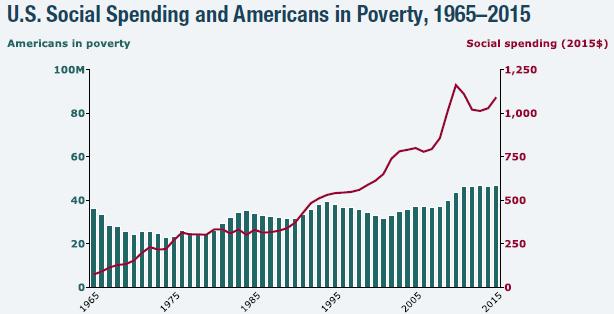
  • Health care dominates safety-net spending. During 1975 – 2015, government social spending per person in poverty more than doubled (in constant 2015 dollars) from $11,600 to $23,400. Rising health care expenditures accounted for more than 90% of that increase.

    capture42

  • Medicaid spending in 2012 was 39% higher than if it had remained a constant share of state budgets since 2000. State spending on education and welfare was 9% and 54% lower, respectively.
  • This allocation is an ineffective poverty-fighting strategy. While the majority of government social spending goes to health care, low-income households not enrolled in Medicaid allocate less than 10% of their spending to health care. Studies consistently show little or no positive impact on health outcomes from Medicaid enrollment.
  • How to strengthen America’s safety net. The federal government should consolidate all antipoverty funding streams, including Medicaid, and allow states to design programs and allocate funding to such programs as states see fit.

Conclusion. The above program outlines a way to both improve the effectiveness of social welfare spending and curtail its costs to both states and the federal government. Let’s do it!

Follow me on Twitter
Follow me on Facebook


Is Single-Payer Health Care a Good Idea?


My last two posts, here and here, have discussed major intrinsic problems with the Affordable Care Act.  It has been set up in an actuarially unsound manner and the cost of insurance coverage through the exchanges is growing very fast.
CaptureThe rapidly rising cost of American health care, public and private, is in fact one of our country’s biggest problems.  It is an affordability issue for millions of American households.  Furthermore the rapidly rising cost of the entitlement programs of Medicare and Medicaid is the fundamental driver of our exploding national debt problem.
As I see it there are two different routes we can take to solve this problem.  One way is to move towards a true free-market approach where healthcare consumers (all of us!) have more “skin in the game” in the sense that we move away from third party payment for routine care.  It is quite interesting that this is already starting to happen under Obamacare!
The other way of getting costs under control is to adopt a single-payer system, like much of the rest of the developed world.  But this would necessarily involve stringent cost controls and severe rationing and would be a lot more difficult than just enrolling everyone in Medicare. For example:

  • American doctors and nurses are very well paid. The average family physician in the U.S. earns $207,000, double the rate for general practitioners in Great Britain, which has a single-payer system. Are we going to arbitrarily chop doctor salaries in half in order to control costs?
  • The State of Vermont recently backed away from implementing its own single-payer system because the needed tax increases would have more than doubled Vermont’s annual budget. Colorado will vote in November on a petition-supported single-payer proposal, ColoradoCare, which would be paid for by a $26 billion annual state tax increase, and is therefore unlikely to pass. For a state to implement its own single-payer system at least requires budget honesty, since all states are required to balance their budgets. There is no such requirement for our federal government and so a single-payer system would be financed just like Medicare, with deficit spending. Bad idea!

Conclusion. American healthcare needs radical reform but adopting a single-payer system is not the best way to do it.

Follow me on Twitter
Follow me on Facebook


How to Improve Obamacare and Lower It’s Costs


I have been making the case for some time now that the rapidly increasing costs of U.S. health care, especially for the entitlement programs of Medicare and Medicaid, is the fundamental cause of our exploding national debt, and therefore these costs must be curtailed.  The only way to fix this problem is for Americans to have more “skin in the game” regarding these costs.
Capture10My last post, “The Inherent Instability of Obamacare,” discusses the separate but related problem that the Affordable Care Act is actuarially unsound because it misprices the basic risks involved in health insurance.  This is why costs on the exchanges are going up so fast which, in turn, leads to fewer enrollees.
A good way to address this double whammy of problems is to use a plan developed (mostly) by the American Enterprise Institute in December, 2015.  The main features are:

  • ACA Mandates, for both individuals and employers, would be abolished.
  • Retain tax preferences for employer-paid premiums, with an upper limit comparable to the cost of catastrophic health insurance.
  • Provide refundable tax credits to households without access to employer coverage, gradually replacing subsidies provided by ACA exchanges.
  • Persons with pre-existing conditions would have continuous coverage protection.
  • Medicare would migrate to a defined contribution, refundable tax credit model as above, with eligibility gradually rising to age 67.
  • Medicaid would be financed with block grants to the states and would supplement the refundable tax credit model.
  • Health Savings Accounts, to accompany high deductible plans, would be encouraged with a one-time federal tax credit matching enrollee contributions.
  • Health Care for Veterans would be integrated into mainstream care.

Summary. Abolishing the mandates means that coverage levels and price would be actuarially determined in the market place. Equal tax credits for insurance and help in setting up health savings accounts ensure fairness and widespread accessibility.  The overall free market model will guarantee both low cost and the greatest possible degree of flexibility, innovation and quality of care.

Follow me on Twitter
Follow me on Facebook


The Inherent Instability of Obamacare


The recent announcement by Aetna Insurance Company that it will exit the health insurance market in most of the states where it now operates raises a fundamental question about the stability of the Affordable Care Act. As shown by the following map  from yesterday’s New York Times, it appears that at least five states with 17% of the American population will have only one health insurer to choose from next year.
Capture33As the Wall Street Journal’s Greg Ip points out in a recent article, “the problem isn’t technical or temporary, it is intrinsic to how the law was written”  Specifically:

  • Insurance is supposed to price risk but the ACA changed this. Insurers can no longer charge or exclude coverage for pre-existing conditions, charge men and women different rates, or charge older customers more than three times as much as the young.
  • For example, a 64-year-old consumes six times as much health care as the average 21-year-old. Adhering to the 3-to-1 maximum ratio, the insurer would have to greatly overcharge the 21-year-old than his actual cost and/or greatly undercharge the 64-year-old.
  • The rational response for unsound pricing is for young and healthy customers to stay away and sick, older customers to flock to the exchanges. ACA mechanisms to prevent this type of behavior aren’t working very well.Capture32
  • One example of this is that the ACA exchanges, which provide income-based subsidies for those without employer provided health insurance, are mainly attracting those people just slightly above the poverty line who get the biggest subsidies (see chart).

I have pointed out many times that the cost of health care, especially for the entitlement programs of Medicare and Medicaid, is the fundamental driver of our exploding national debt and therefore must be curtailed.  But now, in addition to the cost problem, we are discovering that the ACA also has a fundamental access problem as well. Big changes are clearly needed in the ACA.  More details later!

Follow me on Twitter
Follow me on Facebook

The Republican Party beyond Donald Trump


My last several posts have discussed the strengths and weaknesses of the U.S. economy and where the presidential candidates stand on the main issues.  As Donald Trump now slides further and further behind in the polls due to his juvenile tit-for-tat personality, his personal views matter less and less.
Capture31What does matter now is how the Republican Party will use the Trump disruption to broaden its appeal in the future. Here is a restatement of several of my ideas, influenced by two recent articles in the New York Times, here and here:

  • Reject tax cuts for the wealthy. But rather support tax rate cuts across the board, paid for by shrinking deductions which primarily benefit the wealthy. Such tax reform will give a sorely needed big boost to the economy.
  • Help workers displaced by foreign trade with expanded retraining programs and wage insurance. Increased globalization will also boost economic growth but it will stall without greater public support.
  • Acknowledge that universal health care is here to stay but push for market-oriented changes such as eliminating the mandates required by the ACA.
  • Disavow mass deportations but set up a firm border security program along with an adequate guest worker program to provide businesses the workers whom they are unable to hire locally. Again, legitimate immigration reform will boost the economy.
  • Admit that Invading Iraq was a mistake but nevertheless insist on a muscular foreign policy. U.S. economic and military strength provide peace and stability for the whole world including us.
  • Loosen up on social policy. Insist on restrictions on abortion (e.g. a 20 week cutoff) rather than abolition and work requirements for social welfare recipients rather than cutbacks in aid. In general turn over more social policy regulation to the individual states.

Conclusion. The U.S. badly needs more fiscally conservative national leaders. But conservatives will not prevail in the political process without using more common sense.

Follow me on Twitter
Follow me on Facebook